Chapter One: The Parcel at 2:17
At exactly seventeen minutes past two, the dead watch began to tick.
Dr. Miriam Ashford heard it from the other side of her apartment.
She was standing in the kitchen, pouring hot water over tea leaves, when the sound reached her through the rain tapping against the windows.
Tick.
A pause.
Tick.
It was too slow to be the clock above the stove and too heavy to come from the cheap alarm clock in her bedroom. Miriam set down the kettle and followed the sound into the hallway.
A small parcel rested on the floor beneath the mail slot.
She had not heard anyone approach the door.
The package was wrapped in brown paper darkened by rain. There was no stamp, no return address and no name written on it. A black thread had been tied around it three times.
Miriam carried it to the dining table.
For thirty-two years, she had worked as a forensic pathologist. She had opened suitcases pulled from rivers, boxes abandoned in train stations and envelopes containing things no person should ever send through the mail. Retirement had not cured her caution.
She put on a pair of thin gloves before cutting the thread.
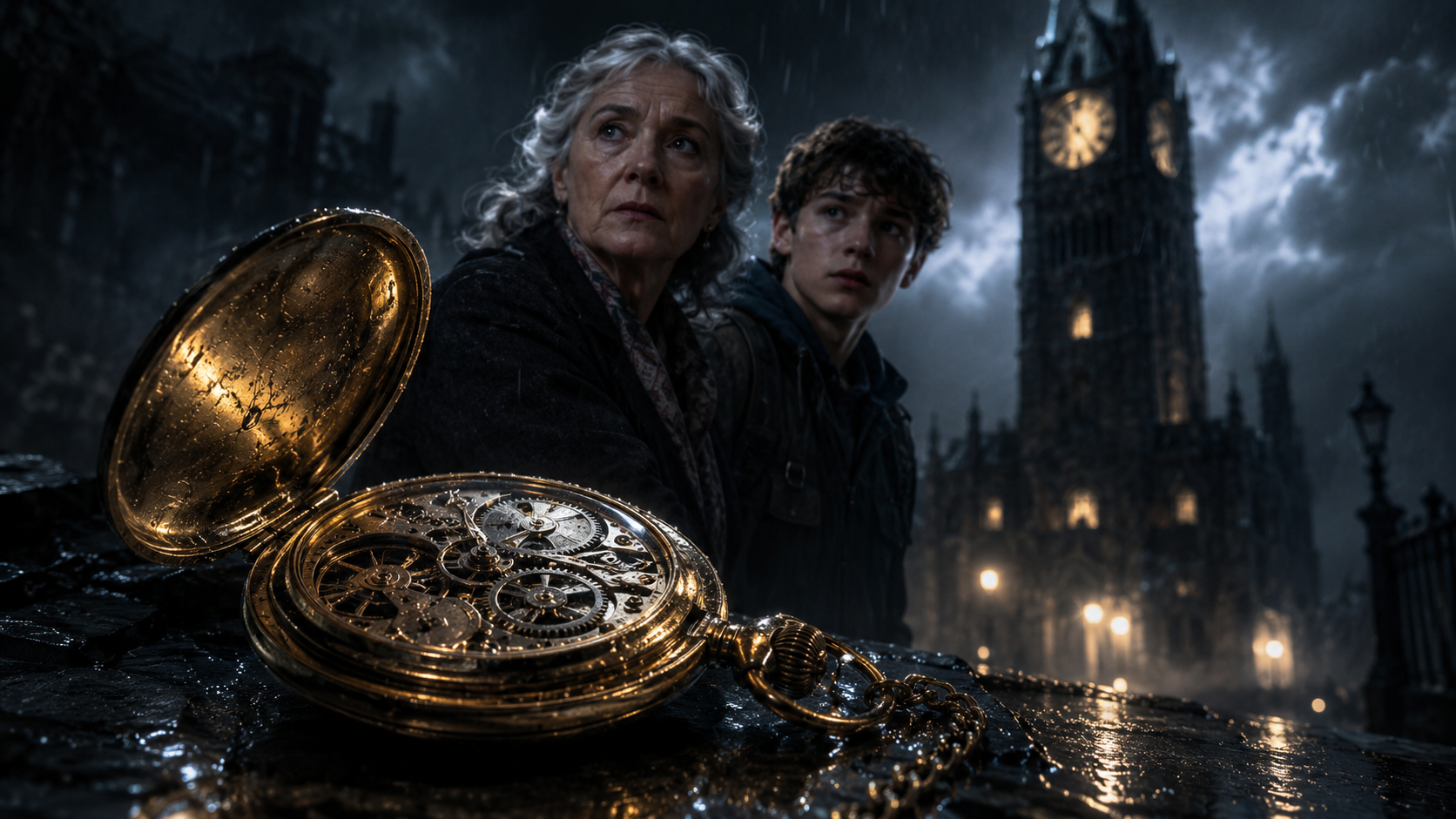
Inside the paper lay a golden pocket watch.
The metal was scratched almost white around the edges. A deep dent crossed the back of the case, as though someone had struck it with a hammer. Despite its age, the watch was running.
Tick.
Tick.
Tick.
Miriam stopped breathing.
She knew that dent.
Her brother Thomas had made it when he was nineteen. He had dropped the watch while climbing the iron fence behind their childhood home. Their father had shouted for an hour. Thomas had laughed through the entire lecture.
The watch had disappeared with him during the North Channel ferry fire in November 1984.
There had been no body.
Only a passenger list, a burned jacket and an official declaration of death.
Miriam pressed the release and opened the watch.
The hands pointed to 2:17, but the second hand was moving backward.
Beneath the glass, someone had replaced the ordinary face with a thin silver disk marked by dozens of tiny numbers.
A folded piece of paper was hidden inside the cover.
Miriam opened it.
The message contained only one sentence.
Your brother did not die on the ferry.
A knock struck the apartment door.
Miriam closed the watch.
“Who is it?”
No answer.
The second knock was weaker.
She moved quietly into the hall and looked through the peephole.
A teenage boy stood outside. His wet hair clung to his forehead, and a bruise spread across one cheek. He wore no coat, though the November rain was cold enough to turn his lips blue.
Miriam opened the door but kept the security chain fastened.
“Are you Dr. Ashford?” he asked.
“Who wants to know?”
“My name is Leo Mercer. My mother sent me.”
Miriam studied him. He looked about fourteen, perhaps younger beneath the exhaustion.
“Did you leave the parcel?”
Leo nodded.
“Where did you get the watch?”
“My mother found it in an old railway locker. Three nights later, she disappeared.”
Miriam’s grip tightened on the door.
“What is your mother’s name?”
“Claire Mercer.”
The name meant nothing to her.
“Why would she send you to me?”
Leo glanced over his shoulder toward the empty stairwell.
“Because she said you were the only person who would recognize the watch.”
A floorboard creaked somewhere below.
The boy’s face changed.
“He followed me.”
“Who?”
“A man from the St. Orison Foundation.”
Miriam had heard the name. St. Orison operated private hospitals, children’s charities and rehabilitation centers across the country. Its smiling blue emblem appeared at charity dinners and on the sides of expensive ambulances.
“Why would a medical foundation be chasing a schoolboy?”
Leo looked directly at her.
“Because my mother discovered what happened to the people who were supposed to die with your brother.”
The elevator bell rang.
Miriam removed the chain and pulled Leo inside.
A man stepped out of the elevator as she locked the door.
He was tall, silver-haired and dressed in a charcoal overcoat. He did not knock.
Instead, he stood in the hallway and spoke in a calm, pleasant voice.
“Dr. Ashford, my name is Adrian Kestrel. I believe the boy has brought you something that belongs to my organization.”
Miriam looked at Leo.
The boy was trembling.
Kestrel tried the handle.
“Open the door,” he said. “There is no reason for this situation to become unpleasant.”
Miriam picked up her telephone.
“I’m calling the police.”
“You may certainly do that.”
His confidence made her pause.
“The police will ask why a retired pathologist is hiding a runaway minor,” Kestrel continued. “They will also find evidence that the boy’s mother abandoned him after stealing confidential medical property.”
“He’s lying,” Leo whispered.
Miriam held the watch against her palm.
Its backward-moving mechanism grew faster.
Tick-tick-tick-tick.
Then it stopped.
The hands pointed to 11:04.
Miriam stared at them.
November fourth.
The date of the ferry fire.
She opened the inner cover again. Under the folded message, four words had been engraved into the gold.
THE DEAD HAVE RECORDS.
Outside, Adrian Kestrel knocked once.
“Last opportunity, Doctor.”
Miriam lowered her voice.
“Leo, does this building have a rear fire escape?”
The boy nodded.
“Then we are leaving.”
She placed the watch in her pocket and turned off every light in the apartment.
Chapter Two: The Voice Inside the Watch
They climbed down six stories through freezing rain.
Miriam’s hands ached by the time they reached the alley, but she refused to slow down. Leo followed without complaining, landing hard on the wet pavement beside her.
Above them, Miriam’s kitchen light came on.
Kestrel had entered the apartment.
“This way,” she said.
They crossed two streets, passed through a late-night market and took separate exits into an underground station. Miriam bought two tickets with cash and boarded the first departing train.
Only when the doors closed did she allow herself to look back.
No one followed them onto the platform.
Leo sat opposite her, dripping water onto the floor.
“Where are we going?”
“My former laboratory.”
“I thought you were retired.”
“I am. The building is not.”
Twenty minutes later, they entered the basement of the old municipal hospital through a service door whose lock Miriam had never trusted. Most of the pathology department had been moved to a modern complex outside the city. The old rooms now held obsolete microscopes, filing cabinets and equipment waiting to be auctioned.
Miriam switched on a desk lamp.
“Tell me everything your mother discovered.”
Leo rubbed his hands together for warmth.
“She repairs old recordings for museums. Last month, a railway company hired her to examine things found behind the wall of a closed station. There were suitcases, documents and a locker key.”
“The watch was in the locker?”
“Yes. Along with photographs of people from the ferry.”
“Survivors?”
“People listed as dead.”
Miriam looked at him sharply.
Leo continued.
“My mother found recent photographs of some of them. They had different names. Most had worked for St. Orison hospitals after the fire.”
“Did she contact the police?”
“She tried. The officer she met called Kestrel before she even left the station.”
Miriam placed the watch beneath a magnifying lens.
The silver disk covering its face was not decorative. It was a miniature spool, as thin as foil, fitted around the central mechanism.
“A recording,” she said.
Leo leaned closer.
“Can we play it?”
“Not with an ordinary machine.”
Miriam searched the storage cupboards until she found a microfilm reader, an old surgical camera and a magnetic playback head once used to examine damaged emergency recordings.
She worked for almost an hour.
The watch had been modified by someone with extraordinary skill. Its backward movement dragged the silver strip across a magnetic contact hidden beneath the face. The times at which the hands stopped were indexing points.
Miriam connected the watch to a speaker.
Static filled the room.
Then a man’s voice emerged.
Weak. Distorted. Older than she remembered.
But unmistakable.
“Miriam, if you are hearing this, I failed to reach you.”
She gripped the table.
Thomas.
Leo stared at her but remained silent.
“The North Channel fire was not an accident,” the recording continued. “The engine-room explosion was used to erase twelve passengers, three members of the crew and twenty-six children being transferred from St. Orison institutions.”
Miriam turned up the volume.
“No children were listed on the public manifest. Some had been taken from unmarried mothers. Others had survived accidents or disasters and no longer had anyone powerful enough to ask questions. St. Orison sold their identities to families willing to pay.”
The recording cracked.
“We discovered the transfers. They staged our deaths and offered us a choice: cooperate or disappear completely. I refused.”
A long stretch of static followed.
Then Thomas spoke again.
“The central register is hidden beneath the Meridian Clock Tower. The entrance opens at 2:17. Claire knows the route. Trust her. Do not trust anyone carrying the blue emblem.”
The message ended with a metallic scrape and a whisper.
“Tell my sister I counted every year.”
Miriam removed her glasses.
For a moment, she was no longer sixty-eight years old. She was twenty-six, standing beside a harbor while officials lowered an empty coffin into the ground.
She had hated Thomas for boarding that ferry after she begged him to stay.
Then she had hated herself for surviving him.
Leo touched the edge of the table.
“My mother never told me she knew your brother.”
“She may not have known him personally.”
“She did.”
Miriam looked up.
Leo took a photograph from his shoe. It was creased and damp, but the image remained visible.
Claire stood beside an elderly man in a wheelchair. He had a narrow face, white hair and one eyebrow raised higher than the other.
Thomas had always raised that eyebrow when he thought someone was lying.
The date printed on the photograph was six weeks old.
“My mother said he was being kept in a St. Orison nursing facility under another name,” Leo explained. “She helped him escape.”
“Where is he now?”
“I don’t know. They took both of them.”
A sound came from the corridor.
Not footsteps.
The gentle squeak of a rubber wheel moving across linoleum.
Miriam switched off the desk lamp.
A pale beam appeared beneath the door.
Someone was pushing a hospital trolley toward the laboratory.
Leo whispered, “They found us.”
The handle began to turn.
Miriam grabbed a bottle of preservative fluid from the shelf and moved beside the door.
It opened.
A security guard entered, pushing an empty metal trolley. A blue St. Orison emblem was stitched onto his jacket.
“Dr. Ashford,” he said. “Please step away from the boy.”
Miriam threw the preservative into his eyes.
He shouted and covered his face.
Leo rammed the trolley into his knees. The guard collapsed, knocking over a tray of instruments.
Miriam seized his access card.
“Run.”
They fled through the specimen corridor as an alarm began to ring behind them.
At the exit, Leo stopped.
The guard’s radio had fallen onto the floor.
A voice spoke through it.
“Kestrel to all teams. They know about the tower. Lock the lower mechanism and prepare the transfer room.”
Miriam picked up the radio.
“What transfer room?” she demanded.
There was a pause.
Then Kestrel answered.
“The room where your brother has been waiting for you.”
Chapter Three: The Meridian Clock Tower
The Meridian Clock Tower rose above the oldest district of the city like a black needle.
It had not displayed the correct time in more than a decade. The eastern face was frozen at 2:17. Ivy covered its lower walls, and iron barriers surrounded the entrance with signs warning that the structure was unsafe.
Miriam and Leo arrived shortly before dawn.
Rainwater ran through the empty streets.
“The public entrance will be watched,” Miriam said.
“My mother showed me another way.”
Leo led her into a narrow lane behind an abandoned theater. They climbed over a wall and descended into a courtyard filled with broken stone figures.
At the base of the tower stood a circular iron plate.
Leo inserted the railway locker key.
Nothing happened.
“Thomas said the entrance opens at 2:17,” Miriam remembered.
She removed the golden watch.
The hands still showed 11:04.
When she pressed the crown three times, the second hand began moving backward again. The hour hand crossed ten, nine, eight, spinning faster until both hands stopped at 2:17.
A mechanism moved beneath the courtyard.
The iron plate opened.
Cold air rose from the darkness.
They descended a spiral staircase into the foundations of the tower.
At the bottom, a corridor extended beneath the city. Copper pipes covered the ceiling, all connected to the clock mechanism above. Each movement of the tower’s gears produced a vibration through the walls, like the heartbeat of an enormous buried animal.
Hundreds of clocks hung along the passage.
Every clock showed a different time.
Small brass plaques had been fixed beneath them.
AMELIA PARK — 3:06
JONATHAN WELLS — 8:44
INFANT FEMALE 27 — 12:19
Leo touched one of the plaques.
“What are these?”
“Times of death,” Miriam said.
“Whose deaths?”
“People who may never have died.”
At the end of the corridor stood a steel door marked with the blue St. Orison emblem.
Miriam used the security card taken from the hospital guard.
The door opened.
Beyond it lay a vast circular archive.
Shelves rose from floor to ceiling, filled with files, medical photographs and sealed evidence boxes. A mechanical system connected the shelves to the tower’s clockwork. Each file had a time code instead of a normal reference number.
Leo found a cabinet marked 11:04.
Inside were records from the North Channel ferry.
Miriam opened the first file.
The official passenger manifest was on top. Beneath it lay another version containing names that had never been released to the public.
Twenty-six children.
Beside each name was a price, a new identity and the address of the family who had received them.
Miriam felt physically ill.
Leo pulled out another folder.
“Here’s my mother.”
The label read:
CLAIRE MERCER
ORIGINAL IDENTITY: UNKNOWN
TRANSFER AGE: THREE MONTHS
SOURCE: NORTH CHANNEL RECOVERY
Miriam stared at the page.
Claire had been one of the children removed from the ferry.
A handwritten note had been added years later.
Biological relationship confirmed: Thomas Ashford.
Leo read it twice.
“Thomas is my grandfather?”
Before Miriam could answer, the archive lights came on.
Adrian Kestrel stood on the upper gallery.
Six guards surrounded him.
“Your mother asked the same question,” he said.
Leo moved closer to Miriam.
Kestrel descended the stairs slowly.
“My father founded St. Orison after the war,” he continued. “He believed identity was merely a form of property. A name could be removed, transferred or improved. Children without protection became children with wealthy parents. Institutions received funding. Officials received generous donations.”
“You sold human beings,” Miriam said.
“We created futures.”
“You created graves.”
Kestrel smiled without warmth.
“The public accepts graves more easily than complicated truths.”
“Where are Thomas and Claire?”
“Alive, for the moment.”
He gestured toward the clocks.
“Your brother designed this archive. He believed recording every transaction would someday bring St. Orison down. My father discovered his plan and made him maintain the system instead.”
“For forty-two years?”
“Guilt is a remarkably durable chain.”
Miriam took out the watch.
Kestrel’s eyes fixed on it.
“That belongs in the central mechanism.”
“It belongs to my family.”
“The watch is the master index. Without it, the archive is useless. With it, every false identity, every payment and every participating official can be traced.”
A sound came from behind the shelves.
Three slow knocks.
Leo turned.
“Mom?”
A guard opened a side door.
Claire Mercer was pushed into the room. Her hands were tied, and dried blood marked one side of her face.
Behind her came an elderly man in a wheelchair.
Thomas Ashford looked older than the man in Leo’s photograph. His skin was gray, and an oxygen tube ran beneath his nose.
But when he saw Miriam, he raised one eyebrow.
“Still wearing those terrible glasses,” he said.
Miriam’s knees nearly failed her.
“You’re alive.”
“I was hoping to make a more dramatic entrance.”
She crossed the room before the guards could stop her and knelt beside him.
Thomas touched her cheek.
“I’m sorry, Mim.”
She covered his hand with hers.
“No. Not yet. You don’t get to apologize in one sentence.”
A faint smile appeared on his face.
“I knew you’d say that.”
Kestrel’s voice cut through the reunion.
“Place the watch in the mechanism.”
A guard pointed a pistol at Claire.
“Now.”
Miriam looked at the central column. A watch-shaped opening had been built into its brass surface.
She understood what Kestrel wanted.
Once the watch indexed the files, he could identify every piece of evidence and destroy it.
Miriam approached the mechanism.
Leo caught her sleeve.
“Don’t.”
She bent close to him.
“Your mother repairs recordings, doesn’t she?”
“Yes.”
“Then she taught you that information should always have a second copy.”
Leo’s eyes widened.
Miriam placed the golden watch into the opening.
The tower began to move.
Chapter Four: The Room Between Minutes
Every clock in the archive started at once.
The noise was overwhelming.
Hundreds of mechanisms clicked, rang and struck different hours. Shelves rotated along hidden rails. File drawers opened and closed. Brass cylinders turned inside the walls.
Kestrel raised his voice.
“Find the North Channel index!”
A guard approached the central column.
Leo dropped to the floor.
Before entering the tower, Miriam had given him the security guard’s radio. Now he connected its exposed wire to a small port beneath the mechanism.
Claire saw what he was doing.
She threw herself sideways into the guard holding her. The pistol fired into the ceiling.
Thomas struck another guard’s knee with the metal footrest of his wheelchair.
Miriam pulled the watch from the mechanism.
The second hand reversed.
The entire archive changed direction.
Drawers slammed open.
Paper flooded into the room.
Kestrel grabbed Miriam by the arm.
“What have you done?”
“Indexed every file.”
“That is not what I asked.”
“No. It is what Thomas designed.”
Thomas laughed weakly from his wheelchair.
“The master watch doesn’t destroy the archive, Adrian. It broadcasts it.”
Kestrel’s face lost its composure.
Above them, the Meridian Clock Tower began to ring.
The bells had been silent for twelve years.
The first strike shook dust from the ceiling.
The second activated an emergency transmitter hidden inside the clock chamber.
The third sent the archive’s data through every frequency once used by the city’s civil defense network.
Police radios received names and account numbers.
Newsrooms received scanned birth records.
Hospitals received lists of falsified deaths.
Government servers received copies of confidential payments made to judges, doctors, officers and adoption agencies.
Leo held the guard’s radio.
A woman’s voice crackled through it.
“Unknown source, repeat your location. We are receiving thousands of files.”
Leo pressed the button.
“Meridian Clock Tower,” he said. “Send everyone.”
Kestrel struck the radio from his hand.
“You foolish child. Do you know how many families this will destroy?”
Claire pulled free of the ropes around her wrists.
“Families built on kidnapping deserve the truth.”
“I gave you a life.”
“You stole my first one.”
Kestrel drew a second pistol from beneath his coat and aimed it at Leo.
Miriam stepped between them.
“Move,” he ordered.
“No.”
“You do not know this boy.”
“He is my family.”
Kestrel’s finger tightened on the trigger.
Thomas pushed himself out of the wheelchair.
He could barely stand, but he placed his body in front of Miriam.
“For once,” he said, “you are going to miss your deadline.”
A shot exploded through the archive.
One of the great clock cables snapped above them.
The heavy iron line whipped across the room and struck Kestrel’s arm. His pistol flew into the rotating machinery.
The weapon discharged again inside the gears.
Metal screamed.
The central mechanism broke apart.
A section of the floor opened beneath Kestrel.
He caught the edge with both hands.
Below him, enormous gears turned in the tower’s foundation.
“Miriam!” he shouted. “Help me!”
She reached the opening but did not take his hand.
“Tell me how many children.”
“What?”
“How many identities did St. Orison erase?”
Kestrel’s fingers slipped.
“Pull me up!”
“How many?”
“I don’t know!”
Thomas looked down at him.
“Three thousand four hundred and twelve.”
Kestrel stared at the old man.
Thomas continued.
“I remembered every one.”
Sirens rose in the streets above.
The tower doors shook as police forced their way inside.
Miriam lowered a fallen cable toward Kestrel.
“Take it.”
He seized the cable, and Claire helped Miriam pull him away from the gears.
Kestrel collapsed onto the floor.
Leo kicked the pistol beyond his reach.
“You saved him,” the boy said.
Miriam looked at the man who had stolen four decades from her family.
“I spent my life examining the dead,” she replied. “I will not create another one for revenge.”
Armed officers entered the archive.
Behind them came paramedics, investigators and a crowd of people holding cameras.
The clocks continued ringing.
Thomas sank into his wheelchair.
Miriam knelt beside him.
His breathing had become shallow.
“Stay with me,” she said.
“I’ve been trying to come home for forty-two years.”
“You’re not finished.”
“No,” he agreed. “But now they know where to find the rest of the story.”
Leo stood beside Claire, gripping her hand.
Thomas looked at them and smiled.
“My daughter,” he whispered.
Claire leaned down and kissed his forehead.
“My father.”
Then Thomas turned to Miriam.
“Do you still hate me for taking the ferry?”
She shook her head.
“I hate that you went alone.”
The corner of his mouth lifted.
“Then perhaps we can argue about it tomorrow.”
Paramedics placed an oxygen mask over his face and rushed him toward the stairs.
Miriam followed.
Behind her, officers handcuffed Adrian Kestrel beneath a wall of clocks bearing the names of people he had declared dead.
For the first time, every clock showed the same time.
2:17.
Chapter Five: When the Hands Moved Forward
The St. Orison investigation lasted eighteen months.
The files from the Meridian Clock Tower exposed a network spanning four decades and seven countries. Doctors lost licenses. Judges resigned. Former administrators were arrested at airports, private clubs and seaside homes.
Thousands of people learned that their birth certificates were false.
Some discovered relatives who had searched for them all their lives. Others faced truths they were not ready to accept. There were reunions, lawsuits, denials and long silences around kitchen tables.
The truth did not repair every family.
It did, however, end the lie.
Adrian Kestrel was convicted of kidnapping, unlawful imprisonment, conspiracy, fraud and multiple counts of attempted murder. During the trial, he continued insisting that St. Orison had rescued unwanted children.
Claire testified for six hours.
When Kestrel’s attorney asked whether she regretted exposing the organization that had placed her in a comfortable home, she answered without hesitation.
“A beautiful cage is still a cage when someone else keeps the key.”
Thomas survived.
His recovery was slow. Forty-two years of confinement, untreated injuries and experimental medication had left permanent damage. He could walk only a few steps, and some mornings he woke believing he was still beneath the tower.
On those mornings, Miriam sat beside him and described the view from her apartment window until he remembered where he was.
Leo visited every afternoon after school.
He and Thomas built model ships together, though neither of them spoke about the ferry while working. Their first ship sank in Miriam’s bathtub because Leo had used the wrong glue.
Thomas called it historically accurate.
Claire returned to restoring damaged recordings. She also began working with investigators to identify voices found in the St. Orison archive.
Miriam discovered that retirement no longer suited her.
She became an adviser to the commission established to reunite separated families and correct falsified medical records. Her desk filled with photographs, letters and requests from people whose official lives had begun with lies.
The golden watch remained with Leo.
A master clockmaker repaired its damaged case but refused to replace the unusual mechanism. The watch could still play Thomas’s message, though the recording became quieter each time.
One evening, nearly two years after the tower opened, the family gathered in Miriam’s apartment.
Rain touched the windows, just as it had on the day the parcel arrived.
Thomas sat near the fireplace. Claire read through a newly recovered list of names. Leo worked at the table with the watch open beside his books.
Suddenly, he called Miriam over.
“Look.”
The watch had always moved backward.
Now the second hand was traveling forward.
Tick.
Tick.
Tick.
Miriam picked it up carefully.
The hands passed 2:17 without stopping.
Thomas watched from across the room.
“I wondered when it would do that.”
“You knew?”
“I hoped.”
Leo frowned.
“How can a watch decide to change direction?”
Thomas tapped the side of his head.
“A watch is only a machine. But a machine can be built to finish one task before beginning another.”
“What was its first task?”
“To lead the truth home.”
“And the next one?”
Thomas looked at Claire, at Leo and finally at Miriam.
“To measure the time we still have.”
Months later, the Meridian Clock Tower reopened as a public archive and memorial.
The false death records were displayed beside corrected names. Visitors could listen to testimonies from survivors and read letters that institutions had hidden for decades.
At the center of the main hall stood an empty glass case.
A small plaque explained that the object responsible for unlocking the archive remained with the family who had carried it there.
Leo had refused to surrender the watch.
“It doesn’t belong in a museum,” he said. “It still works.”
On the anniversary of the tower’s opening, Leo stood with Miriam on the upper balcony while the restored city clocks struck noon.
Far below, hundreds of people filled the square.
Some held photographs of missing relatives. Others carried signs bearing the names they had been given at birth. Parents embraced children who had grown old without them.
Thomas was too weak to attend, but the ceremony was broadcast to his room.
Claire stepped onto the balcony and joined Miriam and Leo.
“Ready?” she asked.
Leo opened the golden watch.
The tiny mechanism caught the daylight. Its scars had not been polished away. Thomas had insisted on keeping every dent and scratch.
Leo held it near the microphone.
For several seconds, the entire square listened to its steady ticking.
There were no speeches.
No music.
No grand promise that everything broken could be made whole.
Only the simple sound of time moving in the right direction.
Miriam placed one hand on Claire’s shoulder and the other on Leo’s.
For most of her life, she had believed the past was a sealed room. She had thought grief was the lock and memory was the key that could open it only from the inside.
She understood now that the past was not a room.
It was a clock.
It could be hidden, stopped or forced to run backward. Its face could be altered and its numbers replaced. But somewhere inside, beneath every lie, the original mechanism continued to move.
Waiting for someone to listen.
Waiting for someone to open the case.
Waiting for the lost to find their way home.

