Chapter One: A Face That Should Not Have Existed
Chicago had learned how to look away.
People hurried beneath the elevated trains while winter wind raced between the buildings. They stepped around sleeping men, ignored trembling hands holding cardboard signs, and lowered their eyes whenever another person’s pain threatened to become inconvenient.
On that December evening, the sidewalks along Michigan Avenue were crowded with shoppers carrying glossy bags and families admiring the holiday lights. Storefront windows glowed with artificial warmth. Music drifted from open doors, promising comfort, celebration, and perfect lives.
Claire Whitmore walked through the crowd beside her thirteen-year-old son, Lucas.
She was answering a message from her assistant when Lucas suddenly stopped.
His hand slipped from hers.
“Mom.”
Claire continued typing.
“Just a second.”
“Mom, look.”
Something in his voice made her raise her head.
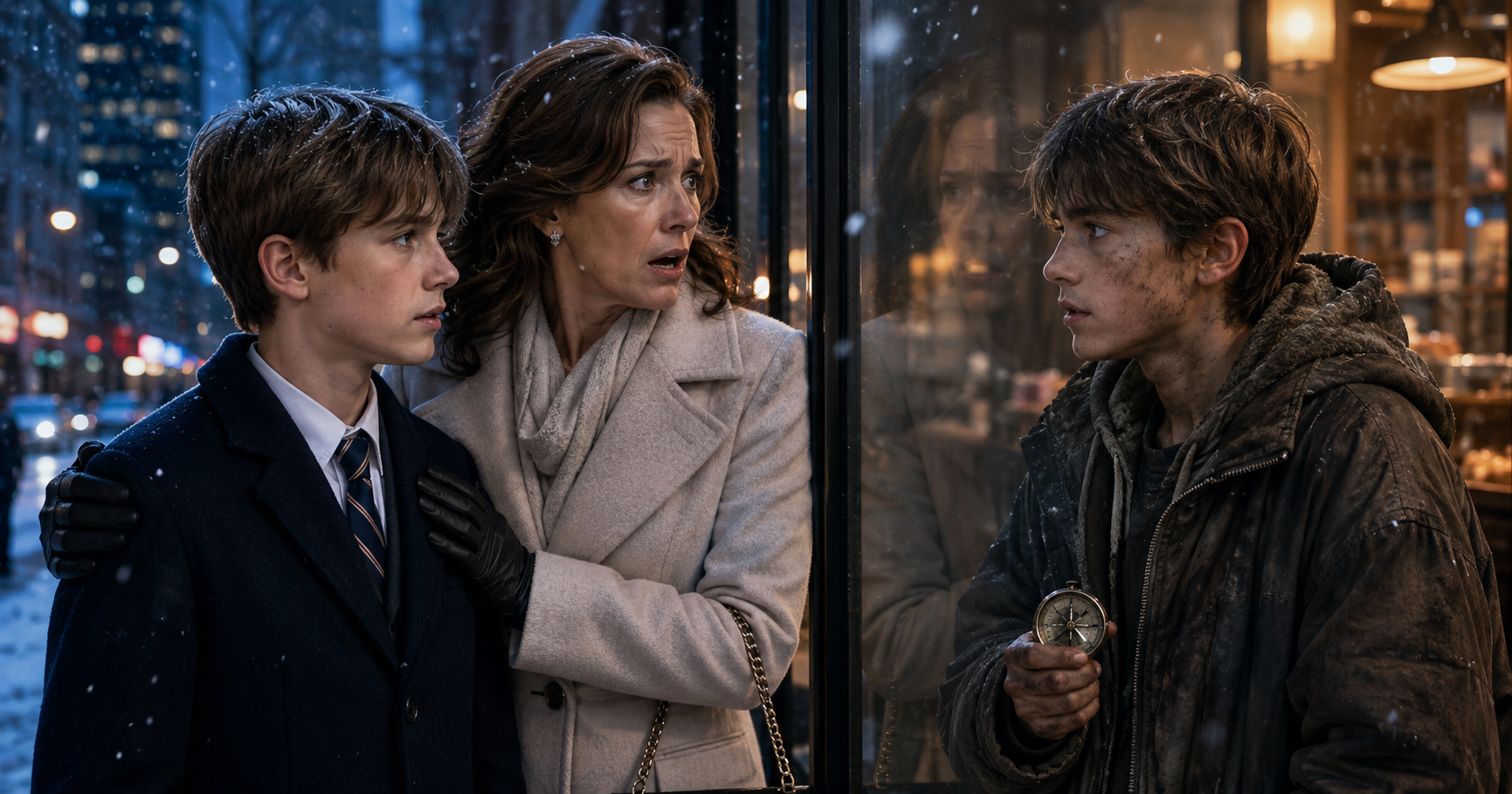
Lucas was staring across the street at the glass wall of a closed café.
At first, Claire saw only their reflection: herself in a tailored wool coat, Lucas in his private-school uniform, white lights hanging above them like frozen stars.
Then a shape moved behind the reflection.
A boy was sitting on the pavement beside the café window.
He wore an oversized army jacket with a broken zipper. His shoes were wrapped in gray tape to keep the soles attached. His hair was too long, and there was a fading bruise near his temple.
But none of those details stopped Claire’s breathing.
It was his face.
The boy had Lucas’s face.
Not approximately.
Not in the vague way strangers sometimes resembled one another.
The same narrow chin.
The same dark eyebrows.
The same small scar above the left eye.
Even the way he tilted his head was familiar.
Lucas crossed the street before Claire could stop him.
“Lucas!”
A horn blared. Claire grabbed his shoulder and pulled him back as a taxi swept past them.
“What are you doing?”
“That boy looks exactly like me.”
“I know.”
The words escaped before she could deny it.
They waited for the traffic light and crossed together.
The boy watched them approach without standing. His expression was cautious but not surprised, as though he had seen them long before they noticed him.
Up close, the resemblance was even more disturbing.
Lucas stared at him.
The stranger stared back.
Neither spoke.
Claire felt as if she were looking at two versions of the same photograph—one protected behind glass, the other left outside in the snow.
“What’s your name?” Lucas finally asked.
The boy’s eyes moved toward Claire.
“Mason.”
His voice was quiet and hoarse.
“Do you live nearby?”
Mason almost smiled.
“I live wherever I can.”
Claire noticed a backpack beside him. One shoulder strap had been repaired with electrical wire. A thin blanket was rolled beneath it.
“Where are your parents?” she asked.
“Gone.”
Claire’s stomach tightened.
The boy reached beneath his jacket and pulled out a chain. A small silver compass hung from it. Its surface was scratched, but a blue stone remained set in the lid.
Claire recognized it immediately.
Her knees nearly gave way.
She had purchased two identical compasses fourteen years earlier from a small antique shop in Prague. She had planned to give them to her children when they were old enough to understand what they meant.
One compass was locked in a safe at home.
The other had supposedly been buried with her stillborn son.
“Where did you get that?” she whispered.
Mason closed his fingers around the object.
“My aunt gave it to me before she died.”
“What was her name?”
“Teresa Bell.”
Claire had never heard the name.
Mason studied her face.
“She told me that when I found a woman who recognized this, I should ask her one question.”
The city seemed to grow silent around Claire.
“What question?”
Mason stood.
He was exactly Lucas’s height.
His hands trembled, although his gaze remained steady.
“She told me to ask why my real family never came back for me.”
Lucas looked at his mother.
Claire could not answer.
Mason opened the compass.
It no longer contained a needle.
Inside the lid was a photograph of two newborn babies sleeping beside each other. Around one infant’s wrist was a blue hospital band. Around the other was a green one.
On the back, someone had written:
Our sons, born together. May they never face the world alone.
Claire knew the handwriting.
It was hers.
A memory struck her with such force that she had to grip the café window.
A hospital room.
Rain against the glass.
The smell of antiseptic.
Her husband, Adrian, holding her hand while a doctor explained that there had been complications.
One child had survived.
One had not.
Claire remembered begging to see the baby who had died.
Adrian had told her it would be too painful.
He had arranged the funeral.
He had chosen the casket.
He had handled every detail while Claire remained sedated and broken.
For thirteen years, she had thanked him for being strong enough to do what she could not.
Now a living boy stood before her wearing the face of the son she had raised.
Mason’s expression changed as he watched the truth appear in her eyes.
“You know what this is.”
Claire’s lips moved, but no sound emerged.
Lucas reached for the compass.
“I have one like it.”
Mason stepped back.
“You do?”
“At home. Mom said it was made before I was born.”
Claire covered her mouth.
Mason looked from Lucas to Claire.
His guarded expression finally cracked.
“Are you my mother?”
Claire felt the question enter her like a blade.
She reached for him instinctively.
Mason recoiled.
“Don’t.”
“I’m sorry.”
“That’s what people say when they want you to stop asking questions.”
“I didn’t know you were alive.”
“You expect me to believe that?”
“Yes.”
“Why?”
“Because I was told you died the night you were born.”
For the first time, Mason looked frightened.
“That’s not what Teresa said.”
“What did she tell you?”
“She said someone paid to make me disappear.”
Chapter Two: The Stranger in the Guest Room
Claire took both boys home.
She did not call Adrian.
She did not call the police.
Not yet.
Fear told her that once other people became involved, Mason might disappear again. Logic told her to contact the authorities immediately. Her heart told her to keep him where she could see him.
The Whitmore residence stood near the lake behind iron gates and bare winter trees. Mason stared at the house from the car.
“You live here?”
Lucas unfastened his seat belt.
“We do.”
Mason did not move.
Claire turned toward him.
“You’re safe.”
“You don’t know that.”
“I won’t let anyone hurt you.”
He looked through the window at the security cameras.
“People who live in places like this always think they can promise things.”
Claire had no response.
Inside, the housekeeper brought soup, bread, clean clothes, and towels. Mason ate too quickly, barely chewing. When he noticed Claire watching, he slowed down and placed his spoon carefully beside the bowl.
“I can leave.”
“No,” Claire said. “Please stay.”
“You think I stole something?”
“I think you’re hungry.”
His face hardened.
“Being hungry doesn’t make me a thief.”
“I know.”
He studied her for several seconds, deciding whether to believe her.
Lucas sat across from him.
“You can have my bread.”
“I have bread.”
“You finished it.”
“I don’t need yours.”
“I wasn’t saying you did. I just don’t want it.”
Mason hesitated before taking the slice.
Claire had to look away.
The boys spent the next hour in Lucas’s room. They compared fingerprints, scars, and habits. Both hated mushrooms. Both slept with one foot outside the blanket. Both rubbed the side of their thumb when nervous.
Their lives, however, could not have been more different.
Lucas had attended the best schools in the city. He had traveled across Europe, learned piano, played tennis, and complained whenever the household internet became slow.
Mason had moved through foster homes after Teresa’s death. He had run away from the last one when an older teenager began attacking him at night. He had slept in stations, shelters, laundromats, and unlocked apartment hallways.
He knew which restaurants threw food away before midnight.
He knew how to identify undercover police officers.
He knew that a person sleeping outside should never remove both shoes, because someone might steal them.
Lucas listened without interrupting.
When Mason finished, Lucas walked to his closet and removed a box containing a pair of new winter boots.
“My grandmother bought the wrong size,” he said.
Mason looked at the label.
They were exactly his size.
“You’re lying.”
“Yes.”
“Why?”
“Because you won’t accept them if I say they’re a gift.”
Mason stared at him.
Then, unexpectedly, he laughed.
It was a small, uncertain sound, as though laughter were a language he had once known but rarely used.
Claire heard it from the hallway.
For one brief second, happiness rose inside her.
Then the front door opened.
Adrian had returned.
Claire met him in the library.
Her husband entered while removing his gloves, his gray coat speckled with snow.
“I thought you and Lucas would still be shopping.”
Claire placed the silver compass on the desk.
Adrian stopped.
He did not ask what it was.
He did not appear confused.
He simply stared at it as the color drained from his face.
“Where did you find that?”
Claire’s last hope died.
She had spent the drive home inventing explanations. Perhaps a nurse had stolen the child. Perhaps hospital records had been confused. Perhaps Adrian had been deceived as completely as she had.
His question destroyed every comforting possibility.
“You recognize it.”
Adrian looked toward the door.
“Where is Lucas?”
“Upstairs.”
“Is anyone with him?”
“His brother.”
Adrian’s eyes closed.
The silence that followed was not the silence of surprise.
It was surrender.
Claire felt rage rising from somewhere deeper than anger.
“You knew.”
“Claire—”
“You knew he was alive.”
Adrian approached her carefully.
“I can explain.”
“Then explain why our son spent thirteen years believing he had been abandoned.”
“I never intended for that to happen.”
“But you intended for him to disappear.”
Adrian lowered himself into a chair.
He suddenly seemed much older than the man who had left for work that morning.
“When the twins were born, Whitmore Development was collapsing. The banks had frozen our credit. Three projects had failed. I owed money to people who were not willing to wait.”
“You told me the company was stable.”
“I was trying to protect you.”
“Do not use that word.”
Adrian flinched.
“A private adoption broker contacted me. He represented a wealthy couple who had been trying to have a child for years.”
Claire’s hands began to shake.
“No.”
“They knew there were twins. They offered enough money to save the company.”
“No.”
“They promised the child would have everything.”
“Stop.”
“A home. Education. Security.”
Claire swept a crystal glass from the desk. It struck the wall and shattered.
“He already had a home!”
Adrian stood.
“I was desperate.”
“You sold our child.”
“I convinced myself it was an adoption.”
“You told his mother he was dead.”
“I knew you would never agree.”
“So you buried an empty coffin and watched me grieve.”
Tears filled Adrian’s eyes.
“I thought one child would grow up with us and the other would grow up with people who could give him a wonderful life.”
“You separated two newborn brothers because your company was losing money.”
“I made a terrible choice.”
“No. A choice is made once. You lied every day for thirteen years.”
Adrian covered his face.
Claire felt no pity.
“What happened to the couple?”
“They were killed in a house fire three years later.”
Claire’s anger turned cold.
“And Mason?”
“The adoption was illegal. There were no legitimate records. After the couple died, the authorities treated him as an unidentified child. I hired investigators, but the broker had disappeared.”
“You looked for him?”
“At first.”
“At first?”
“Every search created a risk. If the truth became public, I would go to prison. The company would collapse. You and Lucas would lose everything.”
“So you stopped.”
Adrian did not answer.
Claire stepped closer.
“He was six years old when you decided your reputation mattered more than finding him.”
“I was afraid.”
“He was a child.”
“I know.”
“No, you don’t. You ate dinner every night while he searched garbage bins for food. You watched Lucas open birthday presents while his brother moved between strangers’ homes. You stood beside me at an empty grave and let me apologize to a child who was still alive.”
A sound came from the doorway.
Mason was standing there.
Lucas was behind him.
Adrian stared at the boy he had sold.
Mason did not cry.
That made the moment worse.
“You’re my father?” he asked.
Adrian stood slowly.
“Yes.”
“And you gave me away for money?”
“It wasn’t that simple.”
Mason’s jaw tightened.
“It sounds simple.”
“I believed you would be safe.”
“Did you ever come looking for me?”
Adrian looked down.
Mason understood.
“You didn’t.”
“I tried.”
“No. You paid people to try. Then you got scared.”
Adrian moved toward him.
“Mason, I am sorry.”
The boy stepped backward.
“Don’t touch me.”
Lucas positioned himself beside his brother.
Adrian stopped.
Mason pulled the compass from his neck.
“Teresa said rich people bought me. I thought she was lying because she was sick. I thought maybe my real parents were dead.”
His voice began to tremble.
“I used to imagine them. I thought my mother was a nurse. I thought my father fixed cars. I imagined they were searching every city for me.”
Claire moved closer, but she did not reach for him.
Mason continued speaking to Adrian.
“I kept moving because I thought one day they might find me.”
Adrian began to cry.
Mason’s expression remained empty.
“You weren’t searching.”
Claire turned toward her husband.
“You need to leave.”
Adrian looked at her.
“This is my home.”
“Not anymore.”
“We should talk after everyone has calmed down.”
“I am perfectly calm.”
“Claire, think about what you’re doing.”
“I am thinking about the child freezing upstairs in borrowed clothes because you decided he was an acceptable price for saving your name.”
Adrian looked toward Lucas.
“Son—”
Lucas shook his head.
“Don’t ask me to defend you.”
That wounded Adrian more visibly than anything Claire had said.
He gathered his coat and left without another word.
Chapter Three: Learning How to Stay
The police arrived the following morning.
So did social workers, attorneys, detectives, and a physician assigned to collect DNA samples. Claire answered every question. She provided the compass, medical records, photographs, and access to the family safe.
The test results confirmed what her heart already knew.
Mason and Lucas were identical twins.
Claire was their biological mother.
Adrian Whitmore was their biological father.
The investigation uncovered payments routed through foreign accounts, falsified hospital documents, and correspondence with the illegal adoption broker. A retired nurse admitted that she had been paid to alter the birth records. The doctor who had signed the death certificate had died years earlier, but his private files contained evidence of several similar transactions.
Adrian was arrested.
News vans surrounded the house.
For weeks, the story dominated television programs and newspapers. Commentators discussed wealth, corruption, illegal adoption, and the morality of a father who had treated his infant son like an asset.
Mason refused to watch.
He also refused to sleep in a bed.
Every night, Claire found him curled on the carpet beside the guest-room door with his backpack beneath his head.
“You don’t have to sleep there,” she told him.
“I know.”
“Then why do you?”
“It’s easier to leave.”
“You’re not leaving.”
“You don’t know that.”
The family court had placed Mason temporarily in Claire’s custody, but he did not trust legal documents. He had been moved too many times by adults carrying folders and making promises.
Claire placed a pillow on the floor several feet from him.
“What are you doing?” he asked.
“Sleeping here.”
“This is stupid.”
“Probably.”
“You have your own room.”
“So do you.”
He watched her arrange a blanket.
After several minutes, Mason climbed into the bed.
Claire remained on the floor until he fell asleep.
The next night, he still slept in the bed.
Healing did not arrive as a sudden miracle.
It arrived in fragments.
A full meal eaten without hiding bread inside a pocket.
A shower taken without bringing the backpack into the bathroom.
A morning when Mason left the compass on the nightstand instead of wearing it beneath his clothes.
There were also setbacks.
He struck a teacher who grabbed his arm from behind.
He disappeared for six hours after overhearing Claire discuss boarding schools with an advisor.
He accused Lucas of trying to replace him after Lucas invited friends to the house.
During therapy, he sat in silence for three sessions before speaking.
“When people say they love you,” he finally told the counselor, “it usually means they want something.”
Lucas became the person Mason trusted most.
They argued constantly.
Lucas hated that Mason borrowed his clothes without asking. Mason hated the way Lucas left half-finished food on plates. Lucas complained that Mason slept with the window open. Mason said closed rooms made him feel trapped.
But every night they talked until long after midnight.
Lucas taught Mason how to play chess.
Mason taught Lucas how to open a frozen lock with a lighter.
Lucas showed Mason the hidden staircase behind the library.
Mason showed Lucas how to tell when someone was following him.
One afternoon, Claire found them in the kitchen attempting to cook pancakes.
Smoke filled the room.
Flour covered the floor.
The smoke alarm screamed above them.
“What happened?” Claire shouted.
Lucas pointed at Mason.
“He said he knew how to cook.”
“I said I knew how to heat food.”
“That is not the same thing!”
Mason started laughing.
Lucas threw a towel at him.
Claire laughed too.
The three of them stood in the ruined kitchen, coughing and laughing while the pancakes burned.
It was the first time Mason called her Mom.
“Mom, turn off the alarm!”
He froze after saying it.
Claire froze too.
Neither acknowledged the word.
But later that night, Claire cried alone in her room—not from grief, but from the fragile hope that her son had begun to believe he belonged there.
Chapter Four: What Money Could Not Repair
Adrian eventually pleaded guilty to charges connected to child trafficking, fraud, falsifying medical documents, and obstruction of justice.
Before sentencing, he asked to meet Mason.
Mason refused.
A month later, he changed his mind.
The meeting took place in a private room at the county detention center. A table separated them. A guard stood outside the door.
Adrian looked thinner. His expensive suit had been replaced by a plain uniform. His hair had turned almost completely gray.
Mason sat across from him.
Claire waited in the hallway.
For a long time, neither spoke.
Adrian broke the silence.
“You look healthy.”
Mason’s expression hardened.
“You didn’t ask me here to talk about my health.”
“No.”
“Then say what you want.”
“I wanted to see you before the judge sends me away.”
“You’ve seen me.”
Adrian lowered his eyes.
“I have thought about you every day.”
“That doesn’t help me.”
“I know.”
“No, you keep saying that, but you don’t know anything about me.”
“You’re right.”
Mason had prepared questions with his therapist, but now that Adrian was in front of him, only one mattered.
“How much?”
Adrian looked confused.
“How much what?”
“How much did they pay you for me?”
Adrian’s face collapsed.
“Mason—”
“I want the number.”
“Two million dollars.”
The boy stared at him.
“That’s all?”
Adrian flinched.
“To you, I mean. That was enough?”
“It wasn’t about your value.”
“It was exactly about my value. You decided the company was worth more.”
“I was a coward.”
“Yes.”
“I have no excuse.”
“No.”
“I know I cannot ask you to forgive me.”
“You can ask. I’ll just say no.”
Adrian nodded.
Mason stood.
“Was there anything else?”
“I loved you.”
The boy paused at the door.
“You didn’t know me.”
“You were my son.”
“That didn’t stop you.”
Mason left without looking back.
Outside, Claire waited with Lucas.
Neither asked what had happened.
Lucas simply held out Mason’s coat.
Mason put it on.
Then the brothers walked toward the exit side by side.
Chapter Five: The Second Compass
Five years passed.
The Whitmore mansion was sold.
Claire could no longer walk through its rooms without remembering secrets hidden beneath polished surfaces. She purchased a smaller home near Lincoln Park where the boys could walk to school and neighbors sometimes appeared at the door without appointments.
Lucas became interested in law.
Mason became interested in everything.
He studied photography, social work, emergency medicine, and investigative journalism. He said he had spent enough years being invisible and wanted to learn how to make invisible people seen.
On their eighteenth birthday, Claire gave the brothers two small boxes.
They opened them together.
Inside were the matching silver compasses.
Lucas’s had been kept in the family safe for years.
Mason’s had been repaired, although every scratch remained visible.
“I asked the jeweler not to polish it,” Claire explained.
“Why?” Mason asked.
“Because surviving should not have to look untouched.”
Mason ran his thumb over the damaged lid.
Lucas opened his compass.
Its needle pointed north.
Mason opened his.
A new needle had been installed.
For a moment, both needles trembled.
Then they settled in the same direction.
Two years later, the brothers established the Northlight Center in a renovated railway building.
It provided emergency beds, legal support, medical care, and family-search services for homeless teenagers and young adults leaving foster care. No one was forced to surrender personal belongings. No one was removed without being told where they were going. Every resident received a lockable room and a key of their own.
Above the entrance, there was no giant family name.
Mason had insisted on that.
“This isn’t a monument to us,” he said during the planning meeting. “It’s a door for people who need one.”
On opening night, snow began falling over Chicago.
Claire stood near the back of the hall while Mason addressed volunteers, donors, social workers, and former foster children.
He spoke without notes.
“When I was thirteen, I believed surviving meant never depending on anyone. I believed a locked door was a warning and every gift carried a hidden price.”
He glanced at Claire.
“Then I met people who taught me that a home is not the building where you are told to stay. It is the place where someone notices when you are missing.”
Lucas stood beside the stage.
Mason looked at him.
“And family is not only the people who share your blood. Family is the person who crosses the street when everyone else keeps walking.”
After the ceremony, the brothers climbed to the building’s rooftop.
Chicago stretched around them in towers of light. Trains moved across the city like glowing threads.
Lucas rested his arms on the railing.
“Do you ever think about that night?”
“Every day.”
“Do you wish it had happened differently?”
Mason considered the question.
“I wish someone had found me sooner.”
Lucas looked down.
“I’m sorry.”
“You didn’t leave me.”
“I still had everything while you had nothing.”
“That wasn’t your fault.”
“It doesn’t feel fair.”
“It wasn’t fair.”
Lucas turned toward him.
Mason continued.
“But fairness isn’t something you find waiting for you. Sometimes you have to build it.”
Lucas smiled.
“That sounds like something they’ll put on a wall.”
“No walls.”
“Right. You hate inspirational walls.”
“I hate inspirational walls with terrible fonts.”
They laughed.
Mason removed the silver compass from beneath his shirt.
Lucas took out its twin.
They opened them.
Two needles pointed north.
“Do you think Teresa knew I would find you?” Mason asked.
“No.”
“Neither do I.”
“Then why did she give you the compass?”
“Maybe she wanted me to believe there was somewhere I belonged.”
Lucas looked across the city.
“She was right.”
Mason closed the lid.
“Eventually.”
Below them, the doors of the Northlight Center opened.
A young girl entered carrying a torn backpack. A volunteer welcomed her, offered her something warm to drink, and showed her to a room that could be locked from the inside.
No one asked her to prove that she deserved safety.
No one told her she should be grateful.
No one looked away.
Lucas placed an arm around his brother’s shoulders.
Mason did not step back.
For most of his life, he had believed that being strong meant always being ready to leave.
Now he understood something different.
Sometimes the bravest thing a person could do was unpack the bag.
Sometimes survival meant staying.
And sometimes two lives separated by greed, silence, and thirteen lost years could still find their way toward the same horizon.
Not because the past had been erased.
Not because every wound had disappeared.
But because neither brother had to face the future alone.