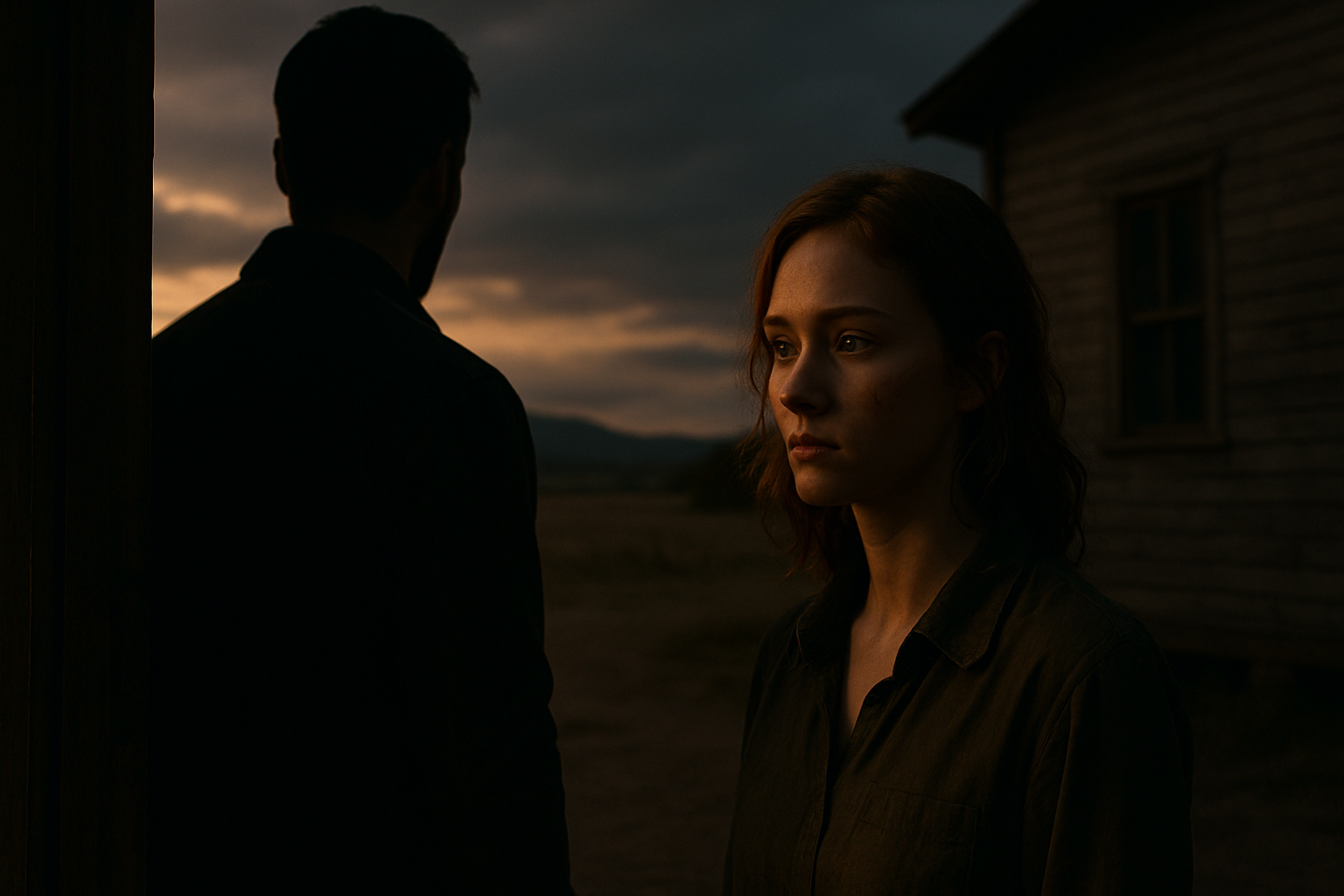
The Scar Seraphine Took to Her Grave
“You think you need protecting from me?”
Rowan Kade’s voice was low enough to be mistaken for calm, but there was iron under it, the old kind, buried too long in weather and rust to shine. He stood in the doorway with the evening behind him, broad shoulders blocking the last gold light as it slid over the empty yard.
Briony looked past him instead of at him.
She looked at the land first — acres of hard, wind-raked earth that rolled away toward a horizon bruised purple by dusk. She looked at the house, still standing though it had the tired posture of something that had survived because falling down required more mercy than the world had offered. She looked at the barn beyond it, and at the blackened claw marks that still climbed one side of its boards.
Even after twenty-two years, the fire had not completely let go.
“I think,” Briony said, drawing her coat tighter across her chest, “we need protecting from everyone.”
The answer struck Rowan harder than defiance would have.
Defiance he knew what to do with. He could meet it head-on, crack it against his own stubbornness until one of them gave way. Fear was different. Fear had a way of slipping past locked doors. Fear could sit down at a man’s table and make itself familiar.
For a moment, no one moved.
Beside Briony, Elowen stood with both hands wrapped around the handle of a battered cloth bag. She was the quieter of the two, softer in the face, rounder in the eyes, but there was no weakness in her. Only exhaustion. Only the kind of sorrow that had been asked to remain polite for too long.
Rowan turned without another word and went inside.
He did not invite them.
He did not say, Come in.
He did not say, You can stay.
But he left the door open.
The porch boards groaned beneath him as he crossed the threshold. The house swallowed him in dimness, smelling of cold ashes, boiled coffee, horse leather, and a solitude so old it had become part of the walls.
Behind him, nothing happened.
Then, after a long moment, he heard the first step on the porch.
Then another.
Then the careful, uncertain weight of two women entering a house that might shelter them or turn them away.
The Kade house looked exactly like what it was: the refuge of a man who had long ago stopped expecting anyone to knock.
One iron bed stood in the far corner, neatly made with a gray blanket folded so square it looked like a habit rather than care. One table sat near the stove. Two chairs stood with it, though one was occupied by a stack of folded feed sacks tied with twine. A dented kettle rested on the black stove. One shelf held chipped plates, three mugs, a jar of salt, a cracked blue bowl, and nothing decorative except a dead sprig of prairie sage someone must have tucked into a jar years before and forgotten.
On the wall, above a row of pegs, hung an empty rifle rack.
The emptiness of it seemed louder than a gun would have been.
Rowan had sold the rifles years ago, one by one, after deciding a man full of ghosts did not need easier ways to make more of them.
Briony and Elowen stopped just inside the door. Their bags sat at their feet like the entire weight of their lives had been forced into canvas and buckles.
With them inside, the room changed.
It seemed smaller. Warmer.
More dangerous.
Rowan stood by the table and looked at the envelope again.
The paper was yellowed at the edges, creased from travel, its seal broken only now beneath his thumb. A faint smell rose from it when he unfolded the letter — lavender and smoke.
His hands were steady until he read the first line.
My dear Rowan,
If Briony and Elowen are standing in your house, then I have run out of road.
He stopped reading.
Outside, the wind came hard across the flatland and struck the side of the house. The window rattled in its warped frame. Somewhere in the barn, a loose strip of tin lifted and fell with a lonely metallic tap.
Rowan stared at the page.
Seraphine’s handwriting had not changed.
Twenty-two years, and there it was: the same slant, the same long loops, the same stubborn pressure where the pen had bitten too hard into the paper. He had once watched those hands braid her hair, button his shirt, smooth the nose of a skittish colt. He had once imagined those hands growing old beside his.
He forced himself to continue.
I know I have no right to ask anything of you after leaving the way I did. I know you must have hated me. Or worse, blamed yourself. You always did have a terrible talent for carrying guilt when anger would have been lighter.
But I am asking anyway.
Pride belongs to the living, Rowan, and I do not have enough living left to keep mine.
These two women are not a mistake.
They are not a burden.
They are not whatever small-hearted people have called them when they feared women who took up room in the world.
They are Briony and Elowen.
They are stubborn, frightened, funny, loyal, and stronger than anyone has ever allowed them to be.
Please accept them.
Not as charity.
Not from pity.
Accept them as the promise we never got to make out loud.
Rowan’s throat closed so tightly it felt as if the old smoke had returned and filled him from the inside.
He looked up.
Briony watched him with her chin lifted, braced for a blow she would rather take standing. Elowen kept her gaze down, fixed on some scar in the floorboards.
Rowan looked back at the letter because looking at either of them was suddenly more than he could manage.
There are things I could not place in the hands of a hired driver. There are truths Widow’s Reach buried that never stayed buried in me.
Briony carries the key.
Elowen carries the memory.
If Garrick Sloane comes for them, do not believe one word that leaves his mouth.
Forgive me for keeping the truth this long.
Forgive yourself for the fire.
And Rowan—
They know about the scar beneath your ribs.
S.
Rowan lowered the letter.
The room had gone utterly silent.
Not peaceful. Not calm.
Silent the way the world goes silent before lightning strikes close enough to split a tree.
Briony’s eyes were on him. Not pleading. Not exactly. Waiting, perhaps, for him to decide whether they were people or trouble.
Elowen looked at the floor as though she had betrayed him simply by being there.
Rowan’s left hand moved without permission.
Not to his cheek, where most people thought the worst of his scars lived. Not to the seam of burn-slicked skin near his jaw.
His palm went to his side.
Beneath his shirt, under the ribs on the left, was another scar.
A crescent-shaped welt, pale and thick, tucked close against the bone. It had faded with time, but it had never vanished. He had never shown it in town. He barely looked at it himself.
He had been told it came from falling against broken tack during the fire.
That was what they had said.
Broken tack. Panic. Confusion. Smoke.
But Rowan had no memory of it.
He remembered heat.
He remembered the barn roaring like some red-mouthed beast.
He remembered smoke scraping down his throat.
He remembered Milo Voss screaming from somewhere inside the flames.
He remembered a beam coming loose overhead.
Then nothing.
“How old are you?” Rowan asked.
His voice sounded wrong in his own ears, scraped raw.
Briony frowned. “Twenty-one.”
“Both of you?”
Elowen answered this time, barely above a whisper. “We’re twins.”
Something inside Rowan’s chest lurched so violently he gripped the edge of the table.
Twenty-one.
The fire had been twenty-two years ago in August.
Seraphine had left Widow’s Reach in September.
No.
The word rose fast, sharp, almost angry.
No.
He remembered the doctor’s office in Grayfall. Whitewashed walls. The sour bite of antiseptic. The physician with a silver watch chain and eyes that would not quite meet his.
Trauma, fever, infection, Mr. Kade. There are consequences. Serious ones. I won’t say impossible, but you should prepare yourself. Some men recover in other ways, but fatherhood is not something you ought to count on.
The town had taken that careful cruelty and made it uglier by supper.
Sterile.
Broken.
Half a man.
No kind of husband.
No kind of future.
Rowan had swallowed the verdict because punishment had felt easier than hope. Hope had teeth. Hope asked questions. Hope made a man imagine a life he could be denied twice.
Briony saw something change in his face.
At once, she stepped in front of Elowen.
It was a practiced movement, smooth and immediate, the reflex of an older sister by minutes who had spent a lifetime making herself into a wall.
“Don’t look at us like that,” she said.
Rowan blinked. “Like what?”
“Like we’re a problem you found lying in the road.”
He folded the letter with deliberate care.
Once. Twice.
If he did not do something with his hands, he might snap the back of the chair clean off.
“You hungry?”
Both women stared at him.
Of all the things they had expected — rejection, suspicion, accusation, silence — supper had clearly not been one of them.
Briony recovered first. “We didn’t come for food.”
“You came in a stranger’s motorcar with two bags and a dead woman’s letter,” Rowan said. “You’re eating before we discuss anything else.”
“I said we didn’t come for—”
Elowen touched Briony’s sleeve.
“Briony,” she murmured. “Please.”
The word was small, but there was a surrender in it that made Briony’s jaw tremble.
Rowan turned toward the stove.
He had beans in a pot, coffee gone bitter from sitting, half a loaf of bread wrapped in cloth, four eggs, and a heel of cheddar sealed in wax paper. It was poor hospitality by any decent measure, but it was what he had.
He cleared the second chair of feed sacks and set them neatly against the wall. Then he went to the corner, dragged an old trunk to the table, and placed it where a third chair should have been.
Briony noticed.
Just for a second, something moved across her face before she shut it away.
People had likely made her feel too large for rooms all her life. Too tall, too broad, too much. Rowan knew something about being treated like a shape no one wanted to make space for.
He set three plates down.
The beans hissed as he stirred them back to warmth. The eggs popped in the skillet. He sliced the bread thick and shaved the cheddar with his pocketknife, putting the largest pieces on their plates without comment.
They ate in careful silence.
Elowen held her bread with both hands, taking small bites as if afraid the meal might disappear if she showed hunger too plainly. Briony ate like a woman determined not to seem desperate, though Rowan saw the way her fingers tightened around the fork.
He leaned against the counter and watched them despite himself.
Their faces were different, but bound by blood in ways that tugged painfully at him. Elowen was softer, with grief pooled close beneath the skin. Briony was guarded, all sharp eyes and locked jaw, carrying anger the way some women carried a knife.
Seraphine’s daughters, he thought.
Then he crushed the thought before it could draw breath.
After supper, Briony stood and gathered the plates.
“You don’t have to,” Rowan said.
“I know.”
She washed them anyway.
The pump groaned. Water splashed into the basin. She scrubbed each plate with unnecessary focus, as if she could make herself useful enough to earn shelter without asking for it.
Elowen remained at the table, rubbing the seam of her cloth bag between finger and thumb. Over and over. The motion had worn the fabric pale.
“What’s in there?” Rowan asked.
She startled, shoulders tightening.
Briony turned from the basin at once. “Nothing.”
Elowen swallowed. “Mama’s things.”
Mama.
The word hit him in a place the letter had already wounded.
Rowan nodded once. “Keep them close.”
Both women looked surprised.
Suspicion, they had expected. Demands. Maybe a search.
Respect had caught them unprepared.
Night came hard over the ranch.
There was no gentle dimming, no soft blue pause. One moment the windows held the last ash-colored light; the next, the world outside had gone black. The temperature dropped quickly, crawling under the door and through the cracks with long, cold fingers.
Rowan gave them the bed.
Briony argued.
Rowan ignored her.
Elowen thanked him in a voice so small it made him uncomfortable.
He shook out a blanket near the stove and banked the fire low. The room filled with the smell of warm iron and old wood. Shadows leaned against the walls.
Before he lay down, Briony spoke from the corner.
“Mr. Kade?”
He paused, one hand on the blanket.
“If you decide tomorrow that we can’t stay,” she said, “we’ll go.”
Rowan looked at her through the darkness.
“Where?”
She did not answer.
That silence told him everything.
Rowan lay awake long after the sisters’ breathing settled into sleep.
He stared at the ceiling beams, at the dark knots in the wood, and listened to the house expand and contract in the cold. The old place creaked like a thing with bones. Outside, the wind dragged dust against the walls.
Seraphine had been alive all these years.
Alive somewhere beyond his reach.
Alive with two daughters.
Maybe his.
No.
The word came again, immediate and hard. Protective.
The doctor had said fatherhood was not something he ought to count on.
The town had said worse.
He had made himself believe it because believing otherwise would have required him to wonder. And wondering would have broken him.
But Elowen had known about the scar.
The one beneath his ribs.
The one no one in Widow’s Reach had ever seen.
The one Seraphine could only have known if she had seen it before she left town.
The one Rowan himself did not understand.
Near dawn, sleep finally took him.
And with sleep came fire.
In the dream, Milo Voss was screaming from inside the barn.
“Rowan!”
The sound ripped through smoke and flame, raw with terror.
Rowan ran toward him.
The barn doors yawned open, breathing heat. Smoke clawed down Rowan’s throat. Flames twisted along the rafters in bright, hungry ropes. A horse kicked through a stall door, wild-eyed, its mane singed, one flank burning orange in the dark.
Rowan grabbed a wet saddle blanket from the trough and plunged forward.
Boards cracked overhead.
The air was alive with sparks.
“Milo!” he shouted.
Then something slammed into his ribs.
Not a beam.
Not falling tack.
A man.
The impact drove the breath from his lungs and sent him crashing sideways into the dirt and straw. Through the smoke, something flashed — silver, bright, quick as a fish in water.
A belt buckle.
A hand caught his shirt and shoved him down hard.
A voice hissed close to his ear.
“Stay down, Kade, unless you want her next.”
Rowan woke with a gasp.
His hand was pressed against his side.
The room was dim with the first weak light before sunrise. The stove had gone low. His shirt clung damp to his back.
Across the room, Briony was already awake.
She sat upright in the bed, one arm curled around Elowen as if she had been guarding her even in sleep. Her loose hair fell over her shoulders. Her eyes, wide and unblinking, looked too much like Seraphine’s.
“You dreamed it,” she said.
Rowan’s voice came out rough. “Dreamed what?”
“The fire.”
He stood too quickly, anger rising because she had seen him afraid.
“You don’t know anything about that.”
Briony slipped out of bed. She was barefoot, her coat wrapped around her like armor, her face pale in the thin morning light.
“No,” she said.
Then she lifted her chin.
“But Mama did.”
Mrs. Harlan brought three coats from the back, still smelling faintly of cedar and dust. They were not fashionable coats. They were not meant for a woman walking past windows where other women measured her worth by the inches between buttons. They were thick, brown, ugly things with wool linings and strong seams.
Willa slid into one.
It fit.
For one second, before she could stop herself, relief crossed her face. Not joy. She did not seem practiced at joy. Relief, and beneath it a terrible little flicker of surprise, as if the world had performed some small kindness it had no reputation for performing.
June tried on a navy coat with frayed cuffs and turned once in front of the narrow mirror, touching the collar.
“Mama had one like this,” she said quietly.
Wyatt looked away from her reflection. He could stand blood. He could stand pain. He could stand the town’s old disgust and his own bad dreams. But he was discovering that tenderness, when it arrived too late, could knock the breath clean out of a man.
“Get gloves,” he said gruffly. “Scarves. Warm socks.”
“We don’t need all that,” Willa said.
“Yes, you do.”
“We can pay some back once we find work.”
Wyatt turned to her. “You’re not guests at a hotel.”
Her face tightened. “Then what are we?”
The question sat between them with all the weight of Caroline’s letter.
June stopped touching the coat collar.
Mrs. Harlan pretended to arrange a shelf of lamp oil, but her ears leaned toward them like thirsty animals.
Wyatt lowered his voice. “I don’t know the word yet.”
Willa’s mouth parted, but no answer came. She looked angry that his honesty had not given her anything easy to strike.
June whispered, “Maybe we don’t need the word today.”
Willa glanced at her sister, and whatever she saw there made her look back down at the gloves.
They bought enough to change the shape of the truck bed: flour, beans, coffee, salt pork, oats, apples beginning to wrinkle, molasses, soap, thread, two quilts, stockings, bootlaces, and three tins of peaches because June’s eyes had lingered on them a heartbeat too long. Wyatt added them without comment. June noticed anyway.
At the register, Mrs. Harlan counted slowly. Her gaze kept traveling from Wyatt to the sisters.
“You got kin visiting?” she asked, trying to make curiosity sound neighborly.
Willa’s shoulders went rigid.
Wyatt placed the money on the counter. “They’re with me.”
Mrs. Harlan blinked. “With you?”
“That’s what I said.”
A flush crept up the older woman’s neck. She wrapped the parcels in brown paper and tied the string too tight.
As they left, the bell over the door clanged like a warning.
Outside, Mercy Ridge had gathered itself into small pockets of judgment. A man in a black hat stood outside the feed store. Two women paused by the church steps, pretending to discuss the weather. The teenage boy who had laughed at Willa now leaned against the hitching rail with two friends, all three wearing the cowardly smirk of boys who mistook cruelty for proof of manhood.
Wyatt loaded the goods into the truck.
June climbed in quickly.
Willa stood beside the passenger door, staring straight ahead, chin lifted as if someone had tied a string from it to the gray sky. She had been stared at before. Wyatt could see that. She had learned the art of not giving strangers the satisfaction of watching her flinch.
One of the boys said something too low for the words to carry.
The other two laughed.
Willa’s fingers curled.
Wyatt shut the truck bed with a hard metal clap.
The laughter died.
He walked toward them.
The boy in the black cap straightened too late.
Wyatt stopped close enough that the boys could see every pale seam of fire damage climbing his neck. Close enough that they could smell the cold coffee on his breath and the iron patience of a man who had spent two decades being hated and had not yet died from it.
“You got something to say?” Wyatt asked.
“No, sir,” the boy said.
“That’s wise.”
Wyatt held his gaze a moment longer, then looked at the other two. They found sudden fascination in their boots.
Behind him, the feed store door opened.
“Now there’s a familiar sight,” a voice drawled. “Wyatt Calder frightening children in the street.”
Wyatt did not turn at once.
His ribs ached before his mind named the voice.
Deke Barlow stepped onto the boardwalk like a man entering a room he owned. Time had silvered his hair at the temples and thickened his waist, but it had not softened him. He still wore confidence the way some men wore a gun: polished, visible, meant to discourage challenge. His coat was fine. His boots were clean. His smile was broad enough for witnesses and sharp enough for enemies.
The street seemed to quiet around him.
Willa looked from Deke to Wyatt.
June drew back inside the truck, one hand pressed to her belly.
Wyatt turned.
“Deke.”
“Been a while.” Deke’s eyes slid over the truck, the supplies, then the two women. They stopped on Willa a fraction too long. Something changed behind them. Recognition, maybe. Calculation, certainly. “I heard you’d brought strays into town.”
Willa went pale, then red.
Wyatt’s voice dropped. “Careful.”
Deke laughed. “Still touchy. Twenty-two years and you still can’t take a little conversation.”
“Wasn’t aware we were conversing.”
“Oh, I think we ought to.” Deke stepped down from the boardwalk. “Seems Mercy Ridge has questions. Folks see you coming in with two women nobody knows, buying half of Harlan’s store, acting like some wounded patriarch. Makes a man wonder.”
Wyatt did not move, but the world inside him tilted.
Wounded patriarch.
Deke knew enough to aim.
“Wondering is free,” Wyatt said. “Speaking can get costly.”
The smile thinned on Deke’s mouth.
His gaze shifted to Willa again. “You Caroline’s?”
Willa did not answer.
June made a small sound.
The entire street seemed to draw one breath and hold it.
Wyatt felt the old scar under his ribs burn hot beneath his shirt.
Deke’s smile returned, slower this time. “Well now.”
Wyatt stepped between him and the truck.
“Get out of our way.”
“Our.” Deke tasted the word. “That’s new.”
Wyatt came close enough to see the thin red veins in Deke’s eyes. “Move.”
For a second, Deke looked like the younger man from Wyatt’s nightmares, the one he could not quite remember until Caroline’s letter had given him shape. The one with smoke behind him. The one with a belt buckle curved like a half moon. The one who had stood between Wyatt and the barn while Thomas Vale burned.
Then Deke tipped his hat.
“Enjoy your homecoming, ladies,” he said. “Mercy Ridge has a long memory.”
Wyatt did not trust himself to answer.
He climbed into the truck, closed the door, and started the engine with hands that wanted to shake and refused.
No one spoke until Main Street fell behind them and the town shrank in the rear window.
Then Willa said, “That was him.”
Wyatt watched the road. “Yes.”
“The man Mama wrote about.”
“Yes.”
“He knew her.”
“Yes.”
Willa’s breathing changed. “He knew us.”
Wyatt tightened his grip on the wheel.
June’s voice was small. “Did he really start the fire?”
Wyatt saw flames in his mind. Heard wood bursting. Heard Thomas shouting his name. Heard his own breath tearing raw through smoke. For years the memory had ended in failure. Now there was a shape inside it that did not belong to smoke or guilt.
“I aim to find out,” he said.
Willa turned from the window. “How?”
Wyatt touched the pocket where the brass key rested like a live coal. “We start in the barn.”
The north beam had not changed much in twenty-two years.
The barn itself had aged around it. Boards had warped. Hinges had rusted. Swallows had nested and left. Hay dust lay golden in the thin winter light, and the air smelled of old animals, weathered wood, and the dry sweetness of stored grass. But the north beam still stood thick and dark, scarred by time, holding the roof the way stubborn men held grief: without grace, without complaint.
Wyatt carried a lantern. Willa carried a crowbar from the tool wall. June followed with Caroline’s letters folded in both hands as if they might run away if she loosened her grip.
“Loose stone,” Willa said, scanning the wall. “Under the north beam.”
“There.” Wyatt crouched.
At the base of the wall, half hidden by a broken feed sack, one foundation stone sat different from the others. Its edge had a notch worn into it. Not by weather. By fingers.
Wyatt brushed away dirt.
His hand trembled then.
He hated that both women saw it.
Willa knelt beside him without speaking and set the crowbar down.
Together they worked the stone free.
Behind it was a hollow lined in oilcloth. Inside sat a small iron lockbox, black with age, its corners rusted but intact.
June whispered, “Thomas put it there?”
Wyatt lifted it out. It was heavier than it looked.
“Caroline said he did.”
“Why would he hide it in your barn?” Willa asked.
Because Thomas trusted me, Wyatt thought.
The answer hurt so badly he almost could not breathe.
He set the box on an overturned crate and took out the brass key. It fit the lock with a tiny metallic certainty.
For a moment, no one moved.
Then Wyatt turned it.
The lock opened.
Inside were papers, tied in bundles with string. Deeds. Maps. Receipts. A water claim filed under Thomas Vale’s name and Caroline Ward’s as witness. A second document transferring partial interest to Wyatt Calder, signed three days before the fire.
Willa read over his shoulder.
“What does it mean?” June asked.
“It means Thomas bought land that needed water to matter,” Willa said slowly, her eyes moving across the lines. “And the water rights made it valuable.”
Wyatt lifted another paper.
There was a survey map, the ink faded but legible. A creek line crossed the north range, then dipped toward land now fenced under the Barlow name.
Deke’s land.
Wyatt stared at it.
“He built his ranch on water he didn’t own,” Willa said.
“Not all of it,” Wyatt said. “But enough.”
June frowned. “Enough for what?”
Wyatt looked toward the barn door, toward the winter fields beyond.
“Enough to ruin him if it came out.”
Willa took the deed in both hands. For the first time since arriving, her anger had found a proper direction. It sharpened her. Made her seem taller.
“And Mama had copies.”
Wyatt nodded.
“So he came for her?”
“Likely.”
June sat on a hay bale, her face drained. “All this for land?”
Wyatt thought of men he had known. Men who would lie for ten dollars, kill for pride, bury a town beneath silence to keep a fence line where they wanted it. Land was never only land. It was power. It was standing. It was the right to look another man in the eye and call yourself untouchable.
“For land,” he said. “For money. For not wanting the truth alive.”
At the bottom of the box lay one more thing.
A small leather pouch.
Wyatt opened it and poured the contents into his palm.
A half-moon of tarnished brass.
Not a whole buckle. A broken piece, curved and engraved with the initials D.B.
The barn faded around him.
Smoke rose in his throat.
He was young again. On his knees. The world orange and black. Thomas screaming inside the burning structure behind him. Wyatt trying to crawl, trying to rise, one arm useless, skin alive with fire. A boot drove into his side. Not a beam. Not falling timber.
A boot.
Then the flash of a belt buckle as Deke bent over him, face streaked with soot, teeth clenched.
Stay down, Calder.
Wyatt heard it.
Clear as a church bell.
Stay down or you’ll burn with him.
He staggered back from the crate.
June stood. “Wyatt?”
He pressed a hand under his ribs, right where the scar curved like an accusation.
Willa’s face changed. “You remember.”
Wyatt swallowed against bile. “Some.”
“What?”
He looked at the broken brass in his palm. “Enough.”
The house felt different that evening.
Not warmer, exactly. The stove burned hot and the windows shone with lamplight, but warmth was not the same as safety. Safety required trust, and trust had arrived like a wounded animal: hungry, skittish, likely to bite any hand offered too fast.
Still, the three of them moved with less awkwardness than they had that morning.
June unpacked food into cupboards, pausing every time she found empty space enough to fill. Willa mended a torn seam in her new coat with small, capable stitches. Wyatt spread the documents across the table and tried to order the past into something a court might believe.
The law was a distant thing in Mercy Ridge. It rode in from the county seat when summoned by men with influence, and Deke had spent twenty years becoming the sort of man whose summons got answered quickly.
Wyatt had spent those same years becoming the sort of man people avoided unless they needed a fence repaired cheap.
Caroline’s papers were evidence.
The buckle was evidence.
His memory, broken and late, was less than evidence but more than silence.
“We need a lawyer,” Willa said.
Wyatt looked up.
She did not meet his eyes. She was threading the needle again, though it was already threaded. “Mama said once that papers only matter if somebody strong enough stands behind them.”
“She was right.”
“Are you strong enough?”
June froze by the cupboard.
Wyatt leaned back.
Willa’s question was not cruel. That made it harder. She was not asking if he could lift a sack of feed or stare down boys in a street. She was asking if he could survive being dragged back through the fire in front of everyone who had once called him coward. She was asking if he could claim them when claiming them might make Deke Barlow bare his teeth.
“I don’t know,” Wyatt said.
Willa’s laugh held no humor. “You say that a lot.”
“I lied to myself for twenty-two years. I’m trying not to start lying to you.”
Her needle stopped moving.
June turned from the cupboard, eyes wet.
Willa looked at the coat in her lap. “Mama lied too.”
Wyatt said nothing.
“She told us you were good. Then she wouldn’t tell us your name. She told us you were trapped. Then she let us grow up thinking maybe you didn’t want us enough to get free.” Willa’s voice thickened. “She loved us. I know she did. But she left us with a ghost for a father and a tin box full of truth after she was gone.”
June came to the table. “Willa.”
“No.” Willa wiped her cheek angrily. “I’m tired of speaking softly because dead people had reasons.”
The words landed hard.
Wyatt looked at Caroline’s photograph where it lay beside the deeds. Nineteen-year-old Caroline smiled up at him from a world where none of them yet knew the cost of trusting the wrong men. He had spent half his life preserving her as the one beautiful thing untouched by ruin. Now she was human again. Frightened. Proud. Fallible. Beloved still, but no longer safe from the grief she had caused.
“She should have told me,” Wyatt said.
Both sisters looked at him.
“She should have found a way. I should have found a way. Thomas should be alive. Deke should have hanged.” He folded his scarred hands on the table. “There’s enough blame to feed crows for a century.”
Willa’s mouth trembled.
“What do we do with it?” June whispered.
Wyatt looked at the papers. Then at the brass buckle. Then at the two women who had arrived as strangers and now sat beneath his roof carrying his blood and Caroline’s eyes.
“We don’t let it bury us too.”
A hard knock struck the door.
June flinched.
Willa rose halfway from her chair.
Wyatt gathered the papers in one swift motion and slid the broken buckle into his pocket.
The knock came again.
“Calder,” a man called. “Open up.”
Wyatt recognized the voice. Sheriff Amos Pike.
He looked at Willa. “Put the deeds in the stove box. Not in the fire. Under the ash pan.”
Willa moved immediately.
June took Caroline’s letters and tucked them inside her dress.
Wyatt went to the door.
Sheriff Pike stood on the porch, hat brim white with frost. He was a broad man with tired eyes and a mustache yellowed by tobacco. Not wicked, Wyatt thought. Worse in some ways. Weak where strong men pressed him. Mercy Ridge was full of men who mistook that weakness for fairness.
Behind him stood Eli Mercer, one of Deke’s ranch hands, with a bruise swelling under his left eye.
Wyatt had never touched him.
That told him plenty.
“Evening, Sheriff,” Wyatt said.
Pike glanced past him into the room. His eyes found Willa and June. Curiosity flickered, then discomfort. “Need a word.”
“You’ve had three.”
Pike sighed. “Don’t make this difficult.”
“Who says I’m making it?”
Eli Mercer pointed. “That’s him. Came at me outside the feed store. Threatened me too.”
Wyatt looked at the bruise. “If I’d hit you, Eli, you’d be talking out the other side of your mouth.”
Eli flushed.
Sheriff Pike cleared his throat. “Deke Barlow says there was a disturbance in town.”
“There was. Some boys laughed at a woman. I invited them to quit.”
“And Mercer?”
“Wasn’t there.”
“He says he was.”
“He’s lying.”
Pike’s eyes hardened, but not with conviction. With embarrassment. “Wyatt, you know how folks are already talking.”
“That a crime now?”
“No. But threatening people is.”
“Then arrest Deke.”
The porch went still.
Pike’s gaze sharpened. “For what?”
Wyatt stepped outside and pulled the door partly closed behind him, shielding the women from the cold and from Eli’s stare.
“Murder,” he said.
Eli snorted. “You’re drunk.”
Wyatt looked at him. “I quit drinking last spring.”
The sheriff shifted. “That’s a serious word.”
“So was fire.”
Pike’s expression closed. “I’m not digging up twenty-year-old tragedies because you got riled in town.”
“Twenty-two.”
“What?”
“Twenty-two years.” Wyatt leaned closer. “And it wasn’t a tragedy. It was a crime.”
Pike looked over Wyatt’s shoulder again. “This have something to do with those women?”
Wyatt’s body went still.
Sheriff Pike noticed. So did Eli.
“Who are they?” Pike asked.
Wyatt spoke slowly. “None of your business tonight.”
Eli smiled. “Deke says they’re Caroline Ward’s girls.”
Wyatt took one step toward him.
Pike put a hand on his pistol. “Wyatt.”
The cold moved between them.
Inside the house, a floorboard creaked. Willa, near the door. Listening.
Eli’s smile widened because he was too foolish to know how close he stood to harm. “He says maybe they came sniffing around what don’t belong to them.”
Wyatt’s voice was quiet. “Tell Deke if he has something to say about Caroline Ward’s daughters, he can say it to me.”
Pike’s brows rose.
There. The words had crossed the threshold.
No taking them back.
The door opened behind Wyatt.
Willa stepped onto the porch.
She wore the brown coat from Harlan’s, her hair braided over one shoulder, her face pale but set. June appeared behind her, wrapped in the navy coat, eyes wide and frightened and brave.
“We can speak for ourselves,” Willa said.
Wyatt turned slightly. “You don’t have to.”
“I know.”
That was all she said to him, but it carried more than thanks. Not forgiveness. Not yet. But something had shifted.
Sheriff Pike removed his hat slowly. “Ladies.”
Willa looked him straight in the face. “I’m Willa Ward. This is my sister, June. Our mother was Caroline Ward. She died twelve days ago.”
Pike’s discomfort deepened into something almost like shame. “Sorry to hear it.”
“Are you?”
The sheriff blinked.
Willa descended one porch step. Wyatt wanted to stop her, but he did not. She had spent too much of her life being made small by other people’s comfort.
“Our mother left us documents,” she said. “If Mr. Barlow is concerned, he has reason to be.”
Eli’s smirk faltered.
Sheriff Pike looked sharply at Wyatt. “Documents?”
“Water deeds,” Wyatt said. “Land transfers. Evidence Thomas Vale owned rights Deke’s been using.”
Pike’s face went flat with alarm. “You best not say that around town unless you can prove it.”
“We can.”
Eli took a step back. “Deke won’t like this.”
“No,” Wyatt said. “I expect he won’t.”
The ranch hand turned toward his horse, but Wyatt’s voice stopped him.
“Eli.”
The man looked back.
Wyatt reached into his pocket and closed his fingers around the broken half-moon buckle. He did not pull it out. Not yet. Some evidence was better kept until the right man was cornered by it.
“Tell him I remember.”
Eli’s face lost color.
Sheriff Pike saw it.
That mattered.
Maybe not enough, but enough to plant a seed.
When the men rode off, the night closed around the house again, deeper than before.
Wyatt stood in the yard until the hoofbeats faded.
Willa remained on the porch beside him, arms wrapped around herself. June had gone back in, but her shadow lingered in the window, unmoving.
“You claimed us,” Willa said.
Wyatt did not look at her. “Should’ve asked first.”
“Yes.”
“I’m sorry.”
The wind moved over the dry grass. Somewhere in the dark, a coyote called.
Willa breathed out slowly. “I didn’t hate it.”
Wyatt’s throat tightened.
He nodded because he could not trust words.
After a while, Willa said, “Mama said your eyes were kind before the fire.”
Wyatt huffed once. “Fire didn’t change my eyes.”
“No,” she said. “But pain can teach a man to look away.”
He turned then.
She was watching the darkness beyond the barn, not him. Her profile in the lamplight was Caroline and not Caroline. Softer in some places, harder in others. A life made without him, standing beside him anyway.
“I looked away from a lot,” Wyatt said.
“Don’t anymore.”
It was not a plea.
It was a condition.
Then she went inside.
That night, no one slept easily.
June took the bed because Willa insisted and Wyatt backed her before June could protest herself into martyrdom. Willa slept on the settee under both quilts, one hand tucked beneath her cheek like a child’s. Wyatt laid his bedroll by the stove again, boots on, shotgun within reach.
The fire burned low.
The house breathed.
Sometime past midnight, Wyatt woke to June crying.
Not loudly. She was trying to swallow each sob before it became sound. That made it worse.
He sat up.
Across the room, Willa stirred, but Wyatt lifted a hand in the dark. Let me.
He rose and went to the doorway of the little bedroom.
June sat on the edge of the bed, Caroline’s letter open in her lap, shoulders shaking.
Wyatt knocked softly on the frame.
She wiped her face with both hands. “I’m sorry. Did I wake you?”
“Yes.”
“Oh.”
“But I was tired of sleeping.”
That earned the smallest broken laugh.
He stayed in the doorway. “May I come in?”
June looked surprised by the question. Then she nodded.
Wyatt sat in the chair near the bed. It was Caroline’s old chair, though he had not known it when he bought it years ago at an estate sale in town. Maybe everything circled back if a man lived long enough.
June folded the letter carefully. “I keep thinking if I read it enough, it’ll feel real.”
“Does it?”
“No.” She touched the paper’s edge. “Mama being gone feels real. Everything else feels like something happening to people in a story.”
Wyatt understood that too well.
“I used to make up what you looked like,” June said.
His hands tightened on his knees.
“When I was little. Willa said it was foolish, but she did too. We’d see a man at church or in town and wonder. Maybe him. Maybe that one. I gave you a black beard once.” She glanced at his scarred jaw, embarrassed. “And a horse.”
“I had a horse.”
“Really?”
“Meanest mare in three counties.”
June smiled through tears. “Mama said you hated carrots but liked apple pie.”
“She remembered wrong. I like carrots fine.”
“She said you sang when you worked.”
Wyatt looked toward the dark window. “Not anymore.”
“Why?”
“People stopped listening kindly.”
June’s smile faded.
He regretted the answer. It was too sharp, too naked.
But June did not retreat from it. She looked down at her hands, twisting in her lap. “People weren’t always kind to Mama either.”
“I know.”
“She got tired near the end. Not just sick tired. Soul tired.” June swallowed. “She kept apologizing when she thought we were asleep.”
Wyatt closed his eyes.
“I was angry with her,” June whispered. “Then she died and the anger had nowhere to go.”
“It can sit here awhile,” Wyatt said.
She looked up.
He tapped his chest once. “I’ve got room.”
June cried harder then, silently, her face crumpling in a way that made her look very young.
Wyatt did not know what a father would do. He only knew what a decent man might. He held out one hand, palm up, giving her the choice.
After a long moment, June placed her hand in his.
Her fingers were cold.
He folded his scarred hand gently around them and sat there until her crying eased, until the fire in the stove settled, until the house no longer felt like three strangers hiding from the same storm but something more fragile and dangerous.
A beginning.
Morning came gray and hard.
So did Deke Barlow.
He arrived after breakfast with six riders behind him, all mounted, all armed, all wearing the dead-eyed confidence of men paid to let another man’s conscience rot in their place.
Wyatt saw them from the barn, where he had been pitching hay.
Willa stood near the pump with a bucket in hand.
June was on the porch shaking out a dishcloth.
The riders spread across the yard in a half-circle.
Deke remained in the center on a tall bay horse, gloved hands resting on the saddle horn. He looked almost cheerful.
“Morning, Wyatt,” he called. “Ladies.”
Wyatt set the pitchfork against the barn wall and walked into the yard.
“Something you need?”
Deke smiled. “Just neighborly conversation.”
“You brought a crowd for it.”
“Conversation sometimes goes smoother with witnesses.”
Willa put down the bucket. June stepped off the porch and moved beside her sister.
Wyatt hated that they had come closer instead of going inside.
He understood why they had.
Deke’s gaze touched them and lingered with poisonous amusement. “Caroline always did have a flair for drama.”
Willa’s face hardened. “Don’t say her name.”
Deke looked delighted. “There’s fire in this one.”
Wyatt stopped ten feet from the horse. “You’re on my land.”
“For now.”
The riders chuckled.
Deke reached into his coat and withdrew a folded paper. “Sheriff Pike came to see me early. Seems there are wild claims flying around. Land. Water. Murder.” He shook his head sadly. “Ugly things to say without proof.”
Wyatt said nothing.
“I thought I’d save everyone embarrassment.” Deke held out the paper. “Five hundred dollars for whatever papers Caroline left those girls. Cash by noon. You hand them over, they leave Mercy Ridge, and we all forget this unfortunate misunderstanding.”
June drew in a sharp breath.
Willa laughed.
It was not bitter this time. It was astonished.
“Five hundred?” she said. “For something you say is worthless?”
Deke’s smile thinned. “I was being generous.”
“No,” Willa said. “You were being scared.”
The riders shifted.
Wyatt’s eyes stayed on Deke.
For the first time, he saw the old man beneath the polish. Not weak. Not yet. But mortal. A man with much to lose and fewer years to rebuild if loss found him.
Deke folded the paper again. “Careful, girl.”
“She has a name,” Wyatt said.
Deke leaned forward in the saddle. “Does she have yours?”
The yard went silent.
Willa’s head turned slightly toward Wyatt.
June held her breath.
Deke smiled like a knife being drawn. “That’s the question, isn’t it? Caroline Ward’s bastards come limping into town, and suddenly Wyatt Calder wants to play father. But blood’s a tricky thing. People will ask. Courts will ask. You ready to swear to it? Ready to let everyone know Caroline crawled into your bed before she took her sorrow elsewhere?”
Wyatt moved so fast one of the riders reached for his gun.
Deke’s horse startled as Wyatt seized the bridle.
The bay tossed its head, but Wyatt held firm, his scarred face inches from Deke’s boot.
“Say one more word about her like that,” Wyatt said, “and you’ll deliver the rest of your threats from the dirt.”
Deke’s eyes flashed with true hatred.
There he was.
Not the smiling rancher. Not the respectable man from Main Street. The man from the fire. The man with smoke in his hair and murder under his nails.
“You always were too sentimental,” Deke said softly. “Thomas had that problem too.”
Wyatt’s fingers tightened on the bridle.
Deke realized his mistake almost as soon as he made it.
Willa heard it. June heard it.
Thomas.
Not Mr. Vale. Not the dead man. Thomas.
Familiarity spoken before caution could dress it.
Wyatt smiled then, and there was no warmth in it.
“I remember the buckle,” he said.
Deke went still.
“The one that broke when you kicked me back from the barn.”
Behind Deke, one rider muttered, “Boss?”
Wyatt reached into his pocket and drew out the tarnished half-moon of brass.
The morning seemed to narrow around it.
Deke stared.
His face did not confess, but his eyes did.
Willa saw.
June saw.
Perhaps even the men behind him saw enough to begin wondering what sort of wages could purchase a soul and whether Deke Barlow paid promptly.
Wyatt held the brass up. “Thomas kept this.”
Deke’s jaw flexed.
“Or maybe he tore it from you before he died,” Wyatt said. “Maybe that’s why you had to let him burn.”
One of the horses sidestepped nervously.
Deke sat back. “You can’t prove a thing.”
“Then why are you here?”
No answer.
Wind moved through the yard, carrying the smell of hay, frost, and something older rising from the earth.
Willa stepped forward.
Wyatt wanted to pull her behind him. He did not.
She stood beside him instead.
“My mother was afraid of you,” she said. “But she still kept the papers.”
June came to Wyatt’s other side, trembling but upright.
“She sent us here,” June said. “That means some part of her stopped being afraid.”
Deke looked at the three of them standing together, and something bitter twisted his mouth.
“Well,” he said. “Ain’t that touching.”
Wyatt lowered the brass.
“Leave.”
Deke gathered his reins. “This isn’t over.”
“No,” Wyatt said. “It’s finally started.”
Deke turned his horse hard enough to tear up frozen dirt. His riders followed, less neatly than they had arrived.
When the last hoofbeat faded, June sat down abruptly on the porch step as if her legs had misplaced their purpose.
Willa remained standing.
Wyatt looked at her. “You all right?”
“No.”
“Fair.”
She looked toward the road where Deke had disappeared. “He’ll come back.”
“Yes.”
“With worse.”
“Yes.”
June wrapped her arms around herself. “What do we do?”
Wyatt looked at the barn, the house, the fields Thomas had died trying to protect, the daughters Caroline had sent home too late and just in time.
Then he looked toward Mercy Ridge, where old lies had lived so long they had learned to pass for history.
“We go to town,” he said.
Willa stared at him. “Now?”
“Now.”
“Why?”
Wyatt slipped the broken buckle back into his pocket and lifted his hat from the porch rail.
“Because Deke Barlow has spent twenty-two years telling this town who I am.”
He opened the door and reached for Caroline’s papers.
“It’s my turn.”
They bought what the season and decency demanded.
Two coats, heavy enough to turn a cutting wind. Three pairs of jeans, stiff and dark on the store counter. Socks rolled in twos. Work gloves with palms thick enough for fence wire. Underclothes wrapped by Mrs. Harlan in brown paper with a delicacy that made the act feel more exposed than if she had tossed them plain into the basket.
Then came the practical things: flour, sugar, beans, coffee, canned peaches because June’s eyes had drifted to them once and stayed there, salt pork, chicken feed, and a small tin of peppermint candy sitting near the register in a red-and-white-striped box.
June picked it up.
For a moment she held it like a thing from a memory she did not quite own. Her thumb traced the painted lid. Then, as if catching herself wanting too openly, she set it back.
Wyatt saw.
He reached around her and put the tin into the basket.
June’s head turned fast. “You don’t have to.”
“I know,” he said.
That was all.
It seemed to trouble her more than kindness ought to trouble anyone.
Mrs. Harlan watched the three of them from behind the counter with the still face of a woman who had spent a lifetime listening more than speaking and making a meal of what she overheard. She folded the brown paper around the underclothes slowly, tucking the edges in with unnecessary care. The paper crackled loudly in the store’s silence.
“Folks will ask,” she said.
Wyatt slid a sack of beans closer to the register. “Let them.”
Mrs. Harlan’s mouth tightened. Her eyes flicked from Wyatt to Willa, then to June, then back again. “Are these relatives?”
Wyatt reached for his wallet.
He had not decided what answer the town deserved. He only knew the one these girls did. But before he could put words to either, a voice carried from the doorway, smooth and pleased with itself.
“Now that is the question, isn’t it?”
The bell over the door gave a weak little shiver, though the man standing beneath it had already entered.
Sheriff Deke Barlow filled the doorway like he owned not just the store but the air inside it. Age had thickened him without softening him. His shoulders had rounded some, his belly pressed hard against the buttons of his uniform shirt, and the skin beneath his jaw had loosened. Silver threaded his hair at the temples, bright against the dark brim of his hat.
But his eyes had not aged.
Wyatt knew those eyes.
Pale. Small. Amused.
They had always looked at pain as if it were a show put on for his benefit.
At the sight of him, something old woke in Wyatt’s body. Not memory, not yet. Something lower. Animal. His ribs began to ache beneath his shirt, deep under the old scar, the way bones sometimes warned of weather before clouds arrived.
Deke smiled.
“Wyatt Calder,” he said, drawing the name out like it had a sour taste he enjoyed. “Didn’t figure you for a man bringing ladies into town.”
Willa stepped nearer to June without seeming to think about it. A small movement, protective and automatic.
Deke saw it.
His smile widened.
“Ladies might be generous,” he added, letting his gaze drag over them. “But I suppose lonely men can’t be choosy.”
The store went dead quiet.
Even Mrs. Harlan stopped folding.
A hard red pulse beat behind Wyatt’s eyes.
Willa’s cheeks darkened with rage or humiliation or both. June stared down at the floor, her eyes shining, her whole body gone still with the practiced stillness of someone who had learned early not to give cruel men the satisfaction of a flinch.
Deke took another step inside.
Then another.
He enjoyed each one. Wyatt could see that plainly. He had always been a man who understood the power of arriving slowly.
“Who are they?” Deke asked.
Wyatt’s voice came out quiet. Too quiet. “None of your business.”
Deke chuckled. “In my county, most things are my business.”
“Not them.”
The sheriff’s gaze slid again, lingering where it had no right to linger, measuring Willa’s height, June’s softness, their worn shoes, their new coats still folded on the counter. Wyatt felt the urge rise in him, hot and clean and dangerous. He wanted to put Deke Barlow through the front window. He wanted the glass to carry him out into the street in pieces.
“Funny,” Deke said. “I heard Caroline Ward passed. Then two big gals show up on your porch.” His eyes sparkled. “World sure does enjoy a joke.”
Willa went rigid.
Not from the insult.
From the name.
Deke saw that too.
He turned his attention to her, taking his time. “You must be Willa.”
Her face changed in an instant. Rage narrowed into alarm.
“How do you know my name?”
Deke tapped one finger to his temple. “Sheriff hears things.”
June’s voice was barely breath. “Willa.”
Deke leaned a fraction toward her, as if she had invited him closer. “And you must be the sweet one.”
Wyatt moved before he thought.
He stepped between Deke and June.
The sheriff’s smile vanished.
Only for one second.
But in that naked second Wyatt saw the man beneath the badge, the same old rot dressed now in county authority. He saw anger there. Possession. A flash of resentment that Wyatt Calder, of all men, would dare stand upright in front of him.
Then Deke smiled again.
“Careful, Calder,” he said softly. “You always did get brave too late.”
The words struck like flint to dry straw.
For an instant the store disappeared.
Smoke.
Heat.
A flash of silver in firelight.
A voice, low and close.
Stay down, Calder.
Wyatt’s fingers curled into a fist at his side.
Deke’s gaze dropped to it.
“So they haven’t told you everything yet,” he said.
Wyatt held himself still by force alone.
Willa’s voice cut through the tension like a blade pulled clean from leather. “Mama told us enough.”
Deke turned his head slowly toward her. “Your mama was a frightened woman with a sick mind.”
“My mama was dying,” Willa said. Her voice trembled, but it did not bend. “There’s a difference.”
Something moved behind Deke’s pale eyes.
Not shame.
Never shame.
Anger.
He tipped his hat with two fingers. “I’ll be out to the ranch tomorrow.”
Wyatt did not answer.
Deke went on, his voice returning to that lazy public drawl meant for witnesses. “We need to discuss property records, stolen documents, and whether these two are in lawful possession of items belonging to the Ward estate.”
Wyatt said, “You’ll need a warrant.”
Deke smiled again.
“By tomorrow,” he said, “I’ll have one.”
Then he turned and left, the bell over the door jangling too cheerfully after him.
No one moved until the sheriff’s truck started outside. Its engine coughed, caught, and rolled away down the street. Only then did the store remember how to breathe. Somewhere near the back, a man cleared his throat. Mrs. Harlan busied herself with the register, though her hands fumbled twice before she got the drawer open.
She would not meet Wyatt’s eyes as she totaled the bill.
Wyatt paid in cash.
He carried the sacks out himself.
Willa took two before he could stop her. June gathered the lighter parcels, the brown-wrapped bundle held tight against her chest. The peppermint tin sat near the top of one bag, bright and foolish and brave among the flour and beans.
No one in the truck spoke at first.
The road home stretched pale beneath a sky that had begun to bruise at the edges. Dry grass bowed in waves across the open land. Fence posts ticked past one by one, marking time none of them trusted.
They passed the church, its white steeple thin against the darkening clouds.
Only then did June speak.
“He’s the man Mama was afraid of.”
Wyatt kept both hands locked on the wheel.
“Yes.”
Willa turned toward him. “Do you remember him in the fire?”
His ribs throbbed so sharply he nearly took his foot off the gas.
“No.”
Willa watched him with Caroline’s eyes, though there was iron in hers that was all her own. “But you’re starting to.”
Wyatt did not deny it.
Back at the ranch, the wind rose hard enough to worry the eaves.
By evening, clouds crowded low over the plains, pressing the sky down until the house seemed smaller beneath it. Wyatt brought in wood and lit the stove. Flame licked, caught, and began to warm the kitchen with a smell of pine and ash.
Willa put groceries away with fierce efficiency, as if every can and sack had personally offended her by being out of place. June folded their new clothes on the bed in the small back room, smoothing the sleeves of the coats, pairing socks, touching the denim with the shy wonder of someone not used to owning things chosen for fit rather than survival.
For a while, if Wyatt let his eyes blur and did not let himself think, they almost looked like a household.
A man by the stove.
A woman putting food on shelves.
Another making a room ready.
Rain threatening beyond the glass.
It was a cruel glimpse. The kind of mercy that made a wound ache worse.
Then Wyatt took the brass key from the tin on the shelf.
The little key lay in his palm, dull and harmless-looking.
“We need to find that lockbox,” he said.
Neither girl argued.
The barn waited under storm light.
It stood a short walk from the house, broad-shouldered and weather-beaten, its boards silvered by years of wind. Wyatt had rebuilt much of it after the fire. He had replaced the south wall, patched the roof, rehung the doors, set new rails. But inside, along the north side, one beam still bore the black scars of flame.
He had never replaced it.
For years he had told himself practical lies. Good timber cost money. The beam remained sound. No sense tearing out what still held.
The truth was uglier.
He had kept it as punishment.
Every morning when he entered the barn, he saw the char and remembered that he had lived. Not Thomas. Not the life he had planned. Just him.
The wind pushed at the barn doors as Wyatt slid them open. Their hinges groaned.
Willa carried the lantern. Its glow trembled over the packed dirt floor, over saddles and feed bins, over tools hanging in their familiar places. June held Caroline’s letter in both hands, though she had read it so many times now the creases had begun to soften.
Wyatt knelt beneath the blackened beam.
The stone foundation was cold under his fingers. He worked along it slowly, feeling for anything uneven, anything placed by a dying woman’s careful instruction twenty-two years too late.
His fingertips found it near the corner.
A loose rock.
He pried it free.
Behind it was a hollow space dark as a held breath.
Wyatt reached inside and touched metal.
He pulled out a lockbox coated in dust.
For a long moment, none of them spoke.
The box sat on the barn floor between them, square and plain, its iron edges rusted, its handle stiff. It looked too small to hold the weight of so many ruined years.
Wyatt set the brass key in the lock.
It resisted.
He turned harder.
The mechanism gave with a reluctant click.
The lid opened.
Inside were documents wrapped in oilcloth, a small ledger bound in cracked brown leather, a silver belt buckle shaped like a half-moon, and a folded blue baby blanket.
June made a sound like her heart had been touched.
She reached for the blanket first.
Her fingers hovered, then settled on the fabric with reverence. It was faded now, the blue gone soft as old sky, the edges worn but carefully hemmed. A thing meant for warmth. For rocking chairs. For tiny fists and milk-drunk sleep.
Willa reached for the buckle.
Wyatt could not touch anything.
He stared.
The silver was tarnished, blackened in the grooves, but the shape was unmistakable. Half-moon silver. Custom-made. Proud as any badge before its owner ever pinned one to his chest.
Deke Barlow had worn a buckle like that as long as Wyatt could remember.
One edge was bent inward.
Dark stains marked the underside.
Willa lifted it carefully between both hands.
Her anger had gone quiet.
“Is this what made your scar?” she asked.
Wyatt’s side burned.
Not metaphor. Not memory.
Burned.
The barn tilted.
The lantern light stretched, smeared, became orange and wild.
Then he was there again.
Smoke thick enough to chew.
Heat crawling over his skin.
Horses screaming.
Thomas shouting somewhere beyond the wall of flame.
“Wyatt! Wyatt, the latch is jammed!”
Wyatt on his knees, coughing blood and soot, crawling under a fallen rail. His palms blistered when they struck hot metal. His eyes streamed. He could not see Caroline. He could not see Thomas. He could only hear the terrible crackle of burning wood and Thomas’s voice breaking apart in it.
“Wyatt!”
He pulled himself forward.
A hand grabbed his shoulder.
Not Thomas.
Wyatt turned.
Deke Barlow’s face loomed through the smoke, younger then, harder, lit orange by fire. No badge on his chest. No sheriff’s hat. Just that half-moon buckle bright at his waist and hate in his eyes.
“You weren’t supposed to be here,” Deke said.
Wyatt tried to rise.
The buckle swung.
Not in Deke’s hand.
On the belt he had yanked free, wrapped once around his fist.
Silver flashed.
Pain exploded beneath Wyatt’s ribs.
All the air left him.
He fell into the dirt, gasping, hands clutching uselessly at his side. The world narrowed to flame, hoofbeats, Thomas screaming, and Deke crouching above him.
The younger man’s face leaned close.
“Stay down, Calder,” Deke said, “unless you want Caroline next.”
Then darkness took him.
Wyatt came back to himself on the barn floor.
The storm had not yet broken, but the wind was battering the walls. The lantern had been set aside. Willa was crouched beside him with one hand gripping his shoulder hard enough to hurt. June was crying his name.
His name.
Not Mr. Calder.
Not sir.
“Wyatt!”
He sucked in air.
It scraped down his throat.
Willa helped him sit. Her face was pale now beneath the flush of fury, her jaw clenched so tight it trembled.
“You remembered,” she said.
Wyatt looked at the buckle lying on the floor between them.
The bent silver caught the lantern flame.
“Yes,” he said.
The ledger proved worse.
They carried the lockbox to the house when the first rain began to spit against the dust. Inside, Wyatt cleared the kitchen table with one sweep of his arm, moving plates, mugs, and a folded towel aside to make room for the dead to speak.
The oilcloth documents had been wrapped well. Caroline had seen to that, or Thomas had before her. The papers smelled faintly of damp earth and old ink.
Wyatt unfolded deed records, survey maps, receipts, letters with signatures cramped by haste. Willa stood over his shoulder, reading fast. June sat with the blue baby blanket in her lap, one hand resting on it as if it might disappear if she did not keep watch.
Thomas Vale had discovered what no poor man was ever meant to prove.
Before Deke wore a badge, before he became the county’s law and the county’s threat in one body, he had been working with a cattle company to forge claims on small ranches with water access. Parcels had been misrecorded. Boundary lines shifted. Taxes “lost” in transit. Deeds copied incorrectly and filed under names that belonged to no one living.
It was not theft done with a gun.
It was theft done with ink.
Cleaner. Safer. Easier to deny.
The adjoining parcel north of Wyatt’s ranch held a spring that fed three seasonal creeks. In dry years, that spring was the difference between holding cattle and selling them off rib by rib. Thomas had bought the land quietly, intending to sell half to Wyatt and Caroline after their wedding. The deed had been recorded properly.
Then Thomas had noticed the maps changing.
A creek moved on paper.
A boundary line bent.
A legal description altered by two words.
Two words, and a man’s land became vulnerable.
Thomas had started copying everything. Dates. Names. Payments. Initials in margins. He had written down conversations, described meetings, listed cattle company men and county clerks and one name that appeared again and again like rot blooming through a wall.
Deke Barlow.
The night of the fire, Thomas had planned to ride to Billings with the evidence.
He never made it.
The fire took him first.
Or men did, and the fire finished the lie.
Deke became sheriff two years later.
The cattle company dissolved, then reappeared under another name: Barlow Land & Feed, operated by a cousin who had never had the brains to build anything but had always possessed a talent for standing where money fell.
And Wyatt Calder became the town’s favorite cautionary tale.
The coward who lived.
The man who crawled out while another burned.
The drunk with scars.
The fiancé who survived his bride’s grief and then vanished into bitterness.
The story had been useful.
A ruined man made a poor witness.
By midnight, the rain came in earnest.
At first it tapped gently on the roof, a scattering of fingers. Then it hardened into a steady drumming that filled the silences between them. Water rushed from the eaves and beat the packed earth outside into mud. The kitchen windows reflected the lamplight and the three figures around the table: Wyatt with the documents spread before him; Willa standing until exhaustion forced her into a chair; June across from him with red eyes and Caroline’s blanket folded now beside the peppermint tin.
Wyatt should have felt vindicated.
He had imagined, in some bitter corner of himself, that truth would arrive like lightning. Bright. Cleansing. Final.
It did not.
It came like rain on ashes.
It darkened everything it touched.
Twenty-two years did not come back because the truth finally found a voice. Caroline did not come back. Thomas did not come back. The wedding that never happened did not bloom again in reverse. The babies born in secrecy did not become newborns in his arms. He did not hear their first cries. He did not watch Willa take her first step, stubborn even then. He did not hear June speak her first word. He did not sit in school auditoriums, embarrassed and proud. He did not stand over fever beds. He did not build doll cradles or teach them to ride or scare off boys or mend their hearts when the world first broke them.
Birthdays had passed.
Nightmares had passed.
Years had passed.
All of them without him.
“I don’t expect you to forgive me,” Wyatt said.
His voice sounded strange in the rain-heavy kitchen.
Willa looked up sharply. “For what?”
“For not finding you.”
June’s face crumpled as if he had reached across the table and touched a bruise.
Willa’s eyes flashed. “You didn’t know.”
“I should have.”
“That’s not fair.”
“No,” Wyatt said. “It isn’t.” He looked down at his scarred hands, at the dirt in the cracks of his knuckles, at the life he had spent surviving instead of living. “Most true things aren’t.”
Willa pushed back from the table so hard the chair legs scraped the floor.
“I spent my whole life being angry at a blank space,” she said.
Wyatt did not move.
He let her stand over him with all of it.
“Do you understand that?” she demanded. “Other girls had fathers who embarrassed them at school dances or yelled too loud at softball games. Fathers who sat in trucks outside movie theaters. Fathers who forgot birthdays, or remembered them wrong, or bought ugly flowers because they didn’t know what else to do.”
Her voice shook harder with every word.
“We had a story. That’s all. Mama said you were good. Aunt Ruth said good men didn’t vanish. Kids at school said we were bastard cows.” Her mouth twisted around the words as if they still tasted foul. “Teachers heard it and said nothing. Men looked at us like our bodies were permission to be cruel. Women looked at Mama like grief was something shameful she’d gotten on her dress.”
June had gone very still.
Willa pressed both hands flat to the table and leaned toward Wyatt, tears standing bright in her eyes.
“And Mama would just say, ‘Your father is behind a locked door, and someday the key will find him.’”
Her voice broke.
She turned her face away, furious with herself for it.
“I hated that key.”
Wyatt took it because he deserved it.
Every word. Every tear. Every year he had not known how to grieve because he had not known what exactly had been stolen from him.
Willa wiped her face with the heel of her hand, angry even at the tears.
“And now here you are,” she said. “Not dead. Not cruel. Just robbed. And I don’t know where to put twenty-one years of anger when the person who stole them is wearing a badge.”
Wyatt stood slowly.
The old floor creaked beneath him.
Outside, thunder rolled low over the plains.
“Put it where it belongs,” he said.
Willa looked at him through wet, burning eyes.
“At Deke?”
Wyatt held her gaze.
“At Deke,” he said. “At every man who helped him. At every person who knew enough to wonder and chose silence because silence was safer.”
June’s fingers closed around the blue blanket.
“And what happens tomorrow?” she asked.
The question was small, but it cut through the room sharper than thunder.
Wyatt looked toward the dark window, where rain slid down the glass in crooked lines. Somewhere beyond that black reflection lay the road from town. Deke would come down it wearing a badge and carrying a paper stamped legal by men who either feared him or owed him.
Wyatt reached for the half-moon buckle and set it in the center of the table.
It struck the wood with a dull, final sound.
“Tomorrow,” he said, “we don’t open the door empty-handed.”
“At Deke,” Wyatt said quietly. “At me, when I earn it. At the whole rotten world when it gives you cause. But not at yourself.”
Willa held herself very still.
Wyatt’s voice did not soften so much as settle, like dust after thunder.
“Not at June. And not at the body that carried you through every hard year cruel people tried to make you ashamed of being alive. Don’t give them that victory. They were too small to see all of you. That is their sin, not yours.”
The kitchen seemed to forget how to breathe.
Willa stared at him across the lamplight, her hands clenched at her sides, her face pale with the effort it took not to break. She had come ready for judgment. She knew what judgment sounded like. She had heard it in parlors, churches, store aisles, and family kitchens where people smiled while cutting deep. But this was not judgment.
This was a man standing guard over a place inside her that no one had defended in years.
June, sitting at the table with red eyes and her fingers wrapped around a cup of untouched coffee, whispered, “Mama used to say that.”
Wyatt looked down at the worn plank floor.
“Caroline was usually smarter than me.”
For the first time since they had arrived at Calder Ranch, Willa’s mouth trembled toward something almost like a smile.
It did not last.
By morning, Mercy Ridge came to their door wearing a badge.
Sheriff Deke Barlow arrived just after sunrise with two deputies, a folded court order, and Earl Ward riding beside him like a bad debt come due.
Earl stepped out of Deke’s truck in a black coat too fine for the mud, polished boots too clean for a ranch yard, and the pinched, satisfied expression of a man who believed law was whatever paper he could get a judge to sign. He had Caroline’s narrow nose, Caroline’s sharp cheekbones, and none of her grace. On him, the family resemblance looked like something stolen.
Willa saw him through the front window and went colorless.
June grabbed her hand so fast the coffee cup beside her rattled in its saucer.
Wyatt noticed both things.
“Who is he?” he asked.
Willa swallowed. “Our uncle.”
June’s voice was thin. “Mama’s brother.”
Something dark moved behind Wyatt’s eyes.
“He was the one in Nebraska?”
Willa nodded once. “He took the house after Mama got sick. Said it was for our own good. Said we ate too much and earned too little.”
June stared at the floor. “He locked the pantry sometimes.”
Wyatt’s jaw flexed.
Willa went on, quiet but steady. “He sent Mr. Bell.”
“I thought Caroline arranged that.”
“She did,” Willa said. “Before she died. She made the plan. Earl only let us go because he thought we were being dumped on you like a problem nobody wanted. He didn’t know about the lockbox. He didn’t know Mama had kept anything.”
A fist struck the front door.
Not a neighbor’s knock.
Not even an impatient one.
It was official. Entitled. Meant to be obeyed.
Wyatt crossed the room and opened it.
Sheriff Deke Barlow stood on the porch with the rising sun behind him, thumbs hooked in his belt, silver hat brim low over his eyes.
“Morning, Wyatt.”
“No.”
Deke blinked. “No?”
“No,” Wyatt said. “You don’t get to make this sound neighborly.”
Deke’s smile tightened.
Earl Ward shouldered forward before the sheriff could answer. “I’m here for my nieces and stolen Ward property.”
Willa stepped into sight behind Wyatt.
“We’re adults, Earl.”
His lip curled as if her voice offended him. “You’re foolish women being manipulated by a ruined man.”
June flinched.
Wyatt saw it. He saw the old reflex in her shoulders, the way she folded into herself without thinking, as if Earl’s words still had hands.
Deke lifted the folded paper. “Court order. Authorizes us to search the property for estate documents unlawfully removed from Nebraska.”
Wyatt did not reach for the paper.
He looked instead at the two deputies behind Deke. Both young. Both stiff. Neither meeting his eyes for long.
They were not Deke, maybe. Not yet. But men became what they obeyed often enough.
“Who signed it?” Wyatt asked.
“Judge Meacham,” Deke said.
Wyatt almost laughed.
Judge Meacham, who played poker badly and borrowed money worse. Judge Meacham, who owed Deke enough favors to fill a ledger of his own.
Earl pointed past Wyatt toward Willa and June. “Get your things. This nonsense is over. I won’t have two obese, ungrateful women embarrassing Caroline’s memory by playing ranch daughters.”
The whole yard went silent.
Even the horses in the near pasture seemed to pause.
Willa’s face drained of every bit of blood. June’s arms crossed over herself instantly, one palm gripping the opposite elbow, chin dropping as if she could make herself small enough to survive him.
And something in Wyatt—something packed in ice for twenty-two years—split clean down the middle.
He stepped off the porch.
Just one step.
Earl backed up anyway.
Wyatt did not shout. He did not need to.
“You say one more word about their bodies,” he said, “and I’ll forget how old I am.”
Deke’s hand drifted toward his holster.
Wyatt turned his eyes on him.
“You want to finish what you started in the barn, Deke?”
The deputies stiffened.
Deke’s face changed.
Only for a second.
But in that second the sheriff disappeared, and the man from the fire looked out—young again, cruel again, afraid again.
“What did you say?”
Willa came onto the porch with the ledger held tight against her chest.
“He said you started the fire.”
Deke gave a short laugh, too sharp to be amusement. “That so?”
June stepped beside her sister. Her hands were trembling, but she held up a towel. Inside it, catching the morning light, lay the half-moon silver buckle they had found under twenty-two years of ash and silence.
“And he said this belongs to you.”
Deke stopped laughing.
One of the deputies looked at the buckle. Then, slowly, he looked at Deke’s belt.
Deke wore a newer buckle now. Shinier. Larger. But the shape was the same.
A silver half-moon.
Earl barked, “This is nonsense. Sentimental lies from a dead woman and two desperate girls.”
Willa opened the ledger.
At first, her voice shook.
Then it found its feet.
“Thomas Vale documented forged land transfers, illegal water claims, and payments made to Deke Barlow before he became sheriff. He wrote names, dates, amounts, parcel numbers. Caroline Ward kept copies after Thomas died. She hid them because she believed Wyatt Calder was being framed.”
Deke’s eyes narrowed to slits.
Willa turned a page.
“She also wrote a sworn statement before she died.”
Deke spat, “A dead woman can’t testify.”
“No,” Wyatt said. “But evidence can.”
The second deputy shifted uneasily. “Sheriff?”
Deke snapped his head toward him. “Shut up.”
And that was the first crack the whole yard heard.
Not the words.
The fear under them.
The first deputy heard it too. Wyatt saw the change in his face—the small, startled recognition that anger and authority did not sound like that. Fear did.
From the road came the crunch of tires.
Then another engine.
Then a third.
Wyatt looked past Deke and saw Mrs. Harlan’s old pickup rattling through the gate, followed by Pastor Bell’s van and three ranch trucks from neighboring spreads. Behind them all rolled a dark SUV with county plates, clean and official in a way Deke’s truck suddenly was not.
A woman in a navy suit stepped out before the dust had settled.
June let out a breath like a prayer.
“Aunt Ruth.”
Willa shut her eyes.
The woman was not their aunt by blood, as Wyatt would later learn. Ruth Bell had been Caroline’s hospice nurse first, then her friend, then her witness, and finally the last piece of strategy Caroline had set in motion from her sickbed. She had followed Pastor Bell’s delivery route from Nebraska. She had contacted the state attorney’s office. She had sent copies of Caroline’s sworn statement ahead of her and refused to trust any single sheriff, judge, or county clerk with the whole truth.
Ruth Bell walked across the yard as if she had every right to be there.
Beside her came a state investigator in a gray coat, his eyes moving from Deke to the deputies to the paper in Deke’s hand.
Deke saw him and went still.
Ruth climbed the porch steps and put one firm, protective hand against Willa’s back.
“I told your mama I’d be here by morning,” she said. “Sorry I’m late. Montana roads are dramatic.”
June made a sound halfway between a sob and a laugh.
The investigator stopped in front of Deke.
“Sheriff Barlow,” he said, “we need to talk.”
Deke’s fingers twitched near his belt.
Wyatt moved before he thought, putting himself between Deke and the women on the porch.
For one terrible second, the yard balanced on the edge of a blade.
The deputies saw it.
Earl saw it.
Mrs. Harlan, still climbing down from her truck, froze with one hand over her mouth.
Then the younger deputy said, very quietly, “Sheriff, don’t.”
Deke turned on him with naked hatred.
But he moved his hand away.
By sundown, Deke Barlow was no longer sheriff.
By the end of the week, he sat in county custody under state charges for evidence tampering, fraud, intimidation, obstruction, and acts connected to the reopening of Thomas Vale’s death. Men who had once lowered their voices when Deke walked into a room now spoke loudly about procedure and accountability. Folks who had taken his word as gospel began claiming they had always sensed something wrong in him.
Mercy Ridge did what towns often do when truth embarrasses them.
It changed its story.
People who had whispered that Wyatt Calder was a coward now said they had always wondered about that old fire. People who had laughed behind their hands at Willa and June now arrived with casseroles, pies, apologies, and expressions of astonished virtue. Women who had looked away in the mercantile pressed jars of preserves into June’s hands. Men who had smirked at Willa’s size now tipped their hats too quickly and called her ma’am.
Mrs. Harlan came one rainy afternoon and cried at Wyatt’s kitchen table.
“I’m ashamed of myself,” she said, twisting a handkerchief until it looked strangled. “I heard talk. I repeated some. I thought silence was kindness when it was cowardice.”
Wyatt believed her.
But he did not turn to Willa and June and ask them to make her feel better.
He did not say, She didn’t mean harm.
He did not say, Let it go.
He simply poured Mrs. Harlan coffee and let her sit with what she had done.
That mattered.
The land north of the ranch—the spring parcel Thomas Vale had bought before greed and fire swallowed the truth—took months to untangle. Lawyers came. Surveyors came. Clerks opened old boxes and found older lies. The chain of title had been muddied on purpose, names scraped thin beneath newer ink, but Caroline’s copies, Thomas’s ledger, and Ruth Bell’s testimony held.
At last, the spring parcel was restored.
Caroline’s daughters inherited her interest.
Wyatt kept his.
Together, awkwardly at first and stubbornly thereafter, they formed the Calder-Ward Ranch Trust.
The name looked strange on paper.
Then, slowly, it began to look like justice.
Willa found her place with the horses nobody else wanted.
Not the pretty ones people bought for parades or photographs. Not the sleek, obedient animals that came when called and took a bit without complaint.
Willa chose the skittish ones.
The scarred ones.
The mean ones that were mostly frightened.
She did not bully them. She did not coo lies at them either. She stood in their fear with them until fear grew bored of itself. Her broad body was steady as a fence post, her hands careful, her voice low and sure. She could read an ear flick, a twitch beneath the hide, a breath taken too fast. She knew what it meant to expect pain before it came.
One afternoon, Wyatt watched from the corral fence as she gentled a mare that had thrown two grown men and bitten a third hard enough to draw blood through denim.
The mare had rolled her eyes white at everyone else.
With Willa, she trembled, snorted, sidestepped—and stayed.
Willa stood with one palm open, not asking too much.
“Easy,” she murmured. “Nobody’s taking anything from you today.”
The mare lowered her head an inch.
Wyatt felt something inside him loosen.
“You’re good,” he said.
Willa did not look away from the horse. “You sound surprised.”
“I am.”
That made her glance over.
Wyatt corrected himself at once.
“Not because of you. Because I didn’t know I could be proud of something I had no right to help make.”
Willa looked away quickly.
But he saw the smile before she hid it.
June took over the books, the garden, the letters, and eventually the town’s opinion, which she managed with a sweetness so precise it could cut rope.
She had Caroline’s kindness, but there was iron under it. Wyatt recognized that iron with some discomfort, because it looked a lot like his own stubborn streak wearing a better dress.
When men at the feed store tried to speak over her, June kept talking.
When they chuckled at her questions about water rights, she asked them about easement language until their chuckles dried up.
When one rancher told her, “You girls ought to let Wyatt handle the hard parts,” June smiled and said, “Mr. Calder does handle hard parts. That’s why he lets me handle the arithmetic.”
After that, the rancher brought his invoices to her and took off his hat before asking questions.
The first time June called Wyatt “Dad,” she did it by accident.
The hinge on the chicken coop door had given out after a windstorm, leaving the door hanging crooked and the hens offended beyond measure. June was kneeling in the dust, screws held between her lips, one hand bracing a board against her hip.
“Dad, hand me the—”
She stopped so suddenly the board slipped.
Wyatt caught it.
June’s face went crimson.
“I mean—Wyatt, I didn’t—”
He held out the hinge.
His own hand was not as steady as he wanted it to be.
“I heard you.”
She looked as if she might cry.
He looked as if he might do the same.
From across the yard, Willa called, “If both of you start bawling over poultry hardware, I’m leaving.”
June laughed first.
Then Wyatt, though it came out rough.
He did not cry then.
Not in the yard. Not with June pretending to scold a chicken and Willa pretending she had not heard the whole thing.
He waited until later.
Until evening.
Until he was alone in the barn beneath the north beam, where the oldest scorch marks still ran black through the grain.
For twenty-two years, he had touched that burned wood with hatred. Hatred for Deke. Hatred for himself. Hatred for the night that had taken Thomas and Caroline and every life Wyatt had thought might have been his.
That night, he laid his palm against the beam and felt only grief.
Grief, and something gentler behind it.
Not forgiveness.
Not yet.
But air.
The trial came the following spring.
By then the snowmelt had swollen the creek, the first grass had greened along the fence lines, and Mercy Ridge had grown used to saying the Vale fire differently. Some said murder now. Some said conspiracy. Some still said tragedy because it cost them less.
The courtroom filled before nine each morning.
Deke Barlow’s lawyers did what lawyers are paid to do when truth is ugly and money is frightened.
They attacked Caroline’s memory.
They attacked Thomas Vale’s notes.
They attacked Ruth Bell’s timing, Pastor Bell’s delivery, the age of the evidence, the handling of the buckle, the reliability of trauma, and the motives of every person who had survived long enough to speak.
They suggested Caroline had been a bitter, dying woman inventing a story to give her unfortunate daughters a place to land.
They suggested Willa and June were greedy.
They suggested Wyatt Calder was a lonely, infertile man so desperate for family that he had mistaken coincidence for providence and grief for proof.
More than once, Wyatt felt Willa go rigid beside him.
More than once, June’s hand found her sister’s beneath the bench.
And more than once, Wyatt had to remind himself that the courtroom was not a barn, and the men speaking lies wore suits instead of smoke.
On the third day, Willa was called.
She rose from the bench in a navy dress that fit because Mrs. Harlan had altered it herself without being asked. Her hair was pinned back. Her chin trembled only once before she lifted it.
June squeezed her hand.
Wyatt did not speak.
He only watched as Willa Ward walked to the witness stand carrying the weight of her mother’s last truth, and every eye in Mercy Ridge turned to see whether she would bend beneath it.
When Deke’s attorney rose, the leather of his chair gave a small, complaining creak that seemed too loud in the courthouse silence. He buttoned his coat as though manners could make his question decent.
“Miss Ward,” he said, voice smooth as watered-down syrup, “isn’t it true that your mother was very ill when she told you this story?”
Willa sat straight-backed in the witness chair. The morning light through the high windows cut across her face, catching the bruise-colored shadows beneath her eyes. She had slept little since arriving in Mercy Ridge, and less since the trial began. Still, she did not look weak. She looked like a woman who had been bent by storms and learned the angle of survival.
“Yes,” she said. “She was dying.”
“And isn’t it possible,” the attorney continued, stepping closer to the jury box, “that in her final weeks, your mother wished to give you and your sister some comfort? A softer story. A more romantic version of the man she once loved?”
A murmur stirred somewhere behind Willa. June’s fingers found the edge of the bench and curled tight. Wyatt, seated two rows behind the prosecutor’s table, felt the old scar across his face pull as his jaw clenched.
Willa did not look at the attorney.
She looked at the jury.
“My mother did not give me a romantic version of anything,” she said. “She gave me the truth late. Late is not the same as false.”
The attorney’s smile flickered, but he held it in place. A practiced man. A man who had spent his life learning how to make cruelty sound like reason.
“And you expect this court to believe you came all this way out of love for a man you had never met?”
Willa’s hands tightened once in her lap. Only once.
“No,” she said.
The attorney paused, as if pleased he had found a crack.
But Willa went on.
“I came because my mother was dead, my uncle wanted our land, and your client thought women like us would be too ashamed of taking up space to fight for it.”
The silence that followed was not empty. It was alive. It moved from bench to bench, from juror to juror, slipping past the old ceiling fans and settling over the bowed heads of those who knew exactly what kind of town Mercy Ridge had been and exactly how long men like Deke had benefited from that knowledge.
The attorney’s face hardened.
“And were you ashamed?” he asked.
Willa turned her head.
She looked at Wyatt.
His ruined cheek, his solemn eyes, the hands he had folded like a penitent’s hands because he still did not know what else to do with tenderness when it was offered to him.
Then she looked at June.
June, who had learned how to make light in dark rooms, who had carried Caroline’s grief differently than Willa had—softer, perhaps, but no less heavily.
Then Willa looked back at the jury.
“Yes,” she said. “For a long time. But shame is not evidence.”
The prosecutor stood before Deke’s attorney could answer.
“Your Honor.”
The judge, who had watched Willa with a face as unreadable as weathered stone, nodded once.
“Sustained. Move along.”
But there was nowhere clean left for Deke’s attorney to move. The damage had been done, though not to Willa. It had been done to the lie. One corner of it had lifted, and everyone in that courtroom had glimpsed the rot underneath.
June testified next.
She wore the blue dress Caroline had once called her “brave dress,” though June had laughed at that then and said dresses did not possess moral qualities. Now she smoothed the skirt over her knees and swore to tell the truth with a voice that trembled only at the edges.
She spoke of Caroline’s final weeks.
The narrow bed by the window.
The damp cloths.
The bad days when breath rattled like a loose latch in Caroline’s chest.
The better days when she could sit up long enough to drink tea and tell stories that hurt too much to be fiction.
She told them about the tin box.
How Caroline had kept it wrapped in flour sack cloth beneath a false bottom in her trunk.
How inside there had been letters tied with blue thread, a photograph creased nearly in half, a dried sprig of prairie sage, and the brass buckle with the Calder mark darkened by years of hands and hiding.
“And why did your mother preserve those items?” the prosecutor asked.
June looked down at her hands.
“Because she said proof was the only language some people respected.”
Someone behind her let out a breath that sounded almost like a sob.
The prosecutor waited, then asked gently, “Did your mother describe Wyatt Calder to you?”
June nodded.
“Yes.”
“How?”
June swallowed.
“She said he was tall, but not in a way he knew what to do with. She said he had a habit of going quiet when he was angry because he was afraid of saying something he couldn’t take back.” Her eyes shifted briefly toward Wyatt, and something like a sad smile touched her mouth. “She said he laughed rarely but meant it when he did.”
The prosecutor’s voice softened. “Did she mention anything that would help you identify him?”
“Yes,” June said. “His scar.”
At that, all eyes moved to Wyatt.
He did not flinch, though years ago he would have turned his face away. He had spent too long believing the scar was a warning to the world: do not come near, do not ask, do not expect a whole man here.
Now, under the scrutiny of strangers, he sat still.
June continued.
“She described it again and again. Not because she wanted to make him sound frightening. Because she was afraid letters would vanish. Records would be changed. Men with badges would lie. She said if everything else was stolen, we would know him by what the fire had left behind.”
Deke stared at the table.
Not at June.
Not at Willa.
Not at Wyatt.
He stared at the table as though the grain of the wood might open and swallow him whole.
The defense tried to unsettle June too, but June had endured worse than questions in a courtroom. She had watched her mother fade inch by inch and learned to smile anyway. She had sat at kitchen tables with men who thought kindness was weakness and seen exactly how little imagination cruelty had.
“So your mother filled your head with suspicion,” Deke’s attorney said.
June tilted her head.
“My mother filled my head with instructions,” she replied. “There is a difference.”
“And yet you admit she never took you to meet Wyatt Calder while she lived.”
June’s face changed then—not with anger, but grief.
“No,” she said. “She didn’t.”
“Why?”
June looked toward the windows. Outside, a wind moved through the town square and set the courthouse flag snapping sharp against the pole.
“Because fear can raise children too,” she said quietly. “It just doesn’t love them well.”
The attorney had no answer for that.
When Wyatt took the stand, the courtroom seemed to shrink around him.
He had faced storms, drought, hunger, cattle gone lame, fences cut, nights so lonely the walls of the house seemed to lean inward. He had faced mirrors only when necessity demanded it. He had faced Mercy Ridge’s long, sideways looks for half his life.
But he had never faced his daughters while telling the truth of the night he lost them before he even knew they existed.
He swore the oath. His voice was rough, scraped raw by all he had swallowed for too many years.
The prosecutor began simply.
“State your name.”
“Wyatt Thomas Calder.”
“Do you own the ranch north of Mercy Ridge?”
“Yes.”
“For how long?”
“It belonged to my father before me. And his before him.”
“Did you know Caroline Ward?”
Wyatt’s eyes closed for the briefest moment.
“Yes.”
“How well did you know her?”
He opened his eyes.
“I loved her.”
The words did not come out grandly. They came out plain. That made them worse, somehow. Made them truer. They sat in the courtroom with all the weight of a body laid gently down.
The prosecutor guided him through the old days.
Caroline arriving in Mercy Ridge with dust on her hem and defiance in her chin.
Thomas Vale offering her work at the store when others whispered she should go back wherever she came from.
Wyatt meeting her beside the feed sacks one spring afternoon and forgetting, for a moment, how words were meant to be arranged.
He spoke of the letters.
The plans.
The argument with Deke weeks before the fire, when Deke warned him that men who didn’t sell when told sometimes lost more than acreage.
He spoke of Thomas Vale’s suspicions.
How Thomas had believed county land records were being altered.
How he had promised Caroline he would help her and Wyatt file their claim properly, safely, beyond Deke’s reach.
Then came the night of the fire.
Wyatt’s hands, resting on the witness stand, curled into fists.
He remembered smoke before flame.
The smell of lamp oil where lamp oil had no business being.
Thomas shouting.
A blow.
Heat.
The world falling red.
The prosecutor did not rush him. No one did.
“I remembered pieces,” Wyatt said. “For years, just pieces. Enough to hate myself with, not enough to understand.”
He looked toward Deke then.
Deke still did not look back.
“After the fire, I was told Caroline had gone. That she chose to leave. That Thomas died because I failed to get him out.” Wyatt’s throat worked. “I believed what I was given because grief makes a man stupid, and guilt makes him obedient.”
Willa’s eyes filled, though her face stayed set.
“What changed?” the prosecutor asked.
Wyatt’s gaze moved to the evidence table, where the brass buckle rested sealed in a clear bag. It had been polished only by time and touch. The Calder mark was worn but visible, a small stubborn emblem of something that had survived being buried.
“That buckle,” Wyatt said. “Caroline had it. I gave it to her. Seeing it brought back the part I’d lost.”
“What did you remember?”
Wyatt drew a breath.
“Deke was there.”
Deke’s attorney objected. The judge overruled him.
Wyatt continued.
“He stood outside the tack room while it burned. I was on the ground. Thomas was inside.” His voice dropped. “Deke told someone to leave it. Said the fire would settle everything.”
A woman in the gallery gasped.
Deke remained motionless.
“He saw you?” the prosecutor asked.
“Yes.”
“And did he help you?”
Wyatt gave a short, humorless breath.
“No. But someone else dragged me clear before the roof came down. I never knew who. Might’ve been a hand. Might’ve been a passerby. Might’ve been God with a strong back and bad timing.”
A few people shifted uneasily. No one laughed.
The defense attacked him for his memory. For the years. For the drinking after the fire, though Wyatt had long since left the bottle behind. For the gaps in his recollection. For the bitterness he supposedly held toward Deke.
“You hated my client,” the attorney said.
Wyatt looked tired then. More tired than angry.
“I hated myself,” he said. “Deke was spared that inconvenience.”
The courtroom held its breath.
The attorney leaned in.
“Isn’t it possible you have invented these memories because these young women needed a father and you needed forgiveness?”
Wyatt’s eyes flicked to Willa and June.
Then back.
“I don’t expect forgiveness,” he said. “Not from them. Not from the dead. Not from myself.”
“Then what do you expect?”
Wyatt’s scar looked livid in the afternoon light, a pale seam across burned flesh, a line drawn by violence and kept by survival.
“I expect the truth to stop being afraid of him,” he said.
For the first time all morning, Deke raised his head.
Only an inch.
Only long enough for Wyatt to see his eyes.
There was no remorse there. No sorrow. No apology waiting beneath the skin. Just calculation, cornered and cold.
Wyatt had spent years imagining that if he ever looked into the face of the man who had broken his life, he would feel fire rise in him. He had thought rage would make him young again. Strong again. Whole.
Instead, he felt something far more final.
He felt Deke become small.
When the verdict came, rain had begun to tap against the courthouse windows.
It was a thin summer rain, the kind that never lasted long but made dust smell like memory. The jury filed in with solemn faces. Willa stood between June and Wyatt, though no one had told her to. June’s hand slid into hers. Wyatt stood close enough that his sleeve brushed Willa’s shoulder.
The foreman unfolded the paper.
Guilty.
The word passed through the room like a bell struck under water.
Guilty on conspiracy.
Guilty on falsification of records.
Guilty on arson leading to the death of Thomas Vale.
Other charges followed, legal words stacked one atop another, but Willa heard only the first.
Guilty.
It did not resurrect Thomas Vale. It did not give Caroline back the years she had spent looking over her shoulder. It did not place Wyatt at the births of his daughters, did not put his hand on Caroline’s belly when the babies kicked, did not let him hear their first cries or teach them to ride before the world taught them caution.
Guilty was only a word.
A necessary word.
A word with iron in it.
But still too small for all it had to carry.
Deke did not collapse. Men like Deke rarely gave anyone the satisfaction of visible ruin. His mouth tightened. His attorney whispered urgently to him. The deputy stepped forward. The judge spoke of sentencing, appeals, custody.
Willa barely heard it.
She was watching Wyatt.
He stood very still, hat in hand, rainlight silvering his hair. For years, he had lived as though every doorway opened only backward. Into regret. Into blame. Into the burning tack room and Thomas Vale’s grave and Caroline’s vanished silhouette.
Now, at last, a door had opened forward.
And this time, Wyatt walked through it.
Not quickly. Not triumphantly.
But he walked.
That summer, the Calder-Ward ranch changed in ways that seemed small until, all at once, they were everything.
The empty house gained one bedroom first, then another.
Willa refused to sleep in a room with rose wallpaper, so June chose it immediately and declared it “tragically charming.” Willa took the room facing the barn, where she could see the horses at dawn and pretend that was the only reason she liked it. Wyatt moved an old trunk out of the hall, patched cracks in the plaster, oiled hinges, and replaced the warped boards that groaned like ghosts at night.
June bought curtains in town.
Willa accused them of being too cheerful.
“They are not cheerful,” June said, standing on a chair with a curtain rod in one hand and three pins in her mouth. “They are alive. There is a difference.”
“They have yellow flowers.”
“Alive things often do.”
Wyatt, passing through with a toolbox, wisely said nothing.
A porch swing came next, delivered by Pastor Bell in the back of his pickup under the pretense that he “had no use for it.” Mrs. Harlan sent over jars of peach preserves, two quilts, and enough unsolicited advice to roof a barn.
“Men don’t know where to put grief,” she told June one afternoon while arranging dishes in Caroline’s old cabinet as though she had always belonged there. “So they nail things. Let him nail things.”
Wyatt did nail things.
Fence rails.
Loose shutters.
The sagging step off the back porch.
A shelf in the pantry because June said the flour deserved dignity.
Willa built a round pen near the barn, measuring the posts twice and accepting help only when Wyatt pretended not to notice she needed it. She had a way with horses that was not softness exactly. It was honesty. She did not coo or flatter. She stood her ground and expected the animal to do the same.
Wyatt watched her work a nervous bay mare one morning, the sunlight coppering dust around them.
“She’s got too much fear in her feet,” Willa called without looking at him.
Wyatt leaned against the fence.
“So did you.”
That earned him a glare.
But not a denial.
They cleared the spring together.
It had been half-choked with weeds and fallen branches, the stones slick with moss. Wyatt brought tools. Willa brought gloves. June brought sandwiches and claimed supervision as her spiritual gift.
They worked until their shirts stuck to their backs and mud striped their arms. Wyatt knelt in the shallows, shifting rocks with patient hands. Willa hauled brush. June filled bucket after bucket with black muck and announced every ten minutes that nature was overrated.
By late afternoon, the water ran clearer.
Not perfectly.
But moving.
That was enough.
They ran a new water line to the lower pasture, repaired the windmill, mended the north fence, and opened rooms that had been shut for years. Dust rose. Mice fled. Old curtains came down. Light entered places it had forgotten.
Wyatt did not say the house felt less haunted.
But one evening, he walked inside and heard June singing off-key in the kitchen while Willa cursed at a stuck window upstairs, and he had to stop in the hall with one hand against the wall.
For a moment, he could not breathe.
Not because of smoke.
Because of life.
On Caroline’s birthday, they rode out to the north parcel with a picnic basket tied shut with cloth and a jar of wildflowers June had picked along the fence line.
The day was hot, but not cruel. A high wind combed the grass flat and let it rise again. The sky arched immense and blue above them, the kind of sky that made a person feel both small and witnessed.
Willa rode ahead, her hat low, her posture easy in the saddle. June followed, holding the flower jar like it was something sacred. Wyatt brought up the rear, watching them move across land that had once been the center of every fight and every loss.
The spring waited beneath the cottonwood.
Water slipped over stones with a sound too gentle for all it had survived.
Willa dismounted first. For a long while, she stood at the edge of the spring without speaking.
“She should be here,” she said at last.
Wyatt removed his hat.
“Yes.”
No excuse followed. No attempt to soften the truth. He had learned that some griefs did not want comfort. They wanted witnesses.
June knelt and placed the wildflowers near the cottonwood’s roots.
“She was scared,” June said. Her voice wavered. “But she still got us here.”
Willa wiped her eyes with the heel of her hand, impatient with her own tears.
“She always did things the hard way.”
Wyatt’s mouth moved toward a smile.
“She loved dramatically.”
June laughed, though it broke halfway through. “That sounds like Mama.”
They spread the blanket in the shade.
The meal was simple: cold chicken, biscuits, peaches, a jar of Mrs. Harlan’s pickles that Willa claimed could wake the dead and June said should not be tested near family graves. They ate slowly. The horses cropped grass nearby. The cottonwood leaves rattled overhead like quiet applause.
For a while, none of them spoke.
The silence was not empty anymore.
Then Willa leaned back on her hands and looked at Wyatt.
“Did you ever want children?”
The question came gently, which somehow made it hurt more.
Wyatt kept his eyes on the spring. The water flashed in pieces between the stones.
“I stopped letting myself want anything after the fire.”
“That’s not an answer.”
He looked at her then.
Her face was Caroline’s and not Caroline’s. Her eyes were sharper. Her mouth more guarded. But there was something of him in her too, something stubborn in the bones, something that would rather bleed than bend falsely.
“Yes,” he said. “I wanted them. I wanted you before I knew your names.”
Willa’s face crumpled so suddenly it seemed to surprise her. June reached for her hand.
Wyatt stayed where he was.
Every instinct in him wanted to fix it—to stand, to apologize again, to gather the pain in his arms and carry it somewhere far from them. But he had learned, slowly and poorly, that love was not always repair. Sometimes love was staying present while the hurt told the truth.
“I’m still angry,” Willa said.
“I know.”
“At Mama too.”
“I know.”
“At you sometimes, even though that’s not fair.”
Wyatt nodded.
“I can take unfair.”
She laughed wetly, pressing her fingers beneath her eyes. “That may be the most father thing you’ve ever said.”
The word hung there.
Father.
Not accusation.
Not demand.
Not even forgiveness.
A beginning.
Wyatt bowed his head, not trusting his face.
June squeezed Willa’s hand and looked out across the grass, blinking hard.
The wind moved over them.
Somewhere in its passing, Caroline seemed less absent than before.
Months later, Mercy Ridge held its first Founders’ Fair since the trial.
Wyatt did not want to go.
He said so at breakfast while June was rolling pie dough and Willa was cleaning mud from her boots at the back door.
“No,” he said.
June did not look up. “That was not a question.”
“I’m not going to stand around while half the town pretends it didn’t spit when I passed.”
Willa scraped her boot with unnecessary force.
“That is exactly why we should go.”
Wyatt frowned.
“I don’t follow.”
“Of course you don’t,” she said. “You’ve been alone too long. People get used to your absence, then call it peace. We should inconvenience them.”
June pointed her rolling pin at Willa. “That is the most beautiful thing you have ever said.”
“I’ve said better.”
“No, that had structure.”
Wyatt looked between them and realized, with resignation and a strange warmth, that he was outnumbered in his own kitchen.
So they went.
June baked six peach pies and entered them under the name Calder-Ward. She wrote it carefully on the card herself, then stared at it for a moment too long before sliding it into place.
Willa saw, but said nothing.
The fairgrounds had been strung with bunting. Children raced between booths with sticky hands. Fiddle music rose from a platform near the church tent. Cattle lowed in temporary pens. Women gossiped beneath parasols. Men pretended not to gossip while standing in tight circles doing exactly that.
When Wyatt stepped from the truck, conversations thinned.
Not stopped.
Thinned.
Like grass bending under wind.
He felt the old instinct rise: turn away, keep to the edge, let them have their town and their whispers. But June came around the truck carrying a pie box, and Willa shut the door hard enough to make two men by the feed display look over.
“You coming?” Willa asked.
Wyatt put on his hat.
“Yes.”
They walked in together.
Mrs. Harlan cried when June’s pie won a blue ribbon.
To be fair, Mrs. Harlan had cried when June entered the pies, cried when Pastor Bell tasted one, and cried when a child dropped lemonade near the judging table because “life is brief and floors can be mopped.”
Pastor Bell announced the prize like it was national news.
“Blue ribbon for June Calder-Ward,” he said, voice ringing across the fairgrounds. “Peach pie.”
June turned scarlet.
Willa clapped loud enough for three people.
Wyatt stood behind them, smiling before he knew he had allowed it.
Near sunset, when the fairgrounds had gone honey-colored and the heat began to loosen its grip, a little boy with a cowlick and a paper sack of taffy stopped in front of Wyatt.
He stared openly at Wyatt’s face.
His mother, several paces behind, saw too late what was happening.
“Does that hurt?” the boy asked loudly.
The mother gasped. “Eli!”
She reached for him, horrified, but Wyatt lifted a hand—not to stop her exactly, but to ask for patience.
Then he crouched, slow enough not to scare the child.
“Sometimes,” Wyatt said.
The boy touched his own cheek in sympathy. “Mine hurt when I fell off my bike.”
Wyatt nodded solemnly.
“Scars remember.”
The boy considered this with the grave attention only children can give to painful truths.
“Does it remember fire?”
Wyatt’s breath caught.
The mother whispered, “Eli, please—”
“Yes,” Wyatt said.
The boy looked troubled. Then he reached into his paper sack, pulled out a piece of taffy wrapped in waxed paper, and offered it.
“This helps mine.”
Wyatt stared at the candy in the boy’s small hand.
Then he took it.
“Thank you.”
The boy nodded, satisfied, and ran back toward the pie table as though he had completed important business.
June watched from a few feet away, smiling softly.
Willa came up beside Wyatt with two cups of lemonade.
“You handled that better than the entire adult population of Mercy Ridge,” she said.
Wyatt turned the taffy once in his fingers.
“I had a good teacher.”
“Who?”
Wyatt looked at June.
June’s smile faded into something tender.
“You asked me once if it still hurt,” he said.
June’s eyes shone. “And you said sometimes.”
“It does,” Wyatt said. “But not the same way.”
Willa handed him the lemonade.
Around them, Mercy Ridge moved in ordinary noise: fiddle strings, children shrieking with laughter, horses stamping, old women bargaining over quilt squares, Pastor Bell trying and failing to throw a ring over a milk bottle while Mrs. Harlan accused him of lacking faith.
The plains stretched gold beyond the fairground.
The same land that had once held Wyatt in exile.
Only now, he was not standing outside life watching it happen to others.
He was inside it.
With two daughters who had arrived like a burden and become proof that stolen years did not have to mean an empty future.
At dusk, the three of them walked back to the truck together.
A man Wyatt barely knew tipped his hat.
“Evening, Calder.”
Wyatt nodded.
Then the man hesitated and added, “Ladies.”
Willa lifted her chin, waiting for the familiar smirk.
It did not come.
The man simply stepped aside to let them pass.
June whispered, “Progress?”
Willa said, “Don’t get sentimental. It scares me.”
Wyatt opened the truck door.
Willa climbed in first, then June. Before Wyatt shut it, Willa looked back at him.
“You know,” she said, “when Pastor Bell dropped us off that first day, I thought this place looked like the end of the world.”
Wyatt glanced toward the darkening road.
“It was,” he said. “Mine.”
June leaned forward from the middle seat.
“And now?”
Wyatt looked at the two women in his truck.
Caroline’s daughters.
His daughters.
Broad and bright and wounded and alive.
Women who had been called too much all their lives and had turned out to be exactly enough to bring a dead ranch back to breathing.
“Now,” he said, “it looks like home.”
They drove toward the ranch under a sky crowded with stars.
Behind them, Mercy Ridge glittered small and uncertain, a town learning—slowly, awkwardly—that truth did not vanish because people refused to speak it.
Ahead, the windmill turned above the house.
The porch light burned.
The land waited.
Not empty anymore.
Not silent.
Not cursed.
Just scarred.
And healing.
By dawn, the rain had washed the ash from the chapel steps, but nothing could cleanse the house itself.
Veyr Hall stood black-windowed against the pale morning, its towers rising like accusing fingers above the valley. Servants moved in silence. Guards who had once bowed to Edric now avoided his name as if it were a sickness. In the east corridor, the portraits of dead Veyrs stared down through the dimness, all those painted men and women who had built their name on pride, inheritance, obedience, and secrets.
Cassian walked beneath them without looking up.
He had not slept. He had not eaten. There was still dried mud on the hem of his coat from the cemetery and a streak of candle soot along his jaw where the wind had blown the flame sideways when they opened Seraphine’s tomb.
No one had spoken when the lid was lifted.
Not Dahlia.
Not Dr. Havel.
Not Father Auren, who had stood with his prayer book pressed against his chest and his lips moving soundlessly.
And certainly not Cassian.
Because there, beneath the faded linen and the wilted flowers, beneath the veil that had been laid over Seraphine’s face as though death could make her peaceful, was the truth everyone had mistaken for shame.
The scar.
It ran from just below her ribs toward her hip, a pale, brutal seam in skin that should have been left untouched by cruelty. It was old, badly healed, and unmistakable. Dr. Havel had wept when he saw it. Dahlia had turned away with a broken sound.
Cassian had not moved at all.
He had simply stared at the mark his family had taught him to hate.
For years, he had believed that scar was proof of Seraphine’s betrayal—proof that she had once carried another man’s secret, proof that she had lied when she looked at him with those solemn gray eyes and said, “Cassian, there are things I cannot tell you yet.”
He had believed it because his mother had told him.
He had believed it because Edric had sworn to it.
He had believed it because believing Seraphine guilty had been easier than believing the people who raised him capable of such deliberate ruin.
But the scar was not the mark of a lover.
It was not the evidence of a child hidden from him, or a sin committed in darkness, or a wound from some reckless affair.
It was the shape of the Veyr signet.
Burned into her with the family seal.
The gryphon’s claw was there, distorted but visible.
So was the broken crown.
So was the crescent notch that had existed only on one ring in the house.
His father’s ring.
The ring that had passed to Edric after the old lord’s death.
The ring Edric still wore when they dragged him from the west wing at midnight, pale-faced and cursing.
Cassian reached the council chamber as the sun broke through the clouds.
Inside, the long table had been cleared. No wine. No papers of estate business. No silver dishes. Only a single black ledger lay in the center, its leather cover swollen with damp from where it had been hidden beneath the angel statue in the cemetery.
The key to that hiding place had been stitched into the lining of Seraphine’s burial gown, directly over the scar.
Even in death, she had carried the truth as close as she could.
Even in death, she had made certain it would be found only by hands willing to look at the wound.
Dahlia stood near the hearth with Liora in her arms. The child had cried herself hoarse in the night and now rested with her cheek against Dahlia’s shoulder, one small fist clenched in the maid’s collar. Her dark lashes trembled each time someone spoke too sharply.
Dr. Havel sat at the far end of the table, spectacles in his shaking hand. Father Auren stood beside him, stern and pale, no longer the gentle priest who had mumbled blessings over Veyr celebrations, but a man who had just realized how many sins had been committed beneath his roof while he mistook silence for peace.
At the opposite side of the chamber stood Lady Isolde.
Cassian’s mother had always possessed the kind of beauty that made people lower their voices. Even now, with her silver hair unpinned and her face drawn tight from the night’s revelations, she carried herself as if the walls belonged to her.
But her hands betrayed her.
They would not stop trembling.
Edric was brought in between two guards.
His coat was torn at the sleeve. His mouth was split where he had struck one of the men trying to escape. The signet ring was gone from his finger; Cassian had taken it himself, prying it loose while Edric hissed that he was making a mistake he could never undo.
Now the ring sat beside the ledger.
Cold gold.
A dead crest.
A weapon disguised as inheritance.
Edric’s gaze swept the room and landed on the black book.
For the first time, fear crossed his face.
Cassian noticed.
So did everyone else.
“Open it,” Cassian said.
Dr. Havel leaned forward, but his fingers shook too badly. Father Auren took the ledger instead and undid the clasp.
The pages were full of names, dates, payments, false accounts, forged signatures. Shipments redirected from the southern ports. Gold stolen from the miners’ relief fund after the collapse at Mirefield. Bribes sent to judges. Debts purchased to force smallholders off their land. A list of women paid to spread stories about Seraphine after she came to Veyr Hall as Cassian’s bride.
And then, near the middle, a page written in Seraphine’s hand.
Not in the hurried slant of fear.
In the precise, graceful script Cassian had once watched her use to label jars of lavender and thyme in the stillroom.
Father Auren read aloud.
“On the seventh night of Frostwane, I witnessed Lord Edric Veyr remove three ledgers from the old study and replace them with forged accounts bearing Lord Cassian’s seal. When I confronted him, he claimed he was preserving the estate from scandal. When I refused silence, Lady Isolde ordered the doors locked.”
No one breathed.
Cassian’s jaw tightened.
Father Auren continued.
“I was taken to the furnace room beneath the west wing. Lord Edric pressed the Veyr ring into the coals until it glowed. Lady Isolde told me that if I spoke, my father’s debts would be called, my sister’s children cast into the street, and Cassian convinced I had betrayed him before our marriage bed had cooled. When I still refused, Edric marked me.”
Dahlia made a strangled sound and turned Liora’s face gently away, though the child could not have understood.
Cassian stared at his mother.
Lady Isolde’s lips parted, but no words came.
Father Auren’s voice faltered on the next line.
“I begged them to let me tell Cassian the truth. Lady Isolde said men believe what protects their pride. She was right.”
The sentence struck harder than any blade.
Cassian closed his eyes.
For a moment, the chamber disappeared. He was back in the blue sitting room years before, Seraphine standing near the window with a shawl drawn around her body though the fire had been high. He remembered the pallor of her face, the careful way she moved, the way she flinched when he stepped too close.
He had thought it guilt.
God help him.
He had thought her flinch was guilt.
And all the while, she had been newly burned by the ring of his house.
Father Auren finished the page.
“I write this not to save myself. I know too well what becomes of women who stand against families like this one. I write this so that one day, if courage finds the person I loved when I could not, Liora will know her mother was not faithless. I did not leave because I hated him. I stayed because I loved him. I stayed because I thought truth would matter more if I survived long enough to prove it.”
Silence fell.
It was not the hollow silence of shock.
It was the silence that comes after a bell has been struck and the sound has not yet decided where to go.
Then Edric laughed.
It was a thin, ugly thing.
“You would condemn me on the word of a dead woman?”
Cassian opened his eyes.
“No,” he said. “On the word of the dead woman, the physician who treated her wound, the servant who carried water to the furnace room that night, the priest whose chapel records you altered, and the ledger in which you were arrogant enough to write your crimes because you believed no one would ever dare open Seraphine’s grave.”
Edric’s face twitched.
“She was going to ruin us.”
“She was going to expose you.”
“She was nothing before this house took her in.”
Cassian crossed the room so quickly the guards stiffened.
Edric tried to step back, but the men held him.
Cassian stopped inches from him.
“Say her name carefully,” he said.
Edric’s mouth curled, but his eyes betrayed him. “Seraphine was—”
Cassian struck him.
Not with the wildness of rage, but with the controlled force of a man who had denied himself violence all night and now chose exactly one blow.
Edric staggered against the guards, blood bright on his teeth.
Cassian did not raise his hand again.
That was the worst of it.
He did not need to.
“You will stand trial,” Cassian said. “Publicly. Not in a private Veyr room. Not behind doors bought with Veyr gold. Every account will be read. Every witness heard. Every coin returned where it can be. Every lie printed and nailed to the town square if I must pay the inkman myself.”
Edric spat blood onto the floor.
“You think this absolves you?”
Cassian went still.
The room seemed to lean toward him.
Edric smiled through the blood. “You hated her before I ever touched her grave. You let us feed you poison, and you swallowed it because it tasted like pride. Do not stand there playing widower now. She died knowing you believed the worst of her.”
The words found their mark.
Cassian did not flinch, but something inside him broke with a quietness more terrible than any shout.
“Yes,” he said.
The answer stunned Edric more than denial would have.
Cassian turned toward the window, where morning light was beginning to touch the floor.
“Yes,” he repeated. “She did.”
His voice lowered.
“And that is the punishment I will carry when yours is finished.”
No one spoke after that.
The guards took Edric away.
Lady Isolde remained.
For a long moment, mother and son faced one another across the table where the ledger lay open like an autopsy.
“You do not understand what I was trying to protect,” she said at last.
Cassian looked at her as if seeing an old portrait stripped of varnish.
“I understand perfectly.”
Her chin lifted. “This family would have been destroyed.”
“This family should have been destroyed before it became capable of this.”
“I did what your father would have done.”
The words seemed to chill the room.
Cassian picked up the signet ring.
The gold caught the light.
For generations, the ring had sealed marriages, contracts, pardons, executions, inheritances. Men had kissed it. Tenants had trembled before it. His father had worn it when Cassian was a boy and reached up with both hands to be lifted into his lap.
Now Cassian saw only the scar.
He walked to the hearth.
Lady Isolde’s composure cracked. “Cassian.”
He dropped the ring into the fire.
Gold did not melt at once. It endured, glowing red amid the coals, defiant.
Cassian took the iron poker and pressed it down until the crest warped.
The gryphon twisted.
The broken crown collapsed.
Lady Isolde made a sound as if he had put the poker through her own heart.
“You will leave Veyr Hall before sunset,” he said.
Her eyes widened. “You cannot cast out your mother.”
“I can.”
“I bore you.”
“And Seraphine bore my contempt because of you.”
Lady Isolde’s face hardened. “That girl bewitched you even from the grave.”
“No,” Cassian said. “She freed me from it.”
He did not send her to prison. Some said later that he should have. Others said exile was too merciful.
Cassian knew only this: he would not let Lady Isolde turn a trial into theatre, would not let her stand in widow’s black before the court and weep about family honor. The law would have Edric. The records would name her. Society would do the rest with the cruelty it usually reserved for women like Seraphine.
By sunset, Lady Isolde left Veyr Hall in a closed carriage with two trunks, no jewels beyond what the law allowed her, and no escort except the old footman who had served her too long to know how not to follow.
She did not look back.
Cassian watched from the upper window with Liora in his arms.
His daughter had woken an hour before and asked, in the small uncertain voice that had become the measure of his remaining world, “Is Mama coming home?”
Dahlia had turned away, unable to bear it.
Cassian knelt before Liora, took both her hands, and told her the first clean truth he had given anyone in years.
“No, little star,” he said, the old name Seraphine had given her. “Mama cannot come home.”
Liora’s lower lip trembled.
“But we can go to her,” he whispered. “And we can speak to her. And we can love her loudly now.”
So they went.
Not that night, because the storm returned and shook the windows like a grieving thing. Not the next day, because magistrates arrived and clerks took statements, and men who had once grinned at Seraphine across dinner tables now lowered their heads and claimed they had always suspected her innocence.
Cassian learned then that cowardice had many costumes.
Concern.
Politeness.
Regret.
By the third morning, the sky cleared.
He carried Liora to the cemetery beyond the yew trees, where Seraphine’s grave had been closed again with gentler hands.
The marble angel still stood above it, though its base had been broken to reach the lockbox hidden beneath. Cassian had ordered it repaired, but not replaced. He wanted the fracture visible.
Some things, once broken, should not pretend otherwise.
Dahlia walked behind them with a basket of white roses and rosemary. Dr. Havel came too, leaning heavily on his cane. Father Auren waited by the gate, not intruding, not performing grief for the family, only present in case prayer was wanted.
Cassian set Liora down before the grave.
The child stared at the carved name.
SERAPHINE AMARA VEYR
Beloved Mother
Beloved Truth
Cassian had argued with the stonecutter over the words.
The man had suggested beloved wife.
Cassian had stood very still and said, “No. I did not earn that inscription.”
So beloved truth it became.
Liora placed one rose on the grave, then another, arranging them with grave concentration.
“Mama liked the yellow ones,” she said.
Cassian’s breath caught.
“Yes,” he managed. “She did.”
“Then why did you bring white?”
Because white was what mourners brought when they wanted to look innocent.
He almost said it.
Instead, he looked at Dahlia.
The maid reached into the basket and, with a sad little smile, drew out a cluster of yellow tea roses hidden beneath the rosemary.
Liora brightened. “Those.”
She placed them at the center of the grave.
Cassian sat on the damp grass beside her, careless of his coat.
For a while, he said nothing.
The wind moved through the yews. Somewhere beyond the hill, a blackbird called. Morning light spilled over the cemetery, touching the angel’s cracked wing, the wet grass, the small hand of his daughter resting on the stone.
Finally, Cassian took a folded letter from inside his coat.
It was the last one.
Not evidence.
Not testimony.
A letter addressed simply:
For Cassian, if he ever comes to me without anger.
He had found it in the lockbox beneath the angel, tied with blue thread.
He had not been able to open it in the house.
Now, beside her grave, with Liora leaning against his arm, he broke the thread and unfolded the page.
Seraphine’s handwriting rose before him like a voice returned from a distant room.
Cassian,
If you are reading this, then some part of the truth has survived me.
I am sorry for the pain it took to reach you.
No—do not argue with a dead woman. Let me say sorry where I wish to. I am sorry for every night we spent on opposite sides of a door. I am sorry for every silence I mistook for patience. I am sorry I did not find a way to make you hear me sooner.
But I will not apologize for surviving as long as I did.
I loved you. That is the part everyone will try to make foolish. They will say I loved blindly, or weakly, or too long. Perhaps I did. But my love was never the weak thing in that house. Fear was. Pride was. The hunger to preserve a name at the cost of a soul was.
If you have found the scar, then you know what they did.
Do not make it holy.
It was not a symbol. It was pain. It was fever. It was the smell of burned skin and the knowledge that people can stand close enough to hear you scream and still call themselves righteous.
If you loved me once, do not turn my suffering into a legend so beautiful that no one has to feel guilty.
Tell Liora I was afraid.
Tell her I cried.
Tell her I laughed too loudly when Dahlia smuggled sugared plums into my room. Tell her I hated winter mornings and loved yellow roses and once dropped an entire tray of custards because you smiled at me across the dining room.
Tell her I was not only what they did to me.
That line blurred.
Cassian pressed the heel of his hand to his eye, but the tears came anyway.
Liora looked up at him, solemn and confused.
“Papa?”
He drew her closer.
“I’m listening to Mama,” he whispered.
Then he continued.
If there is any mercy left between us, Cassian, let it be this: do not spend the rest of your life kneeling at my grave while our daughter grows up reaching for a father made of ashes.
Grieve me.
Then raise her.
Not as a Veyr first. As herself.
Teach her that love without trust becomes a locked room. Teach her that apologies are not resurrection. Teach her that names are not worth more than people.
And if someday she asks about the scar, do not hide it.
Tell her I took it with me because the world gave me no choice.
But tell her she does not have to inherit it.
Seraphine
Cassian lowered the letter.
For a long time, the only sound was the wind.
Then he bowed his head over the page and wept as he had not allowed himself to weep when she died, not at the funeral, not when he saw the scar, not even when Edric named the guilt he already knew would haunt him.
He wept until Liora climbed into his lap and wrapped both arms around his neck.
“It’s all right, Papa,” she said, though it was not.
And because she was Seraphine’s daughter, the comfort broke him more completely than accusation ever could have.
The trial lasted sixteen days.
By the end of it, the valley knew everything.
Women who had once crossed the street to avoid Seraphine’s shadow came to the courthouse with flowers. Men who had profited from Edric’s ledgers found themselves named in public records. Two judges resigned before they could be removed. The miners of Mirefield received restitution. Three families whose lands had been stolen returned to their homes before harvest.
Edric Veyr was convicted of fraud, assault, extortion, and conspiracy.
When the sentence was read, he looked not at the magistrate but at Cassian.
Still searching for the old weakness.
The old family loyalty.
The old instinct to protect the name.
Cassian gave him nothing.
Edric was taken away under a gray sky, his wrists bound, his face stripped of arrogance at last. No crowd cheered. That would have made it too simple. They merely watched him pass, silent as stone, and in that silence he became what he had always feared becoming.
Small.
Afterward, Cassian did what the court could not.
He opened Veyr Hall.
Not for balls.
Not for hunting parties.
Not for men with polished boots and polished lies.
He opened the west wing first, the same wing where Seraphine had once been locked behind velvet curtains and polite rumors. The furnace room was gutted. The walls were scrubbed. The iron hooks were torn out. The old family banners came down and were replaced with plain linen curtains that let in the sun.
By winter, the west wing housed six women and nine children.
By spring, there were more.
Widows cheated by creditors. Servants dismissed after refusing masters. Girls with bruises they had been told to cover. Mothers with infants and nowhere to go. They came quietly at first, suspicious of charity bearing a noble name.
Dahlia ran the household with a discipline that terrified lawyers and comforted children. Dr. Havel visited twice a week until his legs failed, then trained two young women in basic medicine from his chair by the infirmary window. Father Auren kept accounts, because he said prayer without bread was vanity.
Cassian signed the deed on the first anniversary of Seraphine’s death.
The House of Seraphine did not belong to the Veyrs.
It belonged to a trust.
No lord could sell it. No heir could close it. No scandal could erase it.
Above the entrance, carved into pale stone, were words from her letter:
SHE WAS NOT ONLY WHAT THEY DID TO HER.
Some called it an act of devotion.
Some called it guilt.
Cassian did not correct either version.
Both were true.
Years did not soften the scar in his mind.
They changed its meaning, but they did not make it beautiful.
He never remarried.
Not because love had died in him, exactly, but because the part of him that might have offered itself freely had been buried with Seraphine and did not wish to be disturbed. He raised Liora instead. Poorly at times. Tenderly at others. Honestly, when he could bear it, and even when he could not.
When Liora was seven, she asked why people left yellow roses at her mother’s grave.
Cassian told her.
When she was nine, she asked why Grandmother Isolde never visited.
Cassian told her.
When she was twelve, sharp-eyed and fierce, she asked about the scar.
Cassian took her to the cemetery with Seraphine’s letter, sat beside her beneath the yew trees, and told her everything.
Liora did not cry at first.
She listened with her hands folded in her lap, her face pale and still.
Then she stood, walked to the grave, and placed her palm flat against the carved name.
“I won’t inherit it,” she said.
Cassian’s throat tightened.
“No,” he said. “You won’t.”
But Liora looked back at him, and in her gray eyes he saw not Seraphine’s sorrow, but her fire.
“No one should,” she said.
By sixteen, Liora was working in the west wing beside Dahlia, teaching letters to children who arrived afraid to speak their own names. By twenty, she argued law before magistrates who had once bounced her on their knees at banquets. By twenty-five, she had turned the House of Seraphine into three houses, then five, each one beyond the reach of men who thought charity should be obedient.
Cassian lived long enough to see it.
Long enough to see his daughter become the answer to the letter Seraphine had left behind.
Long enough to understand that forgiveness was not a door Seraphine owed him from the other side of death. It was something he had to build in the world without demanding she return to admire it.
On the last autumn of his life, when his hair had gone white and his hands shook too much to fasten his own cuffs, Cassian asked Liora to take him to the cemetery.
She knew which day it was.
She brought yellow roses.
The grave was older now, softened by moss at the base, the angel’s cracked wing silvered by weather. Seraphine’s name remained clear. Beloved Mother. Beloved Truth.
Cassian lowered himself with difficulty onto the bench Liora had installed years before.
For a while, father and daughter sat in companionable silence.
Then Cassian drew something from his pocket.
A small ring.
Not the Veyr signet. That had been melted down decades earlier and made into hinges for the front door of the House of Seraphine, so that every opening and closing would put the old power to better use.
This was Seraphine’s wedding ring.
Plain gold, worn thin.
Cassian had kept it all those years, not on a chain, not displayed, not as a claim. Wrapped in cloth. Hidden in the drawer beside her letters.
“I think,” he said slowly, “she should have this back.”
Liora watched him place the ring at the foot of the stone.
The wind stirred the roses.
“She never stopped being your wife,” Liora said softly.
Cassian looked at the grave.
“No,” he said. “But I stopped being worthy of being her husband.”
Liora’s eyes filled, but she did not deny it. He loved her more for that.
Instead, she took his hand.
“And still,” she said, “you became my father.”
Cassian closed his eyes.
There it was.
Not absolution.
Something humbler.
Something he could carry.
When he died three months later, they did not bury him beside Seraphine.
He had requested that.
Some people whispered it was strange. Romantic stories wanted the husband and wife reunited under one stone, wanted death to tidy what life had shattered.
Liora knew better.
She buried him beneath the old cedar at the edge of the cemetery, close enough that the yellow roses on Seraphine’s grave could be seen in summer, far enough that her mother’s resting place remained wholly her own.
On Cassian’s stone, Liora chose the inscription herself.
CASSIAN V EYR
HE LEARNED TOO LATE.
HE TOLD THE TRUTH AFTER.
And beneath that, in smaller letters:
MAY THAT STILL MATTER.
Every year, on the first bright morning after the winter rains, children from the House of Seraphine walked up the hill carrying yellow roses.
They laid them on her grave not because she had been perfect, nor because suffering had made her sacred, but because she had refused to let cruelty have the final word.
The scar went with her into the earth.
But the truth did not.
It rose.
It rooted.
It bloomed.
And long after the Veyr name lost its power to frighten anyone, people in the valley still spoke of Seraphine—not in whispers, not with pity, and not as a ruined woman who had died beneath the weight of a family’s lies.
They spoke her name in doorways where frightened women were welcomed.
In courtrooms where forged papers were challenged.
In nurseries where daughters were taught that love must never require their silence.
And in the cemetery beyond the yew trees, where yellow roses returned every spring, bright as little flames against the stone.

