The Bracelet Behind the Glass

The wedding was supposed to begin at four.

By three-thirty, Whitmere Hall looked less like a home and more like a portrait of wealth pretending it had never known shame. White roses climbed the stone archways. Crystal glasses waited in perfect rows beneath the terrace awning. A string quartet tuned near the fountain, their notes drifting over the lawns like something expensive and obedient.

I stood in the west gallery, dressed in a black morning suit that had been fitted three times and still felt too tight around my chest.

My name was Julian Ashford. I was the last son of a family that had survived wars, bankruptcies, scandals, and every kind of quiet humiliation money could hide. People called me fortunate. Powerful. Untouchable.

That afternoon, I believed them.

In less than thirty minutes, I was supposed to marry Celeste Marlowe.

Everyone loved Celeste.

She had the kind of beauty that made strangers lower their voices. Pale gold hair, calm blue eyes, a smile so delicate it seemed almost rehearsed by candlelight. She moved through rooms as if she had been born knowing which angle flattered her best. She never raised her voice. Never arrived late. Never failed to say the right thing to the right person.

My mother had called her “a blessing.”

My aunt had called her “the woman who finally made Julian human.”

I had called her my future.

I should have known that perfection is often just fear wearing silk.

The first scream came from the old conservatory wing.

At first, I thought it was a bird striking the glass. Whitmere Hall had too many windows, too many mirrors, too many rooms that turned every sound into an echo. Then it came again.

A child.

Not crying.

Screaming.

The sound cut through the music, the champagne laughter, the murmur of guests gathering outside. It was small, terrified, and desperate enough to make every hair on my arms rise.

I turned toward the sound before I understood why.

From the far end of the gallery, Mrs. Bell, our housekeeper of thirty years, dropped the silver tray she was carrying. Glasses shattered across the marble. She looked toward the west corridor, and the color drained from her face.

“Mr. Ashford,” she whispered.

I was already moving.

The west corridor had been closed to guests that day. Celeste had insisted on it. She said the old rooms were dusty, unsuitable, embarrassing beside the decorated ballroom. I had believed her because I wanted the day to be easy. Because when you are about to marry someone, you begin forgiving small mysteries before they have even been explained.

The scream came again.

Then came the knocking.

Small fists striking glass.

I ran.

My shoes slipped once on the polished floor. Mrs. Bell followed behind me, breathless, one hand pressed to her chest. Around us, the house seemed to hold its breath. Even the quartet outside stopped playing.

At the end of the corridor stood the old garden room, a narrow chamber with a glass-panel door that overlooked the winter courtyard. The room had not been used in years. Its curtains were always drawn. Its lock was stiff. Its air smelled faintly of dust and lemons.

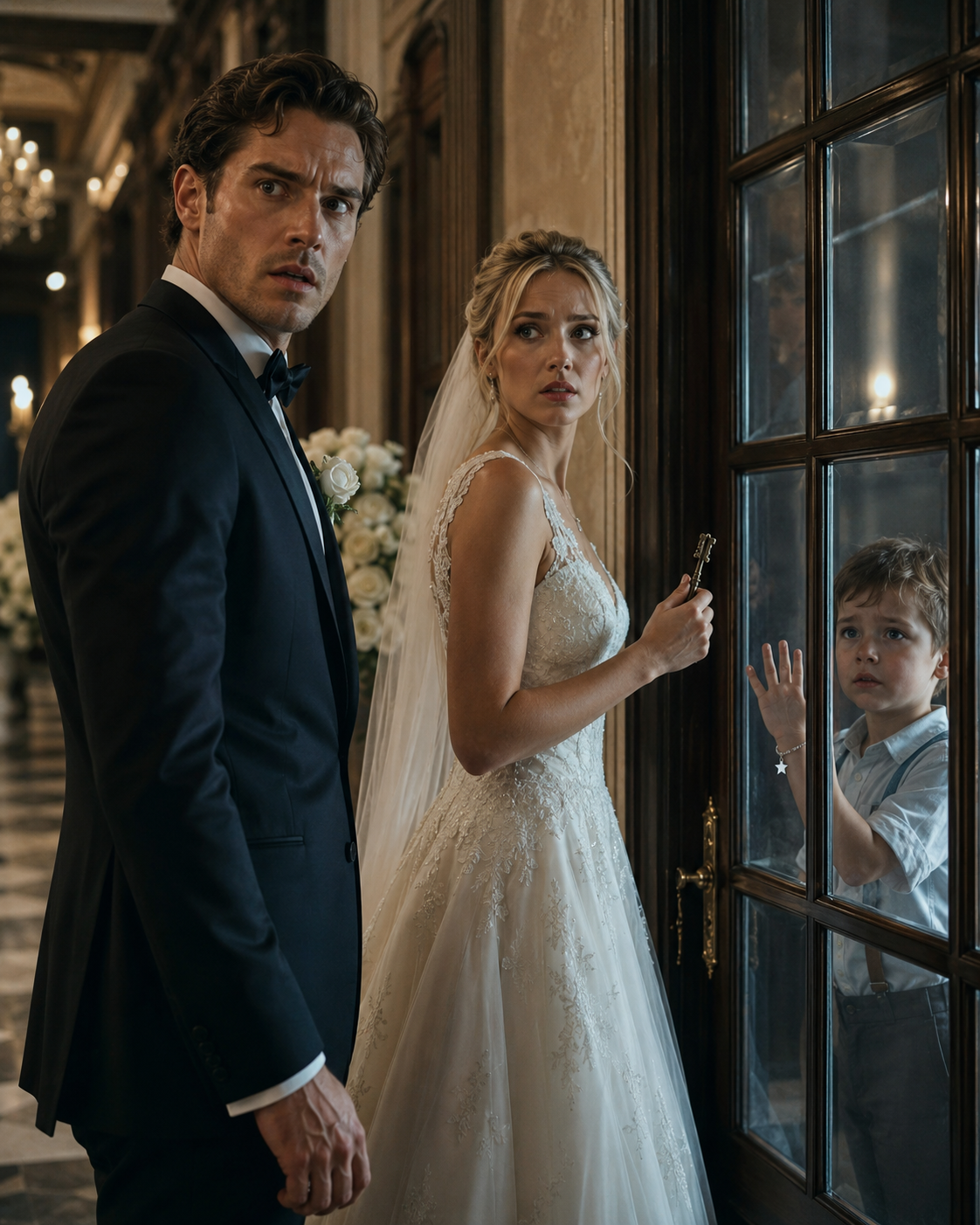
And behind the glass stood a little boy.

He could not have been older than five.

His brown hair was tangled. His cheeks were wet. His shirt was torn at one sleeve and streaked with dirt. He stood on tiptoe, beating both palms against the glass as if the whole world existed on the other side and he had only seconds left to reach it.

When he saw me, his mouth opened, but no sound came out at first.

Then he pointed.

Not at the door.

Not at me.

At the woman standing beside it.

Celeste.

My bride stood in her wedding gown, white lace trailing over the black-and-white marble like spilled moonlight. Her veil was already pinned in place. Pearls circled her throat. Her bouquet lay on a side table, abandoned and crushed at the edges where her hand had gripped it too hard.

In her right hand, she held a brass key.

For one breath, none of us moved.

Then Celeste smiled.

It was the wrong smile. Too quick. Too clean. Too polished for a corridor filled with a child’s terror.

“Julian,” she said softly. “Thank goodness you’re here. I was just about to call someone.”

The boy shook his head violently behind the glass.

Mrs. Bell made a broken sound. “Oh, dear Lord…”

I looked from Celeste to the child, then back to the key in her hand.

“Open the door,” I said.

Celeste blinked. “Of course. I only locked it because he was hysterical. He wandered in from the service gate. I didn’t want him running into the ceremony and frightening people.”

The child slapped his palm against the glass.

“She put me here,” he cried. His voice cracked on every word. “She said I had to stay quiet.”

Celeste’s eyes sharpened.

Not with fear.

With warning.

“Sweetheart,” she said through the glass, her voice dripping with the kind of sweetness adults use when they want children to doubt themselves, “you’re confused. You were lost. I helped you.”

The boy backed away from the door, trembling.

I stepped toward Celeste and held out my hand.

“The key.”

Her fingers closed around it.

“Julian, please don’t make a scene.”

“A scene?” I repeated.

Outside, beyond the corridor, I could hear the distant murmur of guests noticing that something had changed. Footsteps approached and stopped. Someone whispered my name.

Celeste moved closer to me. Her perfume was jasmine and orange blossom, the same scent she had worn the night she told me about the tragedy of her past.

A lost child.

A storm.

A grief she had carried alone.

I remembered holding her while she cried. I remembered thinking no one could fake that kind of pain.

Now there was a child behind a locked door, and the woman I loved was holding the key like a secret she could still force back into silence.

“Julian,” she whispered, “listen to me carefully. This boy is dangerous to us. Not physically, of course, but to everything we’ve built. He came here shouting nonsense. If the guests hear him, if the press hears him—”

“The key,” I said again.

Her mask cracked.

Just for a second.

It was enough.

Mrs. Bell stepped forward. “Miss Marlowe, please.”

Celeste turned on her. “You will stay out of this.”

The housekeeper flinched, but she did not move away.

The boy began crying harder. Not loudly now. Quietly. Exhausted. The kind of crying that sounds older than the child making it.

I took one step closer to Celeste.

She looked at my face and understood something. Whatever power she thought she had over me had reached its end.

With stiff fingers, she placed the key in my palm.

I unlocked the door.

The boy did not run out at first. He stood frozen, staring up at me as if freedom itself might be another trick.

“It’s all right,” I said, lowering myself to one knee. “No one is going to lock you in again.”

His lips trembled.

Mrs. Bell entered the room slowly and wrapped her shawl around his shoulders. The moment she touched him, he collapsed against her, gripping her sleeve with both hands.

Celeste let out a small, controlled breath.

“You see?” she said. “He is fine. He is frightened, yes, but children exaggerate. We can settle this quietly after the ceremony.”

I turned toward her.

“There will be no ceremony until I know who he is.”

Her face went still.

The boy lifted his head from Mrs. Bell’s shoulder.

“My name is Noah,” he whispered.

Something in Celeste’s expression changed.

Not surprise.

Recognition.

Mrs. Bell looked at me. “Sir…”

But I was no longer looking at Celeste’s face.

I was looking at the boy’s wrist.

Around it was a bracelet made from dark braided cord, old and frayed, tied carefully despite years of wear. Hanging from it was a tiny silver charm shaped like a star.

My breath left my body.

The corridor blurred at the edges.

I knew that bracelet.

Not because I had ever held it.

Because Celeste had described it to me so many times that it had become part of the sad mythology of her life.

“My son wore it,” she had told me one night in the library, rain tapping against the windows. “A little silver star. My grandmother gave it to him. After the accident, they never found it.”

The accident.

That was what she called it.

She said her first child had vanished during a storm on the coast. She said she had searched for him until her shoes filled with blood. She said the sea had taken him. She said grief had made her afraid to love again until me.

I had believed every word.

Now the lost child stood in my corridor with that same bracelet on his wrist.

“Noah,” I said carefully, “where did you get that?”

He curled his hand against his chest.

“My auntie tied it back on when it came loose,” he whispered. “She said my mother put it on me when I was a baby.”

Celeste made a sound like a glass cracking.

Not loud.

But final.

The corridor filled with silence. Guests had gathered at the far end now, a careful distance away. Faces hovered beyond the archway. My mother stood among them, one hand at her throat.

I looked at Celeste.

Her lips parted.

“No,” she said.

Just that.

No explanation. No denial formed with confidence. Only one small word falling uselessly into the space between us.

I stood slowly.

“Is he your son?”

Her eyes filled with tears so fast that, once, I would have mistaken them for innocence.

“Julian, you have to understand.”

“Is he your son?”

She looked at Noah.

The boy stared back at her with a terrible, hopeful fear.

For a moment, I thought she might go to him. I thought some buried part of her would break free from the jewels, the lace, the lies, and she would kneel before him. I thought she might say his name as a mother should.

Instead, she looked away.

That was when I knew.

Mrs. Bell held Noah closer.

Celeste pressed a hand to her stomach as if the truth had struck her physically. “I was young,” she whispered. “I had nothing. No money. No family willing to help. You do not know what it is like to be trapped with a child and no future.”

“No future?” I repeated.

Her tears spilled now, but her voice grew stronger, almost angry. “Men like you always speak of morality because you can afford it. I made one terrible choice. One. I left him where someone would find him.”

Noah began to shake.

Mrs. Bell covered his ears, but not before he heard enough.

I stepped between them.

“Where did you leave him?”

Celeste’s gaze darted toward the watching guests. Toward my mother. Toward the open terrace where the wedding flowers moved in the breeze.

“Julian,” she said, “please.”

“Where?”

“At a convent gate,” she said. “In Seabrook. He was wrapped. He had food. I watched from the road until someone came.”

“And then you told everyone he died.”

Her jaw trembled.

“I had to.”

“No,” I said. “You chose to.”

For the first time, anger fully entered her face.

“You think I wanted to arrive here with a child from another life? You think your family would have welcomed me? Your mother inspected my bloodline like she was buying a horse. Your guests smile with knives behind their teeth. I did what I had to do to survive.”

My mother took a step forward. “Celeste…”

Celeste laughed, small and ugly. “Do not pretend shock, Lady Ashford. You would have rejected me the moment you knew.”

Perhaps she was right.

Perhaps my family, with all its polished manners and inherited cruelty, had helped build the world that made women like Celeste believe love was a door that only opened for the spotless.

But none of that changed the child in Mrs. Bell’s arms.

None of that changed the locked room.

None of that changed the fact that Celeste had seen her own son arrive at the house and chosen the key over the truth.

“How did he find you?” I asked.

Celeste wiped her face quickly, regaining fragments of herself. “I don’t know.”

Noah spoke before she could say more.

“I saw her picture,” he whispered.

Everyone turned.

He swallowed hard. “At the bakery. On a newspaper. The wedding picture. Aunt Mara said maybe it wasn’t her, but I knew. I remembered her song.”

Celeste closed her eyes.

“What song?” I asked softly.

Noah looked at her, waiting.

She did not answer.

He sang one broken line under his breath. A nursery tune. Simple. Tender. The kind of song a mother sings before she decides what kind of person she is going to become.

The sound destroyed the last of the wedding.

My mother began to cry quietly. One of the guests turned away. Mrs. Bell bowed her head over the boy.

Celeste stood alone in the middle of the corridor, dressed like a bride and exposed like a criminal before judgment.

“I only needed today,” she said. “After the wedding, I would have handled it. I would have found a place for him. A school. A home. Money. Anything he needed.”

“He needed his mother,” I said.

Her voice sharpened. “And what would you have done, Julian? Married me anyway? Raised another man’s child while society laughed behind your back?”

I looked at Noah.

He had stopped crying. That was worse. His eyes were too tired for a child’s face.

“Yes,” I said.

Celeste stared at me.

“If you had told me the truth,” I continued, “if you had brought him to me and said, ‘This is my son, and I was afraid,’ I would have had a choice. Maybe I would have failed. Maybe my family would have failed. But I would have known what was real.”

I removed the white rose from my lapel.

It had been pinned there that morning by Celeste herself. She had smiled as she adjusted it, telling me white meant loyalty.

I placed it on the table beside her crushed bouquet.

“I cannot marry a woman who locks a child away so the flowers will still look beautiful.”

The words moved through the corridor like cold air.

Celeste reached for my sleeve. “Julian, no. Please. You love me.”

“I loved someone who did not exist.”

Her hand dropped.

Outside, a gust of wind scattered rose petals across the terrace. The quartet did not begin again. No one moved toward the chapel. The entire estate seemed suspended between ceremony and ruin.

My mother approached Noah slowly.

“May I?” she asked Mrs. Bell.

Noah looked uncertain.

Mrs. Bell nodded only after he did.

My mother knelt, silk dress brushing the floor. I had never seen her kneel for anyone. Not servants. Not children. Not grief.

“I am sorry,” she said to him. “This house should have protected you the moment you came through its gates.”

Noah looked at me. “Am I in trouble?”

The question nearly broke me.

“No,” I said. “You are not in trouble.”

Celeste made a strangled sound. “You are all acting as if I am a monster.”

No one answered.

That silence was the only honest verdict she received.

The police were called quietly, though I did not let them storm through the house like theatre. Mrs. Bell took Noah to the morning room, where she gave him warm milk, a blanket, and a plate of biscuits he barely touched. My mother dismissed the guests herself.

There was no announcement.

No explanation.

Just the slow collapse of a day that had cost more money than most people saw in a decade.

By evening, the roses had begun to wilt.

Celeste sat in the library with two officers, her veil removed, her hair falling loose around her face. She no longer looked angelic. She looked young, frightened, and furious at the world for refusing to admire her suffering.

I watched from the doorway as she gave her statement.

She said she panicked.

She said she never meant harm.

She said she intended to explain after the wedding.

Perhaps some of that was true.

But truth, I learned that day, is not a medicine that works after the poison has been swallowed.

Later, when the house was quiet, I found Noah standing by the conservatory windows. The same glass that had trapped him now reflected his small figure back at him.

He touched the bracelet on his wrist.

“Will she come back?” he asked.

I knew he meant Celeste.

I sat beside him on the window bench.

“I don’t know.”

“Does she hate me?”

“No,” I said, though I was not sure I had the right to answer. “I think she hated the truth. Sometimes people hurt the truth and pretend they are only protecting themselves.”

He considered this with the grave seriousness of a child who had already learned too much.

“Are you angry?”

“Yes.”

“At me?”

“Never.”

He leaned his head against the window, looking out at the garden where chairs still faced an altar that would not be used.

“I wanted her to remember me,” he whispered.

I looked at the silver star on his wrist.

“She did,” I said. “That was what frightened her.”

He turned toward me.

“And you?”

“What about me?”

“Will you remember me?”

There are moments in life when a person becomes responsible not because blood demands it, not because law records it, but because the world reveals a wound in front of him and waits to see whether he will look away.

I had looked away from many things in my life.

Not this time.

“Yes,” I said. “I will remember you.”

For the first time that day, Noah’s fingers loosened around the bracelet.

Outside, servants began removing the wedding flowers. One by one, the white roses disappeared from the walls, from the chairs, from the archway where I had been meant to promise forever to a lie.

By morning, Whitmere Hall no longer looked like a wedding house.

It looked like a house after a storm.

But in the breakfast room, Noah sat wrapped in Mrs. Bell’s shawl, eating toast with both hands. My mother spoke gently to a solicitor by the fireplace. The police had found records. A convent. A foster file. A woman named Mara who had raised him when no one else came.

The story Celeste had buried was no longer buried.

It had a name.

Noah.

And when sunlight touched the silver star on his wrist, I understood something I should have known long before the wedding.

Some secrets do not stay hidden because they are weak.

They stay hidden because the people who know them are small, powerless, and waiting for one brave door to open.

That day, the door opened.

Not for the bride.

Not for the guests.

Not for the family name.

For the boy behind the glass.

The Bracelet Behind the Glass
The Cabin They Laughed At