“Fits you perfectly,” my sister said, lifting one manicured hand to cover a laugh she did not bother hiding. “A rotten cabin for a rotten little martyr.”
The lawyer’s office went silent.
My mother turned her face toward the window as if she had not heard. The old attorney lowered his eyes to the papers in front of him. My sister, Maribel, sat across the polished mahogany table in a cream-colored suit that probably cost more than my truck, her diamonds catching the afternoon light every time she moved.
I sat there in my black dress, boots still dusty from the cemetery, hands folded so tightly in my lap that my knuckles ached.
Dad had been buried that morning.
And my sister had waited less than four hours to spit on what he left me.
Russell Vale, my father’s attorney, cleared his throat.
“As I said,” he continued carefully, “Mr. Harlan Whitaker left the Charleston townhouse, the investment account attached to it, and the lake property in Hot Springs to Maribel Whitaker. He left the downtown condo and the remaining cash reserves to Mrs. Celeste Whitaker.”
My mother’s chin lifted a fraction. She liked the word condo. It sounded clean, convenient, respectable.
Russell looked at me.
“And to his younger daughter, Rowan Whitaker, he left the full title to the Ozark cabin, the surrounding two hundred and sixteen acres, all outbuildings, road access rights, water rights, and any attached mineral or subsurface rights.”
Maribel made a little choking sound.
Then she laughed again.
“Wait,” she said. “He left her that place?”
Russell’s mouth tightened. “Yes.”
“The one with the sagging porch?”
“Yes.”
“The one Mom said smelled like wet dogs and dead leaves?”
My mother whispered, “Maribel.”
But there was no strength behind it.
Maribel leaned back in her chair and stared at me with bright, cruel pleasure. “Oh, Rowan. That is so Dad. Even from the grave, he knew what suited you.”
I looked at Russell. “Is that all?”
“No,” he said.
His voice changed.
Maribel noticed it too, because her smile flickered.
Russell slid a sealed envelope across the table. My name was written on it in Dad’s hand.
Rowan.
My throat closed.
I had not cried at the funeral. I had stood beside the grave while people told me how brave I was, how strong I had always been, how my father had been proud of my service, my discipline, my ability to carry grief like equipment. They said those things because it was easier than admitting no one knew what to say to the daughter who had been gone too often and missed too much.
I stared at the envelope.
Russell did not let go immediately.
“Your father asked me to tell you something before you open it,” he said.
Maribel sighed loudly. “Of course he did.”
Russell ignored her.
“He said, ‘Tell Rowan the cabin will only look empty to people who never learned how to listen.’”
My breath caught.
The room seemed to tilt backward.
When I was eight, Dad had taken me to that cabin for three days. Maribel had complained the whole drive, cried because there was no television, and refused to sleep under a quilt that had been folded in a cedar chest. Mom had hated every minute of it. She had stood in the doorway wearing white pants and city shoes, looking at the pine walls like they were a personal insult.
But I remembered the creek.
I remembered Dad showing me how to read animal tracks in the mud.
I remembered him kneeling beside me at dusk while fog gathered in the hollow below the ridge, saying, “Some places keep secrets because nobody respectful has asked the right question.”
At eight, I had thought he was being magical.
Now I wondered if he had been warning me.
Maribel tapped the table with one glossy red nail.
“Can we be done? Some of us have actual arrangements to handle.”
I took the envelope.
Russell’s eyes held mine. “He also said you should spend one night there before making any decisions.”
“Decisions about what?” I asked.
Maribel laughed. “Whether to burn it down or sell it for firewood?”
Russell did not look at her. “He said you would understand when you arrived.”
My mother finally spoke.
“Rowan, darling, you don’t have to go there right away. Grief makes people sentimental. That cabin is old, impractical, and isolated. Your father loved it because he loved difficult things.”
Her glance touched me and slid away.
Difficult things.
That was what she had called me my whole life without using the words.
Maribel got the townhouse, the lake property, the money, the polished life that looked good in photographs.
I got rot, trees, and a mystery.
I stood.
“Thank you, Russell.”
Maribel stood too. “You’re not seriously going there.”
I picked up my coat.
“Why do you care?”
Her smile sharpened. “I don’t. I just think it’s funny. You spent your whole life acting like you were too noble for all of us, and Dad rewarded you with mold.”
I looked at her then.
Really looked.
At the perfect hair, the flawless makeup, the diamonds, the grief she wore like a costume that had been tailored to flatter her.
“You should enjoy what he gave you,” I said.
She blinked. “Excuse me?”
“It may be the last thing you ever get from him.”
For once, she had no answer.
I left before my voice could break.
That night, I sat in my motel room with Dad’s envelope in my hands.
I opened it at 2:13 a.m.
Rowan,
If you are reading this, your sister has probably already laughed.
Let her.
People laugh loudest at what they cannot see.
I am sorry I did not speak more clearly while I was alive. I was a coward in certain rooms. I thought quiet protection was still protection. It was not.
Go to the cabin.
Spend one night.
Do not sell.
Do not sign anything Maribel brings you.
And do not let your mother convince you that peace means surrender.
When you arrive, look for the place where Ruth hid winter money.
You will remember.
I love you more than I ever managed to say.
Dad
I read the letter until dawn.
Then I packed my bag.
The drive into the Ozarks took most of the day.
The highway narrowed into county roads, then gravel, then a rutted track that climbed between black oaks and hickory trees. November hung heavy over the hills. The sky was low and gray, and the wind dragged dead leaves across the road like nervous hands.
My truck complained over the last mile.
I had not been to the cabin since I was twelve.
After that, Mom refused to go. Maribel said the place made her hair smell smoky. Dad stopped asking. Eventually, the cabin became a word people used when they wanted to make him sound foolish.
Your father and that cabin.
As if loving one old place proved something embarrassing about him.
The trees opened suddenly.
My headlights swept over a clearing.
There it was.
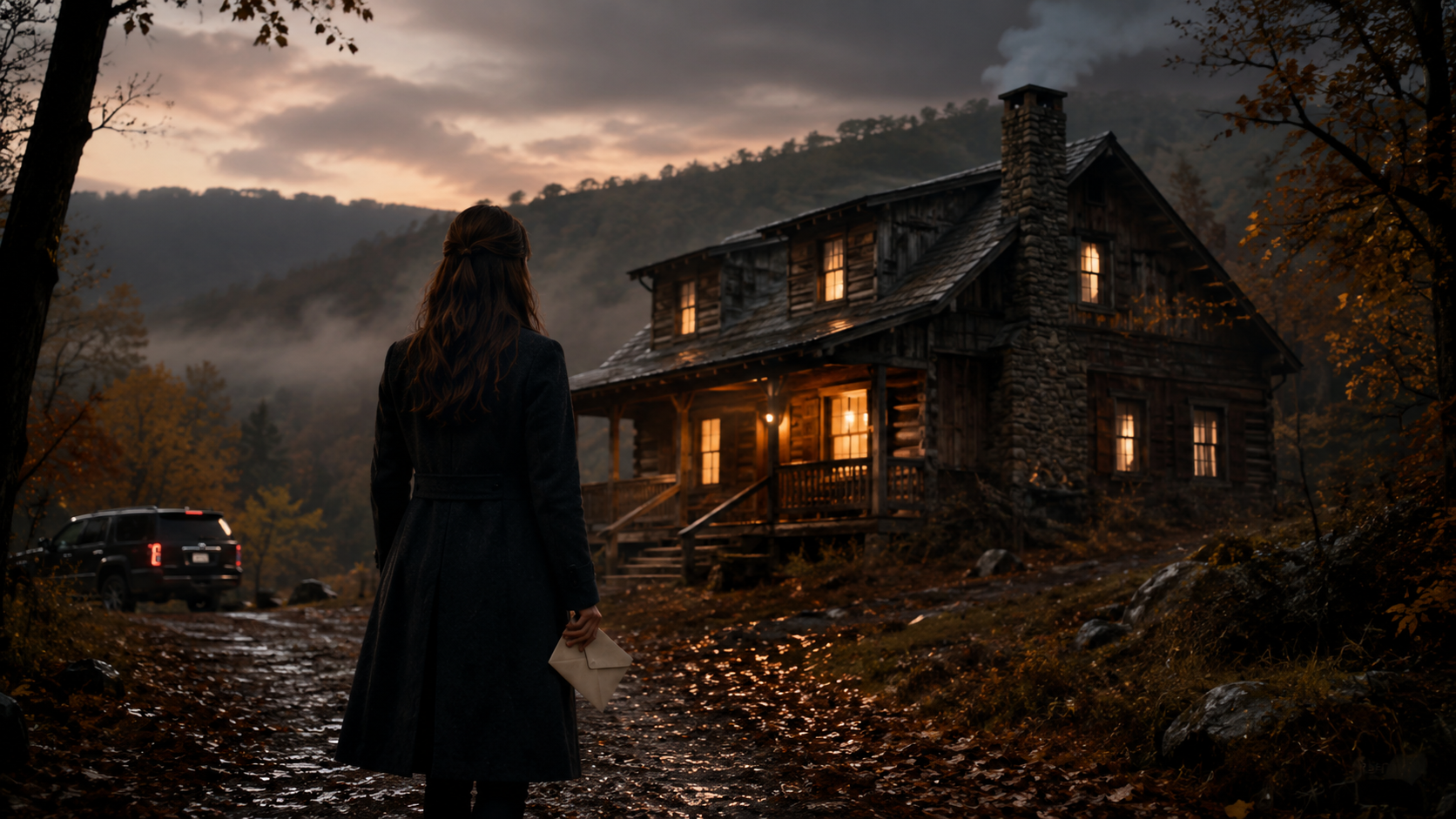
The cabin sat with its back to the ridge and its face toward the valley, built from dark logs and fieldstone, broad-shouldered and low beneath the trees. The porch leaned a little. One shutter hung crooked. Moss climbed the stone chimney.
But it was not collapsed.
It was not dead.
I cut the engine.
Silence gathered around me.
Then I saw it.
Smoke.
A thin gray ribbon rose from the chimney into the cold dusk.
Every part of me went still.
No one was supposed to be here.
I reached automatically for the pistol that was not on my hip. Old training, useless habit. I had flown in for the funeral and borrowed my truck from a friend; my weapon was locked away two states behind me.
I took the tire iron from behind the seat instead.
The porch groaned under my boots.
A lamp glowed behind the front curtains.
Not bright.
Not careless.
Waiting.
I unlocked the door with the key Russell had given me.
Before I turned the knob all the way, the door opened inward by itself.
Warmth touched my face.
The cabin smelled of woodsmoke, coffee, and cedar.
Not rot.
Not mold.
Not abandonment.
A fire burned low in the stone hearth. The floor had been swept. Fresh wood was stacked beside the fireplace. A kettle sat on the iron stove. A quilt lay folded over the back of a worn leather chair.
On the kitchen table sat an envelope.
My name was written across it.
Rowan.
My knees nearly failed.
For one impossible second, I expected Dad to come out of the back room with that quiet half-smile of his, as if death had been another one of his practical jokes.
But the hallway stayed dark.
The cabin held its breath.
I set down my bag, kept the tire iron in one hand, and opened the envelope with the other.
If you came armed, good.
If you came afraid, better. Fear notices what pride misses.
If you came because you still trust me, look under the table where Ruth hid winter money.
Do not open the back room until morning.
Dad
A knock struck the door.
I spun so fast the chair behind me scraped the floor.
A man stood on the porch, broad as an old fence post, white beard trimmed close, canvas coat dusted with wood ash. He raised both hands where I could see them.
“Rowan Whitaker?” he called through the glass.
“Who are you?”
“Name’s Abel Cross. I live beyond the north creek. Your father told me you’d arrive after dark and scare yourself half to death.”
“I’m not scared.”
His eyes dropped to the tire iron in my hand.
“Ma’am, I was in the Marines for twenty-two years. That there is a scared-person object.”
I did not lower it.
“Why is there a fire in my cabin?”
“Because your father paid me six months ago to keep it ready. Said when you came, you’d be angry, tired, and too stubborn to admit you were cold.”
My grip loosened.
Abel held up a covered pot.
“Brought chicken stew. That part was not in the contract.”
I opened the door three inches.
“You knew my father?”
“Long enough to know he carried too much and confessed too little.”
That sentence struck harder than it should have.
I opened the door wider.
Abel stepped inside slowly, wiped his boots without being asked, and set the pot on the counter.
His gaze moved to the envelope in my hand.
“So you found the first note.”
“The first?”
He nodded toward the kitchen table. “Your father liked leaving trails. Said you were the only one in the family patient enough to follow one without tearing up the woods.”
“What is under the table?”
“Not my place to say.”
“You know.”
“I do.”
“Then why come here if you won’t tell me?”
Abel’s face softened.
“Because he asked me to make sure you weren’t alone the first night the truth showed up.”
The fire cracked behind me.
I swallowed.
“My father could have told me all of this while he was alive.”
“Yes.”
“Why didn’t he?”
Abel looked toward the back room, then away.
“Some men can build bridges over rivers and still fail to cross the room where their own daughter is crying.”
I had no answer.
He turned to leave.
“Mr. Cross.”
He paused.
“Why did Dad tell me not to open the back room until morning?”
For the first time, uncertainty crossed his face.
“Because grief is louder in the dark.”
Then he stepped onto the porch and disappeared into the cold.
I locked the door behind him.
For a long time, I did not move.
The kitchen table was old pine, scarred by burns, knife marks, and years of elbows. I remembered sitting beneath it as a child during a summer storm while Dad and a very old woman’s photograph watched from the mantel.
Ruth.
The name surfaced slowly.
Not a person I had known.
A name Dad had said once.
Maybe twice.
Grandmother Ruth made these biscuits.
Grandmother Ruth hated banks.
Grandmother Ruth said a floorboard was safer than a man in a necktie.
I got down on my knees.
Beneath the table, near the back left leg, one floorboard sat a hair higher than the others. I pressed my thumb along the seam.
It shifted.
My pulse jumped.
I used my pocketknife to pry it loose.
Beneath it lay a tin box wrapped in oilcloth.
It was heavier than it looked.
I dragged it out with both hands and placed it on the table.
For a moment, I just stared at it.
Then I opened the lid.
Inside were photographs, maps, letters, old survey documents, a leather journal, and a stack of papers bound with a brass clip.
The photograph on top showed a young version of my father standing beside a woman on the cabin porch. She was small, silver-haired, and straight-backed, with work-roughened hands and eyes that looked as if they could drive a nail through a lie.
On the back, Dad had written:
Ruth Bell Whitaker. The woman who kept the mountain when every man in town told her to let it go.
I had never seen her face.
I opened the journal.
The first page read:
If you came looking for money, close this book and grow a spine first.
Despite myself, I laughed.
It came out broken.
I turned the pages.
Ruth had bought the first eighty acres in 1952 with money from sewing uniforms, teaching children, and selling canned peaches from a roadside table. People called the land useless because it was steep, rocky, and too far from town. She bought more whenever men laughed at her price.
She marked springs.
She drew maps.
She wrote down the names of everyone who offered to “help” her sell.
She refused timber companies. She refused speculators. She refused a mining agent who arrived in a shiny car and called her sweetheart.
Near the back of the box, I found a modern report.
Dated eight months earlier.
I read the first page.
Then the second.
Then I sat down because my legs had gone weak.
The land contained significant deposits of lithium-bearing clay and rare earth minerals.
Not rumor.
Not guesswork.
Documented.
Mapped.
Valuable.
The “rotting cabin” sat above a mountain worth more than every polished thing Maribel had inherited.
My mouth went dry.
I kept reading.
Dad had not planned to sell outright. He had hired environmental consultants. He had prepared conservation restrictions. He had formed the skeleton of a trust. He had negotiated nothing, signed nothing, but studied everything.
Every paper led to another paper.
Every map led deeper.
At the bottom of the box was one final envelope.
Read after the mountain speaks.
I almost could not open it.
But I did.
My Rowan,
Now you know why I left you what looks like less and weighs like more.
This land belonged to Ruth before it belonged to me. She raised me here after my parents died. She taught me that poverty is not shame, but letting greedy people name your worth is.
For years, I thought protecting you meant keeping you away from family conflict. I let your mother call you difficult. I let Maribel call you cold. I told myself you were strong enough not to need defending.
That was cowardice dressed as confidence.
I am sorry.
Your sister sees value when it shines. Your mother trusts what looks respectable from the road. You, my daughter, have always understood damaged things. You repair what others discard. You sit with what is unfinished. You do not run from hard weather.
That is why the land is yours.
Not as a prize.
As a charge.
Do not rush.
Do not sell because someone humiliates you.
Do not keep it only to prove a point.
Use it well.
There is enough here to ruin this mountain or redeem something in our name. I am trusting you to know the difference.
I loved you loudly in my heart and quietly in rooms where I should have stood up.
Forgive me if you can.
Dad
The first sob came from somewhere below my ribs.
Ugly.
Sudden.
I bent over the letter and pressed it to my chest.
The fire burned low. The cabin creaked in the wind. The woman in the photograph looked out from another century as if she had been waiting for me to arrive late, hurt, furious, and finally ready.
I cried until there was nothing left but ash in my throat.
I slept in the chair by the fire.
At dawn, I opened the back room.
It was not a bedroom anymore.
It was an archive.
Shelves lined the walls. Boxes were labeled in Dad’s careful handwriting. Deeds. Water tests. Family letters. Ruth’s recipes. Court filings from the 1970s. Photographs. Newspaper clippings. Old mining offers marked REFUSED in red pencil.
On the far wall hung a framed sketch of the cabin and ridge.
Beneath it, Dad had pinned a note.
This room is the difference between inheritance and memory.
I spent three days there.
I barely answered my phone.
Maribel called twelve times.
My mother called six.
Texts followed.
Maribel: We need to discuss the cabin.
Maribel: Mom says you’re being emotional.
Maribel: Old land comes with liabilities. Don’t touch anything important.
Maribel: I know Dad hid something out there.
That last one made me stand still in the kitchen.
I read it twice.
Then Abel came in carrying split wood and saw my face.
“What?”
I held up the phone.
He read the message and his expression darkened.
“She’s sniffing smoke.”
“How much does she know?”
“Maybe nothing. Maybe enough to be dangerous.”
“Who else knew?”
“Your father. Russell. Me. The engineer. The lab people under nondisclosure. Sheriff Mara Kent knew there had been trespassers last spring, but not why.”
“Trespassers?”
Abel set the wood down slowly.
“Two men came through the south ridge with survey flags. Your father caught them. They claimed they were lost.”
“Were they?”
“They had a drone and soil bags.”
My stomach tightened.
“Why didn’t he report it?”
“He did. Quietly. Your father did everything quietly.”
That sentence made anger rise so fast I nearly shook.
Quietly.
Dad had loved quietly.
Protected quietly.
Regretted quietly.
And now the quiet had left me surrounded by people who thought silence meant weakness.
I called Russell.
He answered on the second ring.
“You found the box.”
“Yes.”
A pause.
“I’m sorry.”
“Don’t be sorry. Tell me if Maribel can challenge the will.”
“She can try.”
“Can she win?”
“No.”
“You sound certain.”
“I wrote the structure myself. Your father transferred the land into a protected trust arrangement before the final will was executed. The mineral rights were verified separately. There is no shared ownership, no management clause, and no opening for your sister unless she can prove incapacity.”
“Can she?”
“No. Your father anticipated that. He completed medical evaluations, recorded statements, and signed everything in front of witnesses.”
The relief should have been comforting.
Instead it made me sadder.
Dad had prepared for war with his own family.
“Why didn’t he tell me about Ruth?” I asked.
Russell exhaled.
“That is a longer answer.”
“I have time.”
“Your mother hated the cabin. She believed your father’s attachment to it kept him tied to a world she wanted him to outgrow. She wanted refinement. Donor dinners. Investment circles. A life without mud on the floors. Ruth represented everything your mother feared people would see if they looked too closely at where he came from.”
“And Dad let her erase Ruth?”
“Yes,” Russell said softly. “He did.”
I looked at Ruth’s photograph on the table.
That old woman had kept a mountain through poverty, insults, and men in suits, only to be hidden by the family she saved.
Not anymore.
“What happens next?” I asked.
“We secure the property. We update the trust. We activate the charitable framework if you choose to.”
“What charitable framework?”
Silence.
Then Russell said, “He hoped you would ask that.”
The foundation papers were in Box Seven.
Dad had planned it all.
Not a resort.
Not luxury cabins.
Not a quick sale.
The Whitaker Ridge Project.
Temporary housing for veterans coming home with nowhere steady to land. Safe transitional cabins for women leaving violent homes. A workshop. A training kitchen. Counseling offices. Legal assistance. Land stewardship jobs.
In Dad’s notes, one sentence appeared again and again:
Let the mountain shelter people who were told they were too difficult to love.
I sat on the floor of the back room with the papers in my lap.
For the first time since the funeral, I did not feel cheated.
I felt summoned.
Maribel arrived two days later in a silver Range Rover that looked offended by the mud.
My mother sat in the passenger seat, pale and tense.
Maribel got out wearing heeled boots, a wool cape, and the expression of someone who expected the wilderness to apologize.
I watched from the porch.
She stopped at the bottom step and looked up at me.
“Are you going to invite us in?”
“No.”
Her mouth opened.
My mother looked wounded. “Rowan.”
“You should have called first.”
Maribel laughed. “Don’t be dramatic. We’re family.”
“That word does a lot of work for you.”
Her eyes narrowed.
She glanced at the cabin, then at the chimney, then at the new lock I had installed on the back room door.
“What are you hiding?”
I leaned against the porch post.
“My property.”
“Dad left you a cabin, not a kingdom.”
“Then why are you here?”
The question landed.
For half a second, the mask slipped.
Panic flashed behind her eyes.
Then she recovered.
“I’m here because Mom is worried. You disappeared into the woods after a funeral. You’re grieving. You’re not thinking clearly.”
My mother stepped closer.
“Rowan, darling, this land is too much for you. You have your career. Your life. Repairs, taxes, legal issues… Maribel has contacts. She knows developers. She could help manage it.”
“There it is.”
Mother frowned. “There what is?”
“The part where peace means giving Maribel control.”
Maribel’s cheeks flushed.
“You always twist everything.”
“No. I finally stopped smoothing it out for you.”
She climbed one step.
“I know Dad hid something here.”
My pulse slowed.
Not quickened.
Slowed.
The way it had before difficult missions. The way fear became focus.
“What makes you say that?”
“Because he was strange about this place. Because he kept coming here when he was sick. Because no sane man leaves two hundred acres to the daughter who barely came home unless he has some sentimental scheme.”
My mother whispered, “Maribel, stop.”
I looked at her.
“What do you know, Mom?”
Her eyes filled, but she said nothing.
Maribel pointed at the cabin.
“That land belongs to all of us.”
“No. It belongs to me.”
“Legally, maybe.”
“Legally is the only maybe that matters.”
Her voice sharpened.
“You think because you wear boots and stare into the distance, you’re better than me.”
“I think Dad made a choice.”
“He was dying.”
The words struck the air like a slap.
My mother closed her eyes.
I came down one step.
“Be very careful.”
Maribel’s jaw trembled.
“He was weak. He was guilty. You used that. You always knew how to make him feel sorry for you.”
I almost told her.
I almost opened the door, dragged out the maps, showed her Ruth’s journal, the mineral report, the foundation papers. I wanted to watch her realize she had laughed at a fortune. I wanted her shame to come back to her with interest.
Then Dad’s letter moved through me.
Do not sell because someone humiliates you.
Do not keep it only to prove a point.
I smiled.
“No.”
Maribel blinked. “No what?”
“No, I will not explain my inheritance to someone who came here to take it.”
“You can’t just refuse.”
“I already did.”
She looked to Mom.
“Say something.”
My mother’s voice broke.
“Rowan, if there is something valuable here, perhaps sharing it would keep the family together.”
I laughed once.
Not because it was funny.
Because some wounds become absurd when they repeat themselves too many times.
“You still think family means handing Maribel whatever she wants so she doesn’t punish everyone with her disappointment.”
“That is unfair.”
“No. It is precise.”
My mother looked down.
Maribel stepped back, shaking with rage.
“I’ll contest the will.”
“Do it.”
“I’ll have the land assessed.”
“No, you won’t.”
“I’ll get an attorney.”
“Get two.”
Her face twisted.
“You really are impossible.”
I walked to the bottom step and met her eyes.
“No. I am finished being convenient.”
For once, neither of them spoke.
Maribel left first.
My mother lingered by the car, one hand on the open door, looking at me as if she wanted to cross the space between us but had forgotten how walking worked.
Then Maribel honked.
Mother flinched and got in.
I watched them drive away through the trees.
For the first time in my life, being left behind did not feel like losing.
It felt like land settling under my feet.
Maribel filed a challenge within three weeks.
She claimed undue influence.
She claimed Dad had lacked capacity.
She claimed I had manipulated him, despite the fact that I had been deployed most of the year and had only seen him twice in his final month.
Russell answered every accusation with paper.
Medical evaluations.
Witness statements.
Transfer records.
Trust documents.
Dad had prepared for every blade Maribel might throw.
I stayed at the cabin through December.
I installed cameras. I fixed the porch with Abel. I learned the old trails. I met Sheriff Mara Kent, a calm woman with gray eyes and no patience for rich people pretending trespass was a misunderstanding.
I hired independent environmental counsel.
I learned about extraction leases, royalty structures, conservation easements, nonprofit governance, and how quickly men in expensive jackets began smiling when they realized a woman owned something they wanted.
Every night, I read Ruth’s journal.
She had buried a husband, a son, and every version of herself that expected fairness from the world. She wrote like a woman who had learned to sharpen grief into tools.
One line stayed with me:
A woman is not bitter because she keeps what others planned to steal.
I taped it above the sink.
Two nights before Christmas, the south gate camera sent an alert at 1:22 a.m.
Headlights.
Then two figures climbing the fence.
I called Sheriff Kent before I put on my coat.
Abel arrived with a flashlight and an old shotgun pointed safely at the ground.
We found the men near the creek with sample bags, GPS equipment, and a portable drill.
One claimed they were hikers.
Sheriff Kent looked at his polished loafers.
“In December? With a drill?”
He stopped talking.
By sunrise, they had admitted a consulting firm paid them to collect samples.
They refused to name the client.
They did not need to.
I called Maribel at 8:04 a.m.
She answered brightly.
“Ready to be reasonable?”
“Two men were arrested on my land last night.”
Silence.
“That sounds like a local matter.”
“They were taking soil samples.”
More silence.
I sat at the kitchen table with Ruth’s photograph in front of me.
“Listen carefully,” I said. “If I discover you sent them, I will not handle it like your sister. I will handle it like the legal owner of protected land with a very patient attorney and a sheriff who dislikes trespassers.”
Her voice turned cold.
“You’ve changed.”
“No. I stopped asking permission to be angry.”
“You think Dad chose you because you’re better than me?”
“I think Dad chose me because he knew I would not sell Ruth’s mountain to the first man who called me smart.”
A pause.
“Who is Ruth?”
That stopped me.
For the first time in years, I felt something almost like pity.
Not forgiveness.
Not softness.
Just recognition.
Maribel did not know either.
We had both grown up in the same house of omissions.
The difference was that I had mistaken silence for shame, and she had mistaken it for entitlement.
“Ask Mom,” I said.
Then I hung up.
The mediation happened in January, in a glass-walled conference room overlooking a wet city street.
Maribel arrived in navy silk with our mother beside her. She looked polished, composed, and ready to win.
She did not look ready for Dad.
Russell played the video near the end.
I had not known it existed.
Dad appeared on the screen thinner than memory allowed, wrapped in a gray cardigan, seated in his study. His face looked tired, but his eyes were clear.
“My name is Harlan James Whitaker,” he said. “I am recording this because I know grief turns people into lawyers when love has failed to make them honest.”
Maribel went very still.
Dad continued.
“Celeste, I loved you. I also let you convince me that where I came from was something to polish away. That was my weakness, not yours alone.”
My mother covered her mouth.
“Maribel, I love you. I have provided for you generously. But you have often mistaken attention for devotion and inheritance for proof. I left you finished things because finished things comfort you.”
Maribel’s eyes filled.
Then Dad looked directly into the camera.
“Rowan, I left you the cabin and the land because you understand unfinished things. You understand duty. You understand repair. You understand that value often hides beneath insult, weather, and work.”
My chest tightened until breathing hurt.
“If anyone claims Rowan pressured me, they are lying. If anyone claims I did not understand what I was doing, they are insulting me. The land, the water rights, the mineral rights, and the responsibility are hers. Not because I love her more. Because I trust her differently.”
Maribel stood so quickly her chair struck the wall.
“This is disgusting,” she whispered.
Her attorney touched her sleeve. She pulled away.
“I was there,” she said, pointing at me. “I sat at appointments. I took Mom to dinner. I smiled at people. I did everything daughters are supposed to do, and he still chose you.”
For the first time, I heard the grief under the greed.
It did not excuse her.
But it made her human in a way I had resisted seeing.
I stood.
“You wanted to be paid for staying,” I said. “I wanted one honest conversation with him before he died.”
She recoiled.
“I would trade every acre for that. But you keep acting like love can be measured in property lines.”
My mother began to cry.
Maribel’s mouth trembled.
“You always get to be noble.”
“No,” I said. “I get to be underestimated. There’s a difference.”
The challenge collapsed within a month.
But the hardest visit came later.
My mother arrived alone in March.
The dogwoods had begun to bloom white along the lower road. I was repairing a step when her sedan rolled into the clearing.
She stepped out carefully, wearing city shoes that sank into the soft ground.
For a moment, she just looked at the cabin.
“I hated it here,” she said.
“I know.”
She flinched.
“Your father brought me here after we got engaged. He was so proud. He showed me the creek. The ridge. The stove Ruth used. He told me she raised him with nothing but grit and biscuits. I remember thinking, ‘This is what I have to rescue him from.’”
I said nothing.
She looked smaller than I remembered.
“I was ashamed of it,” she said. “Ashamed of the poverty, the roughness, the smell of smoke. And he knew. I hurt him with that for years.”
“Why didn’t you tell us about Ruth?”
Mother’s eyes filled.
“Because I was jealous of a dead woman.”
The honesty stunned me.
“She had his admiration in a way I never did. She had roots. Certainty. A kind of strength I could not buy or imitate. I had polish, fear, and ambition. Maribel made sense to me because she wanted the beautiful life I understood. You…” She swallowed. “You wanted distance, discipline, purpose. I called you difficult because it was easier than admitting I did not know how to mother you.”
The apology stood between us.
Late.
Imperfect.
Not enough.
Still real.
I wanted to reject it.
I wanted to say naming a wound did not heal it.
Instead, I picked up the second hammer and held it out.
She stared. “What is that for?”
“This step won’t fix itself.”
For the first time in days, maybe years, she laughed.
It was small and surprised.
“Harlan would find this very funny.”
“Dad would tell you you’re holding it wrong.”
“I am holding it wrong.”
“Yes.”
She took the hammer anyway.
She was terrible at it.
But she stayed.
Afterward, we drank coffee at the kitchen table, and I showed her Ruth’s photograph.
Mother touched the frame with two fingers.
“She looks like you.”
“No,” I said. “I think I am learning how to look like her.”
Mother cried then.
Not loudly.
Not theatrically.
Just quietly, with one hand over her eyes.
“I am sorry I stayed silent,” she said. “At the will reading. Before that. All of it.”
I watched steam rise from my mug.
“I believe you.”
Hope moved across her face.
“That does not mean we are fixed.”
“I know.”
“But it means we can begin with the truth.”
She nodded.
For that day, it was enough.
The Whitaker Ridge Project opened two years later.
Not as a resort.
Not as a monument to Dad’s guilt.
As a practical place built to last.
Twelve small cabins stood beneath the trees, each with a porch, a clean bed, a lock that worked, and a window facing morning light. There was a workshop, a counseling office, a training kitchen, a childcare room, and a garden where the soil had to be fought before it agreed to feed anyone.
We funded it through a careful, limited lease on one section of the land, bound by environmental oversight so strict that three companies walked away before the fourth agreed. Most of the mountain remained untouched. The creek stayed clean. The ridge stayed wild.
Russell handled the legal structure.
Abel taught carpentry to veterans who claimed they did not need help until they discovered everyone there was tired of pretending.
Sheriff Kent joined the advisory board.
My mother volunteered in the kitchen twice a week and learned to make Ruth’s biscuits badly, then better.
Maribel did not come to the opening.
I told myself I did not care.
Then, ten minutes before the ribbon cutting, her silver Range Rover appeared at the end of the road.
She stepped out without sunglasses.
Without diamonds.
Without armor, or at least with less of it.
Abel stood beside me.
“Want me nearby?”
“Yes,” I said. “But not too nearby.”
Maribel approached slowly.
“I’m not here to fight.”
“That would be new.”
She accepted it with a small nod.
“I deserved that.”
We stood facing each other while people gathered near the porch.
She looked at the cabins, the gravel paths, the workshop doors thrown open, the veterans pretending not to be nervous, the women holding children close.
“So this is what you did with it.”
“Yes.”
“You could have bought half of Charleston.”
“I never wanted half of Charleston.”
Her mouth twisted.
“I thought Dad gave me the better life.”
“He gave you the finished thing.”
She looked down.
“I watched the video again. More than once.”
“Did it help?”
“No,” she whispered. “Then yes. Then it hurt worse.”
“That sounds honest.”
Her eyes shone.
“I hated you because he trusted you more.”
I did not soften the truth.
“He did.”
She flinched.
“But that does not mean he loved you less.”
She wiped at one eye angrily.
“I do not know what to do with that.”
“Then sit with it.”
For a while, neither of us spoke.
Then she looked toward the kitchen building.
“Do you need volunteers?”
I almost said no.
Memory rose fast: Maribel laughing in the lawyer’s office. Maribel sending attorneys. Maribel calling me rotten. Maribel trying to take soil from land she had mocked.
Then I thought of Ruth.
A woman is not bitter because she keeps what others planned to steal.
But keeping did not have to mean becoming cruel.
“What can you do?” I asked.
Maribel gave a weak laugh.
“Honestly? I can organize rich people.”
“That is a terrifying skill.”
“It works at fundraisers.”
I studied her.
“If you volunteer here, you do not get photographs. You do not make yourself the story. You do not treat anyone here like a prop.”
“I know.”
“If you insult one person, I will throw you out myself.”
“I know.”
“And Maribel?”
She looked at me.
“You start by washing dishes.”
For the first time since Dad died, my sister smiled without turning it into a weapon.
“Fair.”
The ribbon cutting happened at noon.
I stood on the porch with my mother on one side and Abel on the other. Maribel stood near the kitchen door, sleeves rolled up, hands damp from the sink, watching quietly.
Russell read the dedication.
“To Ruth Bell Whitaker, who bought land nobody valued and protected a future nobody else could see. To Harlan Whitaker, who understood too late that love must be spoken while the living can still hear it. And to every person who has ever been handed scraps by people too blind to know they were giving away seeds.”
When it was my turn, I unfolded Dad’s letter.
The paper had softened from being read so many times.
“My sister once called this place rotten,” I said.
A nervous ripple moved through the crowd.
Maribel lowered her head.
“She was wrong. But so was I. I thought this cabin meant my father had valued me least. I thought I had been handed what was left over.”
I looked toward the ridge.
“What I learned is that some gifts arrive wrapped in insult. Some doors look like exile until you open them. Some inheritances are not rewards. They are assignments.”
My mother wiped her eyes.
I looked at the people gathered in front of me.
“Dad wrote that wealth without character becomes a weapon. We are here because we choose to make it a tool.”
The applause came slowly.
Then stronger.
I did not feel triumphant.
I felt steady.
That night, after everyone left, I returned to the original cabin alone.
The fire was low. Ruth’s photograph sat on the mantel beside Dad’s. Outside, the new cabins glowed softly through the trees.
I made coffee and sat at the old kitchen table.
The floorboard beneath it was back in place.
I thought about Ruth hiding winter money there. Dad hiding maps and apologies. Maribel washing dishes in silence. Mother learning that regret could become labor if you let it.
The cabin still creaked in the wind.
The porch still needed work.
The road still turned to mud after rain.
It was not polished.
It was not easy.
It was not the life Maribel had laughed at because she could not recognize value unless someone expensive named it first.
But it was mine.
And for the first time, that did not mean I had won something from my sister.
It meant I had stopped losing myself to people who could not see me clearly.
I lifted my mug toward Ruth’s photograph, then toward Dad’s.
“You were right,” I said softly. “The valuable things were hidden where they laughed first.”
Outside, the Ozark night settled around the cabin, deep and alive.
I listened.
This time, I heard home.

