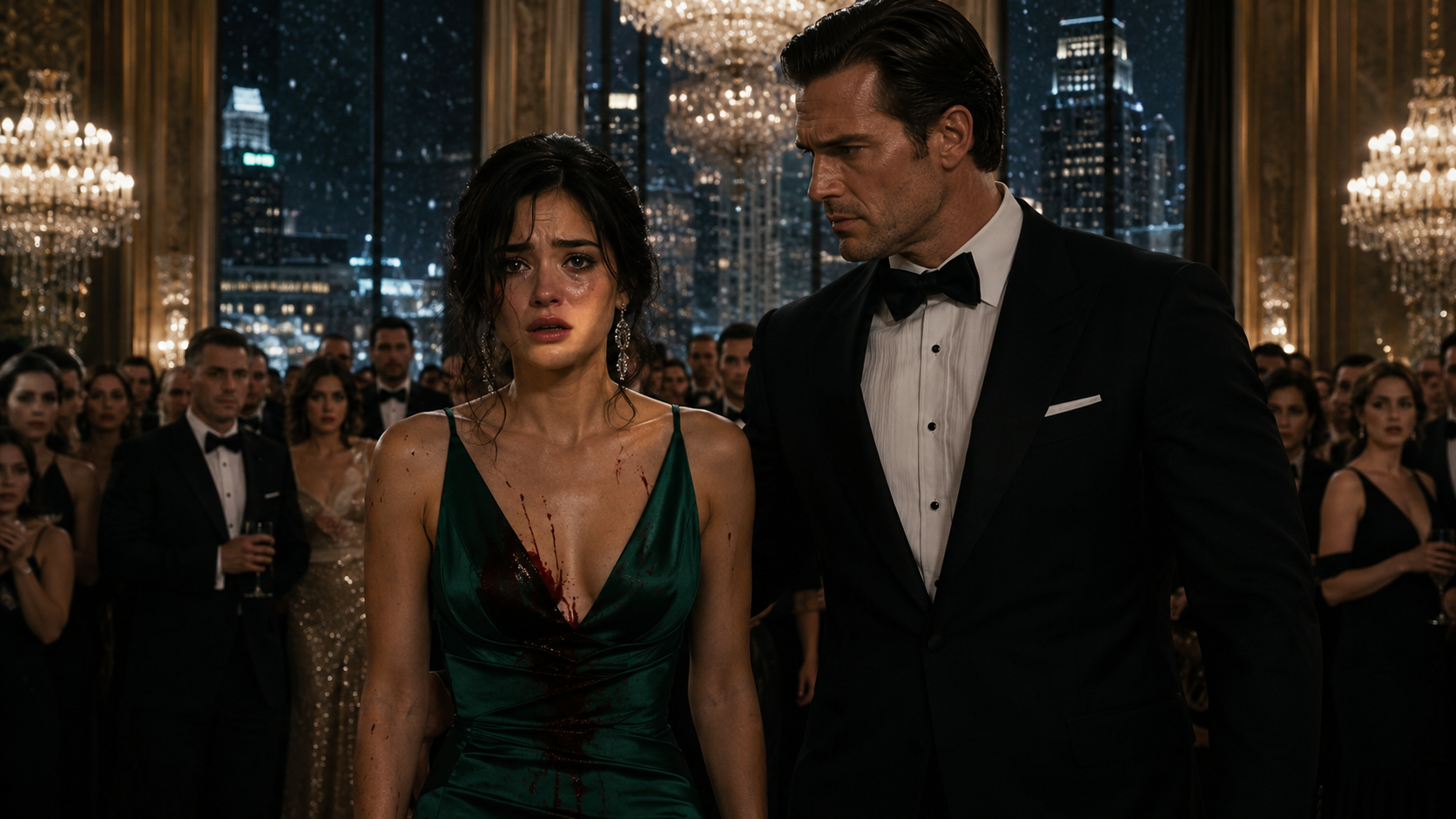
The Question That Silenced the Ballroom

Every chandelier in the ballroom glittered as if it had been paid to lie.

Crystal light fell over black tuxedos, champagne towers, silk gowns, polished marble, and the smiling faces of people who had mastered the art of cruelty without ever raising their voices. The winter gala of Pierce & Hallow Financial was supposed to be a celebration of success, charity, influence, and the sort of old Chicago elegance that looked beautiful in photographs and rotten up close.

Mara Ellison stood near the far end of the ballroom with a glass of water in both hands, trying to make herself smaller.

She had not wanted to come.

Her manager had insisted. Her department had insisted. Human Resources had sent three cheerful reminders with glittering fonts and words like team spirit, family culture, and executive visibility. Mara knew what those words meant. They meant the analysts who did the work were expected to smile while the men who stole the credit toasted themselves in public.

So she had come.

She had worn the only formal dress she owned, a deep green gown she had bought from a consignment shop after three careful weeks of saving. It did not have a designer label. It did not shimmer like the dresses around her. But it fit her well, and for one hour before she arrived, looking at herself in the mirror of her small apartment, she had allowed herself to believe she looked beautiful.

That belief had lasted until Bryce Ward saw her.

Bryce was the kind of man who had never confused confidence with competence because he had been born with enough money to avoid learning either properly. He was a senior associate at Pierce & Hallow, though everyone in the audit department knew Mara corrected his reports before they went upstairs. He smiled too easily, touched people’s shoulders without permission, and called women “brilliant” in the same tone one used for obedient dogs.

He found Mara beside the ice sculpture.

“Well,” Bryce said, loud enough for the nearest circle to hear, “look at this. The archives finally sent someone to represent them.”

A few people laughed.

Mara’s fingers tightened around her glass.

“I’m in forensic review,” she said quietly.

“Of course you are.” Bryce looked at her dress. “That explains the crime scene.”

The laughter grew sharper.

Mara turned to walk away, but Bryce stepped into her path with a full glass of red wine. His smile widened. For one second, she saw the decision happen in his eyes.

Then the wine spilled.

It poured down the front of her green dress in a dark, violent splash. The cold soaked through the fabric and hit her skin. Around her, the ballroom gasped, then broke into laughter. Not everyone laughed. Some people looked away. Some covered their mouths. Some pretended not to see.

But no one helped.

Bryce lifted both hands as if he were innocent.

“Oh, Mara,” he said. “You really should be more careful.”

Her throat closed.

The music kept playing.

The waiters kept moving.

The partners kept smiling.

Mara looked down at herself and felt something inside her fold. She had spent years in quiet rooms doing impossible work for people who forgot her name until something went wrong. She had stayed late through snowstorms, found hidden losses in impossible ledgers, corrected fraud models that men with better offices did not understand, and swallowed every insult because she needed the job, the insurance, the paycheck, the proof that she belonged somewhere better than the life she had escaped.

And now three hundred people were laughing at her because a weak man wanted to feel tall.

“Don’t cry,” someone whispered nearby, though not kindly.

That was when the ballroom changed.

Not loudly.

Not dramatically.

It changed the way a forest changes when every bird suddenly stops singing.

The laughter died one person at a time.

Mara noticed the silence before she noticed him.

A man stood at the entrance to the ballroom, dressed in black evening clothes with no flower in his lapel and no attempt at charm in his expression. He was tall, broad-shouldered, and still in a way that made movement around him seem nervous. His hair was dark with a touch of silver at the temples. A thin scar marked the edge of his jaw. His eyes were the gray of winter steel.

Gideon Vale.

Everyone in Chicago knew his name, even if they pretended not to.

He owned shipping companies, private banks, security firms, half the riverfront, and pieces of businesses that never appeared under his name on paper. Politicians did not mention him unless they had to. Judges spoke carefully when his attorneys entered a room. Men like Richard Pierce smiled too brightly around him because they feared what they owed him.

Mara knew more than most.

For six weeks, she had been reviewing hidden exposure inside Pierce & Hallow’s debt portfolio. She had found ghost loans, mirrored accounts, offshore transfers, and shell companies that circled back toward Gideon Vale’s empire like ravens returning to a tower. She had told herself not to care. She had told herself curiosity was dangerous. She had told herself people like her survived by noticing everything and saying nothing.

Now the most feared man in Chicago was looking directly at her.

The crowd parted as he crossed the ballroom.

No one asked him where he was going.

No one dared.

Gideon stopped in front of Mara. He looked first at the wine stain, then at her face, then at the tears she was trying desperately not to shed.

Mara expected disgust.

She expected calculation.

She expected him to look through her the way powerful men always did, searching for use and finding none.

Instead, something colder than pity and warmer than rage moved through his expression.

Recognition.

He removed a folded black handkerchief from his jacket pocket and held it out.

Mara stared at it.

“You don’t have to take it,” he said.

His voice was low, calm, and deep enough to carry without effort.

She took it because her hands needed something to do.

Gideon turned his head toward Bryce.

“What made you think that was courage?” he asked.

Bryce blinked. “Excuse me?”

“The room laughed,” Gideon said. “So I assume someone here believes humiliation requires bravery. Was it you?”

Bryce’s face lost color.

“It was an accident,” he said quickly. “Just a stupid accident. We’re all friends here.”

Gideon looked around the ballroom.

“Are you?”

No one answered.

He let the silence stretch until it became unbearable.

Then he looked back at Bryce.

“Say her name.”

Bryce swallowed. “What?”

“The woman you spilled wine on. Say her name.”

“Mara,” Bryce said.

“Her full name.”

“Mara Ellison.”

Gideon’s gaze did not move.

“And what does Mara Ellison do?”

Bryce forced a laugh. “She’s in review. Back-office stuff.”

Gideon took one step closer.

The laugh died.

“Back-office stuff,” Gideon repeated. “Interesting. Because I have spent the last month examining Pierce & Hallow’s private ledgers. I found missing collateral, falsified risk statements, duplicate invoices, and an elegant little trail of stolen money hidden badly enough to insult me. Do you know what else I found?”

No one breathed.

Mara felt the floor tilt beneath her.

Gideon turned toward her.

“I found corrections,” he said. “Dozens of them. Someone inside this firm kept fixing the numbers before the lies could collapse the company completely. Someone stayed after midnight tracing transfers no partner here understood. Someone prevented men in expensive suits from drowning in their own incompetence.”

His eyes held hers.

“You.”

The room seemed to disappear at the edges.

Mara could hear her own heartbeat.

Richard Pierce, founder and chairman, pushed his way forward. His smile was stiff and wet.

“Mr. Vale, perhaps this conversation is better held privately.”

Gideon did not look at him.

“Your privacy expired when you used my money to decorate your fraud.”

Pierce froze.

A wave moved through the ballroom. Not sound exactly. Fear disguised as movement.

Gideon extended his hand to Mara.

“You don’t work for them anymore.”

Mara looked at his hand.

Then at Bryce.

Then at the stain on her dress.

“You’re offering me a job?” she asked.

“No,” Gideon said. “I am offering you a door. A job is what people give when they think they own the room on the other side.”

Mara had spent her life being practical. Practical girls did not get into cars with dangerous men. Practical women did not trust billionaires with ruined reputations and colder eyes than January. Practical employees did not quit without notice in a ballroom full of witnesses.

But practical had kept her quiet while men like Bryce laughed.

Practical had never protected her.

Mara placed her hand in his.

Gideon’s fingers closed around hers, not tightly, but with the certainty of a promise made before witnesses.

He removed his jacket and placed it over her shoulders. It was heavy, warm, and dark enough to hide the stain from every watching eye.

Then he led her out while the room that had laughed at her stood silent enough to hear the music stop.

Outside, snow fell over Chicago in silver sheets.

A black car waited at the curb. The driver opened the door before Gideon reached it.

Mara stopped.

“Mr. Vale.”

“Gideon.”

“I know things about your companies.”

“I know.”

“I saw accounts I probably wasn’t meant to see.”

“I know.”

She stared at him. “Then why are you helping me?”

The city lights moved across his face.

“Because everyone in that ballroom saw a woman they could shame,” he said. “I saw the only person in the building who knew where the bodies were buried.”

Mara went still.

Gideon’s mouth barely moved.

“Financial bodies, Miss Ellison. For now.”

She should have been frightened.

She was.

But beneath the fear was something she had not felt in years.

Possibility.

The car carried them along the river, past towers of glass and gold, past streets shining black with melted snow. Gideon did not fill the silence. Mara respected him a little for that.

At last she said, “Where are we going?”

“To a place where no one will laugh when you speak.”

“That sounds expensive.”

“It is.”

“That sounds dangerous.”

“It is.”

“At least you’re honest.”

Gideon looked at her then.

“With you,” he said, “I intend to be.”

His headquarters occupied the top floors of an old limestone building on LaSalle Street, a place built by men who believed stone could make money look moral. Inside, it was all shadowed wood, smoked glass, quiet staff, and the kind of security that did not need to show weapons to be understood.

A woman named Celeste met Mara with a garment bag, warm tea, and a kindness so practical it nearly broke her.

“Mr. Vale said you may need clothes,” Celeste said.

Mara looked at the garment bag. “He guessed my size?”

Celeste’s expression did not change. “Mr. Vale guesses very little.”

Inside the private suite, Mara found a navy dress, a cream blouse, black trousers, a wool coat, and shoes that looked too elegant to belong to her life. Nothing was flashy. Nothing was meant to turn her into someone else.

Everything fit.

Perfectly.

The next morning, Mara walked into Gideon’s office wearing the cream blouse and black trousers. She expected him to stare.

He didn’t.

He glanced up from a wall of screens, and for one unguarded second, his eyes softened with something that looked almost like admiration.

Then it was gone.

“You look less like someone apologizing for existing,” he said.

Mara folded her arms. “That may be the strangest compliment I’ve ever received.”

“It was not intended to be strange.”

“Then you need practice.”

A corner of his mouth moved.

Not quite a smile.

But close.

He pointed to the chair beside his desk. “Show me what Pierce & Hallow tried to hide.”

For the next ten days, Mara lived inside numbers.

Not the dead, gray numbers men used to bore people into obedience. These numbers had pulse, motive, hunger. They moved through invoices, charitable trusts, shipping contracts, municipal bonds, private funds, and accounts labeled so blandly they practically screamed.

Gideon gave her access to everything.

Too much, perhaps.

But he watched what she did with it.

He did not interrupt. He did not explain her own work back to her. He did not ask if she was sure in the tone men used when they meant they hoped she wasn’t.

When Mara spoke, the room listened.

When she questioned a transfer, four attorneys went pale.

When she said an account was false, Gideon closed it before lunch.

At first, his executives resented her. They saw the wine-stained woman from the gala, the quiet analyst, the nobody wrapped in their employer’s jacket.

Then she found three million dollars hidden inside a maintenance contract.

After that, they brought her coffee.

On the eleventh night, thunder rolled over the city. Rain struck Gideon’s office windows hard enough to blur the skyline. Mara sat cross-legged in a chair with her laptop balanced on her knees, hair pinned badly, eyes burning from hours of work.

Gideon placed a cup beside her.

“You forgot dinner.”

“I didn’t forget. I ignored it.”

“That is less admirable.”

“I found something.”

He sat opposite her.

The room changed around those words.

Mara turned the screen toward him. “The missing money from Pierce & Hallow was not moved out of the country. That was theater. The offshore accounts were bait.”

Gideon’s gaze sharpened.

“Where did it go?”

“Back into Chicago.” She opened another file. “Specifically, into a redevelopment fund controlled by Alistair North.”

For the first time since she met him, Gideon went completely still.

Alistair North was not a name spoken carelessly. He owned nightclubs, construction companies, debt, judges, and men who made problems vanish between midnight and morning. For years, he and Gideon had circled each other like wolves on opposite sides of a frozen river.

“Who signed the transfer?” Gideon asked.

Mara hesitated.

Then she opened the authorization page.

“Richard Pierce approved it. Bryce structured it. But the final audit signature is mine.”

Gideon looked at her.

“That is impossible.”

“Yes,” she said. “Which is why it is useful.”

His voice dropped. “They forged your credentials.”

“They did more than that.”

She clicked through file after file. Login records. Access badges. Draft emails. An internal memo labeled contingency liability. A prepared report naming Mara Ellison as the sole analyst responsible for unauthorized transfers, data manipulation, and concealment.

The room seemed to shrink around her.

“They were going to blame me,” she said.

Gideon’s hands slowly curled on the arms of his chair.

“They were going to feed you to North,” he said.

Mara nodded. “And to you. And to the federal investigators once the fund collapsed.”

His face became terrifyingly calm.

For a moment, Mara understood why people feared him.

Not because he was loud.

Because his anger became organized.

He stood and walked to the window. Rain traced the glass between him and the city.

“What do you want?” he asked.

Mara almost laughed because the question was impossible.

No one had ever asked her that before.

People had asked what she could prove. What she could tolerate. What she could finish by Monday. What she could forgive to keep peace. What she could ignore to keep her job.

No one had ever asked what she wanted.

She looked at the forged signature on the screen. Her name, used like a weapon against her.

“I want them exposed,” she said.

Gideon turned. “Exposed is slower than buried.”

“Buried lets people become rumors. Exposed makes them evidence.”

“They tried to destroy you.”

“Yes.”

“They deserve terror.”

“They already live in terror,” Mara said. “That is why they hurt people who cannot fight back. I want them powerless in daylight.”

Gideon studied her for a long moment.

Then he smiled.

It was not a kind smile.

But it was a memorable one.

“Mara Ellison,” he said, “you are far more dangerous than that dress suggested.”

She lifted her chin.

“The dress was never the dangerous part.”

The next evening, Pierce & Hallow held an emergency board meeting under the polite title of “investor reassurance.”

The conference room smelled of leather, coffee, and fear.

Richard Pierce sat at the head of the table, his face carefully powdered for cameras that had not yet arrived. Bryce Ward stood near the window, checking his phone every few seconds. Around them waited partners, lawyers, compliance officers, two silent federal investigators, and Alistair North’s representative, a pale man with a silver tie and dead eyes.

Gideon entered last.

Mara walked beside him.

The room reacted to Gideon first.

Then it noticed her.

She wore a white suit with clean lines and no jewelry except small pearl earrings that had belonged to her mother. Her hair was smooth. Her face was calm. In one hand, she carried a slim black folder. In the other, she held nothing at all.

Bryce stared.

“Mara,” he said, forcing a smile. “Thank God. Tell them this has been blown out of proportion.”

She set the folder on the table.

“I checked your work, Bryce.”

His smile twitched.

“Again.”

The first document appeared on the conference screen.

Then the second.

Then the third.

Mara did not raise her voice. She did not accuse without proof. She did not tremble. She showed dates, transfers, device locations, forged credentials, shell structures, deleted messages, restored backups, mirrored accounts, and the exact path of every stolen dollar.

Richard Pierce tried to interrupt.

Mara allowed him fifteen seconds.

Then she played the audio.

His own voice filled the room.

“She’s perfect for it,” the recording said. “Quiet. No family money. No allies upstairs. By the time she proves she didn’t do it, no one will care.”

Bryce made a sound like something breaking.

Mara stopped the recording.

The silence afterward was not empty. It was crowded with consequences.

One of the federal investigators closed his notebook.

“That will be sufficient for a warrant,” he said.

Richard Pierce looked at Gideon with hatred.

“You did this.”

Gideon stood near the wall, hands in his pockets.

“No,” he said. “I opened the door.”

He looked at Mara.

“She walked through it.”

Everyone turned to her.

This time, she did not shrink.

“I gave this company seven years,” Mara said. “Seven years of late nights, corrected reports, quiet warnings, and loyalty you mistook for weakness. You laughed at me because it was easier than admitting you needed me.”

Bryce’s eyes shone with panic.

“Mara, please. I never meant—”

“Do not use my name like it belongs to you,” she said.

He flinched.

“You poured wine on me in front of a ballroom because you thought embarrassment would keep me small. But you were not only mocking me. You were preparing to erase me.”

Her voice stayed steady.

“That is not a mistake. That is character.”

The arrests were quiet.

No screaming.

No broken glass.

No dramatic threats.

Just handcuffs, lowered heads, and powerful men learning that paper could cut deeper than knives.

As Bryce passed her, he whispered, “You think Vale cares about you? Men like him collect useful things.”

Mara looked across the room.

Gideon stood where he had been, silent, letting the victory remain hers.

She looked back at Bryce.

“Maybe,” she said. “But he saw what I was before I became useful to him. You saw what I was and tried to use it against me.”

Bryce had no answer.

By morning, the scandal owned the city.

Pierce & Hallow collapsed in forty-eight hours. News vans crowded the sidewalks. Commentators called it one of the largest private financial fraud cases Chicago had seen in a decade. Richard Pierce’s portrait came down from the lobby before noon. Bryce’s family hired crisis managers, attorneys, and reputation consultants, but none of them could stop the gala footage from spreading.

Someone had filmed everything.

The wine.

The laughter.

Gideon’s question.

What made you think that was courage?

Millions watched it.

Mara did not.

She had no desire to let strangers turn her worst moment into entertainment.

Instead, she built something.

Gideon transferred the legitimate forensic division of his empire into a new independent firm and asked Mara to run it.

She agreed on three conditions.

Her name came first.

Every client would be vetted.

And no one in the building would ever call kindness a weakness.

The company became Ellison Vale Integrity Group.

Mara hired people who knew what it meant to be underestimated: women pushed out of boardrooms, immigrants whose degrees had been treated like decoration, older analysts replaced by louder young men, disabled accountants ignored until they saved entire departments, and brilliant investigators who had been told they were too strange, too quiet, too difficult, too much.

They found stolen wages.

They exposed nonprofit fraud.

They recovered money from corrupt contractors.

They helped small businesses survive men who thought theft was strategy.

Mara became known as the woman who could find a lie under ten thousand pages and make it confess.

Three months after the gala, she returned to the same ballroom.

Not as an employee.

Not as a guest.

As the keynote speaker at a scholarship fundraiser for students entering forensic accounting, financial law, and public corruption investigation.

The chandeliers still glittered above her. The marble still shone. The old walls still carried the ghosts of money and arrogance.

But Mara no longer felt like an intruder.

She wore a gold dress this time, not because it hid her body or corrected it or apologized for it, but because she liked the way it caught the light when she moved.

Her mother sat in the front row, crying openly into a napkin.

Celeste sat beside her, pretending she was not crying too.

Gideon stood at the back of the room.

He disliked applause.

But he loved watching Mara command silence.

When she stepped to the microphone, the ballroom quieted.

“I used to think power belonged to the loudest person in the room,” Mara said. “Then I thought it belonged to the cruelest. Then I thought it belonged to people with money, names, buildings, lawyers, and doors that opened before they knocked.”

She looked across the audience.

“I was wrong.”

No one moved.

“Power is knowing your value before a room agrees. Power is telling the truth when lies are profitable. Power is refusing to become cruel just because cruelty once had better lighting.”

A soft breath moved through the crowd.

“Once, in this ballroom, people laughed while I stood alone. I thought that was humiliation.”

Her eyes found Gideon.

His face remained calm.

But his gaze warmed.

“It was not humiliation,” Mara said. “It was evidence.”

This time, when the room laughed, it was gentle.

After the speech, Gideon found her on the balcony. Snow drifted through the Chicago night, softening the hard edges of the city.

“You were remarkable,” he said.

Mara leaned against the railing. “You say that as if you’re surprised.”

“I am not surprised.”

“Then say it better.”

That almost-smile returned.

“You were inevitable.”

She looked at him for a long moment.

People had warned her about Gideon Vale. Some warnings were fair. He had done things she did not ask about because she was not foolish enough to believe love turned shadows into sunlight. He was not gentle by nature. He was not harmless. He was not simple.

But he had changed.

Not because she softened him.

Because she made him want to be worthy of softness.

“You didn’t destroy them the way you wanted to,” she said.

“No.”

“Do you regret it?”

“At first.”

“And now?”

Gideon looked out over the city.

“Fear ends quickly,” he said. “Truth keeps working after the room empties.”

Mara smiled. “That was almost beautiful.”

“I am told I have hidden depths.”

“You have hidden accounts.”

“Fewer since you began auditing me.”

She laughed.

The sound warmed something in his face.

Then Gideon reached into his coat pocket.

Mara froze.

“Gideon.”

He took out a small velvet box.

Her heart stumbled.

“I know what people will say,” he said. “They will say I am too dangerous for you. They may not be wrong.”

He opened the box.

Inside was not the largest diamond she had ever seen.

It was vintage, elegant, strong, framed by tiny emeralds the color of the dress she had worn the night everything changed.

“I spent most of my life being obeyed,” Gideon said. “You are the first person who ever made me want to be understood.”

Mara’s eyes filled.

He lowered himself to one knee.

Not for the room.

Not for the cameras.

Not because anyone expected it.

Because power, real power, could kneel without becoming smaller.

“Mara Ellison,” he said, “will you build a life with me that frightens dishonest men and protects everyone they taught to be silent?”

She looked at the man people feared.

Then she thought of the ballroom, the wine, the laughter, the silence, the question.

What made you think that was courage?

She realized then that courage had never looked like cruelty.

Sometimes courage looked like taking a hand.

Sometimes it looked like opening a file.

Sometimes it looked like returning to the room that broke you and speaking clearly enough for every chandelier to tremble.

Mara smiled through her tears.

“Yes,” she said. “But I’m still auditing you.”

Gideon’s mouth curved.

“I would expect nothing less.”

Inside, the ballroom waited.

Outside, snow fell over Chicago.

And for the first time in her life, Mara did not feel rescued.

She felt witnessed.

There was a difference.

A rescue could make a woman grateful.

Being witnessed could make her rise.

So she took Gideon’s hand and walked back toward the light, not as the woman they had laughed at, not as the woman he had saved, but as the woman who had turned humiliation into evidence, evidence into justice, and justice into a future no one in that room would ever dare to mock again.

The Question That Silenced the Ballroom
I used to have a hamster…