Don’t Sign, Mama—The Night My Son Turned On the Lights
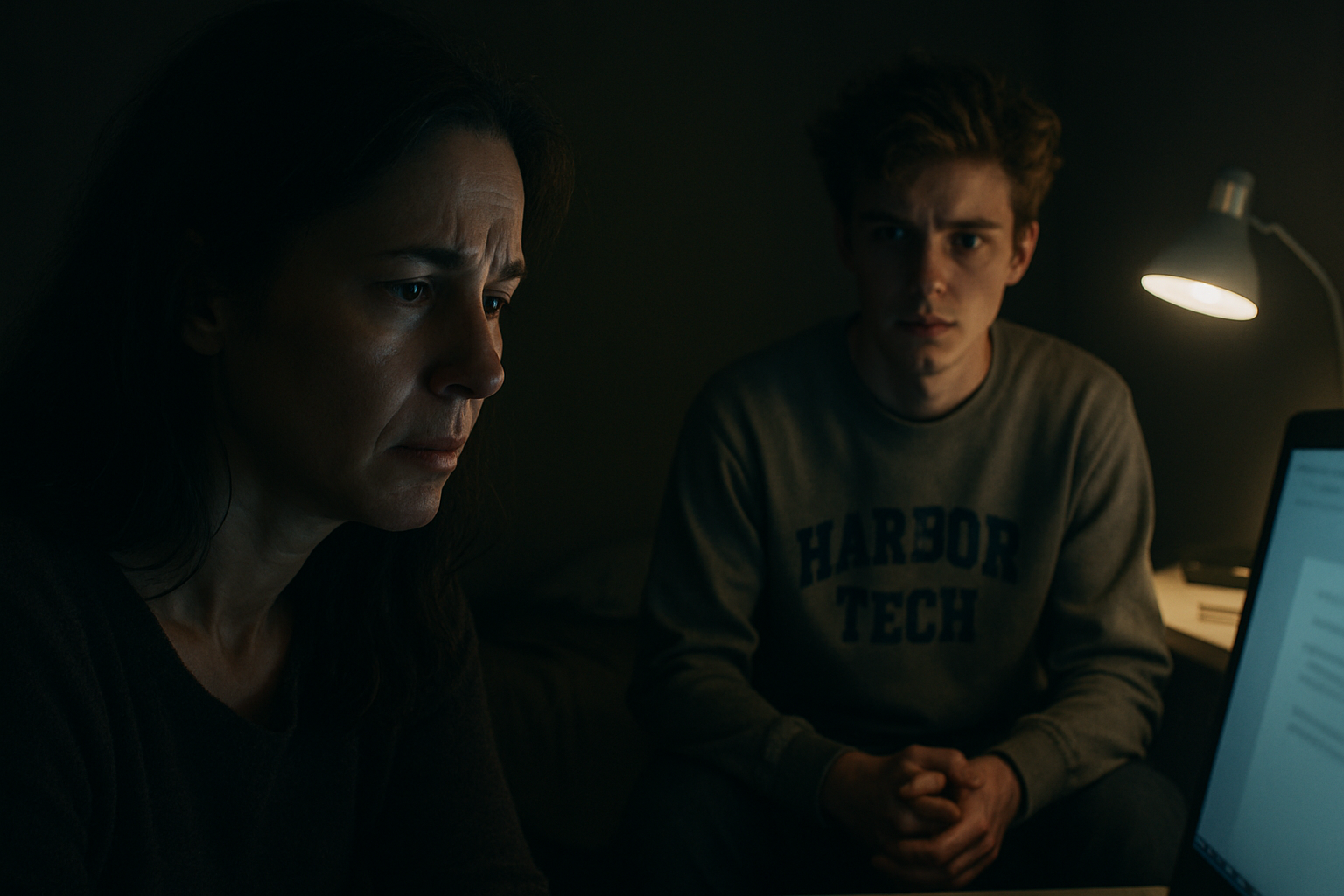
Mara Whitmore stared at the sentence glowing on her son’s computer screen.
Her throat tightened.
“What happens if I sign?”
Noah sat on the edge of his bed, pale beneath the hard white desk lamp. He had his father’s gray eyes, but none of Grant Whitmore’s cold stillness. His hair stood up in anxious tufts where he had dragged his hands through it again and again.
He wore the old Harbor Tech sweatshirt Grant had once mocked.
Software engineering, Grant had said, as if his son had chosen to become a street magician.
Noah looked at his mother now like a young man who had swallowed a terrible secret and could no longer keep it down.
“Dad announces the Whitmore Meridian Fund Monday night,” he said. “At the Bellwether. National press. Investors. Board members. Livestream. Everything. He’s promoting Selene Hart to senior vice president of strategic relations.”
Mara felt the name land in the room like a dropped glass.
Noah kept going.
“After that, he starts moving money, changing ownership, and filing against you before you can even breathe.”
Mara came farther into the room.
“Selene’s child,” she whispered. “Is he Grant’s?”
Noah lowered his eyes.
“His name is Milo.”
Such a small, ordinary name.
That made it worse.
“Is Milo his son?” Mara asked.
“I don’t know,” Noah said. “Dad believes it. Or he wants everyone else to believe it. But that isn’t even the worst part.”
“It feels like the worst part.”
“I know.” His voice broke around the words. “But you have to see the rest.”
He opened a folder.
A bank statement filled the monitor. Blue Harbor LLC. Registered in a desert state. Transfers running through offshore accounts, luxury property trusts, and a sleek city apartment tied to Selene.
Invoices followed.
Outside advisory.
Reputation strategy.
Talent retention.
Payment after payment led to Selene Hart, Selene’s mother, the apartment, a leased black SUV, jewelry, private school fees, medical bills.
Mara read until the words blurred.
“This is company money.”
“Some of it,” Noah said. “Some came from marital accounts. Some came through entities Dad built with assets he says you can’t touch.”
“That can’t be right. We own—”
“On paper, he started shifting things years ago.”
Noah clicked again.
“Trusts. Holding companies. Consulting fees. He told the board it was tax planning. He told you it was estate planning. But look here.”
Mara leaned closer.
Then froze.
“That is not my signature.”
“I know.”
“Who did this?”
“The IP address traces back to Julian Crowe’s office.”
Mara almost laughed.
Not because it was funny.
Because disbelief needed somewhere to go.
Julian Crowe had been Grant’s personal attorney for fifteen years. Smooth voice. Polished shoes. White orchids on Mara’s birthday.
“He forged me?”
“Or arranged it,” Noah said. “I have metadata. Serena will need forensic people.”
Mara sank into the desk chair. Her legs had stopped belonging to her.
“How long have you known?”
“About Selene? Since September.”
Four months.
The answer hurt.
But the shame on Noah’s face hurt more.
“Why didn’t you tell me?”
“At first I thought it was just an affair.”
His mouth tightened around the word just, as if it tasted rotten.
“Then I followed the payments. Then I found the divorce prep.”
He clicked an audio file.
Grant’s voice filled the room.
Familiar.
Measured.
Devastating.
“Mara won’t fight. She has no stomach for public conflict. If she gets emotional, we frame it as instability. Julian, make sure the therapist notes help us.”
Another voice answered.
Julian’s.
Cool as marble.
“We have the photos with the trainer, the cousin lunch at Lumen, and the texts she sent Lydia about feeling trapped. We can build an affair narrative and emotional volatility. Judges don’t respond well to vindictive spouses.”
Mara pressed her hand over her mouth.
Every harmless moment came back, now sharpened into a knife.
Aaron, the trainer, had helped her rebuild strength after her knee surgery.
Daniel, her cousin, had met her for lunch to discuss their aunt’s estate.
The late-night texts to Lydia had been confessions from a lonely wife trying not to disappear.
Grant had not ignored her pain.
He had cataloged it.
Noah paused the recording.
“There’s more.”
“I don’t want there to be more.”
“I know. But you have to know.”
The next file showed an application to an elite leadership academy in Canada.
Housing wire.
Flight itinerary.
A letter signed by Grant authorizing Noah’s immediate enrollment.
Mara’s head snapped up.
“He cannot send you anywhere. You’re eighteen.”
“He can control the tuition account. Corner me with funding. He’s already telling admissions I’m overwhelmed. That you’re unstable. That distance is best.”
“When is the flight?”
Noah looked at her.
“Monday morning.”
The anger came so fast Mara’s hands stopped trembling.
“The same day as the launch?”
“So I’m gone before anyone asks questions,” Noah said. “If you file, he says you’re breaking down. If I speak, he says I’m a confused kid manipulated by you. If I’m in Canada, I can’t contradict him. I can’t help you.”
Mara walked to the window.
Outside, the lawn lay silvered with old snow. The harbor was hidden beyond the trees, but she could feel its cold pressing against the glass.
For years, she had lived inside Grant’s weather and mistaken pressure for climate.
He was late because she did not understand business.
He was distant because she asked too much.
Noah avoided him because Mara had made the boy too soft.
Now she saw the architecture under it all.
Not neglect.
Design.
“How did you get the recordings?” she asked.
Noah hesitated.
Mara turned.
“Noah.”
He rubbed his hands over his jeans.
“Grandmother Lenora.”
Grant’s mother.
The name moved through the room like a ghost.
Lenora Whitmore had died the previous spring after seven long years of partial paralysis and broken flashes of clarity. Mara had bathed her. Fed her. Sat through nights when Grant said he couldn’t bear to see his mother diminished.
When Lenora had been well, she had been severe. Old money. Cold manners. A woman who could make gratitude feel like a debt.
But illness had stripped away the performance.
In her final year, she had held Mara’s hand and whispered apologies Mara had never fully understood.
“What about her?” Mara asked.
Noah pointed to a small black drive on the desk.
“She left this for me. Her nurse gave it to me after the funeral. Grandma recorded things. Dad thought she couldn’t understand. He took calls in her sitting room because he thought she was furniture.”
Mara closed her eyes.
“There’s a letter,” Noah said.
He opened a scanned page in Lenora’s trembling hand.
Noah,
Your father mistakes silence for consent. Your mother saved this family when Grant would have sold his own name to impress men who despised him. If he turns on her, do not let him rewrite the story.
I was not good enough to her while I had the time.
Let this be one useful thing I do before I answer for the rest.
Mara pressed her fist to her lips.
She had stopped wanting vindication from Lenora years ago.
Yet here it was.
Too late to heal the past.
Not too late to matter.
Noah watched her, his face tight with worry.
“Mom, I didn’t hide it because I doubted you. I hid it because I needed to understand what I had. I’m sorry.”
Mara crossed the room and cupped his face in both hands.
For one breath, she saw every version of him.
The toddler reaching for Grant at the airport and being passed to a nanny.
The ten-year-old pretending not to care when Grant left before his school play scene.
The seventeen-year-old who stopped asking his father to show up because hope had begun to feel humiliating.
“You should never have had to carry this,” she said.
“I couldn’t let him do it to you.”
“He already did enough to you.”
Noah’s jaw trembled.
“Then let’s not let him finish.”
The next morning, humiliation arrived wearing perfume and holding a child’s backpack.
Mara had not slept. She had spent the night copying files with Noah, speaking twice with Serena Pike, and learning there is a kind of pain that does not destroy you.
It clarifies.
At 10:13, the doorbell rang.
On the security camera, Selene Hart stood beneath the portico. Beside her was Milo, bundled in a red coat, clutching a toy train.
Noah came into the foyer.
“Don’t open it.”
Mara looked at the child on the screen.
He shifted from one foot to the other, bored and blameless.
Whatever Grant and Selene had built, Milo had not built it.
“I’m opening the door.”
“Mom—”
“Stay close.”
Selene smiled when Mara opened the door.
It was a glass smile.
“Mara. I’m sorry to come without calling.”
“No, you’re not.”
The smile flickered.
“Grant asked me to pick up some documents from his study. And Milo wanted to see Daddy’s house.”
Milo peeked around Selene’s coat.
“Is this where Daddy sleeps?”
Behind Mara, Noah flinched.
Mara bent toward the boy.
“Hello, Milo. It’s freezing out there. Would you like some hot chocolate?”
Selene’s expression sharpened.
“That won’t be necessary.”
“The offer was for him,” Mara said. “Not for you.”
Milo looked up.
“Can I?”
Selene hesitated.
Then shrugged.
“Fine. Five minutes.”
Mara led them to the kitchen instead of Grant’s study.
It was the warmest room in the house, with blue-gray cabinets Grant had wanted replaced with cold white stone. Noah stood near the island, arms folded, watching Selene with the contained fury of a son old enough to understand betrayal, yet still young enough to be wounded by it.
Milo climbed onto a stool.
Mara made hot chocolate with real milk and three marshmallows.
Children remembered small kindnesses.
Adults forgot entire vows.
“Thank you,” Milo said.
“You’re welcome.”
Selene removed her gloves finger by finger and looked around.
“It’s smaller than I imagined.”
“The kitchen?”
“The whole house, actually. Grant always says you fought him on the Riverbend property because you’re sentimental.”
Noah let out a short laugh.
“He means Mom refused to sell the place she paid for.”
Selene’s eyes moved to him.
“You must be Noah.”
“And you must be the strategic consultant with a luxury SUV billed as client development.”
Color climbed her neck.
“You have no idea what you’re talking about.”
“I have invoices,” Noah said. “That’s better.”
Selene reached into her bag and drew out an envelope.
“Grant asked me to give you this. He hoped we could keep this from becoming ugly. He respects your history together.”
Mara did not touch it.
“Does he?”
“It’s generous.” Selene tapped the envelope with one manicured nail. “Two million dollars. Immediate transfer once you sign a private settlement and leave the house. You keep your jewelry, your car, and a monthly allowance for two years. After that, you’ll be comfortable if you’re sensible.”
Noah went very still.
Mara looked from the envelope to Selene’s face.
“Two million dollars for twenty-one years of marriage and a company I helped drag back from bankruptcy?”
Selene tilted her head with rehearsed pity.
“Mara, I’m not trying to hurt you. But you and Grant have been over for a long time. Everyone knows that. At a certain age, dignity matters more than fighting over rooms you don’t need.”
“At a certain age,” Mara repeated softly.
Selene heard her own mistake but did not retreat.
“Grant has a future. Milo has a future. I have one, too. You can step aside gracefully, or you can force him to protect what he built.”
Mara finally picked up the envelope.
The paper was heavy.
Grant had always believed fine paper could perfume an insult.
She opened it.
There was the check.
Two million dollars.
Signed in Grant’s elegant hand.
Drawn from Whitmore Family Management.
Family.
Mara held the check in both hands and tore it slowly down the middle.
Then she tore the halves again.
And again.
The pieces fell across the kitchen island like dirty snow.
Milo stopped stirring his cocoa.
Selene’s mouth tightened.
“This house,” Mara said, “was bought after I sold my father’s lake property so Grant could make payroll and avoid public failure. The first investors in his first fund ate roast chicken in my dining room while I hid overdue bills in a drawer. I cared for his mother in the room down the hall while he built a reputation for loyalty. I raised the son he found too inconvenient to love properly.”
She stepped closer.
“So no, Selene. I will not leave my own life like a trespasser because you arrived late and found the closets full.”
Selene stood.
“You’re making a mistake.”
Mara smiled without warmth.
“Then it will be mine.”
Selene snatched Milo’s backpack.
“Come on, sweetheart.”
At the doorway, Milo turned back.
“Thank you for the marshmallows.”
Mara’s heart cracked in a place still capable of mercy.
“Anytime.”
After the front door closed, Noah lifted his phone from beneath a folded dish towel.
“Recorded.”
Mara exhaled.
“All of it?”
“All of it.”
After the call with Serena ended, Mara stood in silence for nearly a minute.
Then she walked to Grant’s study.
Noah followed.
“What are you doing?”
“Looking for your passport.”
“He keeps documents in the safe.”
“I know.”
“He changed the code years ago.”
Mara stopped before the large abstract painting behind Grant’s desk. Ugly thing. Purchased at auction because Grant said the artist was about to become important.
She swung it outward on hidden hinges.
Behind it was the wall safe.
Noah stared.
“How did you know that opened?”
“Because I told the contractor where to put it.”
She entered their wedding date.
Red light.
Grant’s birthday.
Red.
The founding date of Whitmore Capital.
Red.
Then she thought of Milo, chocolate on his chin, asking if this was where Daddy slept.
She entered the date from Noah’s files.
A recurring medical payment tied to Selene.
Green.
Noah whispered something under his breath.
The safe opened.
Inside were passports, deeds, cash, watches, and a black velvet box Mara had never seen.
She found Noah’s passport and handed it to him.
Beneath it sat a folder labeled:
M.W.—Contingencies.
Mara opened it.
The first page was a draft affidavit claiming she suffered from paranoia, jealousy, mood swings, and a “fixation on imagined infidelity.”
The second listed witnesses.
A housekeeper Grant had recently given a bonus.
A therapist Mara had seen twice after Lenora’s death.
A social acquaintance who once heard Mara joke about burning Grant’s empire to ash after he missed a benefit.
There were cropped photos of her lunch with Daniel.
There were printed texts to Lydia, stripped of context.
I feel like I’m disappearing in this house.
Sometimes I wonder if I’m losing my mind.
At the back was something worse.
A petition for emergency financial restraint against Mara, alleging she might destroy records, harass employees, and damage Whitmore Capital’s reputation.
Attached was a proposed media statement.
Grant Whitmore is saddened by his wife’s recent emotional decline and asks for privacy as he protects his family and company from a painful private matter.
Mara lowered the folder.
“He was going to turn my pain into a press release.”
Noah’s voice was hard.
“That’s why you can’t fight him privately. Privacy is where he’s strongest.”
That sentence stayed with her all day.
Privacy was where Grant had trained them all to behave.
In private, he dismissed Noah’s dreams.
In private, he let Mara cry alone.
In private, he used money like weather, making people grateful for sunlight and terrified of storms.
In public, he donated to hospitals and spoke about stewardship with a clean, solemn face.
At six that evening, Grant came home.
Mara knew from the sound of the door he was angry.
Not loud.
Grant was rarely loud at first.
His fury arrived polished.
He entered the living room, where Mara and Noah sat side by side, and his eyes went first to the space between them.
Measuring the alliance.
“You ignored my calls,” he said.
“You didn’t call.”
His mouth flattened.
“I had Selene reach out.”
“Selene came to my house with your child and a bribe.”
Something dangerous moved behind his eyes at the words your child.
“You’re emotional.”
“No,” Mara said. “I was emotional yesterday. Today I’m informed.”
Grant turned to Noah.
“What have you been telling your mother?”
Noah stood.
He was nearly as tall as Grant now, and somehow looked both younger and older than he had the day before.
“The truth,” Noah said. “You should try it.”
Grant gave a humorless smile.
“You have no idea how adult life works.”
“I know forged signatures are illegal.”
The smile vanished.
Mara watched Grant recalculate.
He had come prepared for a wife.
Not a witness.
For tears.
Not evidence.
For the first time in years, uncertainty touched his face.
“Whatever you think you found,” Grant said, “you don’t understand the context.”
“Then explain it,” Mara said. “Explain Blue Harbor. Explain the forged transfer. Explain the payments to Selene. Explain Julian building a false affair story. Explain why you tried to put Noah on a plane Monday morning.”
Grant removed his gloves slowly.
“You went through my private records.”
“Our marital records. Our company records. Our son’s records.”
“You are making a mistake that will hurt everyone.”
“No, Grant. You made the mistake. I’m deciding whether I survive it quietly.”
He stepped closer.
“Listen carefully. If you push this, reporters will camp outside this house. Noah’s name will be dragged through gossip. Every charity you care about will distance itself. Your friends will choose sides, and most will choose the side that doesn’t threaten their money.”
His voice dropped.
“You may win some settlement after years in court. But you will lose the life you know.”
Mara felt no fear.
The life he threatened to destroy was already gone.
“You keep mistaking my silence for fear,” she said.
“And you keep mistaking hurt for leverage.”
Noah moved forward.
Mara lifted one hand.
Grant turned to his son.
“Pack a bag. Your flight leaves Monday.”
“I’m not going.”
“You are. I pay for your education.”
“No,” Noah said. “Mom paid for more than you ever admitted. And I’m eighteen.”
“You are a child playing with stolen information.”
Noah’s voice shook, but he did not step back.
“I’m your son. That’s what you forgot.”
For one moment, something almost human crossed Grant’s face.
Guilt, maybe.
Or irritation at the inconvenience of guilt.
Then it was gone.
“You both need to think about what happens next,” Grant said. “Tomorrow night matters. Do not embarrass me.”
Mara met his eyes.
“You should have thought about embarrassment before teaching another child to call you Daddy in a mall.”
Grant flinched.
Not much.
Enough.
He left without another word.
The house fell silent, not peaceful, but breathless.
Like a jury before the verdict.
Monday arrived cold and bright.
Mara dressed in a white suit she had bought years earlier for a hospital benefit Grant had skipped at the last minute.
She had not worn it since.
Now it felt right.
White not for innocence.
For visibility.
Grant had spent years dimming her until she became part of the wallpaper.
Tonight, she wanted the cameras to find her.
Noah came into her room holding a silver brooch shaped like a small branch.
“Lydia brought this.”
“My mother’s?”
“Yes. I modified it.”
He turned it over.
A pinhole camera.
Tiny. Nearly invisible.
“Audio and video. Backup only. The main files are already with Serena, two journalists, and one board member Grandmother trusted.”
Mara pinned it to her lapel.
“You contacted the board?”
“One member. Lionel Ash. Grandmother’s old friend. He never liked Dad.”
“That narrows very little,” Mara said. “Many people don’t like your father.”
Noah almost smiled.
The almost broke her heart.
The launch was held at the Bellwether Hotel, in a ballroom overlooking the harbor.
Whitmore Capital had spared nothing.
Ice sculptures etched with the Meridian Fund logo.
Champagne.
A photograph wall.
LED screens large enough to make any lie look official.
Investors filled the front tables. Reporters gathered near the riser.
Grant moved among them with flawless ease, shaking hands, touching shoulders, laughing at the exact right volume.
He looked born to be admired.
Selene sat in the front row in deep blue silk.
Milo sat beside her in a gray little blazer, kicking his shoes against the chair legs.
The sight of the boy steadied Mara.
He was bored by adult ceremony.
Trusting the adults around him to keep the world safe.
Mara silently promised him she would not make him the spectacle.
No matter what his parents deserved.
Lydia squeezed Mara’s hand before sitting near the back.
“You don’t have to do the dramatic version.”
Mara looked toward Grant, who had just placed one hand on Selene’s shoulder, subtle enough for denial and intimate enough to make Selene glow.
“Yes,” Mara said. “I do.”
Grant climbed onstage to applause.
The room quieted as if money itself had asked for silence.
“Tonight,” he began, “Whitmore Capital enters its most ambitious era. The Meridian Fund is not merely an investment vehicle. It is a promise. To rebuild. To innovate. To protect legacy while creating the future.”
Mara almost laughed at legacy.
Men like Grant loved words that sounded noble from far away.
He continued, mixing market forecasts with moral language, praising discipline, thanking partners, describing stewardship with the practiced sincerity of a man who had rehearsed truth’s posture without adopting its soul.
Then his face softened.
“None of us builds alone,” he said. “There are people who stand beside us when the road is uncertain. Tonight I want to recognize someone whose intelligence, loyalty, and vision have become indispensable to this firm.”
Mara felt the room shift before the name came.
“Selene Hart will join Whitmore Capital as Senior Vice President of Strategic Relations, effective immediately.”
Applause began.
Uneven at first.
Some clapped because others did.
Others glanced at Mara, then looked away, realizing they had wandered into the middle of a story and did not yet know its shape.
Selene rose with a radiant smile.
Milo clapped because his mother looked happy.
Grant extended his hand toward Selene.
Mara stood.
Her chair scraped across the floor.
The sound cut through the applause like a blade through silk.
Conversations died in widening circles.
Grant saw her and, for half a second, forgot to smile.
“Mara,” he said into the microphone, voice still warm for the audience, “this is not the time for personal matters.”
She walked to a side table where microphones had been placed for questions.
A young assistant moved to stop her.
Mara looked at him.
Calmly.
He stepped aside.
She took a microphone and turned to the ballroom.
“My husband is right,” she said. “This is not the time for personal matters.”
Grant’s eyes narrowed.
“This is the time for corporate ones. Because private betrayal became public fraud the moment company money was used to finance a second life.”
A sound moved through the room like electricity through water.
Grant laughed once.
Sharp.
False.
“Mara is upset. I apologize to everyone—”
Mara lifted her hand and adjusted her hair near the brooch.
The main screen behind Grant went black.
For one strange second, nothing happened.
Then the first photograph appeared.
Grant at Crown Arcade.
Milo in his arms.
Selene smiling beside him like a wife in a holiday advertisement.
Gasps broke across the ballroom.
Selene sat down hard.
Grant turned to the screen, then back to the room.
“That image is manipulated.”
The screen changed.
Transfers.
Deeds.
Invoices.
Shell company charts.
A luxury apartment trust connected to Selene Hart.
Payments routed through Blue Harbor LLC.
The SUV lease.
Jewelry.
School fees.
Medical bills.
A reporter stood.
“Mr. Whitmore, are those corporate accounts?”
Grant’s face flushed.
“No. This is stolen, incomplete data presented by an unstable spouse.”
Julian Crowe, seated near the aisle, rose halfway as if the floor had caught fire.
Then the audio began.
Grant’s voice filled the ballroom.
“Mara won’t fight. She has no stomach for public conflict. If she gets emotional, we frame it as instability.”
Silence dropped so completely Mara could hear the faint hum of the screens.
Julian’s recorded voice followed.
“We have the photos with the trainer, the cousin lunch at Lumen, and the texts. We can build an affair narrative and emotional volatility.”
Someone near the press riser whispered, “Dear God.”
Grant stepped down from the stage.
“Turn it off.”
No one did.
The screen showed the false psychological complaint.
The cropped photos.
The edited messages.
The proposed media statement about Mara’s “emotional decline.”
Then the academy documents meant to remove Noah from the country before the launch.
A journalist called out, “Did you attempt to fabricate evidence for divorce proceedings?”
Another shouted, “Were investor funds used to purchase property for Ms. Hart?”
Grant’s famous composure began to crack.
He looked toward the control booth.
Then security.
Then Selene, as if she might save him.
Selene had gone pale, one arm wrapped around Milo, who had begun to cry softly in confusion.
Mara turned to the board members at the front.
“For twenty-one years,” she said, “I was introduced as Grant Whitmore’s wife, as if that explained my entire purpose. Many of you sat in my dining room when the first fund nearly failed. Some of you accepted calls from me when Grant was too proud to admit he couldn’t make payroll. My father’s property became the bridge loan that kept this firm alive.”
She took a breath.
“My labor was unpaid because we called it marriage. My silence was mistaken for consent because silence was convenient.”
Lionel Ash, white-haired and severe, stood from the board table.
“Grant. Are these accounts real?”
Grant wiped his mouth with the back of his hand.
An ugly, clumsy gesture from a man who prized control.
“Lionel, you know me.”
“That is not an answer.”
Grant looked at Mara with open hatred.
“You have no idea what you’ve done.”
Mara held the microphone steady.
“I turned on the lights. Whatever people see now was already in the room.”
Then the ballroom doors opened.
Two federal agents entered with hotel security and a woman from the state attorney general’s office.
They did not arrest Grant on the spot.
Real justice rarely moves at television speed.
But they approached the board and spoke quietly.
The effect was immediate.
The launch was suspended.
Whitmore Capital’s counsel asked Grant to step away from the microphone.
Reporters rushed toward the aisles.
Investors began making calls.
Julian Crowe tried to leave through a side exit and was intercepted by cameras rather than agents.
For a man like Julian, that may have been worse.
Selene stood, pulling Milo close.
“Grant,” she said.
Panic had replaced triumph.
Grant did not go to her.
He was staring at the collapsing architecture of his own life.
Mara saw Milo’s wet face above Selene’s sleeve, and anger loosened just enough for mercy to enter.
She walked to a hotel manager near the wall.
“Please take the child somewhere quiet. Away from cameras. He doesn’t understand this.”
The manager nodded and guided Selene toward a private corridor.
Selene paused beside Mara.
Hatred and fear fought across her face.
For a moment, Mara expected one last insult.
Instead Selene whispered, “He told me you knew.”
Mara looked at her.
“No, he didn’t. He told you I didn’t matter.”
Selene flinched as if the words had found a wound she had been hiding from herself.
Then Milo tugged her hand, and she followed the manager out.
Grant reached Mara near the edge of the stage.
Without the microphone, his voice was low.
“You destroyed me.”
“No,” Mara said. “You built a life out of lies and invited witnesses.”
“You think Noah will thank you for this? You put his father on trial in public.”
Mara looked across the room.
Noah stood near the control booth, pale but upright, Lydia beside him.
He was watching Grant without triumph.
Only grief.
The exhausted grief of a son finally realizing his father’s approval had always been a locked door with no room behind it.
“Our son learned the truth before I did,” Mara said. “That trial started long before tonight.”
Grant’s mouth twisted.
“He is weak because of you.”
“No,” Mara said. “He is decent in spite of you.”
For the first time, Grant had no answer.
The aftermath did not feel like victory.
It felt like standing inside a house after a tornado.
Grateful to be alive.
Unable to ignore the wreckage.
Before midnight, the board suspended Grant pending investigation. The Meridian Fund launch was postponed indefinitely. Whitmore Capital issued a statement about serious concerns regarding undisclosed financial arrangements.
By morning, every business outlet had its version.
Billionaire financier accused of hiding assets, funding mistress through shell companies, and fabricating claims against wife.
Mara did not watch.
She went home with Noah and Lydia, kicked off her heels in the foyer, and stood beneath the chandelier while the house hummed with expensive emptiness.
Noah sank onto the sofa.
Without the files and urgency, he looked hollow.
Mara sat beside him.
“I’m sorry,” he said.
She turned, stunned.
“For what?”
“For not telling you sooner. For making it public. For maybe ruining everything.”
Mara took his hand.
“You did not ruin everything. You refused to let ruin happen quietly.”
He stared at the floor.
“I hated him tonight.”
“That is allowed.”
“I also felt bad for him for about two seconds. Is that stupid?”
“No,” Mara said. “That’s human. People don’t stop being complicated because they hurt us.”
Noah’s eyes filled.
“Do you think he ever loved me?”
It was the question Mara had feared.
She could have lied.
Mothers often lie out of mercy.
But lies had already taken enough from him.
“I think your father loved the idea of legacy,” she said carefully. “I think he loved what having a son proved about him. I don’t know if he knew how to love you the way you deserved. But his failure is not proof that you were hard to love.”
Noah bent forward and cried without sound.
Mara wrapped her arms around him.
He was taller now. Broader.
But grief folded him back into the child Grant had disappointed again and again.
And Mara held him the way she had held him after fevers, missed games, and college letters he pretended didn’t matter.
Only now she understood.
Every time she had comforted Noah through one of Grant’s absences, she had been teaching him something Grant never could.
Love stays.
The investigations moved more slowly than headlines.
Serena brought in forensic accountants. The forged signature became part of a civil complaint. Hidden transfers triggered internal audits. Julian resigned before he could be removed, then discovered resignation did not protect him from subpoenas.
Selene hired her own attorney.
The press turned on her with a cruelty Mara did not enjoy.
Mara cooperated with investigators but refused every interview that wanted tears on camera.
She had not exposed Grant to become entertainment.
She had done it because secrecy had been his weapon.
Two weeks after the launch, a sealed envelope arrived through Serena.
Inside were results from a private DNA test Grant had ordered months earlier, along with emails between him and Julian.
Milo was not Grant’s biological son.
Mara read the page twice, waiting for satisfaction.
None came.
Grant had known.
He had known before the mall.
Before the toy train.
Before presenting Selene as his future.
Before trying to erase Mara.
The emails revealed something colder than paternity.
Grant had planned to acknowledge Milo anyway, not out of love, but usefulness.
A young partner and a little boy would soften his image during the Meridian Fund launch. A second family, introduced after Mara had been discredited, would let him tell a beautiful new story.
Unstable aging wife.
Noble businessman rebuilding his life.
Devoted younger woman.
Child he had “chosen.”
Grant had not been fooled by Selene.
He had used her, too.
When Mara told Noah, he sat in silence.
“So Milo was just another asset.”
“To Grant, maybe.”
“What about Selene?”
“I don’t know.”
“You feel sorry for her?”
“I feel sorry for the child,” Mara said. “And for anyone who believed being chosen by your father meant being safe.”
Mara sent one message to Selene through attorneys.
Milo’s name would not be used in any filing unless legally unavoidable, and Mara would not speak publicly about his paternity.
Selene did not answer for three days.
Then a handwritten note arrived.
You owe me nothing. I know that. He told me you were cold, unstable, and cruel. Then you gave my son hot chocolate while I tried to buy your life for two million dollars. I don’t expect forgiveness. I only wanted you to know I am leaving the city with Milo. He deserves to be nobody’s strategy.
Mara folded the note and placed it in a drawer.
Not as absolution.
As proof that shame, sometimes, can still point a person toward decency.
The divorce became final nine months later.
By then, Grant had stepped down permanently from Whitmore Capital. Several assets remained frozen. The company survived under new leadership, though its name carried scars.
Mara kept the house.
She recovered a significant portion of her investment.
And she secured funds for something Lenora had quietly asked for in her letter: a foundation for caregivers whose unpaid labor preserved wealthy families while leaving them vulnerable and unseen.
Noah chose Harbor Tech after all.
Not to please Grant.
Not to defy him.
Because he wanted to build systems that made hidden patterns visible.
On move-in day, Mara carried boxes into his dorm while Lydia complained about parking and Noah pretended not to be emotional.
As Mara adjusted a lamp on his desk, Noah leaned against the doorway.
“Mom?”
“Hm?”
“Do you ever miss him?”
She did not answer quickly.
“I miss who I thought he could become,” she said. “I miss the marriage I kept trying to have. But I do not miss making myself small so someone else could feel powerful.”
Noah looked down the hall, where students laughed and parents fussed over sheets.
“I’m glad you didn’t sign that day.”
Mara smiled.
“So am I.”
Grant asked to see Noah twice that fall.
The first time, Noah declined.
The second time, he agreed to meet in a quiet coffee shop, with Mara waiting outside in the car. Not because Noah needed protection, but because family wounds sometimes require witnesses even after the danger has passed.
When Noah returned, his face was unreadable.
“How was it?” Mara asked.
Noah buckled his seat belt.
“He said he was proud of me.”
Mara tightened her hands on the wheel.
“What did you say?”
“I told him he should work on being sorry before being proud.”
Mara let out a breath that was almost a laugh and almost a sob.
“Then I left,” Noah said. “I don’t know if I’ll see him again.”
“You don’t have to decide forever today.”
“I know.”
They drove home in companionable silence.
The river flashed between buildings, gray and restless under the autumn sky.
Mara thought of all the years she had mistaken endurance for virtue.
Endurance has its place.
It keeps children fed. Elders cared for. Bills paid. Innocent people protected when collapse would hurt them most.
But endurance without truth becomes a room with no doors.
She had lived there too long.
That winter, at the first fundraiser for the Lenora Whitmore Caregiver Justice Foundation, Mara stood before a modest crowd in a hotel ballroom much smaller than the one where Grant had fallen.
She wore the silver branch brooch, restored now to its original purpose.
No camera.
No secret.
Noah sat in the front row beside Lydia, grinning as if he had never doubted her.
Though they both knew he had been the one to hand her the match when she finally stopped fearing fire.
Mara looked out at caregivers, attorneys, social workers, former spouses, adult children, and women who recognized one another by the tired posture of people who had carried invisible weight.
“For many years,” she began, “I believed a family was protected by keeping certain truths inside the house. I thought silence was dignity. I thought sacrifice would eventually be seen and honored.”
She paused.
“But silence can be stolen and used against you. Sacrifice can be erased if no record remains. And dignity is not the same as disappearing.”
The room held its breath.
“I do not regret exposing what happened,” Mara said. “I regret waiting until my son had to become braver than the adults around him. I regret confusing peace with the absence of conflict. But I am grateful that truth, even when it arrives brutally, can become a door. And when that door opens, we do not have to walk through it alone.”
Afterward, an older woman with trembling hands approached her.
“My husband says everything is in his name because he earned it.”
Mara took her hands gently.
“Then let’s find out what the records say.”
Months later, when a reporter finally asked whether her story was about revenge, Mara answered from the steps of the foundation office as snow began to fall behind her.
“No,” she said. “Revenge is wanting someone else to suffer because you suffered. Truth is refusing to keep bleeding just so the person holding the knife can look clean.”
The clip traveled everywhere.
People called her brave.
Elegant.
Ruthless.
Bitter.
Inspirational.
Strong.
Strangers argued over her marriage as if pain becomes simple when viewed through a screen.
Mara read almost none of it.
She had learned that public opinion could become another room without doors if she let it define her.
That evening, Noah came home for dinner.
Lydia brought pie.
The house, once Grant’s monument, had become warmer in his absence.
Books on tables.
Coats over chairs.
Laughter in rooms that used to wait for permission.
Mara had replaced the chandelier with softer lights and turned Grant’s study into a library for the foundation.
On the mantel stood a framed photograph of Mara and Noah at his high school graduation.
Grant was not in it.
He had missed the ceremony for a meeting.
At the time, Mara had cried in the parking lot.
Now she looked at the photo and saw not absence, but evidence.
They had already been a family.
Even when the man who should have joined them chose not to.
At dinner, Noah raised his glass of sparkling cider with great ceremony.
“To Mom.”
Lydia lifted her wine.
“To the woman who finally scared a billionaire.”
Mara laughed.
“I didn’t scare him.”
Noah smiled.
“You kind of did.”
“No,” Mara said, looking between her son and her sister. “I stopped being scared of him. That’s different.”
Outside, snow softened the driveway where Grant’s black car used to idle late at night.
Inside, the kitchen smelled of roasted chicken and cinnamon pie.
Ordinary.
Holy.
Mara thought of Milo somewhere beyond the city, hopefully safe enough to forget the cameras.
She thought of Lenora, whose late courage still mattered.
She thought of Selene, who had mistaken closeness to power for love and paid for the lesson in shame.
And she thought of Grant, alone with whatever remained when applause, fear, money, and performance were stripped away.
She did not forgive him that night.
Forgiveness, she had decided, was not a debt victims owed to make everyone else comfortable.
But she did release the last fantasy that one day he would explain the pain in a way that made it hurt less.
Some people never give closure.
Some people are only the locked door.
Healing begins when you stop begging it to open.
Mara stood to clear the plates, but Noah reached for them first.
“I’ve got it,” he said.
She let him.
Not because she needed help.
Because love offered freely should be accepted freely.
As he carried dishes to the sink, he glanced back with that half smile that had survived his father’s neglect, the scandal, the fear, and the terrible knowledge of how adults can fail.
“Hey, Mom?”
“Yes?”
“I’m glad we turned on the lights.”
Mara looked around the kitchen.
At the warm lamps.
The falling snow.
The life that was finally theirs without permission.
“So am I,” she said.

