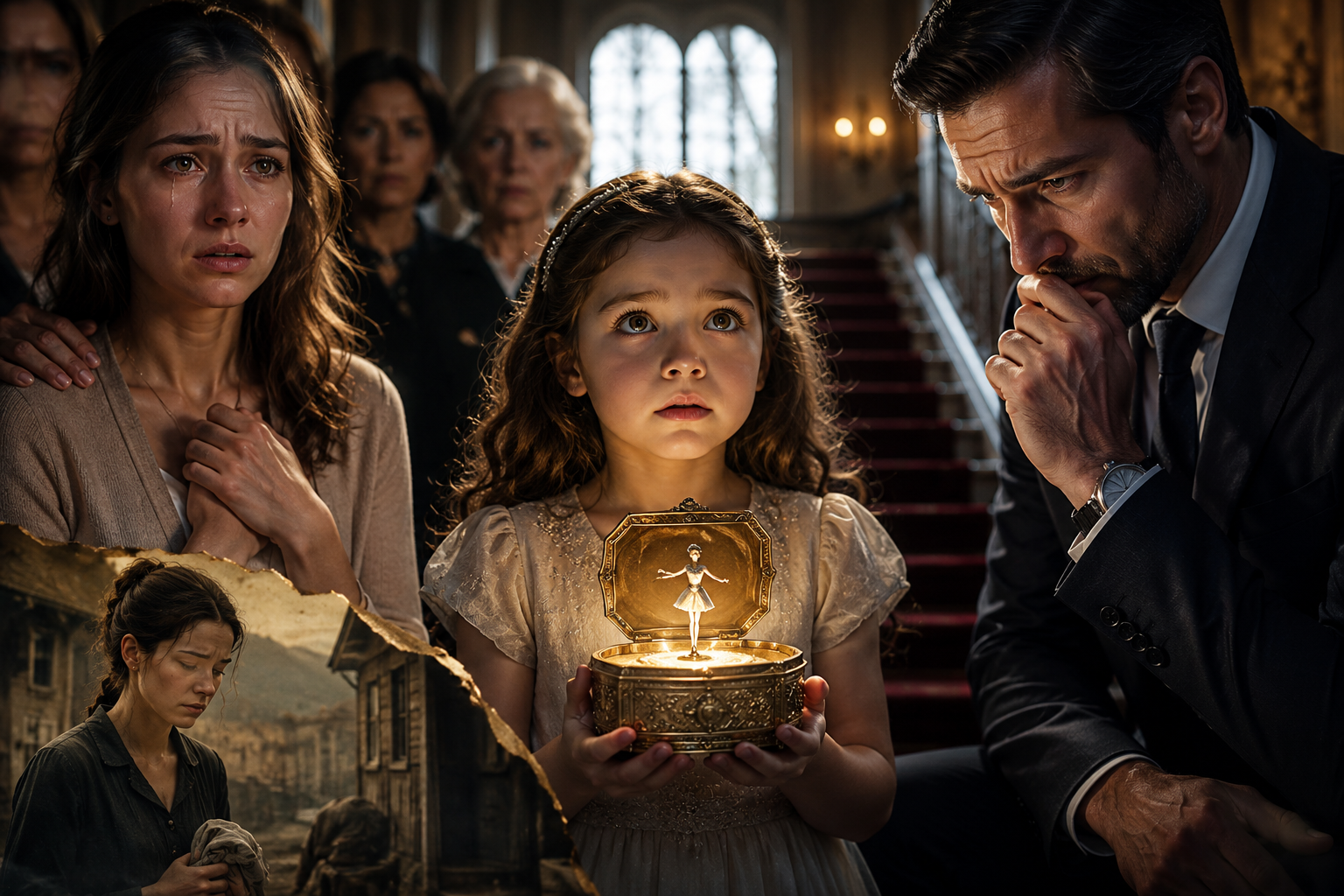
The store manager froze in the middle of the aisle.
For several seconds, he did not speak. He only stared at the small silver charm hanging from the old man’s coat pocket, as if the past had stepped out from behind the shelves and placed a hand around his throat.
The woman in the red store uniform, who had just accused the little girl of trying to steal, looked between them with a confused frown.
“Mr. Whitmore?” she asked. “Is something wrong?”
But the manager did not answer her.
His eyes stayed on the old man.
“Sir,” he said carefully, “may I ask your name?”
The old man looked down first.
Beside him, eight-year-old Lily stood with both hands wrapped around his sleeve. Her cheeks were still wet. She had been crying silently since the saleswoman told her poor children should not touch expensive dolls.
The old man’s jaw tightened.
Then he looked back at the manager.
“Thomas Vale.”
The name changed the air.
The manager’s face lost the last of its color.
Most customers inside Wonderlight Toys saw only a tired grandfather in a frayed brown coat. They saw scuffed shoes, silver hair, rough hands, and a child wearing a winter jacket two sizes too big.
But anyone who knew the true beginning of Wonderlight Toys knew the name Thomas Vale.
He had built the first display shelves with his own hands.
He had painted the first wooden sign.
He had stood beside Eleanor Whitmore when her little shop opened with eleven handmade dolls, a box of painted animals, and a dream too large for the narrow building that held it.
But money has a cruel memory.
It remembers signatures.
It forgets hands.
The manager swallowed.
“My grandmother used to talk about you,” he said.
Thomas stared at him.
“Your grandmother was Eleanor?”
The man nodded.
“I’m Julian Whitmore. I run this location now.”
Thomas studied his face.
Julian Whitmore.
He had seen the name in business articles. He had heard it on television when Wonderlight Toys opened stores in airports, malls, and luxury shopping districts. Julian would have been a child when everything happened.
Too young to know the truth.
Too young to stop the lie.
But old enough now to choose what to do with it.
The saleswoman tried to regain control.
“Mr. Whitmore, I was simply enforcing store policy. The child was handling merchandise without permission.”
Julian turned to her slowly.
“You told her she looked like she came in to beg.”
The woman’s mouth opened.
“I didn’t mean it like that.”
“I heard how you meant it.”
The silence that followed was hard and cold.
Lily pressed closer to her grandfather’s leg.
Thomas placed one heavy, gentle hand on her shoulder.
Julian’s gaze returned to the silver charm.
It was shaped like a tiny moon with a star cut into the middle. Old. Scratched. Worn smooth by twenty-two years of grief.
“May I see it?” Julian asked.
Every muscle in Thomas’s body resisted.
That charm had belonged first to Eleanor Whitmore.
Then to his daughter, Clara.
Now it belonged to him.
He closed his fist around it.
“It doesn’t leave my hand.”
Julian nodded immediately.
“Of course.”
That small respect surprised Thomas more than he wanted to admit.
For twenty-two years, every Whitmore who came near him had wanted something.
His silence.
His signature.
His apology for “misunderstanding.”
His agreement to stop “damaging the company’s reputation.”
Julian was the first one to ask permission and accept no for an answer.
The manager looked past Thomas toward the glass display at the center of the store.
Inside sat a blue music-box doll with painted lashes, a velvet dress, and a silver crank in her back.
“Why did you come here today?” Julian asked.
Lily’s fingers tightened around Thomas’s sleeve.
Thomas answered because lies had already taken too much.
“She wanted to see the doll her mother used to sing about.”
Julian’s expression shifted.
“The Moonlight Melody doll?”
Thomas looked at the blue doll.
He did not know that name.
But he knew the tune.
Clara had hummed it in their kitchen when Lily was a baby.
She hummed it when she was tired.
She hummed it in the hospital room during the last week of her life, when rain tapped against the window and machines breathed beside her bed.
“Yes,” Thomas said quietly. “That one.”
Julian went still.
“That doll was never supposed to be sold.”
The saleswoman blinked.
“What are you talking about? We sell those every Christmas.”
Julian shook his head.
“We sell the remake. The original prototype disappeared before the first collection launched.”
A murmur moved through the store.
Parents stopped pretending not to listen.
A cashier covered her mouth.
Lily looked up.
“Grandpa, what’s a prototype?”
Thomas lowered himself to one knee, though pain shot through both legs.