The Ten-Dollar Wife Who Opened a Million-Dollar Door
For nearly ten seconds, Malcolm Vale said nothing.
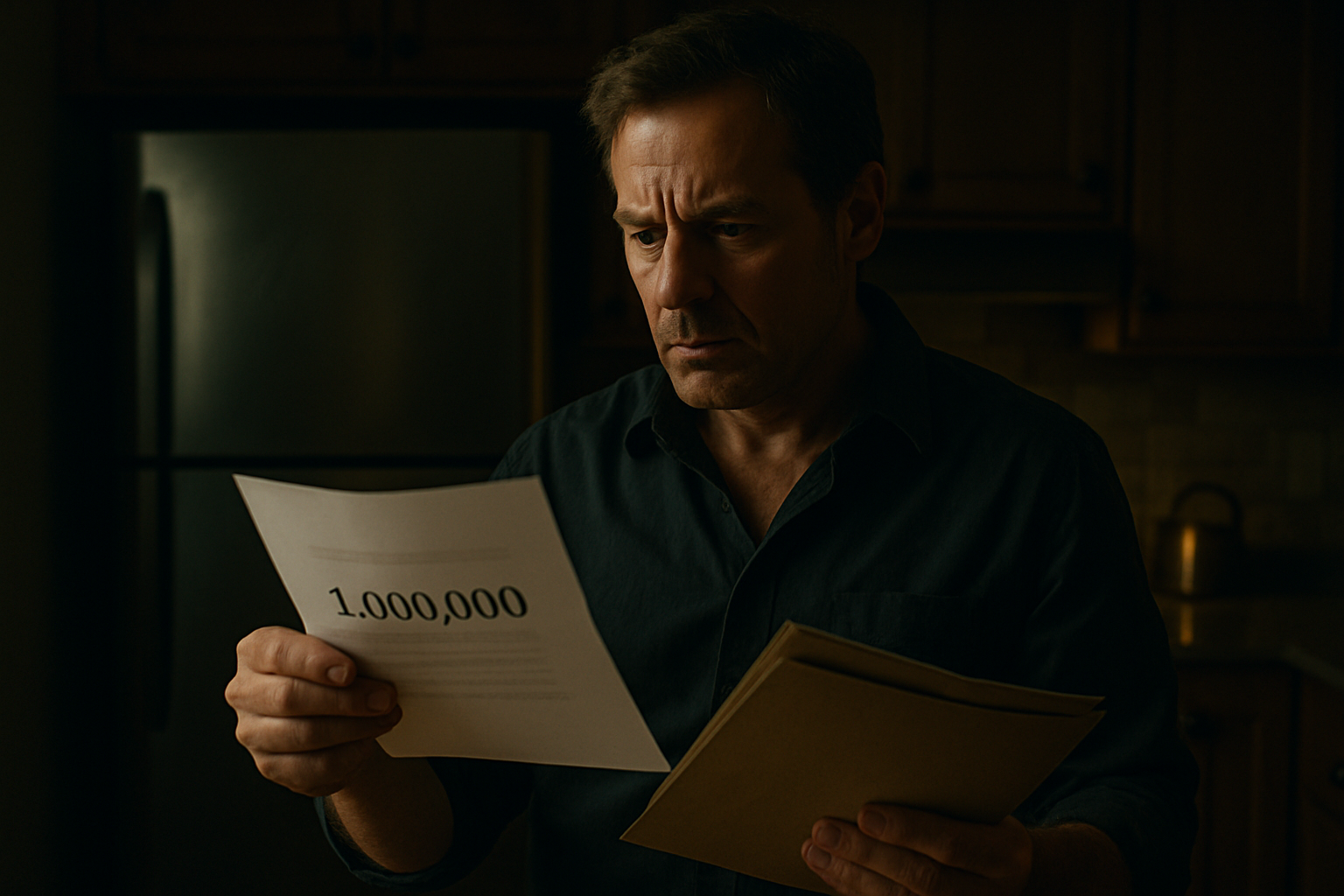
He stood in the kitchen with Adeline Mercer’s letter in one hand and the legal packet in the other. His eyes stayed fixed on the figure printed on the page, as if the number had insulted him personally.
One million dollars.
Behind him, the refrigerator hummed. The house was so still you could almost hear your own life coming back to you.
For twenty-two years, Malcolm had filled every room with himself.
His opinions. His plans. His complaints. His speeches. His little corrections. Even when he was gone, the house still bent around him. What Malcolm needed. What Malcolm expected. What Malcolm would want waiting when he came through the door.
Now he was quiet.
And Lydia Vale, to her own surprise, did not mind.
At last, he looked up.
“This is legitimate?” he asked.
You sat across from him at the kitchen table, still wearing the plain navy dress you had worn to dinner with Julian Mercer. No jewelry. No fresh lipstick. No effort to look like a woman hoping to be admired.
You were tired.
But you were not small.
“It’s legitimate,” you said.
Malcolm looked down again.
“A housing fund?”
“For women on the edge of eviction,” you said. “Adeline wanted it managed apart from your foundation.”
His head snapped up.
“My foundation?”
There it was.
The turn.
It was no longer shock. It was calculation.
You could almost see him rearranging the room in his mind. Sliding the money into place. Imagining the announcement. Measuring the donors’ applause.
Malcolm had always known how to turn another person’s suffering into words that made rich people clap.
Once, you had admired that.
Now it made your stomach tighten.
“No,” you said. “Not your foundation.”
His mouth hardened.
“Lydia, don’t be ridiculous. A million-dollar housing fund connected to the Vale name obviously belongs inside the structure we already have.”
“The structure we already have?”
He gave a sharp little laugh.
“You know what I mean.”
You did.
That had always been the trouble.
For twenty-two years, “we” had meant your labor and his applause. “Our marriage” had meant your endurance and his ambition. “Our foundation” had meant his name at the microphone and your hands on every hidden detail that kept the whole thing standing.
You folded your hands on the table.
“Adeline left it to me.”
Malcolm stared at you as if you had spoken a language he refused to learn.
“She probably didn’t understand the administrative side.”
Something settled inside you then.
Not rage.
Clarity.
You remembered Adeline at your kitchen table years before, rain still shining in her hair, both hands wrapped around a mug of tea as if it were the first warm thing she had touched in weeks. You remembered how quickly she listened. How fiercely she learned. How her whole face changed when she realized someone believed she could begin again.
Adeline had understood plenty.
Far more than Malcolm ever had.
“She knew exactly what she was doing,” you said.
He dropped the packet onto the table.
“Do you understand how this is going to look?”
You almost smiled.
Not because it was funny.
Because after the ballroom, the microphone, the laughter, the ten-dollar insult, Malcolm’s first fear was still appearances.
“Yes,” you said. “It will look like a woman you dismissed had a life you never bothered to notice.”
His face tightened.
“Don’t turn a bad joke into a trial of my character.”
“A bad joke?”
“It was a gala. People expect entertainment. You know how those rooms work.”
You looked at him for a long moment.
That was when you finally understood.
Malcolm had not accidentally humiliated you.
He had simply never considered your dignity worth protecting.
“They laughed because you gave them permission,” you said.
His eyes flickered.
And there it was.
Not remorse.
Annoyance.
He was not ashamed he had wounded you. He was irritated you had decided the wound counted.
He pulled out the chair across from you and sat.
“Fine,” he said. “I went too far. I apologize.”
The words were correct.
The tone was not.
You had spent decades translating Malcolm’s apologies. This one meant, Please stop making this inconvenient.
It did not mean, I understand what I destroyed.
You drew Adeline’s letter closer.
“No.”
His brows rose.
“No?”
“No,” you said. “You don’t get to lay a cheap apology over something you did in front of two hundred people.”
He leaned back.
“What do you want, then? Flowers? A public statement? An apology from the stage?”
You looked around the kitchen.
The marble counters. The pendant lights. The framed magazine cover with Malcolm’s face on the wall.
From the outside, this house looked like victory.
From where you sat, it looked like a beautiful room where a woman had slowly disappeared.
“I want you to understand something,” you said.
Malcolm sighed.
That sigh had ended hundreds of conversations.
It used to make you rush. Soften. Say, “Forget it.”
This time, you did not.
“I’m going to manage Adeline’s fund myself,” you said. “I’m going to meet with Julian’s attorneys. I’m going to build the housing program the way she asked. And your foundation will not touch it.”
His jaw tightened.
“You have no idea how much legal and administrative labor that involves.”
“I handled the legal and administrative labor for your foundation for fifteen years.”
“That’s different.”
“Why?”
“Because I was leading it.”
There it was.
Plain. Clean. Ugly.
A faint smile touched your mouth.
“Thank you.”
“For what?”
“For finally saying aloud what you’ve believed all along.”
He rose so fast the chair scraped the floor.
“I am not doing this tonight.”
“No,” you said. “For once, you are not deciding when the conversation is over.”
He froze.
The old Lydia would have lowered her voice.
The old Lydia would have worried about making things worse.
The old Lydia would have protected his comfort and called it love.
But the old Lydia had been auctioned for ten dollars beneath a glittering chandelier while strangers laughed.
She did not live in this house anymore.
Malcolm studied you.
“What are you saying?”
You picked up the letter and the legal packet.
“I’m sleeping in the guest room.”
His face changed.
That frightened him more than the money.
Not because he treasured you beside him at night.
Because separate rooms meant a crack in the story he sold the world.
“Lydia.”
You stood.
“No.”
He reached for your wrist.
Not violently. Not even forcefully.
Automatically.
As if your body were still part of the furniture of his life.
You looked at his hand.
Then at him.
“Let go.”
Something in your voice made him release you.
You walked upstairs without hurrying.
Behind you, Malcolm remained in the kitchen, surrounded by evidence that you had never been empty-handed.
The next morning, he tried tenderness.
That was how you knew he was afraid.
Malcolm made coffee, something he had not done in years. He set your mug beside your laptop and kissed your temple as if the night before had been a passing storm.
“Big feelings last night,” he said softly.
You looked at the coffee.
You did not touch it.
“Don’t do that.”
“Do what?”
“Talk to me as if I’m overreacting to my own humiliation.”
He looked wounded.
Malcolm was very good at looking wounded when accountability entered the room.
“I’m trying to repair this.”
“No,” you said. “You’re trying to make me easy to manage again.”
Before he could answer, your phone rang.
Julian Mercer.
Malcolm saw the name. His expression sharpened.
“You two are calling each other already?”
You answered without looking away from your husband.
“Good morning, Julian.”
Julian’s voice was calm, but tight.
“Lydia, I’m sorry to call early. My attorneys received a message from the Vale Foundation asking for preliminary coordination on the Mercer Housing Fund.”
You turned slowly toward Malcolm.
He looked away.
Of course.
Of course he had not waited.
Of course he had reached for the valuable thing the moment it appeared near you.
“I did not authorize that,” you said.
“I assumed as much,” Julian replied. “My mother was very clear. The fund is independent. I wanted you to know before anyone tried to muddy the water.”
“Thank you.”
“There’s something else,” he said.
Malcolm’s jaw locked.
“What?”
“Several donors from last night have contacted my office to ask whether the million-dollar bid was real. Some also asked whether you’ve been managing the Vale Foundation’s programs.”
Your heart beat once, hard.
“What do you mean?”
Julian’s voice softened.
“I think people are beginning to understand that your husband mocked the woman who kept his foundation breathing.”
You closed your eyes.
For years, part of you had longed to be seen.
Another part had feared it.
Invisibility had hurt.
But visibility had consequences.
When the call ended, Malcolm demanded, “What did he say?”
You set the phone down.
“Your office contacted his attorneys.”
“I was being proactive.”
“You were trying to take control of Adeline’s fund.”
“I was protecting you from being overwhelmed.”
You laughed once.
It startled you both.
“Protecting me,” you said. “Is that what you called it when you put a price on me last night?”
He struck the counter with his palm.
“It was a joke!”
Your voice stayed quiet.
“And everyone laughed because they knew you meant it.”
That landed.
For a moment, he had no answer.
Then his phone began to buzz.
Once. Twice. Again.
Board chair.
Major donor.
Public relations consultant.
The color drained from his face.
Then came the first news alert.
A society columnist had posted the clip from the gala.
The headline read:
Foundation Founder Offers “Useless Wife” for Ten Dollars — Anonymous Donor Bids One Million for Dinner With Her
Malcolm went pale.
The article was short and merciless. It described the laughter, the bid, the silence afterward, and the awkward applause that tried to cover what everyone had seen.
It ended with one sentence that felt like a match dropped into dry grass.
Several guests now say Mrs. Vale has long been the quiet force behind the foundation’s most successful programs.
Malcolm looked at you as though you had written it yourself.
“I didn’t leak this,” you said.
“Someone did.”
“You used a microphone,” you replied. “In a ballroom full of phones.”
His mouth opened.
Then closed.
For once, the obvious defeated him.
By noon, the clip was everywhere.
Not silly-viral.
Dangerous-viral.
One post cut deeper than the rest.
It came from a retired social worker named Nora Bell.
Malcolm Vale gave the speeches. Lydia Vale showed up. I watched her sit with families after the cameras left. I watched her arrange emergency motel rooms after midnight. If that woman is useless, I’d like someone to explain what usefulness means.
You read it three times.
Then you cried.
Not because you were sad.
Because being seen after years of silence can feel almost violent.
Malcolm spent the afternoon behind closed doors with his public relations team.
You heard pieces.
“Context.”
“Misunderstood.”
“Affectionate teasing.”
“Marriage humor.”
“Need Lydia beside him.”
That last phrase sent his assistant to your door.
Tessa stood there holding a printed statement, fear gathered around her eyes.
“Mrs. Vale,” she said, “Malcolm asked if you could review this before the five o’clock response.”
You took the page.
It began:
Last night, during a lighthearted charity moment, I made a teasing remark about my beloved wife, Lydia…
You stopped reading.
Beloved.
The word felt obscene in his mouth now.
You handed it back.
“No.”
Tessa swallowed.
“He really needs your approval.”
“He needed my dignity last night,” you said.
Her eyes dropped.
“I’m sorry.”
And you believed her.
Not because she had defended you.
She had not.
But many women learn to survive powerful men by staying employed near them.
You understood that too well to hate her.
At five o’clock, Malcolm released the statement without your approval.
It collapsed immediately.
People hated “teasing.”
They hated “beloved wife.”
They asked why a beloved wife had looked as if she wanted the floor to open and swallow her.
By seven, the board requested an emergency meeting.
By eight, Malcolm came to the guest room door.
He knocked once.
Then entered before you answered.
Old habits.
You were sitting on the bed with Adeline’s letter open beside you.
He stopped when he saw your suitcase.
It was small.
Only half packed.
But it did what no argument had done.
It made him understand you might truly leave.
“Lydia,” he said carefully.
You folded a sweater.
“The board is overreacting,” he said.
“Are they?”
“They want me to step aside temporarily.”
That surprised you.
Not because he didn’t deserve it.
Because institutions usually protect men like Malcolm until protecting them becomes too expensive.
“What did you tell them?” you asked.
“That I need you at the meeting tomorrow.”
There it was again.
Need.
Not love. Not remorse.
Need.
“You want me to rescue you.”
“I want my wife to stand with me.”
“You should have thought of that before you asked strangers if anyone wanted me for ten dollars.”
His face twisted.
“I said I was sorry.”
“You said words designed to help you escape consequences.”
He came farther into the room.
“I made a cruel joke. Yes. But are you really going to throw away twenty-two years over one night?”
You turned toward him fully.
“No,” you said. “I’m going to stop pretending one night wasn’t the truth about twenty-two years.”
He looked struck.
You kept going.
“You diminished me in front of donors. You introduced me as ‘the organized one’ while taking credit for programs I designed. You interrupted me in meetings. Corrected details you had wrong. Let people believe I was decorative because that belief served you.”
His eyes hardened.
You raised your hand.
“I am not finished.”
He stopped.
That small obedience felt enormous.
“You did not make me invisible all by yourself,” you said. “I helped. I told myself it was humility. I told myself marriage was teamwork. I told myself your success was our success.”
Your voice shook, but it did not break.
“But teamwork does not mean one person becomes a ladder while the other becomes a brass nameplate.”
For one second, real shame touched his face.
Then the instinct to survive returned.
“What do you want from me?”
“The truth,” you said.
“I’m sorry.”
“No. That is not the truth. That is the door you want to walk through without paying for the room you set on fire.”
He sank into the chair by the window.
“What truth?”
You looked straight at him.
“The gala files.”
His expression changed before he could stop it.
A flicker.
A shadow.
A door cracked open.
“For two years, I’ve noticed donor restrictions being shifted between program categories,” you said. “I asked you last March. You told me I didn’t understand accounting. I asked again in September. You told me to stop playing auditor.”
Malcolm went still.
The room became dangerous.
“What did you do?” you asked.
His voice dropped.
“Nothing illegal.”
That was not an answer.
That was a confession wearing a coat.
“Malcolm.”
He stood.
“I moved funds temporarily. Cash flow was tight. Some pledges came in late. The expansion campaign had to look strong.”
Your stomach dropped.
“Restricted funds?”
“Temporarily.”
“For what?”
He looked away.
“The gala. Donor cultivation. Branding. Consultants.”
The room seemed to tilt.
You thought of families waiting for rent assistance. Women calling after eviction notices arrived. Staff begging for budget approval while white orchids filled a ballroom.
Your voice came out almost too soft.
“You used housing money to buy applause.”
“Don’t make it sound so ugly.”
“It is ugly.”
“It was strategic.”
“It was theft from people who needed help.”
He flinched.
“Don’t use that word.”
“Why?” you asked. “Because it fits?”
He dragged both hands over his face.
“You don’t understand the pressure. Men like Julian Mercer don’t walk into a room unless the room looks powerful. The gala brings donors. Donors bring money. Money saves programs.”
“And if people were evicted while you were saving them?”
He said nothing.
The silence answered.
You rose slowly.
“Tomorrow, I’m going to the board meeting.”
Relief flashed across his face.
“Thank God.”
You looked at him.
“Not to save you.”
The relief vanished.
“To tell the truth.”
His face hardened.
“You think that million-dollar trust makes you powerful?”
You picked up Adeline’s letter.
“No,” you said. “It reminded me I already was.”
The next morning, you walked into the Vale Foundation boardroom wearing a gray suit Malcolm had once called “too serious.”
Julian sat at the far end as a guest observer, invited by board members suddenly very interested in why he had bid one million dollars for dinner with the founder’s wife.
Malcolm sat near the head of the table.
His face was composed.
His hands were not.
You noticed because you had spent years noticing everything.
The board chair, Beatrice Lorne, cleared her throat.
“Lydia, thank you for coming.”
Malcolm reached for your hand under the table.
You moved yours away.
Everyone saw.
The room understood before he wanted it to.
Beatrice began with the public scandal.
The clip. The donor calls. The failed statement.
Malcolm apologized in his polished way, saying he regretted “a moment of poor judgment” and valued your “quiet partnership.”
Quiet partnership.
You nearly laughed.
Then Beatrice turned to you.
“Lydia, would you like to say anything?”
Malcolm stared at the table like a man praying to a god he had ignored until thunder hit the roof.
You breathed in.
“Yes,” you said. “But not about the joke.”
The board shifted.
Malcolm lifted his head.
You opened the folder you had brought.
Not Adeline’s folder.
Your own.
For years, you had kept copies. Emails. Budget notes. Donor restriction letters. Program reports with unexplained delays.
You had not known what you were saving.
Maybe some part of you had.
“I believe the board needs to review restricted-fund transfers connected to the last two gala cycles,” you said.
Malcolm closed his eyes.
The general counsel leaned forward.
“What kind of transfers?”
You slid the documents down the table.
“Housing assistance funds moved into event production, donor cultivation, and campaign branding accounts. I raised concerns twice. I was told I misunderstood the accounting.”
No one spoke.
Then Julian said quietly, “My mother’s trust will not be linked to any institution under financial investigation.”
The sentence fell like a gavel.
Malcolm turned on him.
“This has nothing to do with you.”
Julian’s expression did not change.
“You auctioned your wife. I bought dinner. At dinner, I learned she was the only person in your orbit my mother trusted. So yes, Mr. Vale. Unfortunately for you, it does.”
Beatrice looked at counsel.
“Begin an independent audit immediately.”
Malcolm stood.
“Beatrice, wait.”
She did not.
“Malcolm Vale is placed on administrative leave pending review.”
The room went still.
Malcolm looked around at people who had applauded him for years.
None of them rescued him.
That was when you understood something about public admiration.
It is not love.
It is rent.
And when the house catches fire, admirers move out fast.
Malcolm looked at you last.
“How could you?” he whispered.
You gathered your papers.
“The same way you did,” you said. “In front of witnesses.”
You left before he could answer.
Julian followed you into the hallway.
For a moment, neither of you spoke.
Then he said, “My mother would have liked that.”
You laughed softly.
“Would she?”
“She had very little patience for arrogant men after my father.”
A real smile came.
Then faded.
“I didn’t want it to happen this way,” you said.
Julian nodded.
“Good. That means you are not like him.”
Those words stayed with you.
Because the hardest part of leaving a long marriage is not packing.
It is wondering whether pain has made you cruel.
But cruelty wants humiliation.
Truth wants air.
You had given the truth air.
What followed was not clean.
Real life rarely is.
The audit found more than you expected. Restricted funds had been shifted again and again. Some had been replaced later. Some had not. Malcolm had authorized misleading reports, pressured staff to delay payments, and used foundation money to preserve the image of growth while vulnerable families waited for help already funded.
The scandal grew.
Not because of the ten-dollar joke anymore.
That had only been the door.
Behind it was a house full of rot.
Malcolm resigned after ten days.
The day before the announcement, he called seventeen times.
You answered once, with your attorney present.
His voice sounded smaller.
“Lydia, please,” he said. “They’re going to ruin me.”
You sat in Julian’s conference room, Adeline’s letter tucked in your bag.
“No,” you said. “They’re going to report what you did.”
“I did it for the foundation.”
“You did it for the version of yourself the foundation reflected back at you.”
He went quiet.
Then he asked the one question that still had power to hurt.
“Was none of it real to you?”
You closed your eyes.
Twenty-two years rose before you.
Bills spread over the kitchen table. Late-night laughter. His hand at your back at your mother’s funeral. The first cramped office you painted together. The day he cried when the foundation received its first major grant.
Some of it had been real.
That was the cruelty.
Real love can still be buried beneath entitlement.
“Yes,” you said. “Some of it was real.”
His breath shook.
“But you made me pay for it by disappearing inside it.”
Then Malcolm began to cry.
Once, you had imagined that sound would satisfy you.
It did not.
It only made you tired.
“I don’t know who I am without this,” he said.
“I know,” you answered. “That is why you should have protected the people who helped you become it.”
He asked if you would come home.
You said no.
Not angrily.
Not dramatically.
Just no.
It was the cleanest word you had ever spoken.
Six months later, the Vale Foundation had a new name.
Not yours.
You refused that.
The board renamed it Harborlight Community Housing Initiative, after the first emergency shelter program you had quietly designed years before.
You accepted a limited advisory role on one condition.
Every donor report would include staff names, not only executive names.
Every program lead would be credited.
Every dollar restricted for housing would stay in housing.
No more invisible women holding up visible men.
Adeline’s fund stayed separate, exactly as she had wanted.
You named it the Mercer Doorway Trust.
The first building it purchased was a small brick apartment house in Eastmere, with cracked front steps, good bones, and sunlight in the kitchen windows.
You stood on the sidewalk the day the papers were signed, keys resting in your palm.
Julian stood beside you.
“My mother would cry,” he said.
You looked up at the building.
“So would I, but I put on mascara.”
He smiled.
You both cried anyway.
The first residents moved in at the beginning of spring.
A mother with two daughters who had been sleeping in her car.
A retired nurse whose landlord had doubled her rent.
A young woman leaving a marriage so quietly dangerous she flinched when any man raised his voice.
You met each one at the door.
Not as a savior.
Not as a benefactor.
As a woman who finally understood that shelter is more than walls.
It is the first place where fear stops following you from room to room.
One afternoon, while you carried donated dishes into the community kitchen, Nora Bell looked at you and smiled.
“Do you know what people are calling this place?”
You shook your head.
“The ten-dollar miracle.”
You groaned.
“Please don’t let that become the name.”
“It already has.”
You laughed.
For the first time in a long time, laughter did not feel borrowed.
It belonged to you.
In July, Malcolm sent a letter.
Not an email.
Not a text.
A real letter, handwritten and uneven.
You almost threw it away.
Then you read it on a bench outside the Eastmere building while children drew chalk flowers on the sidewalk.
He did not ask you to come back.
That surprised you.
Near the end, he wrote:
I called you useless because I was terrified that if people saw what you were, they would see what I was not.
You read the sentence twice.
Then you folded the letter.
For years, you had wanted Malcolm to understand.
Now that he did, it did not change your decision.
That was another surprise.
Closure does not always reopen a door.
Sometimes it simply lets you walk away without turning back.
The divorce became final in September.
That same week, the Mercer Doorway Trust held its first public fundraiser.
You almost canceled when you saw the invitation draft.
Your name was too large.
Your photograph too central.
The old instinct returned at once.
Make it smaller.
Move it lower.
Put the work first.
Julian watched you stare at the design.
“You’re allowed to be seen,” he said.
You looked at him.
“I don’t want to become what I left.”
“You won’t,” he said. “Because that worries you.”
That night, you stood in a different ballroom.
No golden excess.
No cruel jokes.
No husband pacing the stage with a microphone and a grin.
Only warm lights, round tables, former residents, social workers, donors, staff, and a framed photograph of Adeline Mercer near the entrance.
When it was time to speak, your hands trembled.
Not because you feared being mocked.
Because being heard has weight.
You stepped to the microphone.
A year earlier, that object had been turned against you.
Now it waited.
You looked out at the room.
“I used to believe kindness did not need witnesses,” you began. “A woman named Adeline Mercer disagreed with me.”
Julian lowered his eyes, smiling.
“She believed quiet good should not stay hidden forever,” you continued, “because hidden labor is too easy for the wrong people to steal. She believed a door opened for one woman could become a hallway for many more.”
You paused.
Your voice shook, but only a little.
“A year ago, someone tried to put a price on me in a ballroom. Ten dollars. It was meant to make me small.”
The room went silent.
“But no insult can appraise a life. No cruel joke can measure a woman’s worth. And no one who profits from your silence gets to decide what your voice is worth when you finally use it.”
Applause rose.
Not polite applause.
The kind that moves through the chest.
You looked first at the staff table.
Then at the women from the building.
Then at Julian.
You did not look for Malcolm.
He was not there.
And his absence felt peaceful.
After the speech, an older woman approached you near the lobby. She wore a plain black coat and held a program folded in both hands.
“I don’t have much,” she said. “But years ago, someone let me sleep on her sofa when I had nowhere else to go. I never forgot it.”
She pressed a check into your hand.
Twenty-five dollars.
Your eyes filled.
Because now you understood.
The million-dollar bid had stunned the ballroom.
But this check mattered too.
Kindness did not become powerful because it became rich.
It became powerful because it kept moving.
One door.
Then another.
Then another.
Late that night, after the guests left and the staff finished cleaning, you stood alone in the empty ballroom.
The microphone was off.
The lights were dim.
The tables held half-folded linens and forgotten coffee cups.
You thought of the woman you had been the night Malcolm laughed.
Hands folded.
Face composed.
Heart cracking quietly while strangers decided whether your humiliation was amusing.
You wished you could go back and stand beside her.
You wished you could tell her not to confuse endurance with love.
You wished you could whisper that one day, the room would stop laughing.
But maybe she had known.
Maybe the stillness inside her had not been defeat.
Maybe it had been the first sound of a lock turning.
Julian appeared beside you with two paper cups of coffee.
“You disappeared,” he said.
“Just thinking.”
He handed you one.
“Dangerous habit.”
You smiled.
“Apparently, it’s worth at least a million dollars.”
He laughed softly.
Then the room settled into quiet.
Not the old quiet.
Not the kind that swallowed you.
This quiet had room inside it.
Julian looked toward Adeline’s photograph.
“She really did want to find you,” he said.
“I wish I could have seen her again.”
“She knew.”
You turned to him.
“She knew what?”
“That you would know what to do.”
You looked down at the coffee warming your hands.
For twenty-two years, Malcolm had treated you like a background detail in his story.
But Adeline had seen you in one ordinary week.
Julian remembered you because his mother had.
The women in Eastmere knew your name.
The staff knew your name.
And at last, so did you.
Outside, the city glittered in the cold.
Somewhere, people were being locked out, priced out, pushed out, told they were difficult, useless, too late, too much, not enough.
Tomorrow, there would be calls to make.
Forms to review.
Doors to open.
Real work.
The kind that does not always become a headline but decides whether someone sleeps safely at night.
You took one last look at the empty stage.
Then you turned away.
The woman Malcolm tried to auction for ten dollars was gone.
Not destroyed.
Released.
And in her place stood someone he had never cared enough to meet.
A woman with her own name.
Her own work.
Her own doorways.
Her own light.
And this time, when the room went silent, it was not because you had been humiliated.
It was because everyone was finally listening.

