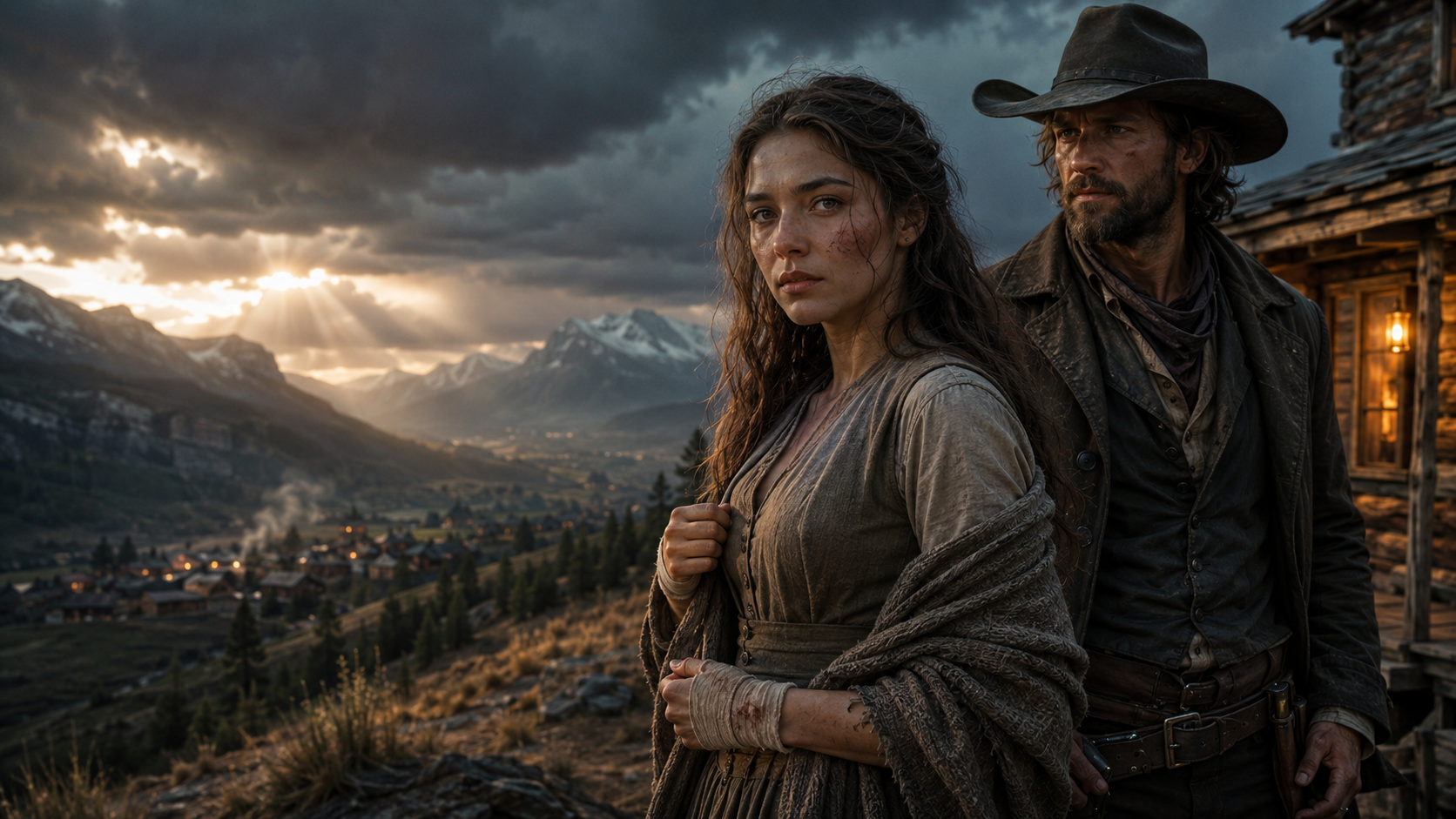
“Bring Me the Monster,” the Mountain Rider Said — Then He Found the Real Sickness in Town

When Rowan Pike first saw the woman, she was standing at the edge of the storm like a thing the mountain had refused to swallow.

Rain ran from the brim of her torn bonnet. Mud covered the hem of her dress. One sleeve hung loose where the stitching had failed, and beneath it her arm was wrapped in dirty linen. She stood twenty yards from his cabin door, trembling so hard the lantern light caught the motion.

Most people who climbed to Pike’s Ridge came with a reason.

A mule with a broken leg.

A child blue with fever.

A man bleeding from a knife fight he swore had begun as friendly cards.

This woman carried no child, led no animal, dragged no wounded man behind her.

She had come carrying only herself.

And from the way she looked at the cabin, even that seemed too much.

Rowan opened the door wider. The fire behind him bent in the draft.

“Come in,” he said.

The woman did not move.

Her eyes, dark and fever-bright, fixed on him through the rain. “Are you Pike?”

“Depends who’s asking.”

“A dead woman.”

That made him step onto the porch.

Lightning opened the valley for a breath, showing him the narrow trail behind her, the black pines, the long fall down toward the town of Briar Glen. No horse. No wagon. No companion. She had climbed the ridge alone in weather that sent wolves into their dens.

Rowan’s voice lowered. “Who called you dead?”

Her mouth twisted, though not quite into a smile. “Everyone.”

Thunder rolled over the mountains.

“Everyone is rarely worth listening to,” he said. “Come inside before you prove them right.”

She swayed.

Rowan moved before she fell. He caught her by both shoulders, expecting bones. Instead he found a strong frame starved thin by fear and neglect. She gasped when his hand touched her sleeve.

“Pain?”

“All over.”

“That’s not an answer.”

“It’s the only one I have.”

He guided her into the cabin. She tried to pull away when the light reached her face, as if she expected him to recoil.

He did not.

He had seen men with half a cheek gone from cannon fire. He had seen miners dragged from collapsed shafts with stone dust packed into their lungs. He had seen childbirth turn a bed into a battlefield. A woman with cracked skin and frightened eyes did not scare him.

Still, he noticed everything.

The raw patches along her neck. The blistering around her wrists. The way she held her hands curled inward. The smell of cheap salve beneath rainwater and old wool. The hunger in her face. The shame sitting heavier on her shoulders than the wet dress.

He pointed to the chair beside the hearth. “Sit.”

She obeyed, then immediately looked ashamed for obeying.

“What’s your name?”

“Mara.”

“Full name.”

She hesitated. “Mara Wren.”

A seamstress name, Rowan thought. Or a widow’s name. Something quiet. Something people forgot until they needed mending done.

He set a kettle over the fire. “Who sent you up here, Mara Wren?”

“No one sends people to you.”

“Usually they send curses first.”

Her eyes flicked toward him. “They said you were dangerous.”

“I am, depending on the company.”

“They said you cut men open.”

“Only when leaving them closed would kill them.”

“They said you were thrown out of the army hospitals.”

“I walked out.”

“Why?”

“Because commanders enjoy clean ledgers more than living soldiers.”

She stared at him as if deciding whether that made him better or worse.

Rowan took a blanket from the peg and held it out. “Take off the coat.”

Her fingers froze at her collar.

“I need to see the wounds.”

“They’re not wounds.”

“What are they?”

Her throat moved. “The mark.”

He waited.

“The mark of rot,” she whispered. “Dr. Harrow said it was in my blood. He said it was eating me from the inside.”

Rowan went very still.

Dr. Lucian Harrow of Briar Glen wore a pearl tiepin, kept his nails polished, and spoke with the voice of a church bell. He also had a habit of deciding poor people were morally responsible for illnesses rich people found inconvenient.

“What else did Harrow say?”

“That I should not touch anyone. That no one should touch me. That my sheets should be burned. That the church should seat me outside. That if children came near me, they might carry it home.”

Rowan’s jaw tightened.

“Show me.”

Mara flinched.

He pulled a chair closer and sat opposite her. “You climbed six miles in a storm. Don’t stop at the door.”

Her laugh was small and broken. “You don’t understand. People screamed when they saw my hands.”

“I didn’t ask for people. I asked for the monster.”

Slowly, Mara unwound the linen from her right hand.

The cloth stuck to the skin in places. She bit her lip hard enough to turn it white. Beneath the wrapping, her hand was red, cracked, swollen around the knuckles, with shiny patches where blisters had opened and dried badly. The rash climbed her wrist like fire caught under the skin.

She would not look at it.

Rowan did.

Not with disgust.

Not with pity.

With attention.

He took her hand carefully, palm up, then palm down. His touch was firm but never careless. He examined the spaces between her fingers, the curve of her nails, the ragged line where the rash stopped below the sleeve.

“Does it itch?”

Mara swallowed. “Until I want to tear the skin off.”

“Burn?”

“Yes.”

“Worse after washing?”

Her eyes lifted.

“After sewing? After handling dyed cloth? After using Harrow’s salve?”

She stared at him as though he had opened a locked room inside her life.

“Yes,” she said. “Yes. Especially the blue thread. And the green ribbons from Mrs. Calder’s shop. I thought I was imagining it.”

“What did Harrow ask you?”

“He looked from the doorway.”

“Did he touch the rash?”

“No.”

“Did he ask what you worked with?”

“No.”

“Did he ask what was in the salve he sold you?”

“He made it.”

“That is not an answer.”

Her chin trembled. “No.”

Rowan stood and crossed to the shelf where he kept jars, cloth, instruments, and bottles with labels only he bothered to understand. He spoke without turning.

“You are not rotting.”

The room went silent except for the rain.

Mara’s lips parted.

“What?”

“You heard me.”

“No.”

“Yes.”

“No,” she said again, and this time it came out almost angry. “Don’t say that if you don’t know.”

“I know enough.”

“Dr. Harrow said—”

“Dr. Harrow is wrong.”

The words struck harder than thunder.

Mara pushed herself out of the chair, then staggered and grabbed the table. “No. No, if he was wrong, then the town—then all of them—”

“Were afraid.”

“They threw stones.”

“I know.”

“They left food on the road like I was a dog.”

“I know.”

“They told my aunt to lock the door when I came.”

Rowan turned then. His face, carved by weather and old sorrow, hardened.

“I know.”

“How could you know?”

“Because Briar Glen has done this before.”

Mara’s breath came in shallow pulls.

He set a basin on the table and poured warm water into it. “You likely have a severe reaction from chemicals in the cloth dyes, made worse by hunger, wool rubbing open skin, and whatever poison Harrow put into that salve. It can become dangerous if neglected. It can scar. It can infect. But it is not a curse, not a plague, and not proof that God has grown bored of mercy.”

Mara folded as if the bones had gone from her.

Rowan caught her before she hit the floor.

She did not sob loudly. She made only one sound, a thin crack of grief, and then she covered her mouth with her ruined hands as if even her crying was something shameful.

Rowan did not tell her to stop.

He had never trusted men who rushed to silence pain.

He only said, “This next part will hurt.”

Mara gave a wet, disbelieving laugh. “Everything hurts.”

“This will hurt toward healing.”

That was the first sentence she did not know how to answer.

He cleaned the wounds. Slowly. Thoroughly. When cloth stuck, he soaked it until it let go. When the wash stung, Mara shook and cursed him under her breath. When she apologized for cursing, he ignored the apology. When she tried to hide her hands, he brought them gently back into the light.

By midnight, her arms were wrapped in clean cotton. Her hair was drying near the fire. A bowl of stew sat empty beside her, though she had wept halfway through eating it because hunger, once fed, reminded the body how long it had been betrayed.

Rowan gave her the bed.

She refused.

He pointed at the floor. “You can argue with me tomorrow if you survive the night.”

“I’m not taking your bed.”

“You are if you want treatment.”

“You’re rude.”

“I’ve been called worse by people with stronger lungs.”

She looked at him then, and for the first time something almost like life moved behind the fear.

“Do you speak kindly to anyone?”

“Animals. Sometimes babies. Rarely adults.”

Mara slept in the bed.

Rowan slept by the hearth with one boot still on and a rifle within reach.

But Mara did not sleep quickly. She lay awake under a wool-free blanket, staring at the rafters while the mountain wind worried the cabin walls.

Not dying.

The words frightened her.

Dying had become the one thing she knew how to do. The town had taught her to disappear inch by inch. Stop knocking. Stop asking. Stop sitting inside the church. Stop hoping someone would choose truth over comfort.

If she was not dying, then something worse waited.

Living.

Living meant remembering who had watched and done nothing.

At dawn, Rowan was already awake, grinding dried leaves with a pestle.

Mara sat up slowly. Her hands throbbed, but the fire beneath the skin had softened.

“Do you always rise before daylight?” she asked.

“Only when I plan to outlive the foolish.”

“Is that every day?”

“In Briar Glen territory, yes.”

On the foot of the bed lay a folded shirt and a pair of trousers.

Mara stared at them. “Those are yours.”

“They’re cotton.”

“They’re men’s clothes.”

“They’re clean.”

“I can’t wear trousers.”

“You can wear cotton, or you can bleed into that dress until pride kills you faster than Harrow’s diagnosis.”

She hated that he was right.

By noon, she wore the trousers.

By sundown, she had chopped carrots badly, spilled half a bucket of water, and learned that Rowan Pike did not consider invalids useless unless they insisted on being useless.

“You’ll help where you can,” he said. “Rest where you must. Learn the difference.”

“I’m not afraid of work.”

“No,” he said, tying a fresh bandage around her wrist. “You’re afraid that work is the only thing people valued you for.”

She jerked her hand back.

He let her.

“You don’t know me.”

“I know what people look like when they apologize for taking up space.”

Mara turned toward the window.

Outside, the clouds had broken open over the mountain. Far below, Briar Glen sat in the valley, small and neat and cruel in the morning light.

“I was useful once,” she said. “Before this. I sewed their dresses. Mended their coats. Hemmed mourning black for women who would not look me in the face when I became the one grieving.”

Rowan said nothing.

His silences were not empty. They made a person hear herself.

For two weeks, Mara healed in increments so small they felt insulting.

The itching did not vanish. Her skin did not become beautiful. Her strength did not return in a grand sunrise moment. It crept back while she ate eggs, broth, beans, bitter greens, and meat when Rowan had it. It returned while she hauled one log, then three. While she slept four hours without scratching. While she learned to wash her skin without tearing it open.

Every morning Rowan unwrapped her hands and inspected the changes.

Every morning she looked away.

On the fifteenth day, he said, “Look.”

“I don’t want to.”

“You should.”

“I know what they look like.”

“No. You know what they were.”

Mara forced herself to look.

The wounds had closed in several places. The swelling had receded. The skin remained scarred and pink, but it looked less like punishment and more like skin.

Her hands.

Still hers.

A sound rose in her throat.

Rowan began reaching for a cloth, then stopped. Perhaps he knew this was not the kind of crying that needed wiping away.

“Better?” he asked.

She nodded.

“Words.”

“Yes,” she whispered. “Better.”

“Good. Don’t become stupid about it.”

She almost laughed.

That afternoon he rode to town for supplies.

Mara stood on the porch long after the horse disappeared into the trees. The mountain seemed too large without him. The cabin, too quiet. She hated that she had begun to feel safer in a strange man’s house than in the streets where she had spent her whole life.

He returned near dusk with flour, salt, coffee, thread, a sack of apples, and a face like bad news.

Mara knew before he spoke.

“They know I’m here.”

Rowan set the supplies down. “Harrow knows.”

Her stomach tightened. “How?”

“Silas Voss saw smoke from the ridge and sold his guess for a drink.”

Silas Voss had once asked Mara to sew a wedding vest on credit, then told people she had begged him for attention when she asked for payment.

“What will Harrow do?”

“What weak men do when cornered. Call fear duty.”

Three days later, fear climbed the mountain.

They came in the cold afternoon: five men on horseback and one carriage that had no business on the narrow ridge trail. Dr. Lucian Harrow stepped down first, coat black, gloves gray, silver watch chain glinting against his waistcoat. Behind him came Constable Reed, Silas Voss, two hired hands from the mill, and Mrs. Calder, the cloth shop owner, wrapped in fox fur and righteousness.

Mara watched from the porch with her bandaged hands at her sides.

Rowan stood beside her, rifle held low.

Harrow smiled as if arriving for tea.

“Miss Wren. What a mercy to find you alive.”

Mara said nothing.

He looked at Rowan. “Pike. I should have known decay would find its way to your door.”

Rowan’s expression did not change. “You brought a crowd to admire it?”

“I brought witnesses. This woman is under quarantine by my medical order. You have no authority to keep her here.”

“She walked here.”

“She is sick.”

“She is healing.”

Harrow’s smile thinned. “You were a battlefield butcher. Not a physician.”

“And yet I had to ask the questions you didn’t.”

Constable Reed shifted uncomfortably. “Doc says she’s dangerous, Pike.”

Rowan looked at him. “Then ask him how.”

Reed blinked.

Harrow’s gaze sharpened. “This is not a public lecture.”

“No,” Mara said.

Everyone looked at her.

Her voice shook, but she continued. “It should be.”

Harrow’s face cooled. “Miss Wren, you are confused.”

“I was confused when you told me not to touch my own face. I was confused when you told my aunt to burn my bedding. I was confused when Mrs. Calder refused to pay me for the dresses I had already sewn because she said my hands had ruined them.”

Mrs. Calder lifted her chin. “I had customers to consider.”

“You had money to consider.”

A murmur ran through the men.

Mara began unwinding one bandage.

Rowan’s eyes moved to her hands, but he did not stop her.

Harrow did. “Miss Wren, that display is unnecessary.”

“No,” she said. “It is evidence.”

She held up her hand.

The scars were visible. So was the healing.

Silas Voss frowned. “Looks better than it did.”

“That is because it was treated,” Rowan said.

Harrow snapped, “With what? Mountain superstition?”

“With cleanliness, food, removing the irritant, and not smearing poison on broken skin.”

The word poison moved through the clearing like a struck match.

Harrow’s mouth tightened. “Careful.”

Rowan stepped forward. “I’ve been careful. You were careless.”

One of the hired men laughed. “Want us to take her down, Doctor?”

Rowan lifted the rifle slightly.

Not to his shoulder.

Only enough.

The laughter died.

“If any man grabs her,” Rowan said, very softly, “he’ll need a new hand before sunset.”

The hired man swallowed.

Harrow looked from Rowan to Mara, and for the first time Mara saw it: not certainty. Calculation.

He had come expecting a frightened woman.

He had found a witness.

“This will be reported,” Harrow said.

“Good,” Mara answered. “Report all of it.”

After they left, her legs failed.

Rowan caught her elbow.

“I shook the whole time,” she said.

“But you stood.”

“I thought I was going to faint.”

“But you stood.”

Those three words became a nail in the wall of her new life. Something to hang courage on when courage had no shape of its own.

Winter came, and with it work.

Rowan did not mean to make her his apprentice.

At least, that was what he claimed.

But one snowy evening he found her studying the labels on his jars, and instead of telling her to stop, he asked, “Which would you use for a burn?”

“I don’t know.”

“Then learn before curiosity kills someone.”

The next morning, a stack of medical books appeared on the table.

Mara stared at them. “All of these?”

“Planning to be half useful?”

“I didn’t say I wanted to be useful to you.”

“No. You keep acting like you want to be useful to yourself.”

She read by firelight until her eyes ached. Rowan quizzed her while she kneaded bread, while she swept, while she tried to rest.

“Child with fever and stiff neck.”

“Dangerous. Needs immediate care.”

“Man falls from horse. Leg bent wrong.”

“Check blood flow. Keep him still. Don’t let fools yank it straight.”

“Woman screaming during birth, bleeding too much.”

Mara froze.

Rowan’s gaze sharpened. “Answer.”

“I don’t know.”

“That answer kills people.”

Her face flushed.

He did not apologize.

So she learned.

Patients came because mountains have no respect for official reputations. A miner with a crushed thumb. A trapper half frozen. A boy with a cough that rattled like stones in a tin cup. A mother who arrived in labor with terror in her eyes because the baby had not moved right for a day.

Mara held the woman’s shoulders while Rowan worked.

There was blood.

There was screaming.

There was a moment when Mara thought she would run.

She did not.

Afterward, when the baby cried and the mother lived, Mara stumbled outside and vomited behind the woodpile.

Rowan found her crouched in the snow.

“I’m sorry,” she gasped.

“For what?”

“I thought I was stronger.”

“You stayed.”

“I was afraid the whole time.”

“Good.”

She looked up at him, furious and pale. “Good?”

“Fear means you understand a life is not a sewing pattern. You can’t cut a second one if you ruin the first.”

That night Mara opened a blank ledger and wrote her first case note.

Mrs. Ellen Roake. Difficult birth. Mother lived. Child lived. I did not run.

Spring thawed the ridge and changed the gossip below.

At first Briar Glen whispered that Rowan Pike had bewitched the Wren woman.

Then they whispered that Harrow had been mistaken.

That whisper was the dangerous one.

Dr. Harrow could endure being feared, envied, and even disliked. But he could not endure being questioned.

In April, the territorial medical inspector arrived with a satchel, a gray traveling coat, and eyes that made lies uncomfortable.

Her name was Dr. Beatrice Lorne.

She came up the ridge with Constable Reed, Dr. Harrow, and Mayor Ainsley, who smiled at everyone as if hoping history would forget he had been present.

“I am here,” Dr. Lorne announced, “to investigate allegations of unlawful medical practice, improper confinement of a vulnerable woman, and reckless treatment endangering the public.”

Mara nearly laughed.

Improper confinement.

Rowan made her scrub instruments until her fingers cramped, read until she dreamed in symptoms, and eat when grief tried to convince her she did not deserve hunger. But confinement was not the word.

Dr. Lorne inspected the cabin.

She examined the shelves, instruments, records, and ledgers. She asked Rowan where he had learned medicine.

“War hospitals,” he said. “Then under Dr. Amos Bell in St. Joseph.”

“License?”

“No.”

Harrow’s mouth curved.

Dr. Lorne turned to Mara. “And you?”

Mara felt every eye on her.

In the old days, she would have looked at the floor.

Now she forced herself to stand inside her own name.

“Mara Wren. Former seamstress. Student under Mr. Pike.”

Harrow gave a soft laugh. “A seamstress playing physician.”

Mara looked at him. “Better than a physician playing executioner.”

Constable Reed coughed.

Dr. Lorne’s mouth did not smile, but her eyes almost did.

“Let us test the seamstress,” she said.

She asked about fever, shock, frostbite, infection, childbirth, contamination, and care of wounds. Mara answered with a voice that shook only twice. When Dr. Lorne asked about chemical skin injuries, Mara met Harrow’s eyes and spoke clearly.

“Redness. Burning. Cracking. Blisters. Worse where the irritant touches. Remove exposure. Clean gently. Protect the skin. Watch for infection. Feed the patient enough to heal.”

Dr. Lorne studied her. “And what caused yours?”

“Dyed fabric from Mrs. Calder’s shop, worsened by Dr. Harrow’s salve.”

Harrow stepped forward. “This is slander.”

Mara held his gaze. “No. It is memory.”

Over two days, people climbed the ridge to testify.

The mother whose baby had survived.

The miner whose thumb still bent.

The trapper who held up all ten fingers and declared Rowan Pike rude, ugly, and useful.

A widow named Mrs. Ives told Dr. Lorne that Harrow had refused to see her grandson’s fever until she produced payment, while Rowan had ridden down in the rain for nothing but a loaf of bread.

By the end, Dr. Lorne’s face had changed.

“Mr. Pike,” she said, “you are skilled. You are also exposed. Take the licensing examination in Denver. Pass it, and men like Dr. Harrow will have less rope to throw around your neck.”

Rowan’s face closed. “Paper does not make a healer.”

“No,” Dr. Lorne said. “But it sometimes keeps one out of jail.”

After she left, Rowan stood by the window for a long time.

Mara let the silence stretch until it grew teeth.

“You should take it,” she said finally.

He looked back. “You should mind your own recovery.”

“You are my recovery.”

His expression shifted.

She stepped closer. “Not because you saved me. Because if they take you, they take every person who climbs this ridge when Briar Glen shuts its doors.”

“I survived before permission.”

“You are not alone now.”

That landed harder than she expected.

Rowan took the examination in July.

While he was gone, Mara kept the cabin open.

The first day brought a twisted ankle. The second, a child with a fishing hook buried in his palm. On the fourth night, a farmer carried his wife through the door wrapped in a blood-soaked sheet, his face blank with panic.

Mara’s fear rose so fast she almost drowned in it.

Then Rowan’s voice came from memory.

First breathe. Then choose.

She worked until dawn.

The woman lived.

The child she had been carrying did not.

When the woman woke and understood, Mara sat beside her and held her hand through the first terrible wave of grief.

“I’m sorry,” Mara whispered.

The woman’s fingers tightened around hers. “Am I alive?”

“Yes.”

“Then don’t apologize for saving what could be saved.”

Rowan returned that afternoon with dust on his coat, exhaustion under his eyes, and a folded certificate in his hand.

“I passed,” he said.

Mara smiled so hard it hurt.

Then she burst into tears.

His alarm was immediate. “What happened?”

She told him about the farmer’s wife.

He listened without interrupting. When she finished, his face was grave.

“You saved her.”

“I did what you taught me.”

“No,” he said. “You did what healers do. You carried the weight after the room went silent.”

Then he took another paper from his satchel.

Mara unfolded it slowly.

Her name stared back at her.

Mara Wren, registered medical apprentice under Rowan Pike.

For years, her name had meant pity, gossip, unpaid bills, a locked door.

Now it meant a future.

But Harrow was not done.

His final strike came in October, when the aspens burned gold and the mountain looked peaceful enough to trust.

He arrived with Mayor Ainsley, two deputies, a lawyer from Denver, and a crowd of townspeople who had the decency to look ashamed but not the courage to turn back.

Dr. Harrow stood in front, neat as a knife.

The lawyer unrolled a paper.

“Rowan Pike, your license is hereby suspended pending investigation into the death of Lydia Crane, aged nineteen, who died last winter following an unauthorized surgical intervention performed by you.”

Mara went cold.

Lydia Crane.

She knew the case because Rowan carried it like a stone behind his ribs.

Lydia had been in labor too long. The baby had been trapped. Her sister had begged Harrow first. He had refused to come through a snowstorm for a poor girl from the tannery road. Rowan had tried when trying was all that remained.

The baby lived.

Lydia did not.

Harrow lifted his chin. “A reckless act by an arrogant man.”

Mara stepped forward. “You were not there.”

“My professional opinion—”

“Is a clean coat hiding dirty hands.”

Mayor Ainsley frowned. “Miss Wren, control yourself.”

“No,” she said, and the word cracked across the clearing. “I controlled myself when you left food on the road for me. I controlled myself when your town called me plague. I controlled myself when this man poisoned my skin and named me monster to protect his pride.”

Harrow’s eyes flashed. “Enough.”

“No,” said a voice from the trail. “Not nearly.”

Everyone turned.

A young woman came through the trees carrying a child wrapped in a yellow shawl.

Mara recognized her at once.

Nell Crane.

Lydia’s sister.

Behind Nell came Mrs. Roake with her baby, the trapper, Mrs. Ives, the farmer and his wife, Silas Voss looking sick with guilt, and half the people Rowan and Mara had treated in the last year.

Nell walked straight to the lawyer and held out a folded statement.

“My sister asked Mr. Pike to try,” she said. “So did I. She was dying before he touched her. Dr. Harrow refused to come.”

Harrow’s face hardened. “Grief has confused you.”

Nell’s voice shook, but did not break. “You gave me a bottle and told me if she screamed, to give her more.”

Mara’s attention snapped to the small brown bottle Nell drew from her bag.

Rowan took it, uncorked it, and smelled it.

His face changed.

Mara had seen him angry. She had never seen him look ready to kill.

Dr. Lorne, who had ridden up behind the witnesses unnoticed, pushed forward. “Let me see.”

Harrow paled. “That could have come from anywhere.”

Nell pointed at the label.

Harrow Apothecary. Briar Glen.

The clearing went silent.

Mara stared at the bottle. That smell. Bitter, metallic, sharp. Not only from Lydia’s story. From her own past.

She ran into the cabin and returned with the dented tin she had kept from the bottom of her old sewing basket. Rowan had told her never to use it again, but she had kept it for reasons she had not understood until this moment.

She held it out to Dr. Lorne.

“This is what Dr. Harrow sold me before he called me contagious.”

Dr. Lorne opened it. Smelled it. Her face hardened.

“This compound should never have been used on broken skin.”

Rowan’s voice went quiet. “He worsened the injury, then called her dangerous to hide the damage.”

Harrow’s mouth opened.

No defense came.

Mara looked at him, and all at once he became smaller.

Not a devil.

Not a monster with horns.

Just a proud little man who had loved obedience more than truth and money more than the sick.

Somehow that was worse.

“You knew,” she said. “You knew the cloth dyes burned women’s hands. You knew your salve made mine worse. You knew Lydia needed help. But if people learned that your apothecary harmed them and your judgment failed them, they would stop bowing.”

Constable Reed stepped forward slowly.

“Dr. Harrow,” he said, voice heavy, “you should come with me.”

Harrow looked toward Mayor Ainsley.

The mayor looked away.

That was the moment Briar Glen changed.

Not because justice arrived cleanly. It rarely does.

But because fear finally lost its audience.

Harrow’s license was suspended within weeks and revoked before winter. His apothecary was shuttered. The town did not collapse without him. The sun rose. Babies were born. Bones broke. Fevers came and went. People discovered, with discomfort, that one man’s authority had never been the same thing as truth.

The ridge cabin expanded the next spring.

First came a second room for patients. Then glass windows for light. Then a proper table, shelves, a washing room, and a garden of medicinal herbs Mara planted herself.

Two apprentices arrived by summer.

Nell Crane came first, carrying grief like a lantern.

Then Ruth Ives, the widow’s daughter, who could remember every instruction after hearing it once and had hands steadier than any man who mocked her.

Rowan complained about the noise.

Mara caught him adding extra chairs to the table.

Years passed in work, argument, dawn coffee, and emergencies that never asked whether anyone was ready.

Mara studied until her dreams filled with bones, fevers, blood, breath, and the thousand ways a body could beg for help. She failed often. She cried in private less often than before. She fought Rowan over caution, over risk, over when mercy became arrogance and when fear became cowardice.

He pushed.

She pushed back.

Trust grew between them not like a flower, but like a trail worn into rock by repeated steps.

When Mara rode to Denver for her licensing examination, she wore a blue cotton dress she had sewn herself from fabric tested twice and washed three times. It fit her body without apology. It did not hide her scars. It honored the woman who had climbed the mountain in the rain.

Three days later, she returned with a certificate.

Rowan waited in the clearing, leaning against the porch post as if he had not been watching the trail for hours.

“Well?” he asked.

Mara held up the paper.

For once, Rowan Pike smiled without hiding it.

“Congratulations, Dr. Wren.”

The title struck her like sunlight.

That evening, the mountain cabin filled with people. Mrs. Roake brought bread. The trapper brought a fiddle. Nell brought Lydia’s child, now walking unsteadily and laughing at everything. Even Mrs. Calder came, older, quieter, carrying a bolt of undyed cotton and shame she had not yet learned how to hold.

“I was cruel,” Mrs. Calder said.

Mara looked at the woman who had helped make her a ghost.

“Yes,” she said. “You were.”

Mrs. Calder’s eyes filled. “I was afraid.”

“That explains it. It does not excuse it.”

“No.”

Mara touched the cotton. “But you came back with cloth instead of stones. That is a beginning.”

Ten years after the storm, the cabin was no longer a cabin.

People called it Pike Ridge Infirmary, though Rowan argued the mountain had not consented to branding. Then they called it Wren House after patients began asking for Dr. Wren more often than Mr. Pike. Eventually the sign over the door read:

Wren House School of Practical Medicine

Beneath it, Mara carved the rule Rowan had taught her before either of them knew he was teaching.

See the person before you name the wound.

Healers trained there rode out across Colorado, Wyoming, Montana, and beyond. They carried instruments, ledgers, clean cloth, stubborn questions, and the knowledge that sometimes the first treatment was refusing to believe a cruel diagnosis.

Rowan grew older and slower, though never gentler in standards. Mara grew into authority with scars on her hands and silver beginning at her temples. People who had once crossed the street to avoid her now traveled two days to ask her opinion.

One autumn evening, Mara stood in the clearing where she had first unwrapped her hands.

Below, Briar Glen glowed in the valley. She no longer hated it. Hate required a room in the heart, and her life had grown too large to spare one.

Rowan came to stand beside her, leaning more heavily on his cane than he admitted.

“Thinking?” he asked.

“Remembering.”

“Dangerous habit.”

“You taught it to me.”

The infirmary behind them shone with lamplight. Students moved between rooms. A baby cried. Someone laughed. The garden smelled of rain, mint, and clean earth.

“I climbed this mountain because they said I was dying,” Mara said.

Rowan looked at her. “Were you?”

She thought of the woman she had been: ashamed of her body, afraid of her hands, starving for kindness, carrying other people’s verdicts like scripture.

“Yes,” she said softly. “But not from the rash.”

Rowan nodded once. “No. Not from the rash.”

Mara lifted her scarred hands into the last amber light of evening.

They were not pretty hands.

They were better than pretty.

They had closed wounds, delivered children, held the grieving, steadied the dying, and taught other hands to do the same.

Once, a town had called her monster because it was easier than admitting the sickness lived in its own fear.

Once, a mountain rider had said, Bring me the monster.

And when she showed him, he had not seen a curse.

He had seen evidence.

He had seen a witness.

He had seen a future.

Mara Wren looked toward the road leading down to every frightened person still waiting to be believed.

Then she smiled.

She had not survived the mountain to become small again.

She had survived to make room for others to live.

And that, finally, was enough.

“Bring Me the Monster,” the Mountain Rider Said — Then He Found the Real Sickness in Town
She used to weigh over 300 kilograms, but things have changed dramatically recently: now no one recognises her.