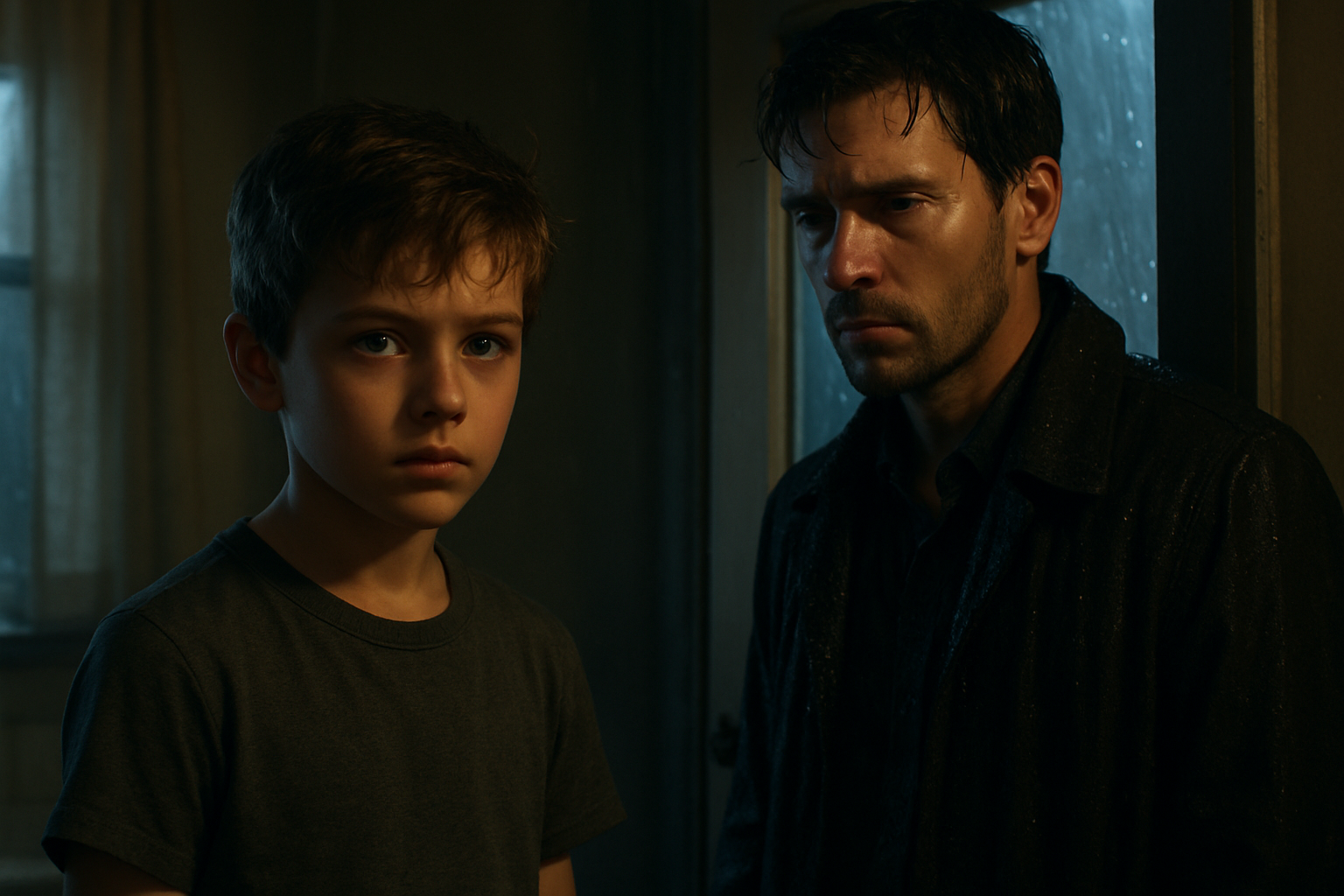
The Boy with the Storm-Gray Eyes
“Is he my son?”
The question did not fall gently. It cracked through Elara Quinn’s small kitchen like thunder, sharp enough to make the rain seem suddenly quiet against the windows.
Adrien Voss stood just inside the doorway, his black coat dripping water onto her worn linoleum floor, his hair darkened by the storm, his face stripped of every polished expression that had once made boardrooms bend and cameras adore him. He was no longer the untouchable billionaire whose name flashed across business magazines and skyline billboards. He was not the prodigy, the conqueror, the man who could buy silence, loyalty, time.
He was simply Adrien.
And he was staring at the little boy by the table.
At the boy’s eyes.
At the crescent-shaped birthmark circling the fragile bone of his wrist.
Elara held his gaze. She had always been able to lie to other people when survival required it. Small lies. Necessary lies. “I’m fine.” “We have enough.” “It doesn’t hurt anymore.”
But lies had never survived between her and Adrien. Not once. Not even when they were young and proud and terrified.
So she gave him the only answer she could.
“He is mine.”
It was cruel.
It was also true.
Adrien’s jaw tightened as if the words had struck him physically. Rainwater slipped from the hem of his coat and gathered in a dark, trembling puddle around his expensive shoes. The child, oblivious to the full weight of the moment, curled one hand around a chipped blue mug of cocoa and watched the stranger with solemn, storm-gray eyes.
Adrien’s eyes.
Elara’s heart clenched so violently she almost reached for the counter.
For the first time in all the years she had known him, Adrien Voss had no clever answer. No devastating half-smile. No sharp remark designed to hide the wound beneath. His entire empire seemed to collapse into that tiny birthmark, into that little wrist, into the silence between one breath and the next.
But Elara had told herself their story ended long before this storm.
Long before he appeared at her door unannounced.
Long before he saw the child.
Long before that terrible question.
It had begun in the city of Harrowmere, when Adrien was sixteen years old and furious at every locked door he had not yet learned how to purchase.
His mother, Celeste Voss, had dragged him there from Northwyck for what she called “a strategic development year,” which sounded elegant when spoken in her cool, commanding voice. In practice, it meant private athletic coaches before sunrise, advanced mathematics tutors after dinner, investor breakfasts on Saturdays, etiquette dinners with men who smiled too much, and a schedule so ruthless it seemed designed to carve all softness from a brilliant boy and leave only a weapon behind.
Adrien was supposed to become a professional tennis champion first.
Then a mathematical prodigy.
Then a technology founder.
Celeste changed his destiny whenever a richer room opened somewhere else.
She studied opportunity the way generals studied maps. She saw her son as talent, brand, legacy, leverage. He was handsome, unnervingly intelligent, and angry enough to confuse pressure with purpose. In certain circles, he was already becoming a rumor: the beautiful teenage genius with the impossible serve, the boy who built prediction software for athletes before he was old enough to sign his own contracts, the son investors watched with the bright-eyed hunger of men hoping to buy the future early.
Elara Quinn met him in eleventh-grade literature at Alderbrook Preparatory, a scholarship school where wealthy students arrived in casual clothes that cost more than her mother earned in a week.
Adrien sat behind her and tapped his pen through the entire discussion of The Golden House of Ash.
Tap. Tap. Tap.
The sound crawled under her skin.
After eleven minutes, Elara turned around without raising her voice.
“If your hands are that bored,” she said, “use them to take notes.”
Adrien blinked.
No one spoke to him that way.
Teachers excused him because brilliance made adults generous. Coaches praised him because winning made them look good. Girls watched him from across hallways and whispered behind notebooks. Boys either envied him or tried to attach themselves to his orbit. Even adults who should have known better treated him like a walking lottery ticket with a pulse.
Elara Quinn told him he was annoying, then turned back around as if dismissing a fly.
The next day, he borrowed her pen without asking.
The day after that, he followed her to the library and claimed the seat across from her as though fate had reserved it with his name engraved on a brass plaque.
“You always study like someone’s grading your breathing?” he asked.
Elara did not look up from her notes. “You always talk like silence owes you money?”
His mouth curved.
“You’re mean.”
“You’re loud.”
“I’m interesting.”
“You’re exhausting.”
That should have been the end of them.
Instead, somehow, it became the beginning.