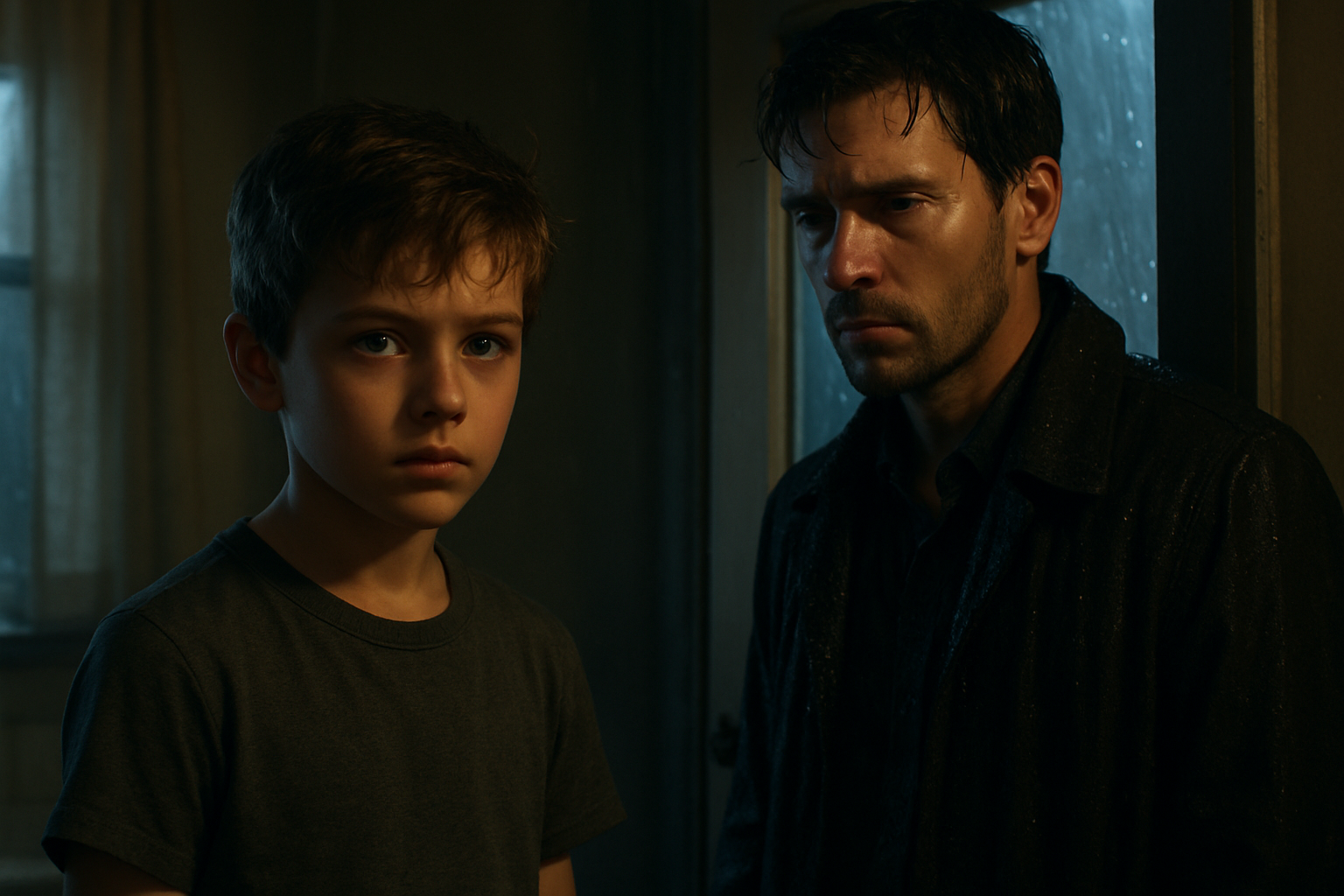
Adrien began appearing at Elara’s house after school. At first, he had excuses. Calculus. A literature presentation. A group research project no one else in the group seemed aware of. Then the excuses grew thinner, flimsier, almost insulting in their lack of effort, until finally he stopped offering them at all.
He simply arrived.
The Quinn house was nothing like the glass-walled penthouses and leased town cars of Adrien’s life. It was narrow and warm and always slightly noisy. The front step cracked in the middle. The hallway smelled faintly of lemon soap and old paperbacks. The kitchen was too small for three people and somehow always held five. There were bills tucked under a chipped ceramic rooster, grocery lists on the refrigerator, mismatched mugs in the cabinet, and a stubborn radio that worked only when slapped on the left side.
Elara’s mother, Maribel Quinn, fed anyone foolish enough to stand still too long in her kitchen.
Adrien learned very quickly to stand still.
“Skinny boys are always trouble,” Maribel declared the first afternoon he wandered in wearing a school blazer that cost more than their stove. “Sit. Eat.”
“I’m not skinny,” Adrien said.
“You’re rich skinny,” Maribel replied, setting a plate in front of him. “Different illness.”
Elara laughed so hard she nearly dropped a glass.
Adrien, who was used to being flattered, studied the steaming food before him as if it were a challenge, then picked up a fork.
After that, he came back.
Often.
Callan Quinn, Elara’s older brother, returned from evening classes at the city college one night and found Adrien eating his second helping of fried chicken at the kitchen table.
Callan stopped in the doorway and narrowed his eyes.
“You live here now?”
Adrien wiped his mouth with a napkin. “I was invited.”
“No, you weren’t,” Elara said from the sink.
Adrien did not look ashamed. “The chicken invited me.”
Callan tried not to laugh.
He failed.
From then on, he treated Adrien like a suspicious stray dog the family had accidentally adopted. He challenged him at basketball on the cracked court behind the laundromat. He corrected the way Adrien lifted boxes when Maribel needed help bringing groceries in from the corner store. He warned him, in a voice so calm it was more frightening than shouting, not to make Elara cry.
Then later, when the house grew quiet and Maribel went to bed, Callan sat with Adrien on the back steps and talked to him like an older brother might.
They talked about music that made them feel invincible. About cars neither of them could afford in the ways that mattered. About money, and the difference between having it and being owned by it. About fathers who left, mothers who endured, and all the ways young men convinced themselves that pain would become purpose if they just ran fast enough.
For two years, Adrien lived between worlds.
In one world, Celeste Voss put him in rooms with men who used words like acquisition, valuation, market capture, and scalable dominance while looking at him as though he were a rare machine they hoped to own before anyone else discovered it.
In the other world, Elara’s house smelled of garlic, laundry detergent, rain-damp coats, used books, and safety.
Maribel argued with the weather as if the clouds could hear her.
Callan sang too loudly while washing dishes and got half the lyrics wrong on purpose.
Elara sat at the kitchen table with one foot hooked on the rung of Adrien’s chair and informed him whenever he was being an idiot, which was often.
People at school assumed they were dating.
They were not.
Other people insisted they were only friends.
They were not that either.
There was no clean word for what existed between them. It was too tender for friendship and too frightened for romance. It sat in the charged space between glances, in unfinished sentences, in the way Adrien always saved her the last dumpling and pretended not to notice that she noticed. It lived in how Elara could read his moods before he spoke, and how he trusted her irritation more than other people’s praise.
Naming it would have required courage.
Neither of them trusted themselves with that much truth.
So they left it unnamed.
Adrien knew he loved her by seventeen.
He knew it during a debate tournament when Elara dismantled a senior from Graybridge Academy with one lifted eyebrow and a speech about poverty that left the judges silent for three full seconds before they remembered to breathe.
He knew it when she showed up at his regional match holding a homemade sign painted in crooked blue letters:
HIT THE BALL, GENIUS.
He knew it most clearly on a freezing winter night when his mother forgot his birthday because she was in Westhaven closing a deal.
No call.
No message.
No apology.
Only a wire transfer from an assistant and a schedule update for the following week.
That night, Elara arrived at his apartment with Callan, three cupcakes, and a candle shaped like a question mark because the corner store had run out of numbers.