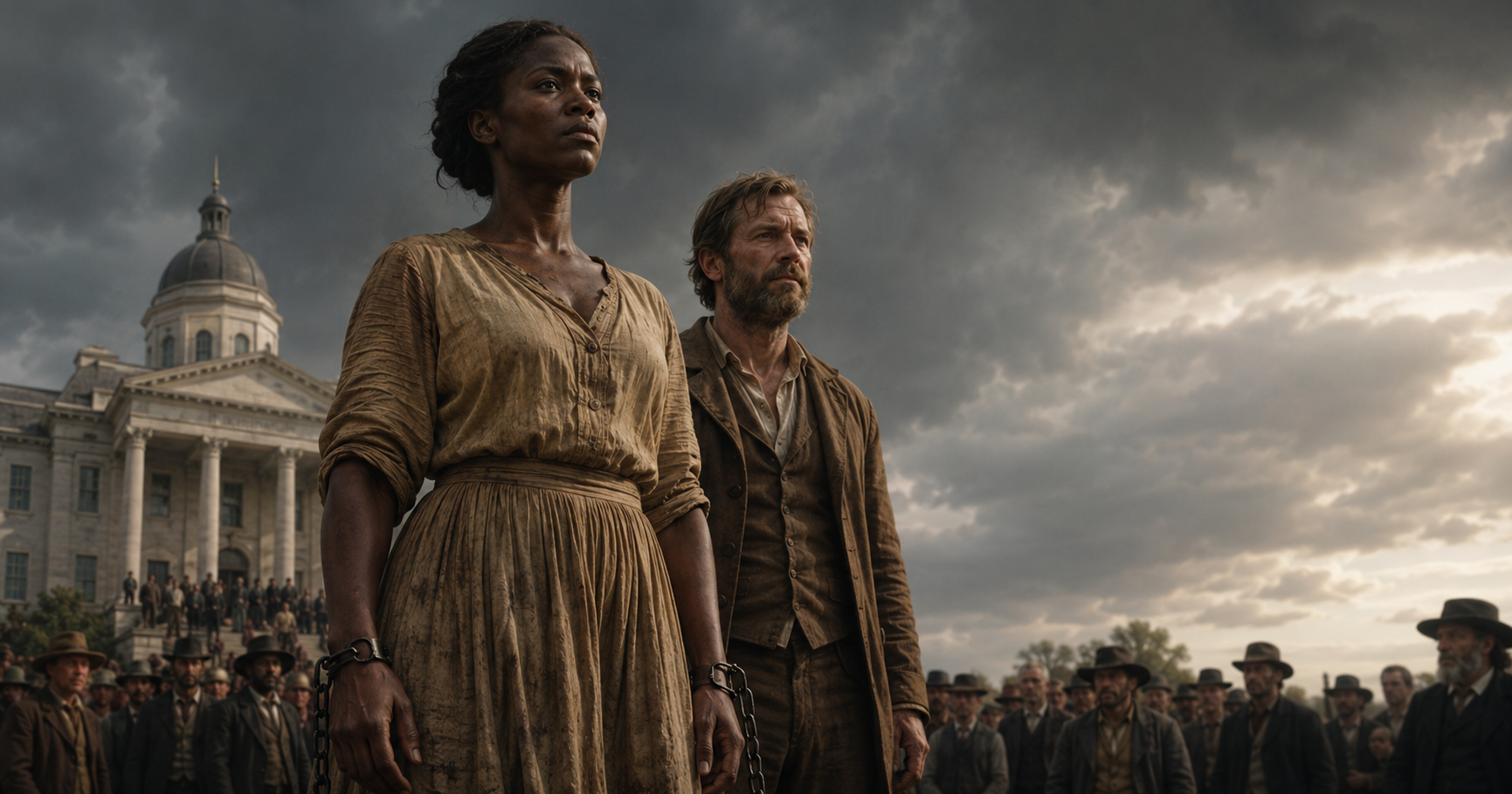
By the time the rain began, the auction yard already smelled of mud, horse sweat, wet tobacco, and shame.
No one in Carter’s Landing had meant to stay so late. Men had come for mules, wagons, plows, sacks of seed, and the sort of human misery they pretended was business because business sounded cleaner than sin. The sky had been low all morning, the river thick and brown beyond the warehouses, and the auctioneer’s voice had grown hoarse from selling the living and the broken with the same careless rhythm.
“Next lot!”
The crowd shifted.
A woman was brought onto the platform.
For a moment even the rain seemed to pause.
She was tall. Not merely tall in the way a man might say at supper, “That woman has height on her.” She stood above most of the men in the yard by half a head, broad-shouldered, long-armed, with wrists thick enough to make the iron cuffs look foolish. Her dress had been patched so many times that no original cloth remained. Her hair was wrapped in a torn gray rag. One cheek was swollen. Her mouth was cut.
But it was her stillness that unsettled them most.
She did not tremble.
She did not plead.
She did not look at the buyers as if they held her fate.
She looked beyond them, toward the courthouse clock, as if measuring how long a lie could stand before it cracked.
The auctioneer cleared his throat.
“This one is called Bina,” he said. “Strong as an ox, though twice as troublesome. Sold cheap because she is difficult. Good for hauling, timber work, stone clearing, mill labor, field labor if watched close. No domestic use. No guarantee of obedience.”
A laugh moved through the crowd.
Someone near the front spat and said, “No guarantee she won’t tear the roof off your barn, either.”
Another man said, “Or your head off your shoulders.”
The woman’s eyes moved, slow as a gate swinging open.
The man who had spoken found sudden interest in his boots.
The auctioneer lifted the paper in his hand. “Starting bid. One dollar.”
No one answered.
The rain started again, harder now, ticking against hats and shoulders.
“Seventy-five cents.”
Silence.
“Fifty.”
A butcher laughed. “Pay me fifty and I’ll take her off your platform.”
More laughter.
The auctioneer’s smile tightened. He did not like losing a sale, even an ugly one.
“Twenty-five cents.”
A farmer in a patched brown coat stood near the back of the crowd with his hat low and his hands in his pockets. His name was Jonah Vale, though most men in Carter’s Landing called him either poor Jonah, stubborn Jonah, or that fool from Briar Creek. He owned forty-two acres of hard land, one tired horse, a barn that leaned south in high wind, and debts enough to make a banker smile in church.
He had not come to buy anyone.
At least, that was what he had told himself when he crossed the river at dawn.
But in his coat pocket lay seven cents.
And in the lining beneath his left sleeve lay something far more dangerous than money: a folded deed, sewn flat against the cloth, its edges worn thin from years of being hidden.
The auctioneer dropped his voice. “Ten cents.”
No one moved.
The woman on the platform looked down at the boards beneath her feet.
“Seven cents,” Jonah said.
At first the auctioneer did not hear him.
Then every face turned.
Jonah lifted his chin. “Seven cents.”
A roar of laughter broke over the yard.
“Seven cents?” shouted the butcher. “Jonah Vale finally found a wife he can afford!”
Another man called, “Careful, Jonah. She’ll eat your little farm by winter.”
The auctioneer’s face colored. “This is not a market for jokes.”
“I offered money,” Jonah said.
“Seven cents is not money.”
“It is if you are poor enough.”
More laughter.
The woman looked at him then.
Jonah had expected anger. He had expected contempt, suspicion, hatred. He deserved all three.
But what he saw in her eyes was recognition without knowing. As if she had been waiting for something terrible to happen and understood, before anyone else did, that he was part of it.
The auctioneer glanced at the man who had brought her in, a narrow fellow named Abel Crane, trader, thief, liar, and friend to men who wore better coats while doing worse things.
Crane leaned in and muttered, “Take it. She is costing me feed.”
The auctioneer struck the block with his hammer.
“Sold. Seven cents.”
The laughter changed shape.
Some men laughed harder.
Some stopped laughing altogether.
Jonah walked forward. He counted the coins into the auctioneer’s palm. One by one. Five pennies. Two copper cents gone green at the edges.
The receipt was written with mock ceremony.
Lot name: Bina.
Price: seven cents.
Buyer: Jonah Vale.
Condition: unsound temper.
When the paper was handed to him, Jonah did not look at the woman. He looked at the name.
Bina.
A name placed over another name like dirt thrown over a grave.