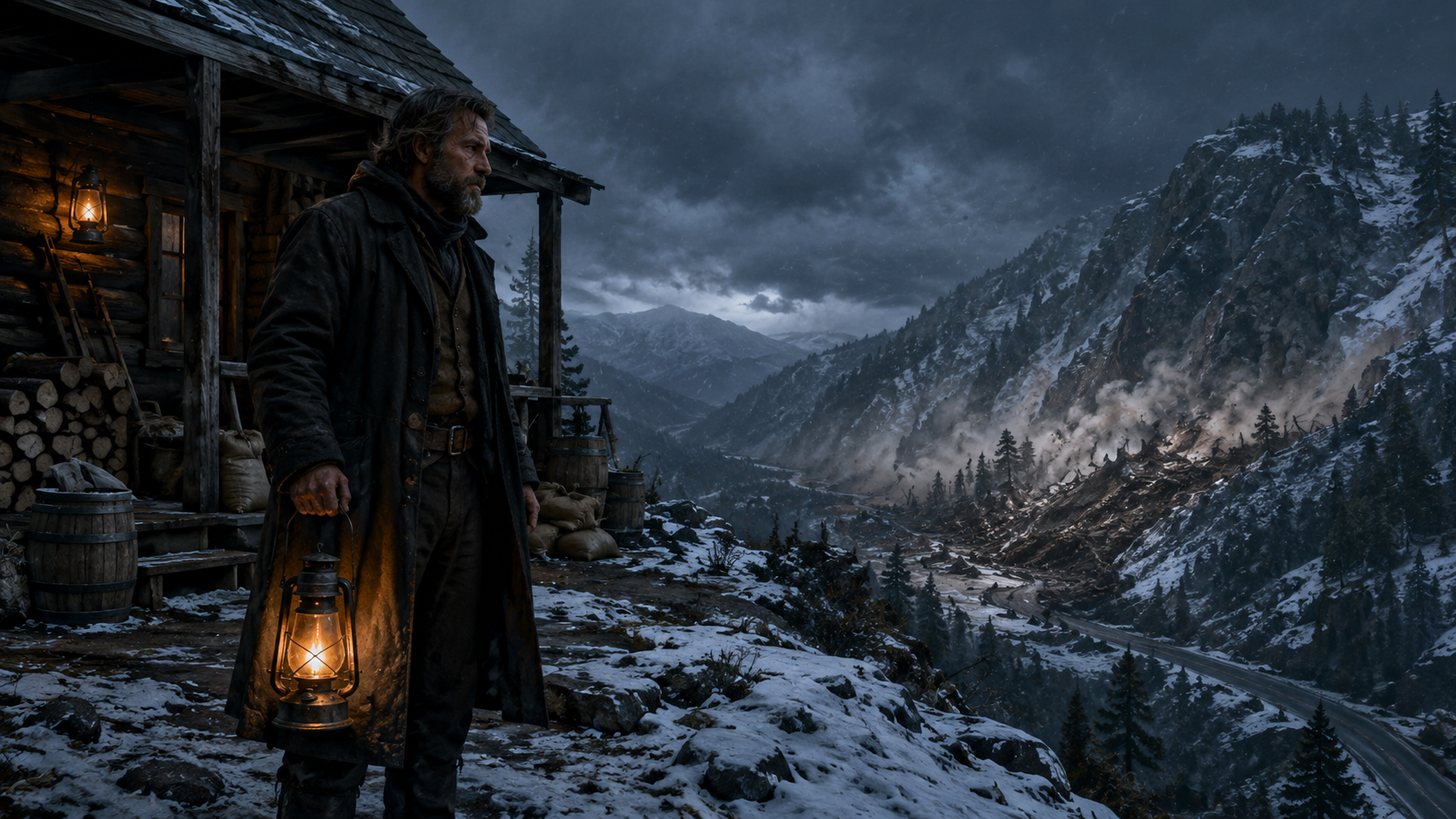
They called Nathaniel Crowe a lunatic because he counted potatoes like coins, stacked firewood higher than his roof, and spent the last warm days of summer smoking meat while the rest of Briar Hollow laughed at him from below.
Children made dares of it.
“Run up to the old ridge cabin,” they whispered, “and ask the madman if he’s building a castle for squirrels.”
Men at the livery said grief had hollowed his head.
Women at the church said his daughter, Juniper, deserved better than a father who kept jars under floorboards and nailed shutters twice as thick as any storm required.
The storekeeper, Amos Bell, said Nathaniel bought salt like a man expecting to preserve the whole mountain.
And Mayor Elias Vane, who owned nearly every debt in town, smiled whenever Nathaniel’s name was mentioned.
“Poor Crowe,” Vane would say, folding his polished hands across his silver watch chain. “A man can survive losing a wife, but not always losing his mind.”
Nathaniel heard all of it.
He answered none of it.
Silence had become his strongest tool. Better than an axe. Better than a rifle. Better than prayer, sometimes. Silence did not feed pride. Silence did not waste heat. Silence did not give foolish men something to twist.
So when boys shouted from the road, “How many beans you hiding, Mad Crowe?” Nathaniel kept splitting cedar.
When Amos Bell asked whether he planned to eat through Judgment Day, Nathaniel paid for another sack of flour and said nothing.
When Reverend Peale preached one Sunday about fear disguising itself as wisdom, every eye in the church slid toward Nathaniel’s empty pew.
He had stopped attending months before.
Not because he had stopped believing in God.
Because he had stopped believing that people who felt safe could recognize a warning.
Nathaniel lived halfway up Wolfpine Ridge in a cabin made of black logs and stubbornness. The cabin had belonged to miners once, back when silver fever had pulled men into every seam of the mountain. Those men had dug poorly, drunk heavily, and left suddenly. They abandoned rusted tools, broken rails, and a half-finished root chamber beneath the floor.
Nathaniel found the place after burying his wife, Clara.
He came with one horse, one grieving child, two trunks, and a dog named Birch whose left ear had been torn by a coyote. The townspeople of Briar Hollow watched him pass and assumed he was a man running away from sorrow.
They were wrong.
He was carrying it with him.
Clara had died three winters earlier when fever came through the valley like a thief that knew every door. Their two sons died the same week. Juniper survived because Nathaniel shut her in a cold shed with clean blankets, boiled water, and every curse the neighbors were willing to throw at him.
“She’ll freeze,” they said.
“She’ll hate you,” they said.
“Let the child sit beside her mother,” they said.
Nathaniel had locked the shed door anyway and listened to Juniper crying for Clara until morning burned gray through the cracks.
His wife’s last words had not been grand.
She had not said, “Remember me.”
She had not said, “I love you.”
She had gripped his wrist with a fever-hot hand and whispered, “Keep her alive.”
So he did.
He kept Juniper alive when love would have opened the door.
Since then, he had trusted preparation more than comfort.
By late August of 1891, the mountain began speaking.
It did not speak in words. Mountains never did. Words were for people, and people often used them to lie.
The mountain spoke through elk moving down too soon. Through field mice pouring from the western gullies. Through ravens leaving the quarry cliffs before sunset. Through the sour-metal smell that rose after rain. Through tiny cracks spreading across the old pass road like black veins under skin.
Nathaniel saw the signs and tightened his jaw.
He rode three miles down to Briar Hollow and walked into the mayor’s office with mud on his boots.
Elias Vane looked up from his desk. Everything in that office shone: the brass lamp, the framed land deeds, the black cane leaning against the wall, the mayor’s pale hair combed flat and clean.
Nathaniel disliked clean men who made others dirty.
“The western slope is moving,” Nathaniel said.
Vane blinked slowly. “Good morning to you too.”
“The old mine cuts above the pass are filling with water. The shale is breaking. If we get a hard rain, the road to Mercy Crossing will be buried.”
Mayor Vane leaned back. “You walked into my office to tell me a mountain is unhappy?”
“I came to tell you to stop blasting near the old Silver Hook cut.”
Something changed in Vane’s eyes.
It was small. So small another man might have missed it.
Nathaniel did not.
“Blasting?” Vane said gently. “Who told you there was blasting?”
“No one had to.”
“Then no one did.”