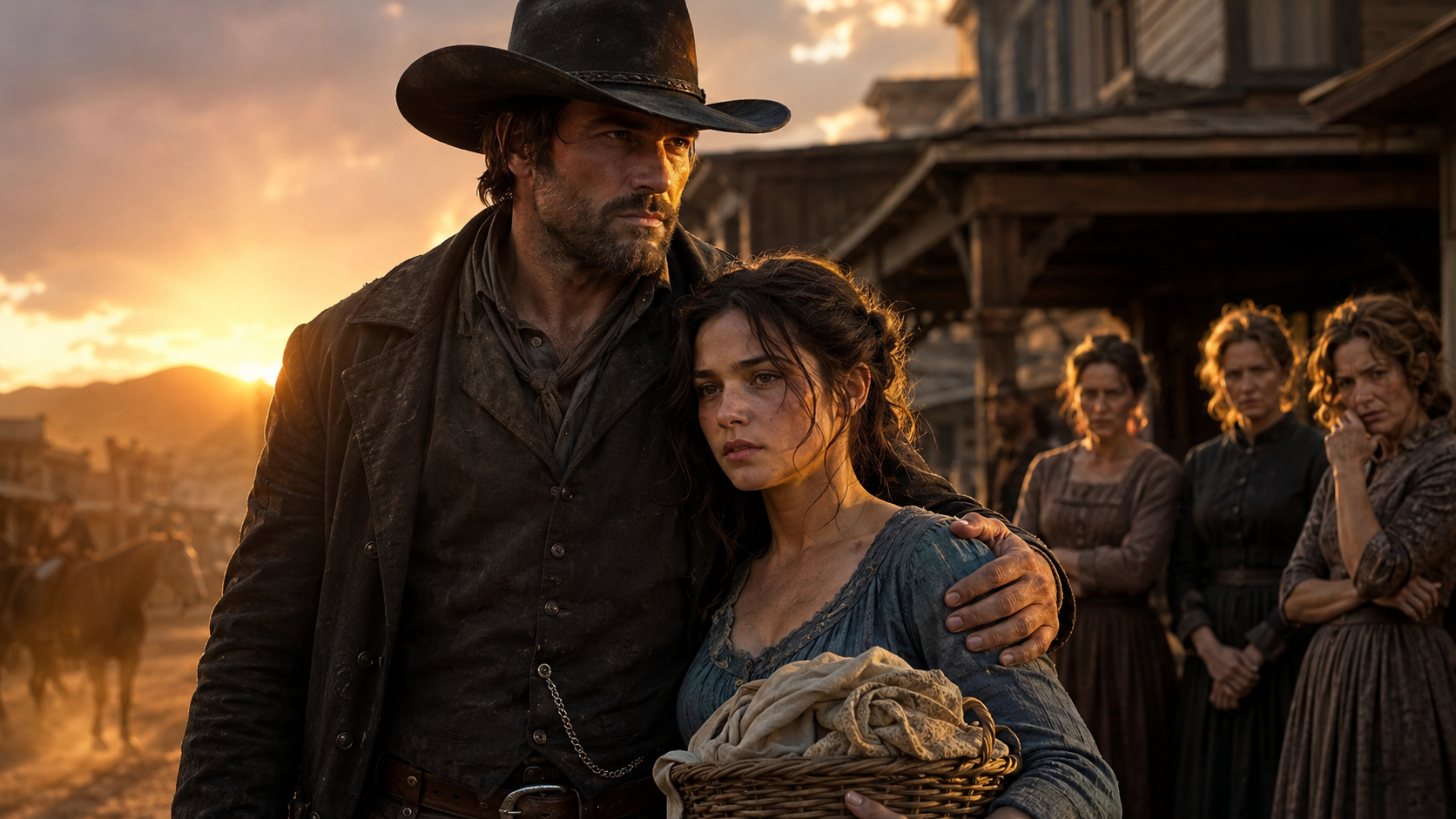
By the time Gideon Vale rode into Mercy Crossing, the whole town had already decided he was a man best left alone.
They said he was too tall to be natural, too quiet to be honest, and too scarred to have lived a peaceful life. Children stared at him from behind water barrels. Women stopped talking when his shadow crossed the boardwalk. Men who owed him money suddenly found important work inside the nearest doorway.
Gideon noticed all of it.
He simply did not care.
He had come for flour, coffee, salt, lamp oil, two sacks of feed, and a cook.
The first four things were easy.
The last one was the problem.
His old cook had vanished three mornings earlier with half a bottle of Gideon’s whiskey, a mule that did not belong to him, and a note that read, I would rather fight coyotes than feed your men another day.
Gideon had stared at the note for a full minute, then folded it neatly and put it in the stove.
He had twelve ranch hands, three hired boys, two injured wranglers, and a branding season coming fast. Men could survive bad weather, bad horses, and bad luck. They could not survive long on burnt beans and anger.
So Gideon stood in front of Harlan’s Mercantile, a giant in a dust-covered coat, and pinned a notice to the post.
COOK WANTED FOR IRON MESA RANCH.
ROOM, BOARD, FAIR WAGES.
HARD WORK. NO NONSENSE.
He had barely driven the nail in before the first laugh came.
It belonged to Mrs. Dorothea Pike, the mercantile owner’s sister, who believed Mercy Crossing had been created so she could judge it.
“A cook?” she said, pretending surprise. “For your ranch?”
Gideon turned slowly.
Dorothea stood on the porch with three other women, each of them holding a parcel, each of them hungry for entertainment.
“That is what the sign says,” Gideon answered.
“No decent woman would go out there,” Dorothea said.
“Then I’m not looking for a woman who scares easy.”
Her smile sharpened. “That is not the same as decent.”
The other women murmured, pleased by the cruelty.
Gideon took his change from Mr. Harlan, loaded his supplies, and ignored them. He had learned years ago that some people mistook silence for weakness because they had never met the kind of silence that came before a storm.
He was tying the last sack to his wagon when the crowd shifted.
A young woman had stopped at the edge of the street.
She carried a basket of wet laundry against one hip. Her dress was plain, faded at the elbows, and patched with careful hands. Her bonnet hung down her back instead of sitting properly on her head, and loose dark hair clung to her cheeks from the heat of the washhouse.
She looked tired.
Not delicate tired. Not the pretty kind that invited rescue.
She looked worn down to the bone.
Gideon saw the moment she noticed the sign. Her eyes moved across the words once. Then again.
Dorothea saw it too.
“Well,” she said loudly, “perhaps Mr. Vale has found exactly what he deserves.”
The young woman’s face changed.
Only for a second.
A smaller person might have lowered her eyes. She lifted her chin instead.
Gideon watched her cross the street.
“What does it pay?” she asked.
Her voice was steady, but the basket trembled slightly in her hands.
“Twenty dollars a month,” Gideon said. “Room and board. Sundays after morning chores unless cattle are moving.”
Someone behind him laughed.
The woman looked at Gideon, not at the crowd. “How many men?”
“Twelve most weeks. More during branding.”
“Do they complain?”
“Constantly.”
“Do they work?”
“They had better.”
“Do you expect pies?”
Gideon almost smiled. “I expect food.”
“I can cook food.”
Dorothea stepped forward. “Mara, don’t embarrass yourself.”
So her name was Mara.
The young woman did not turn. “I was speaking to Mr. Vale.”
“You are not suited for ranch work,” Dorothea snapped. “You are barely suited for laundry.”
Mara’s hand tightened around the basket handle.
Gideon looked from one woman to the other. He understood many things in that single glance. Not all of them, but enough.
He looked back at Mara.
“When can you start?”
The whole street seemed to hold its breath.
Mara blinked once, as if she had expected him to laugh too.
“Today,” she said.
Dorothea made a choking sound. “You cannot be serious.”
Gideon untied the rear flap of the wagon. “Put your basket in.”
Mara did not move yet. “I have one carpetbag at the boardinghouse.”
“We’ll stop there.”
“You don’t know anything about me.”
Gideon held her gaze. “You know how to work?”
“Yes.”
“You steal?”
“No.”
“You run from hard days?”
Her mouth curved, but it was not quite a smile. “Hard days usually run from me first.”
“That’s enough.”
Dorothea’s voice rose. “Mr. Vale, that girl is trouble.”
Gideon turned toward her then.
He did not step closer. He did not raise his voice. He did not need to.
“She is not a girl,” he said. “And if trouble works harder than manners, I’ll take trouble.”
Mara stared at him.
For one strange moment, no one in Mercy Crossing spoke.
Then Gideon helped her climb onto the wagon.
By sundown, the town had already made the story ugly.
By midnight, it had made it unforgivable.
And by morning, every person in Mercy Crossing knew that Gideon Vale had hired the woman nobody wanted.
What they did not know was that he had also done the first wise thing of his life.
Iron Mesa Ranch sat beyond the last cottonwoods, where the land rose hard and red toward the broken hills. It was not a pretty ranch. It did not soften itself for visitors.
The house was built wide and square, with a deep porch and weathered shutters. The barn leaned slightly west from years of wind. The corrals were strong, the well ran clean, and everything smelled of dust, horses, iron, and sun-baked wood.
Mara took it in without speaking.
Gideon watched her from the corner of his eye as he drove the wagon up the lane. Most people saw Iron Mesa and understood only its size. Mara saw the wash line with no clothespins, the sagging hinge on the smokehouse door, the stacked dishes visible through the kitchen window, and the three ranch hands pretending not to stare.
One of them, a red-haired man named Boone, let out a whistle.
Gideon climbed down from the wagon.
The whistle stopped.
“This is Mara Bell,” Gideon said. “She cooks. She works. You’ll treat her with respect.”
Boone looked at Mara’s patched dress and thin carpetbag. “Yes, boss.”
Gideon waited.
Boone swallowed. “Ma’am.”
Mara climbed down before Gideon could help her. “Where’s the kitchen?”
Gideon pointed.
She walked inside.
Five minutes later, something crashed.
Every man in the yard froze.
Then Mara appeared in the doorway holding a blackened skillet between two fingers.
“Who ruined this?”
Nobody answered.
Her eyes moved from face to face.
Boone looked at the ground.
Mara nodded slowly. “Fine. I’ll assume it was all of you.”
A few of the men coughed to hide smiles.
She held up the skillet. “Dinner will be late because your kitchen is a crime scene. Anyone who complains will be fed whatever I scrape from the bottom of this pan.”
No one complained.
Gideon looked away before she could see the amusement on his face.
That first night, she served beans with onions, cornbread that did not break teeth, fried potatoes, coffee strong enough to make men honest, and a peach cobbler she had somehow made from dried fruit Gideon had forgotten existed.
The ranch hands ate in silence at first.
Then they ate like wolves.
Boone reached for a third helping.
Mara slapped his hand with a spoon.
“You finish what’s already on your plate before you take from men who haven’t had seconds.”
Boone looked offended. “I was going to.”
“Then go ahead and become that better man.”
The table erupted in laughter.
Boone grinned despite himself and sat back.
Gideon watched from the head of the table. He had expected food. He had not expected order. He had not expected the room to feel less like a bunkhouse and more like a place people might survive the season.
After supper, he found Mara at the pump, washing dishes under the violet sky.
“You did well,” he said.
She did not look up. “They were hungry.”
“They’re always hungry.”
“That explains the kitchen.”
He leaned against the porch rail. “You’ll need supplies.”
“I made a list.”
“Already?”
She lifted a folded paper from her apron pocket and held it out.
Gideon opened it.
Flour. Salt pork. Dried apples. Vinegar. Coffee. Beans. Pepper. Baking powder. Lard. Soap. Clothespins. Two decent knives. One broom that has not died of shame.
He read the last line twice.
Mara kept washing.
“Something funny?” she asked.
“No.”
“You looked like you nearly laughed.”
“I don’t laugh much.”
“That sounds like a condition.”
“It has not killed me.”
“Yet.”
This time, he did smile.
It came and went so quickly that Mara almost missed it.
Almost.
The next weeks changed Iron Mesa in ways Gideon did not know how to name.
Mara rose before dawn and had biscuits ready before the men came in. She learned who liked coffee black, who watered it down, who pretended not to like molasses but scraped the jar clean when no one looked. She put the youngest hired boy, Ben, in charge of eggs because he was too clumsy with knives and too proud to be useless. She made Boone scrub the stove after he complained about ash in his bread.
The men tested her, because men often mistook kindness for an invitation.
Mara gave them no such invitation.
When one of them left muddy boots under the kitchen table, she put them in his bed.
When another called her “little lady,” she handed him a bucket and said, “Little lady needs water.”
When Boone tried to steal a biscuit before supper, she made him peel onions until he confessed every sin he could remember.
By the end of the month, the men still teased, still cursed, still tracked dirt where they should not.
But they washed before meals.
They said thank you.
They stopped speaking badly about women in the kitchen.
And they looked at Mara the way a crew looks at someone who has become necessary.
Gideon noticed that too.
He noticed more than he wanted.
He noticed the way she hummed when she forgot to be guarded. The way she counted sacks before signing for supplies. The way she sat on the porch steps after everyone slept, as if quiet was something she had to borrow when the world was done using it.
He noticed that she flinched whenever a wagon came unexpectedly up the lane.
He noticed that letters never arrived for her.
He noticed she never spoke of family.
One evening, he found her mending a torn shirt by lamplight in the kitchen.
“That mine?” he asked.
“No.”
“Whose?”
“Boone’s.”
“Boone can mend his own shirt.”
“He tried. It looked like a spider died in the sleeve.”
Gideon sat across from her. “You do too much.”
Mara pulled the needle through cloth. “People usually say I don’t do enough.”
“People say many stupid things.”
She looked at him then.
The lamp softened her face but did not hide the old hurt in her eyes.
“You always defend people you barely know?” she asked.
“No.”
“Then why me?”
Gideon did not answer quickly.
Because he was not a man who lied well. And because the truth, once spoken, could not be put back where it had slept.
“At the mercantile,” he said finally, “you looked like someone standing in a room where everyone had already decided your sentence.”
Mara’s hands stilled.
“I know what that feels like,” he said.
For a while, the only sound was the ticking stove.
Then Mara looked back down at the shirt.
“My aunt took me in when my mother died,” she said. “She called it charity so often that everyone else started calling me charity too. I worked in her laundry from twelve years old. If money went missing, it was me. If a man stared too long, it was my fault. If food burned, if rain came, if someone’s baby cried too loud, somehow I had invited the disaster.”
Gideon’s jaw tightened.
Mara smiled faintly without humor. “When I was nineteen, a traveling salesman told people I had promised to marry him. I had spoken to him twice. He left town laughing. I stayed and wore the shame.”
“You did nothing?”
“I survived.”
“That is not nothing.”
She looked at him again.
This time, something in her expression shifted. Not trust exactly. But the possibility of it.
Outside, the wind moved over the dark yard.
Mara folded Boone’s shirt and set it aside.
“I don’t need pity, Mr. Vale.”
“Good. I don’t have any.”
“What do you have?”
He met her eyes.
“Work,” he said. “Food. A roof. Wages paid on time.”
She waited.
“And respect,” he added.
Mara looked away first.
But she did not leave.
Trouble came, as it usually did, wearing a clean coat.
The man’s name was Victor Sloane.
He owned three ranches east of Mercy Crossing, two stores, half the debt in the county, and every conversation he entered. He had silver at his temples, gold in his pockets, and a smile that never reached any honest place in him.
He arrived at Iron Mesa on a bright Thursday afternoon with polished boots and two riders behind him.
Gideon met him at the gate.
Mara watched from the kitchen window.
Victor removed his hat. “Vale.”
“Sloane.”
“I hear you’ve had staffing changes.”
“I hear you listen to gossip.”
Victor chuckled. “In my position, information matters.”
“In mine, work matters.”
Victor’s gaze drifted toward the house. Mara stepped back before he could see her clearly, but not fast enough. His smile deepened.
“So it’s true,” he said. “You brought the Bell woman here.”
Gideon’s eyes cooled. “Her name is Mara.”
“That is generous of you.”
“That is accurate.”
Victor looked amused. “Careful. Mercy Crossing forgives many things. Making the wrong person respectable is not one of them.”
Gideon stepped closer to the gate. “Did you ride here to offer advice?”
“I rode here to offer money.”
“No.”
“You have not heard the amount.”
“I heard the man offering.”
Victor’s smile thinned.
“The south pasture of Iron Mesa has the only reliable spring between here and dry creek,” he said. “You use half of what it gives. I could use all of it.”
“That sounds unfortunate for you.”
“I’ll pay fairly.”
“You’ll pay what makes you feel clean.”
Victor’s jaw moved once. “You are a stubborn man.”
“I’ve been called worse by better.”
The riders behind Victor shifted in their saddles.
Victor put his hat back on.
“Men like you think land makes them untouchable,” he said. “It doesn’t. Land can be taxed. Loans can be tightened. Supply lines can become inconvenient. Hired men can be persuaded to leave.”
Gideon’s voice dropped. “Are you threatening me on my own road?”
“I’m explaining weather.”
“Then pray it doesn’t change.”
Victor looked past him one more time toward the house.
“Ask your cook what happens when a whole town gets tired of a person,” he said. “She knows.”
Gideon moved so fast the horses startled.
Victor’s hand went halfway to his pistol before he realized Gideon had only taken one step.
But that one step was enough.
“Leave,” Gideon said.
Victor studied him, and for the first time, Mara saw something like caution in his face.
Then he laughed softly, turned his horse, and rode away.
That night, Gideon said nothing about the visit.
Neither did Mara.
But two days later, Harlan refused to extend credit for ranch supplies.
Three days after that, the blacksmith delayed shoeing Gideon’s horses.
By the next Sunday, two ranch hands quit after receiving better offers from Sloane.
On Monday morning, someone painted a word across the side of the smokehouse.
It was meant for Mara.
Gideon found it before breakfast.
By the time the men came out, he was already scrubbing it away with lye water, his sleeves rolled up, his face carved from stone.
Mara stood in the yard and stared.
“You should have left it,” she said.
Gideon kept scrubbing. “No.”
“They’ll just do something else.”
“Then I’ll clean that too.”
“You can’t fight a whole town with a bucket.”
He stopped then and turned.
“No,” he said. “But I can decide what stays on my walls.”
Mara had no answer.
That was the thing about Gideon Vale. He rarely gave speeches. He simply planted himself between cruelty and its target as if that were the most ordinary place in the world to stand.
And without meaning to, Mara began to believe him.
The county fair came at the end of August.
Gideon did not want to go.
Mara insisted.
“You need supplies,” she said. “You need men. You need people to see you standing where they told you not to stand.”
“I need cattle to behave and fences to hold.”
“You need more than that.”
He frowned at her across the kitchen table. “Since when do you order me?”
“Since you hired me to keep people fed and alive. Morale counts.”
“Morale?”
“Yes.”
“My morale is fine.”
“You look like a funeral learned to walk.”
Boone laughed into his coffee and nearly died choking.
So Gideon went.
He rode into Mercy Crossing with Mara on the wagon seat beside him, Boone and Ben riding behind with two horses for sale. The town noticed immediately.
Of course it did.
Mercy Crossing could ignore poverty, hunger, bruises, and lies.
It could not ignore a woman sitting beside a man it had failed to control.
Mara wore a blue dress she had made from old curtain cloth, plain but clean, with her hair pinned at the nape of her neck. Gideon wore a black coat that made him look even larger than usual. Together, they drew every eye in the street.
Dorothea Pike turned pale with satisfaction, as if she had waited weeks for a chance to perform outrage.
“Well,” she said, stepping into their path. “You are bold.”
Mara climbed down from the wagon. “Good morning.”
“I was not greeting you.”
“I know. I was improving the conversation.”
A nearby man coughed.
Dorothea’s eyes hardened. “You may dress yourself up, Mara Bell, but people remember what you are.”
Mara felt Gideon move beside her.
She lifted one hand, stopping him.
“What am I?” she asked.
Dorothea smiled. “Unwanted.”
The word struck with the old force.
For one heartbeat, Mara was back in the laundry heat, twelve years old, carrying baskets too heavy for her arms while her aunt told customers not to mind the charity case.
Then Gideon’s voice came low beside her.
“Careful.”
Dorothea looked at him. “Or what?”
Mara answered before he could.
“Or nothing,” she said. “That is what frightens you, isn’t it? Nothing happens. I don’t cry. I don’t run. I don’t beg you to take the word back. You throw it, and I keep standing.”
Dorothea’s mouth tightened.
Mara stepped closer.
“You called me unwanted because it made you feel chosen,” she said. “But you were wrong. I was wanted every morning someone ate my bread. Every night a tired boy asked for more stew. Every time a man came in from the rain and found coffee hot. You don’t decide my worth anymore.”
The street went silent.
Gideon looked at Mara as if seeing her through new light.
Dorothea’s face flushed. “You insolent—”
“Enough,” said another voice.
Everyone turned.
A woman in a green traveling dress stood outside the stage office, holding a leather satchel. She was older than Mara by perhaps ten years, with sharp eyes and a posture that suggested she had spent her life refusing to bend.
Mara went still.
The woman looked directly at her.
“Mara Bell,” she said softly.
Mara whispered, “Clara?”
The satchel slipped from the woman’s hand.
And then Mara was running.
She crossed the street and crashed into the woman’s arms with such force that both of them nearly fell.
Gideon had never seen Mara break before.
Not under insult. Not under exhaustion. Not under fear.
But she broke then, silently, fiercely, clinging to the woman like someone holding the last piece of a life she thought had burned.
Later, in the shade behind the livery, Clara told them the truth.
She was Mara’s half sister.
Mara’s mother had sent Clara east before she died, hoping one child might escape the poverty that had swallowed them. Letters had been written. Money had been sent. None of it had reached Mara.
Her aunt had taken the money.
Her aunt had hidden the letters.
Her aunt had kept Mara poor, dependent, and ashamed because shame was cheaper than wages.
Clara had spent years searching.
“I thought you had refused to answer,” Clara said, wiping her eyes. “Then I thought you were dead.”
Mara sat very still.
Gideon stood a few steps away, giving them space, but every word entered him like a nail.
“How did you find me?” Mara asked.
Clara smiled through tears. “A cattle buyer passed through Abilene talking about a giant rancher who hired a woman from Mercy Crossing and nearly broke a man’s jaw when someone insulted her. I knew it had to be you.”
Mara laughed once, then covered her mouth.
Clara took her hands.
“I own a boardinghouse now,” she said. “A good one. Respectable. Warm. You can come with me. You never have to scrub another person’s floor again.”
The words landed heavily.
Gideon looked away.
He had known, of course, that Mara might leave someday.
He had not expected someday to arrive wearing a green dress and carrying proof that Mara had been loved all along.
Mara did not answer.
That night, the fair dance filled the town hall with lantern light and fiddle music.
Gideon stood outside near the hitching post while people moved and laughed inside.
He told himself he was guarding the wagon.
He was lying.
Mara found him there.
“You’re hiding,” she said.
“I’m standing.”
“With purpose?”
“With a hat.”
She smiled faintly.
For a while, they listened to the music.
“Clara wants me to go east,” Mara said.
“I heard.”
“She says I could work for her. Or not work for a while.”
“That sounds good.”
“It does.”
Gideon stared at the lanterns glowing through the windows. “You should take good when it comes.”
Mara turned toward him.
“You make that sound easy.”
“It isn’t.”
“No.”
A silence opened between them, full of all the things he would not ask and all the things she was afraid to want.
Finally, Gideon said, “You owe Iron Mesa nothing.”
Mara’s voice softened. “That isn’t true.”
“It is.”
“No. That place gave me back my name.”
Gideon looked at her then.
She stepped closer.
“And you,” she said, “were the first person in years who didn’t act like kindness was a debt I would have to repay.”
His face changed, just slightly.
“Mara…”
The hall doors burst open before he could finish.
Boone stumbled out, blood running from his nose.
Behind him came two of Sloane’s riders.
Then Victor Sloane himself appeared in the doorway, smiling like a man who had arranged a pleasant evening.
“Vale,” he called. “Your men don’t hold their liquor.”
Gideon moved toward Boone. “What happened?”
Boone spat blood. “They said Mara stole from Mrs. Pike. Said they found her aunt’s missing money in our wagon.”
Mara went cold.
Dorothea appeared behind Victor holding a small cloth purse.
“My money,” she announced. “Hidden under a sack in Mr. Vale’s wagon.”
The crowd gathered fast.
Of course it did.
Mercy Crossing loved a scandal best when it could pretend to be justice.
Victor looked at Mara with false sadness. “Old habits, I suppose.”
Gideon took one step toward him.
Mara caught his arm.
“No,” she said.
Gideon looked down at her.
Her hand trembled, but her voice did not.
“No,” she repeated. “Not this way.”
Then she turned to Dorothea.
“How much was in the purse?”
Dorothea blinked. “What?”
“How much money?”
“Seventy-two dollars.”
Mara nodded. “In what coins?”
Dorothea hesitated.
Mara’s eyes sharpened.
Clara stepped from the crowd. “Answer her.”
Dorothea flushed. “I don’t recall every coin.”
“You don’t recall because it isn’t yours,” Mara said.
Victor sighed. “This is desperate.”
Mara looked at him. “Yes. You are.”
A murmur moved through the crowd.
Mara faced the sheriff, who had arrived with his thumbs tucked in his belt and uncertainty all over his face.
“Open the purse,” she said.
Dorothea clutched it tighter. “This is improper.”
“Open it.”
The sheriff took the purse from Dorothea and emptied it into his palm.
Coins fell out.
And a folded paper.
Mara picked up the paper before anyone could stop her. She opened it.
Her face went very still.
Then she handed it to Clara.
Clara read it aloud.
“Paid to E. Pike for continued silence regarding letters and remittances belonging to Mara Bell.”
Dorothea’s face drained of color.
The crowd shifted.
Victor’s smile vanished.
Mara looked at her aunt.
“You kept receipts?” she asked quietly.
Dorothea opened her mouth, but no sound came.
Clara’s voice shook with fury. “You stole from her.”
“I fed her,” Dorothea snapped.
“You used her,” Clara said.
Victor stepped back.
Gideon saw it.
So did Mara.
She turned on him.
“You planted the purse,” she said. “But you didn’t know what was inside.”
Victor’s expression hardened. “Careful.”
“No,” Mara said. “I have been careful all my life. It never saved me.”
The sheriff looked between them. “Mr. Sloane?”
Victor laughed coldly. “You’re going to take the word of a laundry girl?”
Gideon’s voice came from behind Mara.
“No,” he said. “They’re going to take mine.”
Victor looked at him.
Gideon stepped forward, huge and calm and terrible.
“I saw your rider near my wagon,” he said. “Boone saw him too. Ben saw him. And if the sheriff searches that rider’s saddlebag, I expect he’ll find something else that doesn’t belong to him.”
The rider bolted.
He made it three steps before Boone tackled him into a water trough.
By dawn, the whole story had turned.
Dorothea Pike was arrested for theft and fraud.
Victor Sloane’s rider confessed before breakfast.
Victor denied everything, but men like him always did. The difference was that Mercy Crossing had finally heard the crack in his voice.
Mara did not go back to Iron Mesa that night.
She stayed with Clara at the hotel.
Gideon returned alone.
The ranch felt wrong without her.
The kitchen was clean. The bread box was full. The coffee tin was labeled in Mara’s neat hand.
Everything worked.
Nothing felt alive.
For three days, Gideon threw himself into labor with a violence that made the men avoid him. He fixed a fence that did not need fixing. He split enough wood for winter. He rode the south pasture twice a day.
On the fourth morning, Boone found him in the barn oiling a saddle.
“You could just ask her,” Boone said.
Gideon did not look up. “Ask who what?”
Boone leaned against the stall. “Right. And I’m the Queen of England.”
“Get to work.”
“I am working. On your stupidity.”
Gideon finally looked at him.
Boone raised both hands. “Boss, I’ve seen you face down stampedes, lightning, and Sloane’s men. But one woman with honest eyes has you hiding in a barn.”
“I’m not hiding.”
“You are polishing a saddle that belongs to a dead horse.”
Gideon looked down.
The saddle did, in fact, belong to a horse that had died two winters earlier.
Boone nodded. “Powerful work you’re doing.”
Gideon said something unkind.
Boone grinned and left.
That afternoon, Gideon rode to town.
He found Mara behind the hotel, helping Clara hang sheets.
She saw him and stopped with two clothespins in her mouth.
He removed his hat.
For some reason, that made her smile.
“Mr. Vale.”
“Mara.”
“Did the ranch burn down without me?”
“No.”
“Did Boone poison everyone trying to make coffee?”
“Not yet.”
“Then this must be personal.”
Gideon looked at the ground, then at her.
“I’m not good at this,” he said.
“At laundry?”
“At asking.”
Her expression softened.
He took a breath.
“I want you to come back,” he said. “Not because I need a cook, though I do. Not because the ranch runs better with you, though it does. Not because the men miss you, though they’re useless about it.”
Mara stood very still.
“I want you to come back because Iron Mesa became home when you walked into it,” he said. “And because I am selfish enough to want to be where you are.”
The sheet moved in the wind between them.
Mara took the clothespins from her mouth.
“Gideon,” she said softly, “Clara offered me a life.”
“I know.”
“A good life.”
“You should have one.”
“And if I choose one that includes dust, cattle, bad coffee, and a man who thinks feelings are a disease?”
His mouth twitched.
“Then I’ll improve the coffee.”
She laughed.
It broke something open in him.
He stepped closer, then stopped, giving her the choice.
Mara crossed the rest of the distance herself.
When he kissed her, it was gentle, almost careful, as if both of them understood how much of a life could change in one breath.
From the hotel window, Clara watched and cried.
From across the street, three women pretended not to watch and failed.
And from the mercantile porch, Victor Sloane saw everything.
His face went dark.
The last trouble came in the season of first frost.
Sloane had lost influence, but not money. Mercy Crossing had turned on him publicly, which was a dangerous thing to do to a man who believed people were tools.
He waited until Gideon took half the crew north to bring in cattle.
He waited until a cold rain started.
Then he sent men to cut the fence at the south pasture and drive Iron Mesa’s herd toward the ravine.
Mara heard the cattle before she understood the danger.
The sound came through the rain like thunder under the earth.
She stepped onto the porch.
The herd was moving wrong.
Too fast.
Too blind.
Ben came running from the barn. “Fence is cut!”
Mara’s heart slammed once.
Gideon was miles away.
Boone was in town.
The only people at the ranch were Mara, Ben, Clara, who had come visiting, and an old hand named Amos with a bad knee.
Mara grabbed Gideon’s rifle from inside the door.
Ben stared. “Can you shoot?”
“No,” she said. “But I can make noise.”
They ran.
Rain turned the ground slick. The cattle came wild through the gray light, pushed by fear and the pressure of the herd behind them. If they reached the ravine, dozens would die. Maybe all.
Mara saw the torn fence. Saw three riders beyond it. Saw one of them turn and flee.
Sloane’s men.
No time.
“Ben!” she shouted. “Lanterns!”
“What?”
“Every lantern in the barn! Light them and hang them along the ravine path!”
“In the rain?”
“Do it ugly!”
He ran.
Mara fired the rifle into the air.
The shot cracked across the pasture.
The cattle veered, not enough.
She fired again.
Amos limped from the barn beating a shovel against a pan. Clara came behind him with two lanterns and a face white with fear.
Together they made light, noise, movement.
Mara ran straight toward the lead cattle, waving her coat, screaming until her throat tore.
For one second, the whole world became hooves and mud.
A steer charged.
Mara slipped.
The animal came at her like a wall.
Then a horse cut between them.
Gideon leaned from the saddle, seized Mara by the back of her dress, and lifted her clean off the ground as the steer thundered past.
He set her down behind him and wheeled his horse.
“Gate!” he shouted.
Boone appeared on the ridge with three riders from Dutch Keller’s place, all of them yelling, ropes swinging.
For the next twenty minutes, the pasture became chaos.
Men rode hard. Cattle turned. Lanterns swung in rain. Mara kept shouting until the herd finally broke away from the ravine and poured toward the holding field.
When it was over, Gideon found Mara standing in the mud, shaking so badly she could barely stay upright.
He got off his horse and crossed to her.
“You could have died,” he said.
“So could your herd.”
“I don’t love the herd.”
The words hit them both at the same time.
Mara stared at him.
Rain ran down Gideon’s face.
He looked angry. Terrified. Alive in a way she had never seen him.
“I love you,” he said, as if it hurt to keep it inside. “And if you ever run in front of stampeding cattle again, I will marry you just so I can spend fifty years telling you not to.”
Mara began laughing.
Then crying.
Then she grabbed his coat and kissed him in the rain.
Behind them, Boone yelled, “Finally!”
Amos said, “Took him long enough.”
Clara covered her face and smiled through her hands.
Two days later, Sheriff Abel Crow rode to Sloane’s house with witnesses, statements, and one of Sloane’s own men tied to a confession.
Victor tried to run.
He did not get far.
Mercy Crossing watched him brought back in handcuffs, muddy, furious, and smaller than anyone remembered.
No one cheered.
That would have been too honest.
But doors opened. Curtains moved. Men who had bowed to him for years suddenly found the courage to look him in the eye.
Mara stood beside Gideon on the boardwalk.
Dorothea Pike, awaiting trial and stripped of her old power, watched from a wagon outside the jail. Her face was gray.
For a moment, Mara thought she would feel triumph.
She did not.
She felt free.
That was better.
Winter came early.
Iron Mesa survived it.
The ranch hands complained about the cold, the beans, the mud, the snow, and Boone’s singing. Mara told them complaints cost a penny each and collected enough by Christmas to buy new curtains for the kitchen.
Clara stayed through the first frost, then decided Mercy Crossing needed a respectable boardinghouse more than the east needed another widow with opinions. She bought Dorothea’s old laundry at auction and turned it into a place where no hungry woman was ever told she should be grateful for crumbs.
Gideon rebuilt the south fence stronger than before.
Mara painted the smokehouse herself.
Not to cover old cruelty.
To claim the wall.
In spring, Gideon asked her to marry him under the cottonwoods by the creek.
He had planned words. Good ones, he thought. Simple. Honest.
But when Mara came walking toward him with flour on one sleeve and sunlight in her hair, every word vanished.
So he held out a small ring made from his mother’s old gold chain and said, “Stay.”
Mara looked at the ring.
Then at him.
“You ask like a man offering shelter from rain,” she said.
“I’m asking like a man who built a house and only just realized it was empty before you.”
Her eyes filled.
“Yes,” she whispered.
The wedding was held at Iron Mesa because Mara refused to be married in a church where people had once prayed for her shame.
Boone cried and denied it.
Ben dropped the cake.
Clara fixed it with frosting and threats.
Dutch Keller gave Gideon a saddle blanket and told Mara she had his condolences.
The whole town came, or near enough.
Some came because they loved them.
Some came because they were curious.
Some came because Mercy Crossing had learned, slowly and painfully, that a community was not the same as a crowd.
When the music started, Gideon held out his hand.
Mara looked at it, remembering the day he had helped her into his wagon while the town watched with hungry eyes.
Back then, she had thought he was only hiring a cook.
Back then, he had thought the same.
She took his hand.
“You know,” she said, “you still need a cook.”
Gideon smiled. “No.”
“No?”
“I need a partner.”
Mara stepped closer.
“Good,” she said. “Because partners get equal say.”
His smile faded slightly. “In everything?”
“In everything.”
Boone, passing behind them with a plate of cake, muttered, “He’s doomed.”
Mara heard him.
“Boone,” she called sweetly.
He froze.
“Kitchen. Dishes. After cake.”
“Yes, ma’am.”
Gideon laughed then.
Not a small almost-smile. Not a quiet breath.
A real laugh.
The sound moved across the yard, startling birds from the fence.
Mara looked at him as if she had discovered gold in a riverbed.
And maybe she had.
Years later, people in Mercy Crossing would tell the story many ways.
Some said Gideon Vale rescued Mara Bell.
Others said Mara Bell saved Iron Mesa.
The wiser ones said both were true, but incomplete.
Because Gideon had not saved her by carrying her away from shame.
He had simply made room for her to stand.
And Mara had not saved him by bringing warmth into a cold house.
She had taught him that strength was not the same as loneliness.
The town had tried to break him.
It failed because he stopped standing alone.
The town had tried to bury her.
It failed because she learned she had roots.
And on quiet evenings, when the work was done and the kitchen windows glowed gold against the dark, Gideon and Mara would sit on the porch of Iron Mesa while the wind moved softly through the cottonwoods.
Sometimes neither of them spoke.
They did not need to.
There are silences made of fear.
There are silences made of pain.
And then there are silences made by two people who have finally found a place where no one is waiting for them to prove they deserve to stay.
That was the silence they kept.
And it was home.

