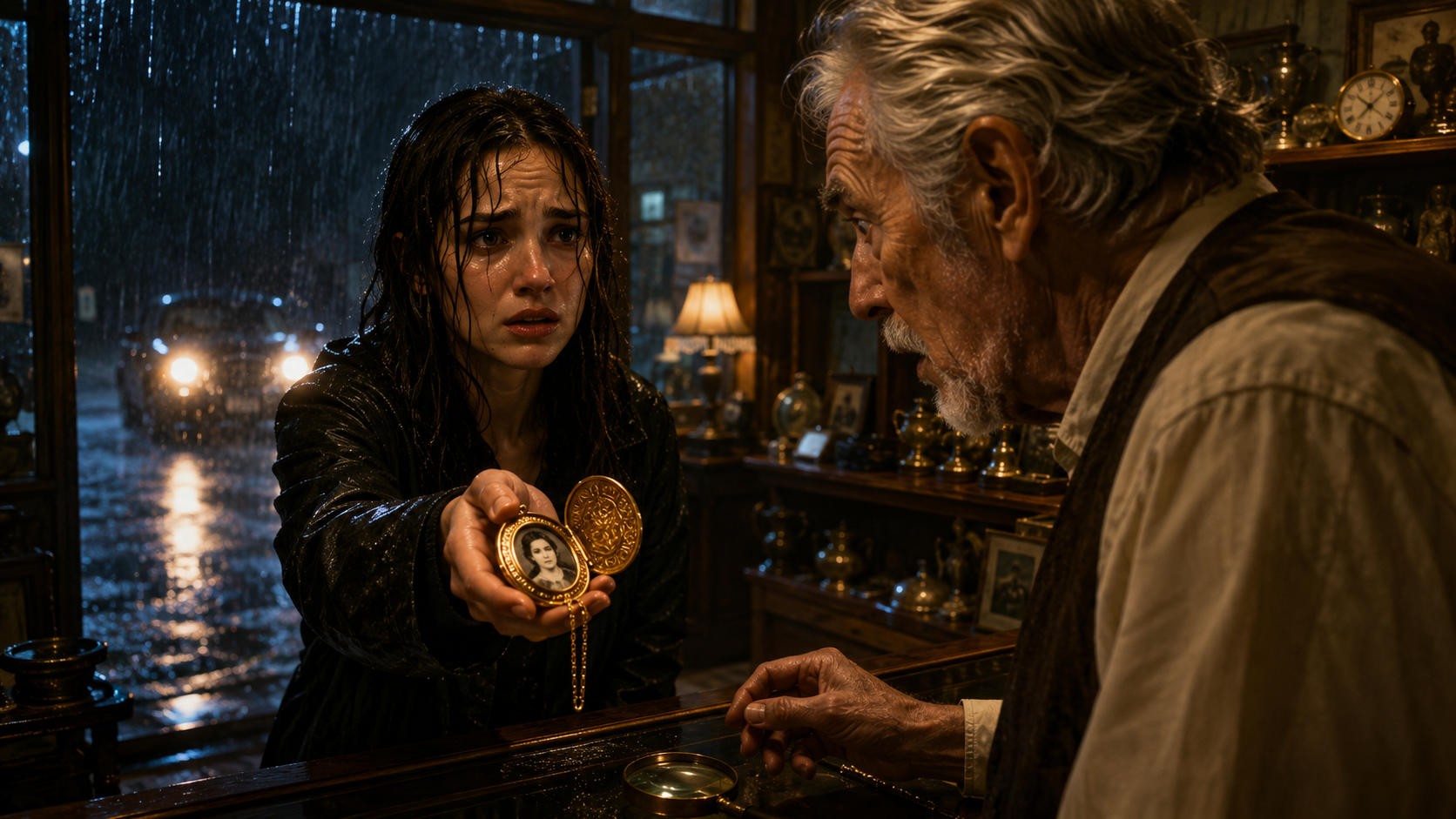
The door of the pawnshop slammed open so hard the bell above it nearly tore from its hook.
For a second, the sound cut through everything.
The rain hammering against the windows.
The soft jazz playing from an old radio behind the counter.
The quiet ticking of antique clocks lined along the back wall.
Then a young woman stumbled inside.
She was soaked through, her dark coat clinging to her thin shoulders, her hair plastered to her cheeks. Water streamed from her sleeves and gathered in shining puddles on the floor. She looked as if the storm had not merely followed her, but chased her.
Behind the counter, Silas Merrick slowly lowered the magnifying glass he had been using to inspect a cracked pocket watch.
He was an old man with sharp eyes, silver eyebrows, and hands that still moved with the patience of someone who had spent a lifetime handling fragile things. His shop sat on the corner of Briar Street and Camden Avenue, squeezed between a closed bakery and a laundromat that flickered all night.
For forty-three years, people had brought him broken jewelry, stolen-looking watches, family silver, wedding rings after divorces, and heirlooms sold with shaking hands.
Silas had learned to read desperation.
This girl was drowning in it.
She rushed to the counter and dug into the pocket of her coat.
“I need money,” she said.
Her voice cracked on the last word.
Silas did not answer immediately.
The girl opened her palm.
A necklace lay there.
Gold.
Old.
Beautiful in a way new money could never imitate.
The chain was thin but strong, and at the end of it hung a small oval locket carved with tiny leaves so delicate they looked alive beneath the yellow shop light. It was not flashy. It did not scream wealth.
It whispered history.
Silas’s expression did not change.
But something in his chest tightened.
“How much do you want for it?” he asked.
“As much as you can give me.”
“That is not an answer.”
She swallowed. Her lips were pale. Her eyes kept moving toward the window, toward the street, toward the dark blur of rain outside.
“Please,” she whispered. “I don’t have time.”
Silas reached for the locket.
The girl hesitated before handing it over, as if some part of her body refused to let go.
When the gold touched his palm, the old man went still.
It was heavier than it looked.
Not because of the metal.
Because of memory.
He turned it over carefully. The back was worn smooth where fingers must have rubbed it for years. Near the hinge, almost hidden in the engraving, was a tiny maker’s mark.
Silas knew that mark.
He had made it himself.
A lifetime ago.
The shop around him seemed to fall away. The clocks faded. The rain blurred. The girl’s frightened breathing became distant.
His thumb found the nearly invisible seam.
Click.
The locket opened.
Inside was a photograph, faded with age but protected behind a curved sliver of glass.
A little girl sat on the shoulders of a younger man. She was laughing, one hand tangled in his hair, her smile wide and missing a front tooth.
The younger man in the photo had dark hair.
No wrinkles.
No silver eyebrows.
No grief carved into the corners of his mouth.
But Silas knew his own face.
He knew the child too.
His fingers began to tremble.
The girl noticed.
“What?” she asked quickly. “What is it?”
Silas could not speak.
For eighteen years, he had dreamed of that face.
For eighteen years, he had woken from those dreams into silence.
His daughter had vanished when she was four years old. Vanished with her mother on a cold October night while he was away delivering a private estate collection to a bank vault. The police had told him there were signs of flight. Later, they told him there were signs of crime. Eventually, when no bodies were found and no ransom ever came, people stopped using careful words.
They said his wife had run.
They said his child was likely dead.
Silas had buried them without graves.
Now the proof of his missing life lay open in his palm.
“Where did you get this?” he asked.
The girl’s eyes hardened with fear.
“It’s mine.”
“No.”
Her face changed.
“What do you mean, no?”
“This locket belonged to my daughter.”
The words entered the room like thunder.
The girl stepped back.
“I didn’t steal it.”
“I didn’t say you did.”
“You’re looking at me like I did.”
“I’m looking at you like a man who has just seen the dead walk through his door.”
She froze.
Silas came around the counter too fast for his old knees. The girl turned toward the door, but he raised one hand.
“Please,” he said. “Do not run from me.”
“Then don’t call the police.”
“I won’t.”
“You don’t know me.”
His eyes moved from her face to the photograph and back again.
“What is your name?”
She looked at the door again.
The rain hit the glass in silver streaks. Outside, a bus passed slowly, its headlights spreading across the wet pavement like torn gold.
“My name is Mara,” she said at last.
Silas gripped the counter behind him.
The name struck him harder than the photograph.
Mara.
His daughter’s name had been Maribel.
Only her mother had called her Mara.
Only when she was sleepy.
Only when she was loved.
Silas’s voice broke.
“Who gave you that necklace?”
“My mother.”
“What is her name?”
The girl did not answer.
“Mara,” he said softly, and she flinched.
Not because she hated the name.
Because he had said it like he had known it before she did.
“My mother’s name is Noelle,” she whispered.
Silas closed his eyes.
Noelle.
His wife.
The woman he had loved.
The woman he had doubted.
The woman he had cursed in his loneliest hours because grief had needed someone to blame.
The room seemed to tilt beneath him.
“Noelle is alive?” he asked.
Mara stared at him.
“You know her?”
Silas laughed once, but there was no humor in it.
“I married her.”
The girl’s face drained of color.
“No.”
“Yes.”
“No. My father died before I could remember him.”
Silas looked down at the locket still open in his hand.
“And my daughter died because everyone told me she did.”
For a moment, neither of them moved.
Then Mara whispered, “That’s impossible.”
“I have spent eighteen years saying the same thing.”
Her knees seemed to weaken. She grabbed the edge of a glass display case to steady herself.
Silas took a slow step back, giving her space.
He had seen frightened people before. But this was different. This was not the fear of being caught.
This was the fear of being found.
“Sit down,” he said.
“I can’t.”
“Are you in danger?”
Her eyes flicked toward the window.
That was answer enough.
Silas walked to the door, turned the sign from OPEN to CLOSED, and locked it.
Mara panicked.
“What are you doing?”
“Keeping the storm outside.”
“You locked me in.”
“No,” he said. “I locked them out.”
The girl went very still.
Silas looked toward the rain-dark street.
“You were followed.”
She said nothing.
“People do not come into a pawnshop at night trying to sell a priceless family piece for whatever cash an old man can offer unless they are running from something.”
Mara’s face crumpled for just one second.
Then she sat down.
Not gracefully.
Like someone whose strength had finally run out.
Silas placed the locket on the counter between them.
Not behind him.
Not in his pocket.
Between them.
A promise.
“Tell me why you need the money,” he said.
Mara wrapped her arms around herself. Rainwater dripped from the hem of her coat.
“My mother is sick.”
Silas stopped breathing.
“She needs surgery. The clinic won’t move her until we pay part of the cost. I tried selling my phone. I tried begging the landlord. I tried a jewelry buyer two blocks over, but he said he needed papers. Another man offered me forty dollars and then grabbed my wrist.”
Her voice shook, but she forced herself to continue.
“I ran. I saw your lights. I thought… I thought maybe you would give me enough for a deposit.”
“How much do you need?”
“Fifteen thousand.”
Silas stared at her.
“And you were going to take whatever I offered?”
Her eyes filled.
“I was going to take anything.”
The old man looked at the locket again.
“Noelle told you never to sell this, didn’t she?”
Mara’s eyes widened.
“How do you know that?”
“Because I made it for her.”
The words sat between them.
Mara reached for the locket but stopped before touching it.
“She told me it was the only thing I should keep no matter what. She said if everything went wrong, I had to find Briar Street. Find the shop with yellow lamps. Find the man who knows how to open leaves made of gold.”
Silas looked toward the ceiling as if the old boards above him might hold him upright.
Noelle had not forgotten.
She had sent their daughter home.
“Why did she leave?” Mara asked.
The question carried a lifetime inside it.
Silas turned back to her.
“I don’t know the whole truth.”
“She said bad people wanted something from her.”
“What people?”
“She never said names. She only said they were close enough to smile at you.”
Silas’s face hardened.
Old memories began to rise.
A business partner who had wanted expansion too quickly.
A collector who had pressed too hard about a private vault.
A missing emerald from an estate case.
A police report full of holes.
A night when his wife disappeared with their child and everyone seemed too eager to call her guilty.
“Did she ever mention a man named Roland Vale?” he asked.
Mara’s reaction was small.
But Silas saw it.
Her fingers tightened around her sleeve.
“She told me if I ever heard that name, I should leave the building.”
Silas’s jaw clenched.
Roland Vale had once stood in this very shop and called himself Silas’s friend.
Roland had helped search for Noelle.
Roland had comforted him.
Roland had bought his debts years later for pennies through a shell company and tried to force Silas to sell the building.
Silas had refused.
Now he knew why Roland had never stopped circling.
“What did he want?” Mara asked.
Silas picked up the locket.
“The same thing everyone thought your mother stole.”
“What?”
“The Veyne Ruby.”
Mara frowned.
“My mother never stole anything.”
“No,” Silas said. “I don’t believe she did.”
Eighteen years ago, the shop had been entrusted with a ruby pendant belonging to the Veyne family, along with papers proving ownership of a private trust worth more than the jewel itself. The ruby disappeared the same night Noelle vanished. The papers vanished too.
Everyone assumed Noelle had taken both.
Silas had defended her at first.
Then the whispers grew.
Then the evidence appeared.
Then grief became poison.
He had believed and not believed at the same time, and that had been his greatest shame.
Mara leaned forward.
“My mother has been hiding from that man all my life.”
Before Silas could answer, headlights swept across the window.
Slowly.
Too slowly.
A black sedan rolled to the curb across the street and stopped.
The engine stayed running.
Mara stood so abruptly her chair scraped the floor.
“They found me.”
Silas looked through the rain.
Two men sat inside the car.
Watching.
He reached beneath the counter and pressed the silent alarm he had installed after a robbery fifteen years earlier.
Then he opened a drawer and pulled out a small velvet tool case.
“What are you doing?” Mara whispered.
“Something I should have done eighteen years ago.”
Silas laid the locket beneath the jeweler’s lamp and turned it over. His fingers moved with sudden certainty.
Mara watched, confused and afraid.
“There is a second hinge,” he said.
“I’ve opened it a hundred times. There’s only the picture.”
“There is what your mother wanted you to see.”
He pressed the engraved leaf nearest the clasp.
Nothing happened.
He pressed another.
Then a third.
Click.
A thin panel beneath the photograph released.
Mara gasped.
Inside was a strip of folded paper, sealed with brittle wax.
Silas lifted it with tweezers.
His hands shook so badly he had to pause before unfolding it.
The paper was old, but the ink remained legible.
He read the first line.
Then the second.
Then his face turned white.
“What is it?” Mara asked.
Silas looked toward the black sedan.
“It says your mother did not steal the ruby.”
Mara stepped closer.
His voice lowered.
“It says who did.”
The bell above the door rang again.
This time, softly.
Almost politely.
Mara turned.
Two men entered the shop.
The first was broad-shouldered, younger, with rain shining on his shaved head. The second was older, lean, elegant, wearing a dark wool coat and leather gloves.
Roland Vale had aged well.
Men like him often did.
His hair was silver at the temples, his smile expensive, his eyes calm in the way snakes are calm.
“Silas,” Roland said warmly. “Still open this late?”
“The sign says closed.”
Roland glanced at the locked door behind him.
“And yet here we are.”
His gaze moved to Mara.
For one second, the mask slipped.
Recognition.
Hunger.
Then he smiled.
“My goodness,” Roland said. “Noelle’s little girl.”
Silas stepped in front of her.
Roland chuckled.
“Still playing the protector after all these years? You were never very good at it.”
Mara felt Silas go still.
Not weak.
Not afraid.
Still in the way a blade is still before it cuts.
“You framed my wife,” Silas said.
Roland’s smile thinned.
“That is an ugly sentence to throw around in front of a young lady.”
“I found the paper in the locket.”
The room changed.
Even the clocks seemed to hold their breath.
Roland’s eyes dropped to Silas’s hand.
“What paper?”
“The one Noelle hid before she ran.”
The younger man shifted.
Mara saw his hand move toward the inside of his coat.
Silas saw it too.
Roland sighed.
“Noelle always had a talent for making simple things difficult.”
“She was protecting our daughter.”
“She was protecting herself.”
“She was protecting proof.”
Roland removed one glove finger by finger.
“You know, Silas, grief made you much easier to manage. I preferred you broken.”
Mara stepped out from behind Silas.
“You destroyed our lives.”
Roland looked at her with mild curiosity.
“No, child. Your mother did that when she refused to cooperate.”
“With what?”
“With reality.”
Silas’s voice was cold.
“You stole the Veyne Ruby. You planted evidence against Noelle. You made me believe she ran with my child because you needed time to unlock the trust.”
Roland tilted his head.
“Almost correct.”
Silas narrowed his eyes.
Roland smiled again.
“The ruby was never the real prize. The trust papers were. Your wife hid the original. That little locket only carried a copy, didn’t it?”
Mara’s mind flashed back.
Her mother feverish on a clinic bed.
Her fingers pressing the necklace into Mara’s palm.
“Find the yellow lamps,” Noelle had whispered. “If he opens it and cries, trust him.”
Mara had thought pain had made her mother confused.
Now she understood.
Her mother had not sent her to sell the necklace.
She had sent her to deliver the truth.
Roland extended his hand.
“Give me the locket, Silas.”
“No.”
“Don’t be foolish.”
“I was foolish for eighteen years. I am finished now.”
The younger man lunged.
Before he reached the counter, red and blue lights burst across the rain-soaked windows.
Police sirens cut through the night.
Roland froze.
Silas smiled faintly.
“You always did talk too much.”
The door opened again.
Officers entered with weapons drawn.
The younger man tried to run.
He made it two steps before hitting the floor.
Roland did not move. His eyes stayed on Silas.
“You have no idea what this will uncover.”
Silas looked at Mara.
Then back at Roland.
“Yes,” he said. “I do.”
He closed his hand around the locket.
“My family.”
The clinic smelled of bleach, damp coats, and fear.
Mara ran ahead down the hallway, her wet shoes squeaking against the floor. Silas followed as quickly as he could, one hand gripping the locket, the other gripping the payment receipt for the surgery deposit he had made before leaving the shop.
Room 318.
Mara stopped outside the door.
For the first time since Silas had met her, she looked like a child.
Not because she was young.
Because hope had made her helpless.
“What if she doesn’t want to see you?” she whispered.
Silas’s eyes filled.
“Then I will thank her for keeping you alive, and I will go.”
Mara stared at him for a moment.
Then she opened the door.
Noelle lay beneath a thin white blanket, smaller than the woman in Silas’s memory. Her hair was streaked with gray. Her cheeks had hollowed. Time had taken what fear had not.
But when she turned her head, Silas knew her.
Some faces change.
Some remain carved into the soul.
At first, Noelle saw only Mara.
Then her gaze moved past her.
To the doorway.
To Silas.
Her lips parted.
No sound came.
Silas took one step inside.
Then another.
“Noelle.”
She began to cry before she spoke.
“Silas…”
Mara stood between them, trembling.
Noelle tried to sit up, but pain caught her. Silas reached her bedside before the nurse could move.
He did not ask why first.
He did not accuse.
He did not demand eighteen years of answers from a woman who looked as if she had spent every one of them surviving.
He simply took her hand.
The same hand he had once held in a courthouse when they were young and broke and laughing.
The same hand he had believed abandoned him.
The same hand that had carried their daughter through a life of hiding.
“You kept her alive,” he said.
Noelle sobbed.
“They said they would kill her if I came back. They said they would kill you if I called. Roland had men inside everything. Police. courts, banks. I had the copy, but not enough power to make anyone listen.”
“I would have listened.”
She looked at him through tears.
“Would you?”
The question broke him.
Because once, yes, he would have.
Later, after the evidence and the whispers and the years of silence, he did not know.
That was the cruelty of lies.
They did not need to win all at once.
They only needed to wait until love became tired.
Silas lowered his head.
“I should have found you.”
“You searched.”
“Not long enough.”
“You searched until they taught you to hate me.”
His eyes closed.
Mara watched them both, tears sliding silently down her face.
All her life, her story had been made of warnings.
Don’t stay too long.
Don’t use your real name.
Don’t trust men in expensive coats.
Don’t ask about your father.
Now the warnings had become people.
A mother who had sacrificed everything.
A father who had been robbed of the chance to protect her.
And a truth that had waited inside gold.
Silas opened the locket and showed Noelle the hidden paper.
Her hand flew to her mouth.
“You found it.”
“Mara brought it home.”
Noelle looked at her daughter.
Pride and heartbreak filled her face.
“I told you to trust him if he cried.”
Mara let out a broken laugh.
“He did.”
Silas brushed his thumb over Noelle’s knuckles.
“Roland has been arrested.”
Noelle’s expression tightened.
“For how long?”
“Long enough for us to start.”
“No. Men like him never fall alone.”
“Then we will pull down everyone holding him up.”
For the first time, Noelle smiled.
Faintly.
Tiredly.
But it was there.
“You still sound like the stubborn man I married.”
“And you still sound like the woman who scared thieves more than any lock I ever bought.”
She laughed.
The laugh turned into a cough.
Mara moved quickly, but Silas was already calling for the nurse.
By dawn, Noelle was in surgery.
Mara sat in the hallway with her hands clasped so tightly her knuckles turned white.
Silas sat beside her.
Neither of them spoke for a long time.
At last, Mara whispered, “I almost sold the only thing that could prove who I was.”
Silas shook his head.
“No.”
She looked at him.
“You carried it exactly where it needed to go.”
The case spread quietly at first.
Then violently.
Roland Vale had not merely stolen a jewel. He had built an empire on forged inheritances, missing estate papers, bribed officials, and families too poor or too broken to fight back. The Veyne Ruby was only one thread in a much larger knot.
The locket contained the first proof.
Noelle remembered where the rest had been hidden.
For eighteen years, she had buried pieces of the truth in safe places no criminal would think to search. A church basement. A library book. A storage unit rented under a false name. A sealed envelope behind a loose tile in a rooming house bathroom.
Not because she believed revenge would come.
Because she believed her daughter might one day be safe enough to tell the truth.
Now she was.
Silas reopened locked cabinets in the pawnshop that had not been touched in years. He pulled ledgers from dusty shelves. He called lawyers he had once mistrusted. He gave statements until his voice went hoarse.
And Mara, the girl who had entered his shop soaked, hunted, and ready to trade her past for a handful of cash, stood beside him.
At first, neither of them knew how to belong to the other.
Silas did not know how to be a father to a grown woman.
Mara did not know how to be someone’s daughter without expecting to run.
They were careful with each other.
Too careful.
He asked if she liked sugar in her coffee, then looked wounded when she said she hated coffee.
She called him Mr. Merrick for three days until Noelle, still weak but recovering, told her from the sofa, “If you keep doing that, you may finish him off before my medicine does.”
The first time Mara called him Dad, it happened by accident.
They were in the shop after closing, sorting through boxes of old receipts connected to the case. Mara reached for a stack too quickly, and a tray of silver rings scattered across the floor.
“Dad, I’m sorry—”
Both of them froze.
Outside, rain tapped lightly against the glass.
Not fierce like the night she arrived.
Soft.
Almost kind.
Mara’s face turned red.
“I didn’t mean—”
“Yes,” Silas said quickly.
Too quickly.
His voice cracked.
“I mean… only if you want to.”
She looked at him for a long moment.
Then she smiled.
“Okay.”
That was all.
But to Silas Merrick, it felt as if the world had returned something no court, no money, and no apology ever could.
Months later, Noelle survived.
Not easily.
Not without scars.
But she survived.
She came back to the apartment above the shop in a wheelchair at first, then with a cane, then with slow, stubborn steps that made Silas hover until she threatened to throw a teacup at him.
Mara moved into the small room that had once been painted pale yellow for a child who disappeared before she could outgrow it.
The walls were repainted.
The cracked window was replaced.
The old cradle was gone.
But one mark remained.
A tiny line carved into the doorframe, with a date beside it.
Mara, age four.
Silas had made it three weeks before she vanished.
Mara touched that mark every morning.
Not because it hurt.
Because it proved something.
Before she was lost, she had been loved.
The shop changed too.
People came from across the city after hearing the story.
Some came to buy rings.
Some came to sell watches.
Some came only to stand beneath the yellow lamps and look at the counter where a soaked young woman had once tried to pawn a gold locket for emergency money and instead found the life stolen from her.
Silas placed a small sign in the front display case.
It did not mention Roland.
It did not mention the ruby.
It did not mention the arrests, the newspapers, or the families who finally got their names back.
It said only:
Some treasures are doors.
Mara learned the trade slowly.
How to weigh gold.
How to spot fake stones.
How to clean old silver without erasing the marks that made it human.
How to hear the difference between a liar and someone too ashamed to tell the whole truth.
Silas taught her patiently, as if every lesson returned one missing year.
One rainy evening, Mara held the locket under the lamp and studied the hidden hinge.
“You know,” she said, “I still would have taken fifty dollars that night.”
Silas looked insulted.
“It was worth far more than fifty.”
“I know.”
“Then why say that?”
She smiled.
“Because fifty dollars brought me home.”
Silas stared at her.
Then he laughed.
From the back room, Noelle shook her head from beneath a blanket.
“You two are impossible.”
Mara walked over and kissed her mother’s forehead.
“You made me that way.”
Noelle took her hand.
“No,” she said softly. “I kept you alive. But you found the door.”
Mara looked toward the rain-streaked window.
Then toward Silas.
Then at the locket resting open beneath the warm yellow light.
The same locket she had almost sold.
The same locket that had carried a photograph, a secret, a crime, and a miracle inside its golden shell.
She finally understood why her mother had told her never to let it go.
Not because it was valuable.
Because it remembered the way home when she could not.
And on the night when Mara had nothing left—
No money.
No shelter.
No time.
No hope.
She had walked into an old pawnshop ready to sell the last piece of her past.
Instead, she found her name.
Her father.
Her mother’s truth.
And a family that had never stopped existing.
Only waiting.
Outside, rain continued to fall over the city.
Inside, the lamps glowed warm against the glass cases.
Silas turned the lock on the front door.
Noelle closed her eyes in peace.
And Mara stood between them, holding the locket in her palm.
For the first time in her life, she did not feel like a girl running from a story someone else had written.
She felt like a woman finally living inside the truth.

