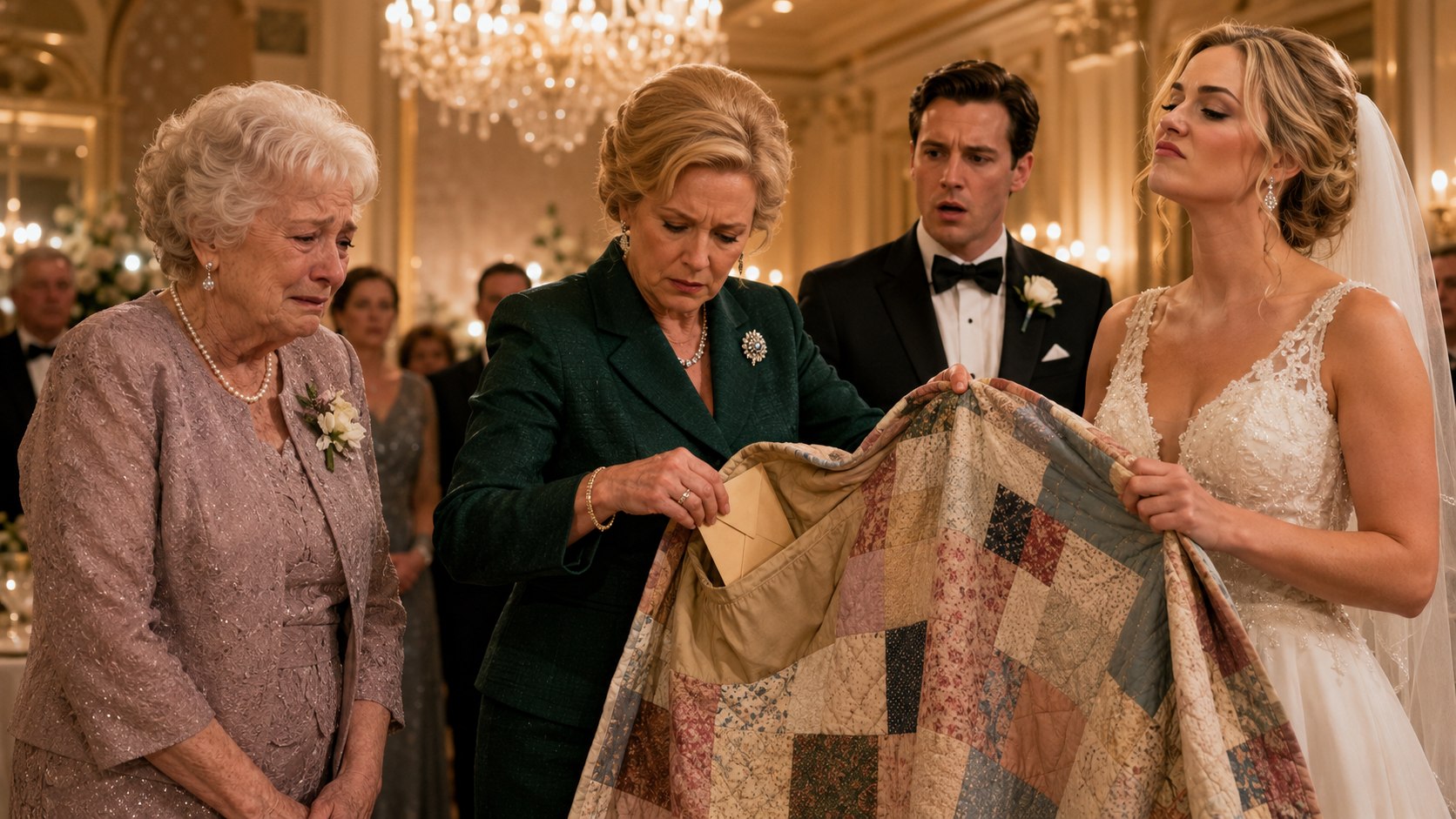
The woman who caught your wrist before you could leave was Eleanor Ashford.
Even people who had never spoken to her knew that name.
The Ashford name was engraved on hospital wings, university libraries, scholarship plaques, and the brass doors of the very hotel where the wedding reception was taking place. Eleanor owned the grand ballroom, the marble lobby, the crystal chandeliers, and half the block around it. She was seventy-six years old, dressed in a deep emerald suit, her white hair pinned neatly behind diamond earrings that did not need to sparkle loudly to announce their value.
But it was not her wealth that froze the room.
It was her voice.
“Mrs. Bennett,” she said quietly, “please don’t go.”
You stopped with one hand on your purse and the other trembling against the folded edge of your coat.
You had been trying to disappear.
That was all.
Not make a scene. Not ruin anyone’s celebration. Not embarrass your grandson, who stood near the head table in his black tuxedo with the empty look of a man who had not yet decided whether shame belonged to him.
You had only wanted to leave before the tears came hard enough for people to notice.
But Eleanor Ashford’s fingers rested gently around your wrist, and her eyes were not full of pity.
They were full of anger.
Not at you.
For you.
Across the ballroom, the bride still held the quilt.
Isabelle Vale looked perfect in every way that magazines cared about. Perfect hair. Perfect makeup. Perfect lace gown. Perfect smile that could turn sharp in an instant when she thought someone beneath her had stepped too close to the spotlight.
The quilt hung from her manicured fingers as if it were something damp and unpleasant.
A moment earlier, she had lifted it in front of four hundred guests and laughed into the microphone.
“Well,” she had said, tilting her head, “I guess every wedding needs one… homemade surprise.”
The crowd had chuckled because rich rooms often laugh before they ask whether something is cruel.
Then she had added, “It’s sweet, Grandma, really. Very… budget farmhouse.”
That was when the laughter grew.
Not from everyone.
But enough.
Enough to make heat rush up your neck.
Enough to make your grandson Noah stare at the floor.
Enough to make you feel the six months of aching fingers, late nights, old memories, and careful stitches collapse into something small and foolish under the chandelier light.
You had made that quilt from everything your family had left.
A square from Noah’s baby blanket.
A strip from his father’s old blue shirt.
A patch from your late husband’s work coat.
A piece of your own wedding veil, yellowed but still soft.
You had stitched love into it because you had no money for crystal, silver, or an envelope thick enough to impress Isabelle Vale’s family.
And Isabelle had called it cheap.
So you had smiled.
Because old women learn to smile when they are breaking.
Then you had turned to leave.
But Eleanor Ashford stopped you.
“Mrs. Bennett,” she said again, louder this time.
The room shifted.
People who had been whispering turned their heads. The band softened, then stopped altogether. A waiter holding a tray of champagne stood still near the kitchen doors.
Isabelle’s smile faltered.
She knew Eleanor, of course. Everyone in the room did. Eleanor was not just another wealthy guest. She was the kind of woman whose approval could open doors and whose silence could close them forever.
You whispered, “Please, Mrs. Ashford. It’s their wedding day. I don’t want trouble.”
Eleanor’s jaw tightened.
“No,” she said. “It is the day they learn the difference between expensive and priceless.”
Then she released your wrist and walked toward the gift table.
Every eye followed her.
The wedding host, a polished man in a velvet jacket, tried to laugh.
“Mrs. Ashford, I’m sure the bride was only teasing. We’re all having a bit of fun tonight.”
Eleanor turned her head slowly.
“One more word,” she said, “and you can have your fun outside my hotel.”
The host closed his mouth.
The silence that followed was so complete you could hear the soft hum of the lights above the dance floor.
Eleanor held out her hand.
“Give me the quilt.”
Isabelle blinked.
“It’s just a blanket.”
“No,” Eleanor replied. “That is what a person says when she has eyes but no manners.”
A few guests gasped.
Isabelle’s mother, Vivian Vale, rose halfway from her chair with a tight social smile.
“Eleanor, darling, I’m sure this is a misunderstanding. Isabelle has very refined taste. She wasn’t trying to insult anyone.”
Eleanor took the quilt from Isabelle’s hand with more care than the bride had shown it in the entire evening.
“Refined taste,” she said, “is never an excuse for public cruelty.”
Vivian sat down.
You stood near the side aisle, unable to move.
You wished your husband were alive. Just for one minute. Just long enough to stand beside you and place his warm, work-worn hand over yours. Harold would have known what to say. Or maybe he would have said nothing at all. He had always been the kind of man whose silence could hold you steady.
But Harold was gone.
Your son Samuel was gone.
And Noah, your grandson, the little boy you had raised after grief split your family open, stood in front of everyone and looked as though he had forgotten how to be yours.
Eleanor spread the quilt across the gift table.
She did not toss it.
She did not shake it open roughly.
She laid it down as carefully as if it were a flag from a fallen battlefield.
Her fingers moved over the first square.
“This fabric,” she said. “Where did it come from?”
Your throat tightened.
“My son’s shirt,” you whispered. “Samuel’s. Noah’s father.”
Noah lifted his head.
For the first time that night, he truly looked at the quilt.
Eleanor touched another square, faded cream with tiny stars.
“And this?”
“That was Noah’s baby blanket,” you said. “He wouldn’t sleep without it. My husband used to walk him around the kitchen with that blanket over his shoulder, singing old church songs until the baby stopped crying.”
The ballroom remained silent.
Eleanor moved to a dark brown patch near the border.
“My husband’s jacket,” you said. “Harold wore it when he built the back porch on my house. Noah used to follow him with a plastic hammer.”
Something moved across Noah’s face.
Not enough for everyone to notice.
But you noticed.
You had known that boy when his hands were sticky with jam, when he cried over scraped knees, when he slept on your couch because thunder scared him. You knew the difference between embarrassment and guilt.
What you saw now was guilt.
Deep guilt.
The kind that hurts because it arrives late.
Isabelle crossed her arms.
“That’s very touching,” she said, trying to recover her smile. “But I don’t think we needed a whole museum lecture during the reception.”
Eleanor looked at her.
“Apparently, you did.”
A murmur passed through the guests.
Then Eleanor turned to the room.
“Many of you know I serve on the board of the Ashford Textile Foundation. For forty years, we have preserved quilts made by women who had no fortune, no platform, no portrait in a gallery, and yet left behind the truest records of their families. Births. Deaths. Migrations. Marriages. Wars. Poverty. Survival.”
Her hand rested on the quilt.
“This is not a cheap blanket. This is a family archive.”
You lowered your eyes.
Kindness can hurt when it arrives after humiliation.
Eleanor continued, “Some families display love in diamonds. Better families preserve it in labor.”
At the head table, Noah stood slowly.
“Grandma,” he said.
Your heart stumbled.
Not because he spoke.
Because his voice sounded like the boy who used to run through your screen door shouting your name.
But before he could say more, Vivian Vale rose fully from her chair.
“Noah, sit down. This has gone far enough. Everyone is uncomfortable.”
“Good,” Eleanor said without looking away from the quilt. “Discomfort is often the first honest guest in a room like this.”
Noah did not sit.
Isabelle turned toward him with a tight smile.
“Baby, don’t make this weird. I was joking.”
A joke.
People always called cruelty a joke when they wanted the wounded person to carry the blame.
They cut you in public, then acted shocked when you bled where others could see.
Noah looked at his bride.
“You called my grandmother’s gift cheap.”
Isabelle rolled her eyes.
“Because it looked cheap, Noah. I didn’t know we were supposed to pretend it was sacred.”
The words landed hard.
Several guests looked away.
Eleanor’s fingers moved along the lower border of the quilt. Suddenly, she paused near the corner where you had stitched Noah and Isabelle’s names in blue thread.
She leaned closer.
“Mrs. Bennett,” she said slowly, “did you sew a pocket here?”
Your breath caught.
For a second, the room tilted.
You had nearly forgotten.
No.
Not forgotten.
Buried.
The memory had been folded beneath grief, beneath nerves, beneath the shame of standing in a ballroom that smelled of roses and money while holding something made from old cloth and old love.
“Yes,” you whispered.
Noah turned toward you.
“What pocket?”
You pressed a hand to your chest.
“Your father asked me to make it.”
The room changed.
It was not merely quiet now.
It was waiting.
Noah’s face went still.
“My father?”
You nodded, and the lights blurred through your tears.
“Before Samuel died, he wrote you a letter. He told me not to give it to you when you were young. He said grief would swallow the words. He wanted you to have it on the day you became a husband.”
Noah stepped toward the table.
Isabelle went pale.
But not with tenderness.
With panic.
Because suddenly the quilt she had mocked was no longer a quilt.
It was a door.
And behind it was a dead man’s voice.
Your hands shook too badly to open the hidden seam yourself.
Eleanor saw this and turned the corner of the quilt gently. Inside was a small cloth pouch stitched shut with blue thread.
The thread matched Samuel’s shirt.
You remembered sewing it through tears.
Eleanor looked at you for permission.
You nodded.
She opened the pouch and removed a folded envelope, yellowed with time. Noah’s name was written across the front in your son’s handwriting.
Noah stared at it.
His fingers trembled when he reached for it.
You remembered those fingers holding toy cars, birthday candles, baseball gloves, graduation flowers. Now they held the last words his father had saved for him.
He opened the letter.
He read the first line silently.
Then his face broke.
Not cracked.
Broke.
He covered his mouth with one hand and bent forward as if someone had struck him in the chest.
The entire ballroom watched in stunned silence.
Even Isabelle seemed to understand that she had stepped into something too sacred to repair with a pretty apology.
Noah looked at you through tears.
“Grandma,” he whispered.
You wanted to go to him.
But your legs would not move.
Eleanor spoke softly.
“Noah, would you like to read it aloud?”
At first, he shook his head.
Then he looked at Isabelle.
Then at her parents.
Then at the guests.
Then at you.
“Yes,” he said, his voice rough. “Everyone should hear what she almost threw away.”
Isabelle flinched.
Noah unfolded the paper.
His voice shook, but he read.
“My dear Noah, if you are reading this, then your grandmother kept her promise. It means you are standing at the edge of a new life, and I am not there to put my hand on your shoulder like I should be.”
Your tears fell silently.
Noah continued.
“I need you to remember something. A man’s family is not measured by how much they can afford to give him. It is measured by who stayed when staying cost them something.”
The words moved through the ballroom like a hand reaching out from the grave.
Noah swallowed hard.
“Your grandmother gave me everything after your mother left. She worked double shifts. She repaired clothes because buying new ones was impossible. She made meals out of almost nothing and still found a way to put candles on your birthday cakes.”
You closed your eyes.
You had never told Noah all of that.
You had never wanted him to feel guilty for being loved.
Noah’s voice cracked.
“If she gives you something made by her hands, do not look for the poverty in it. Look for the hours. Look for the memories. Look for the love that outlives the body.”
Someone near the back sobbed.
Maybe a cousin.
Maybe a stranger.
It did not matter.
Noah wiped his face and read the final lines.
“If the woman you marry cannot honor the hands that raised you, ask yourself whether she wants a husband or a stage. Choose carefully, son. Beauty fades. Money moves. But cruelty shown in public is a mercy, because it reveals the truth before it costs you a lifetime.”
The letter lowered in Noah’s hands.
No one clapped.
No one whispered.
The silence was no longer empty.
It was full of shame.
Isabelle looked as if the chandelier had fallen on her.
Vivian stood again, slower this time.
“This is emotional manipulation,” she said, though her voice had lost its strength. “A wedding reception is hardly the place for old family drama.”
Noah turned to her.
“No,” he said. “A wedding is exactly the place to learn who people are.”
Isabelle stepped forward, tears suddenly shining in her eyes.
But you had lived long enough to know the difference between sorrow and strategy.
“Noah,” she whispered, “I didn’t know.”
He looked down at the quilt.
“You didn’t ask.”
“I was nervous. I was overwhelmed. Everyone was watching.”
“My grandmother was watching too.”
Isabelle’s mouth trembled.
“I made one joke.”
Noah’s expression hardened.
“No. You made my grandmother small so you could look bigger.”
The sentence hit the room like thunder.
Vivian hurried to Isabelle’s side.
“Noah, you are humiliating your wife.”
“She humiliated my grandmother first.”
Isabelle’s father, Charles Vale, stood at last. He was tall, silver-haired, and calm in the expensive way of men who believed every disaster could be handled by lawyers and lowered voices.
“Son,” Charles said, “emotions are high. Let’s not turn one unfortunate moment into a catastrophe. Isabelle has apologized.”
“No,” Noah said. “She hasn’t.”
Charles’s smile tightened.
“She will.”
Isabelle looked at her father, then at Noah, then at the guests.
“I’m sorry if Grandma felt hurt,” she said.
Eleanor touched your elbow gently.
That was not an apology.
Even at eighty-one, you knew the sound of a door painted onto a wall.
Noah knew it too.
“Her name is Clara,” he said.
Isabelle blinked.
“What?”
“My grandmother’s name is Clara. You’ve had two years to learn it.”
The guests shifted.
Two years.
Two years of dinners, cards, engagement photos, bridal showers, family calls, wedding plans. Two years in which Isabelle had smiled at you as if you were furniture and called you “Grandma” only when she wanted Noah to hear it.
You had told yourself it was enough.
Young people were busy.
You should not expect too much.
You should be grateful to be included.
But Noah had pulled the truth into the light.
She had never seen you as a person.
Isabelle’s tears dried quickly, anger burning through the performance.
“Are you seriously doing this in front of everyone? Over a blanket?”
Noah lifted the letter.
“Over my father. Over my grandmother. Over the woman who raised me when no one else could.”
Your heart ached.
Not because of Isabelle anymore.
Because for the first time in years, Noah sounded like yours again.
Eleanor folded the quilt carefully and placed it in your arms.
“Mrs. Bennett,” she said, “this belongs with someone who understands its value.”
You held it tightly.
Then Noah came toward you.
“Grandma,” he said, “may I?”
You looked at him.
He was crying openly now, no longer caring who saw. Beneath the expensive tuxedo and polished wedding photographs, you saw the little boy who used to fall asleep against your shoulder.
You handed him the quilt.
Noah lifted it gently.
Nothing like Isabelle had done.
He wrapped it around his shoulders.
A murmur moved through the room.
He looked at the guests.
Then at Isabelle.
“My grandmother spent six months making this. She stitched in my baby blanket, my father’s shirt, my grandfather’s jacket, and part of her wedding veil. She gave us the only kind of wealth that cannot be bought.”
Isabelle’s face twisted.
“Noah, please stop.”
He shook his head.
“No. I should have stopped you.”
That was the sentence that finally broke you.
Because he was not pretending he had no part in your pain.
He knew silence had been its own betrayal.
Noah turned to you.
“I’m sorry, Grandma. I saw your face, and I still didn’t speak fast enough.”
You could not answer.
So you did what old women do when words become too heavy.
You opened your arms.
Noah came to you like he was ten years old again. He bent down because he was taller now, and you held him while the ballroom watched. You felt his shoulders shake. For a moment, the chandeliers, cameras, flowers, rich guests, and ruined wedding disappeared.
There was only your grandson.
Your last thread.
Not broken.
Frayed, perhaps.
But still in your hands.
Then Isabelle said the worst possible thing.
“So what?” she snapped. “Are you choosing her over me?”
The room froze.
Noah slowly released you.
He turned around.
Isabelle stood in the center of the ballroom, beautiful and furious, her gown glittering beneath the lights. She no longer looked like a bride. She looked like someone angry that the script had been taken from her.
Noah stared at her.
“I should never have had to choose.”
“But you are,” she said.
“No,” he answered. “You made the choice visible.”
Vivian rushed forward.
“Noah, think carefully. There are contracts, deposits, reputations. Do you understand what canceling this reception would look like?”
Noah gave a sad laugh.
“Better than living with a woman who thinks kindness is embarrassing.”
Charles’s voice went cold.
“You are making a mistake.”
Noah looked him straight in the eye.
“No. I made the mistake when I let your family teach me to treat my own like an accessory.”
Several guests were crying now.
Not politely.
Truly crying.
Older women. Servers near the kitchen doors. Men who looked away because Samuel’s letter had found something in them they had buried years ago.
The laughter from earlier had become collective shame.
Eleanor stepped beside Noah.
“As the owner of this hotel,” she said, “I can confirm that the remaining charges for tonight will be billed according to contract. I will also personally cover Mrs. Bennett’s transportation home, security if she wants it, and the preservation cost of that quilt.”
Vivian stared.
“Preservation cost?”
Eleanor’s smile was sharp.
“Yes. The Ashford Textile Foundation would be honored to document it as an example of contemporary family memory quilting. With Mrs. Bennett’s permission, of course.”
Isabelle looked as though she might faint.
The “cheap” quilt had just become museum-worthy in front of every person she had wanted to impress.
But you were not thinking about museums.
You were thinking about Samuel.
The letter.
The promise.
Noah held the paper and looked at it as if he could touch his father through ink.
“Grandma,” he said softly, “why didn’t you tell me Dad wrote this?”
“He asked me to wait.”
“For my wedding day?”
“Yes.”
Noah’s eyes filled again.
“I wish he were here.”
You touched his cheek.
“So do I, honey.”
For a moment, he closed his eyes against your hand.
Then Isabelle laughed once.
It was not a joyful sound.
It was sharp and broken and angry.
“You’re all acting like I burned the thing,” she said. “I made a joke. A bad joke, maybe, but a joke. Now everyone is treating me like a monster.”
Eleanor looked at her steadily.
“People are often revealed by what they laugh at.”
The words spread through the room like fire through dry paper.
Isabelle’s face hardened completely.
“Fine,” she said. “If Noah wants to ruin our wedding over his grandmother’s sewing project, let him.”
Noah took off the quilt and placed it carefully over a chair.
Then he removed his wedding ring.
The room gasped.
You grabbed the edge of the table.
Isabelle stared at his hand.
“Noah,” she whispered, afraid now.
He looked at the ring in his palm.
“We signed the papers this morning,” he said. “We can talk to lawyers tomorrow.”
Vivian shouted his name.
Charles cursed under his breath.
Isabelle reached for him, but Noah stepped back.
“No,” he said. “Don’t touch me because cameras are watching.”
That sentence told the room he had seen more than tonight.
Maybe this was not the first cruel thing.
Maybe it was only the first one that bled in public.
Isabelle’s mask cracked.
“You think anyone else will love you like I did?” she hissed.
Noah looked exhausted.
“I hope not.”
People would repeat that line for weeks.
Someone had recorded everything, of course.
By midnight, the video would be online. By morning, strangers would watch Isabelle lift the quilt and mock it. They would watch Eleanor stop you from leaving. They would listen to Noah read his father’s letter and watch an entire wedding collapse beneath the weight of one handmade gift.
But in that moment, you knew none of that.
You only knew that Noah took your hand.
“Come home with me,” he said.
You shook your head gently.
“No, sweetheart. You don’t have to take care of me tonight. You need to breathe.”
“I should have visited more,” he said.
“Yes,” you answered softly.
He flinched.
You did not take it back.
Love does not mean pretending neglect never happened.
“You should have called,” you continued. “You should have come by before asking me to mail back invitations and smile for pictures. I waited for you more times than I admitted.”
Noah’s eyes filled.
“I know.”
“Do you?”
He nodded.
“I let being loved by them make me forget who loved me first.”
That pierced you clean through.
You squeezed his hand.
“Then remember now.”
He did.
Not perfectly.
Not magically.
Real life does not heal in one dramatic ballroom scene. But some moments become hinges. A door that once swung one way begins to swing another.
Eleanor insisted on sending you home in her private car, but Noah would not let anyone else take you.
So the three of you rode together: you, Noah, and Eleanor Ashford, who had somehow become both guardian angel and battlefield commander. Noah sat beside you with the folded quilt on his lap like a sacred thing. He kept looking at the hidden pocket, then the letter, then you.
At your little house, he stepped out first.
The porch light flickered over peeling paint, a cracked step, and flower pots you could no longer bend easily to tend. After that ballroom, your house looked painfully small.
Noah noticed.
“Grandma,” he said quietly, “this place is home.”
You looked at him.
He touched the porch railing.
“Grandpa built this, didn’t he?”
“With his own hands.”
“I remember the kitchen window sticking in summer.”
“You used to hit it with your plastic hammer.”
He smiled through tears.
“I thought I fixed it.”
“You made it worse.”
For the first time all night, you laughed.
A real laugh.
Small, tired, but alive.
Inside, you made tea because that was what you did when the world ended or began again. Eleanor sat at your kitchen table as if she had been there a hundred times. Noah stood in the doorway, staring at the wall of photographs.
There was one of him at six, missing a front tooth.
One of Harold holding a fish he absolutely had not caught.
One of Samuel in work boots, grinning with his arm around Noah.
Noah reached for that photo.
“I forgot this existed.”
“You didn’t forget,” you said. “You stopped looking.”
He lowered his head.
That could have sounded cruel.
But it was only true.
Eleanor wrapped her hands around her teacup.
“Truth is not cruelty, Noah. It only feels cruel when it arrives after a long absence.”
Noah nodded slowly.
Then he turned to you.
“Can I read the letter again?”
You smiled.
“It’s yours.”
He sat at your table and read it twice.
The second time, he cried silently.
You did not stop him.
Some tears are overdue, and interrupting them is like closing a window in a house full of smoke.
When Eleanor finally left, she gave you her personal card.
“Call me tomorrow,” she said. “Not as charity. As a curator. That quilt deserves care.”
You shook your head.
“I don’t want money for it.”
“I didn’t offer money.”
She smiled.
“I offered respect.”
You kept the card.
After she left, Noah stayed.
He slept on your couch, still wearing his dress shirt, the quilt folded over his chest. At dawn, you found him awake, staring at the ceiling. He looked younger without the tuxedo jacket and the weight of Isabelle’s world around him.
“I don’t know what happens now,” he said.
You sat in the old armchair across from him.
“That’s all right.”
“My marriage might be over before it started.”
“Yes.”
“My phone has hundreds of messages.”
“Leave it off.”
“Dad’s letter is going to be everywhere.”
“Then let it remind people to be kinder.”
He turned his head toward you.
“Are you angry at me?”
You considered lying.
Old love makes lying tempting.
But Samuel’s letter had filled the house with courage, and you did not want to waste it.
“Yes,” you said.
Noah closed his eyes.
“I deserve that.”
“I’m not angry because you loved Isabelle. People can love badly before they learn. I’m angry because you let me become small in front of you.”
His jaw trembled.
“I know.”
“I am old, Noah. I don’t have endless years left to wait outside your life until you remember me.”
He sat up slowly.
“I don’t want you outside my life.”
“Then open the door.”
He nodded.
“I will.”
Over the next few days, the world discovered your quilt.
The video went viral before lunch. People wrote about their grandmothers, handmade gifts, old recipes, and things they had thrown away before understanding their value. Strangers said they called elderly relatives after watching Noah read the letter.
Isabelle posted a statement.
It was beautifully written and completely empty.
She said her words were taken out of context. She said weddings were stressful. She said she respected family traditions and regretted that some people had interpreted the moment negatively.
Eleanor Ashford responded with one sentence.
The context was cruelty.
That sentence went viral too.
Noah did not respond online.
Instead, he came to your house every morning that week.
At first, you thought guilt was driving him, and maybe it was. But guilt can pass like weather, or it can become a tool in the hands of someone willing to change.
Noah repaired the porch railing without asking for praise.
He fixed the kitchen window.
Properly this time.
He replaced the porch light, cleaned the gutters, and sat with you at lunch while you told him stories about his father he had been too young to remember. Some stories made him laugh. Some made him cry.
All of them brought Samuel back into the room for a little while.
One afternoon, Noah found an old box of fabric beneath your sewing table.
“What are these?”
“Pieces I saved.”
“From what?”
“Everything.”
There was a square from Samuel’s baseball jersey. A piece from Noah’s first Halloween costume. A strip from the curtains in the first apartment you and Harold rented.
Fabric looked useless to some people.
But you had always known it could hold a life.
Noah touched a faded yellow square.
“Can you teach me?”
You looked at him.
“To sew?”
“Yes.”
You almost laughed.
Then you saw he meant it.
So you taught him how to thread a needle.
His stitches were terrible.
Crooked, uneven, too tight in some places and loose in others. He frowned at them as if they had personally betrayed him.
You smiled.
“Now you know how my hands felt making your gift.”
He looked up.
“I’m sorry.”
“I know.”
This time, you believed him.
A month later, the legal news came.
Noah filed for annulment.
Isabelle’s family tried to fight it quietly, but the public damage had already been done. Stories surfaced from former friends, assistants, bridesmaids, and planners who admitted Isabelle had mocked people for years when she thought there would be no consequences.
People love calling a single cruel moment a mistake.
But sometimes one moment is only the window.
The house behind it has been ugly for years.
Noah struggled with that truth.
You watched him grieve not only the woman he had married, but the version of himself who had wanted her approval so badly. He had mistaken being accepted by glamorous people for becoming worthy.
That was not rare.
You had seen many lonely people do it.
One evening, he sat at your table and said, “I think I was embarrassed by where I came from.”
You stirred honey into your tea.
“I know.”
He looked wounded, then nodded.
“I wanted to be the kind of man Isabelle’s family respected.”
“And did they?”
“No,” he said. “They only liked that I was willing to leave parts of myself outside the door.”
You reached across the table and touched his hand.
“Then stop leaving them.”
He did.
Slowly.
He brought old photographs to his apartment. He framed his father’s letter. He asked Eleanor to help preserve the quilt, but refused to let it disappear into an archive forever. Instead, you agreed it could be displayed for one month in a family memory exhibit, then returned to Noah.
Opening night was small but beautiful.
The quilt hung under soft lighting, not as an object of pity but as a work of memory. Beside it was a card explaining each square: baby blanket, school shirt, father’s work shirt, grandfather’s jacket, grandmother’s veil.
At the bottom, Eleanor added a line with your permission.
Handmade by Clara Bennett, who believed love should be useful enough to keep someone warm.
You cried when you saw it.
Noah stood beside you in a plain navy suit, no designer flash, no society mask.
“I’m proud of you,” he said.
You smiled.
“For sewing crooked lines?”
“For loving us better than we deserved.”
That nearly broke you.
But it healed something too.
Not everything.
Never everything.
Grief still sat beside you some mornings. Harold was still gone. Samuel was still gone. Your hands still hurt when it rained.
But Noah was no longer just a photograph you waited beside.
He was there.
Really there.
Months passed.
Your little house became loud again in small ways. Noah came every Sunday. Sometimes he brought groceries. Sometimes takeout. Sometimes nothing but himself, and that became your favorite gift.
He learned to make Harold’s soup recipe.
Badly at first.
Then better.
He planted flowers in the porch pots so you would not have to bend. He also learned to sit quietly when you were tired, which is one of the kindest skills a young person can learn for an old person.
Then one spring morning, Noah brought someone with him.
Her name was Lily.
She was not glamorous in Isabelle’s way. She wore simple jeans, carried a homemade lemon cake, and looked nervous when she stepped into your kitchen.
Noah did not introduce her as a girlfriend.
Not at first.
He said, “Grandma, this is my friend Lily.”
You noticed how Lily looked at the photographs.
Not with boredom.
Not with judgment.
With attention.
She asked about Samuel before asking about Noah’s job. She touched the back of one kitchen chair and said, “This woodwork is beautiful.” When you told her Harold had made it, she listened as if that mattered.
That afternoon, while Noah went outside to check the porch, Lily helped you wash cups.
She saw the quilt folded carefully in the living room.
“May I look at it?” she asked.
May I.
Not “What is that?”
Not “How old is it?”
Not “Does it match anything?”
You nodded.
Lily washed her hands first.
That was when you knew.
She unfolded the quilt gently, studying every square without rushing. When she reached the lace from your wedding veil, her eyes softened.
“This is the kind of gift people spend their whole lives hoping to deserve,” she said.
You looked through the window at Noah kneeling by the flower pots.
Maybe love had not finished with him.
Maybe it had only waited until he remembered how to recognize it.
A year after the wedding that became no wedding at all, Noah asked you to come to the courthouse.
No ballroom.
No orchestra.
No four hundred guests.
Just you, Eleanor Ashford, Lily’s parents, and a judge with kind eyes.
Lily wore a cream dress. Noah wore a suit he already owned. There were no champagne towers, no designer gift table, no host turning love into entertainment.
After the ceremony, Noah handed you a small box.
Inside was a silver thimble.
Your name was engraved on it.
Clara.
Underneath, in tiny letters, it said:
You kept us together.
You closed the box and held it to your chest.
Noah hugged you.
Lily hugged you after asking first, which made you laugh through tears.
Then Lily said, “We don’t want gifts. But if someday you feel like sewing something for our home, it would be an honor.”
An honor.
That word wrapped around your old heart like sunlight.
You did make them something.
Not another wedding quilt.
That first quilt belonged to a different chapter, one stitched from grief and survival and a letter that arrived exactly when it was needed.
For Noah and Lily, you made a smaller quilt from new fabric. Soft greens, warm creams, and one little blue square from Samuel’s old shirt, because the past does not need to disappear for the future to begin.
Your hands still trembled.
The seams were still not perfect.
But this time, when you handed it to the bride, she did not lift it up for applause.
Lily pressed it to her chest.
Then she cried.
Not because cameras were watching.
Not because she wanted to look sweet.
Because she understood.
Noah stood behind her, his eyes wet.
“Dad would have loved this,” he whispered.
You looked at your grandson, at the woman holding your work like treasure, and at the small courthouse garden blooming behind them.
For the first time in years, you did not feel like the last thread of a dying family.
You felt like a thread still being woven forward.
That night, Noah walked you back to your little house.
The porch light glowed steadily now. The flowers he had planted were blooming. The kitchen window opened smoothly. The chair Harold made still stood by the table.
Noah carried the preserved quilt inside and placed it across the back of your sofa.
“Do you ever regret bringing it?” he asked.
You thought of Isabelle’s laughter.
The microphone.
The shame.
The way your knees nearly failed as you turned toward the door.
Then you thought of Eleanor’s hand on your wrist.
Samuel’s letter.
Noah’s apology.
The museum.
The Sundays.
The second wedding, quiet and real.
“No,” you said.
Noah looked surprised.
You smiled.
“Sometimes the gift is not what changes the room. Sometimes it reveals what was already there.”
He sat beside you.
“I almost lost you that day.”
“Yes,” you said softly. “You almost did.”
He swallowed.
“I won’t again.”
You believed him.
Not because he said it beautifully.
Because he had spent a year proving it in small, ordinary ways.
And that is where love is usually rebuilt.
Not in speeches.
Not in viral videos.
Not beneath chandeliers.
But in repaired windows, Sunday soup, threaded needles, porch flowers, returned phone calls, and the courage to say, “I was wrong,” without demanding to be forgiven immediately.
You rested your hand over his.
Your fingers were thin now.
His were strong.
Once, those hands had been tiny and sticky with jam. Once, they had held toy cars on your kitchen floor. Once, they had failed to defend you when you needed him.
Now they held yours carefully, as if he finally understood that old hands are not weak.
They are history.
They are sacrifice.
They are the last living bridges to people who can no longer speak.
The bride had called your quilt cheap.
But she was wrong.
It had cost you six months of aching fingers.
It had cost you pieces of every person you had loved and buried.
It had carried your son’s final warning, your husband’s memory, your grandson’s childhood, and your own quiet hope that family could still be saved.
In the end, that quilt did not ruin a wedding.
It rescued your grandson from a lifetime of mistaking cruelty for love.
And when Noah kissed your forehead before leaving that night, he whispered the words you had waited years to hear.
“Thank you for not walking out before I remembered who I was.”
You watched him leave through the repaired front door.
Then you sat beside the quilt, listening to the house settle around you.
Your husband was gone.
Your son was gone.
But love had not left.
It had simply been waiting, stitched into fabric, hidden in a pocket, ready to speak when the room finally went silent enough to hear it.