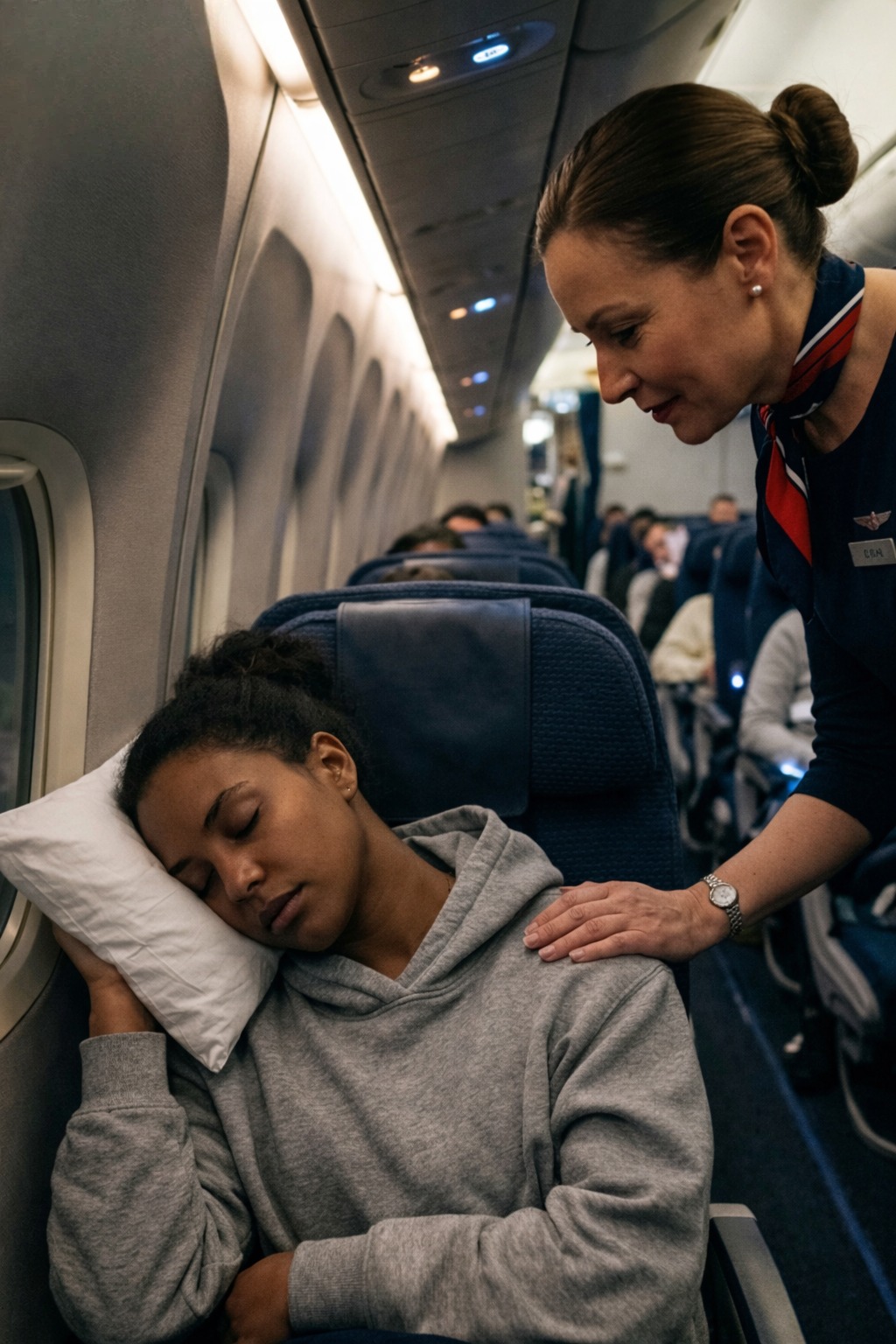
She was asleep in seat 8A – until the captain made an announcement that changed everything
That morning, when Mara Dalton walked into Kennedy Airport, she looked no different from the hundreds of other passengers rushing across the Atlantic on a typical Tuesday. A plain green jumper, jeans, a small carry-on suitcase. Nothing about her appearance suggested that she had fifteen years in the cockpit behind her, that she had flown more hours in combat conditions than many pilots accumulate in their entire careers, and that the manoeuvres she had once performed would have made most civilian pilots grip the control column nervously even before take-off.
She was doing her utmost to look ordinary.
That was exactly what she had been doing for the past six months — ever since she left the service, handed in her resignation, closed the door of the military base behind her, and told everyone who knew her the same thing: it’s all over. No more army. No more adrenaline. No more of that particular fear you feel when you take off, unsure whether you’ll ever return.
The crowd at JFK moved to its familiar rhythm. People walked quickly, confidently, as if they’d walked this path a hundred times before. They had their own routes, their own connections, their own boarding passes, and the habit of not getting lost in the airport bustle. Mara moved with them — blending in, becoming one of the many, inconspicuous, unremarkable. That was exactly what she wanted.
Boarding had already begun for her flight. London. A week in a city where no one knows her name, where she can wander slowly through museums, sit in a café by the window and pretend she’s never looked down from thirty-five thousand feet, knowing that the ground beneath the wing is set on killing her.
She took her seat, 8A by the window, and closed her eyes, listening to the familiar pre-flight background noise of the aeroplane. The low hum of the engines outside. The measured footsteps of the flight attendants in the aisle. Calm voices checking seatbelts, luggage, trays, drinks — all in that tone of voice that comes only after thousands of identical flights.
The usual rhythm. A sense of order. Of safety. That very normality she had longed for over six long months.
Mara took a slow breath, trying to keep the memories at bay. The very ones that come at two in the morning when sleep won’t come. The ones in which words, decisions and faces play out over and over again — moments when you realise that your choice has changed someone’s life forever.
She was already drifting into that light drowsiness that sometimes overtakes you at the start of a flight, when consciousness wavers between reality and dreams, when suddenly the cabin speaker clicked.
‘Ladies and gentlemen, this is the captain speaking.’
The voice was even, businesslike, the sort usually used to announce altitude, weather or arrival time. But beneath that familiar professional façade, Mara immediately heard something else.
Something that made her snap her eyes open.
— If there is a pilot with combat training on board, please identify yourself immediately. This is not a drill. I repeat: this is not a drill.
Those words seemed to physically rip through the cabin.
Conversations fell silent. People exchanged glances. A woman across the aisle stared at her husband in bewilderment. The man in front turned round, trying to make sense of what he’d just heard and why a civilian flight over the ocean would need a combat pilot.
Mara felt a familiar tightening inside. It was a tension she knew all too well: her body already understood that something was wrong, even before her mind had had time to process it.
For fifteen years, she had taken to the skies precisely for situations like this. She knew all too well what such a request meant. It meant one thing: something had gone very wrong. And the captain was running out of options.
But that was all over now.
She had promised herself that — standing in her former commander’s office and signing her discharge papers. She’d promised she wouldn’t come back. That someone else would carry that burden now. That she’d learn to live a normal life — normal flights, normal cities, normal days.
But when the flight attendants began moving quickly down the aisle, and the urgency on their faces was impossible to hide, Mara realised: this was serious.
One of the flight attendants stopped by her row and, glancing at the passengers, asked:
‘Excuse me… is there anyone here who knows how to fly? The captain needs to know if there’s at least one person on board with flying experience.’
Mara froze.
She could have said nothing. Pretended she hadn’t heard. Stayed in seat 8A and let someone else step forward. Let someone else take responsibility for what was coming.
That was exactly what she had been trying to do all these months — to no longer be that person. To let go of the identity that had defined her since she was twenty-two.