I was raised in an orphanage, separated from my little sister at eight years old, and spent the next three decades wondering whether she was even alive. Until an ordinary business trip turned a routine supermarket stop into something I still can’t fully explain.
My name is Elena, and when I was eight, I promised my little sister I would find her.
Then I spent the next 32 years failing.

Mia and I grew up in an orphanage.
We didn’t know our parents. No names. No photos. No comforting story about them coming back someday. Just two beds in a crowded room and a few lines in a file.
We were inseparable.
She followed me everywhere, held my hand in the hallways, cried if she woke up and I wasn’t there. I learned to braid her hair using my fingers because we didn’t always have a comb. I learned how to sneak extra bread rolls without getting caught. I learned that if I smiled and answered adults politely, they were kinder to both of us.
We didn’t dream about big futures.
We just wanted to leave that place together.
Then one day, a couple came to visit.
They walked alongside the director, nodding and smiling. The kind of people who looked like they belonged in those “adopt, don’t abandon” brochures.
They watched the kids play.
They watched me reading to Mia in the corner.
A few days later, the director called me into her office.
“Elena,” she said, smiling too much, “a family wants to adopt you. This is wonderful news.”
“What about Mia?” I asked.
She sighed like she’d practiced it.
“They’re not ready for two children,” she said. “She’s still young. Other families will come for her. You’ll see each other someday.”
“I won’t go,” I said. “Not without her.”
Her smile flattened.
“You don’t get to refuse,” she said gently. “You need to be brave.”
Brave meant do what we say.
The day they came, Mia wrapped her arms around my waist and screamed.
“Don’t go, Lena!” she sobbed. “Please don’t go. I’ll be good, I promise.”
I held her so tightly that a worker had to pull her off me.
“I’ll find you,” I kept saying. “I’ll come back. I promise, Mia. I promise.”
She was still screaming my name when they put me in the car.
That sound followed me for decades.
My new family lived in another state.
They weren’t bad people. They fed me, clothed me, gave me a bed without other kids in it. They called me “lucky.”
They also hated talking about my past.
“You don’t need to think about the orphanage anymore,” my adoptive mom would say. “We’re your family now. Focus on that.”
I learned English better. Learned how to fit in at school. Learned that mentioning my sister made conversations uncomfortable very fast.
So I stopped saying her name out loud.
In my head, she never stopped existing.
When I turned 18, I went back to the orphanage.
Different staff. New kids. Same peeling paint.
I gave them my old name, my new name, my sister’s name.
A woman went into the records room and returned with a thin file.
“Your sister was adopted not long after you,” she said. “Her name was changed and her file is sealed. I can’t share more than that.”
“Is she okay? Is she alive? Can you tell me that much?”
She shook her head.
“I’m sorry,” she said. “We’re not allowed.”
I tried again a few years later.
Same answer.
Sealed file. Changed name. No information.
It felt like someone had erased her and written a new life over the top.
Meanwhile, my life moved forward the way lives do.
I finished school, worked, married too young, divorced, moved cities, got promoted, learned to drink decent coffee instead of instant.
From the outside, I looked like a functional adult woman with a normal, slightly boring life.
Inside, I never stopped thinking about my sister.
I’d see sisters arguing in a store and feel it.
I’d see a girl with brown pigtails holding her big sister’s hand and feel it.
Some years, I tried to search for her online or through agencies. Other years, I couldn’t face hitting the same dead end again.
She became a ghost I couldn’t fully grieve.
Fast-forward to last year.
My company sent me on a three-day business trip to another city. Nothing exciting—just an office park, a cheap hotel, and one decent coffee shop.
On the first night, I walked to a nearby supermarket to grab food.
I was exhausted, thinking about emails, silently cursing whoever scheduled a 7 a.m. meeting.
I turned into the cookie aisle.
A little girl stood there, maybe nine or ten, staring intensely at two packs of cookies like it was the most important decision of her life.
As she reached up, her jacket sleeve slipped down.
That’s when I saw it.
A thin red-and-blue braided bracelet on her wrist.
I stopped like I’d hit a wall.
It wasn’t just similar.

Same colors. Same uneven tension. Same ugly knot.
When I was eight, the orphanage got a box of craft supplies. I stole red and blue thread and spent hours trying to make two “friendship bracelets” I’d seen older girls wear.
They came out crooked and too tight.
I tied one around my wrist.
I tied the other around Mia’s.
“So you don’t forget me,” I told her. “Even if we get different families.”
Hers was still on her wrist the day I left.
I stared at the bracelet on this child’s arm. My fingers actually tingled, like my body remembered making it.
I stepped closer.
“Hey,” I said softly. “That’s a really cool bracelet.”
She looked up at me—not scared, just curious.
“Thanks,” she said, holding it up. “My mom gave it to me.”
“Did she make it?” I asked, trying not to sound unhinged.
She shook her head.
“She said someone special made it for her when she was little,” she said. “And now it’s mine. I can’t lose it or she’ll cry.”
I laughed lightly, even though my throat tightened.
“Is your mom here?”
“Yeah,” she said, pointing down the aisle. “She’s over there.”
I looked.
A woman walked toward us holding a box of cereal.
Dark hair pulled back. Minimal makeup. Jeans. Sneakers. Early-to-mid thirties.
Something in my chest lurched.
Her eyes. Her walk. The way her eyebrows tilted when she squinted at labels.
The little girl ran to her.
“Mom, can we get the chocolate ones?” she asked.
The woman smiled at her, then looked at me.
She had the same eye shape Mia had at four—just on an adult face.
I stepped closer before I could lose my nerve.
“Hi,” I said. “Sorry, I was just admiring your daughter’s bracelet.”
She glanced down and smiled.
“She loves that thing,” she said. “Won’t take it off.”
“Because you said it’s important,” the girl reminded her.
“That too,” the woman said.
I swallowed.
“Did someone give it to you?” I asked. “When you were a kid?”
Her expression shifted slightly.
“Yeah,” she said slowly. “A long time ago.”
“In a children’s home?” I blurted.
Her eyes snapped to mine.
We stared at each other for a beat.
“How do you know that?” she asked.
“I grew up in one too,” I said. “And I made two bracelets just like that. One for me. One for my little sister.”
Her face drained of color.
“What was your sister’s name?” I asked, my voice shaking.
She hesitated, then said, “Her name was Elena.”
My knees nearly buckled.
“That’s my name,” I managed.
Her daughter’s jaw dropped.
“Mom,” the girl whispered. “Like your sister.”
The woman looked at me like she was seeing a ghost she’d both hoped for and feared.
“Elena?” she asked, barely audible.
“Yeah,” I said. “It’s me. I think.”
We stood there frozen in the cookie aisle.
Carts rolled by. Someone laughed near the milk. Life kept moving.
The little girl—Lily, I would learn later—looked between us like she’d wandered into a movie.
“Are you my mom’s sister?” she asked.
“I think I am,” I said.
The woman gripped the cart handle.
“Can we… talk?” she asked. “Not… here?”
“Please,” I said.
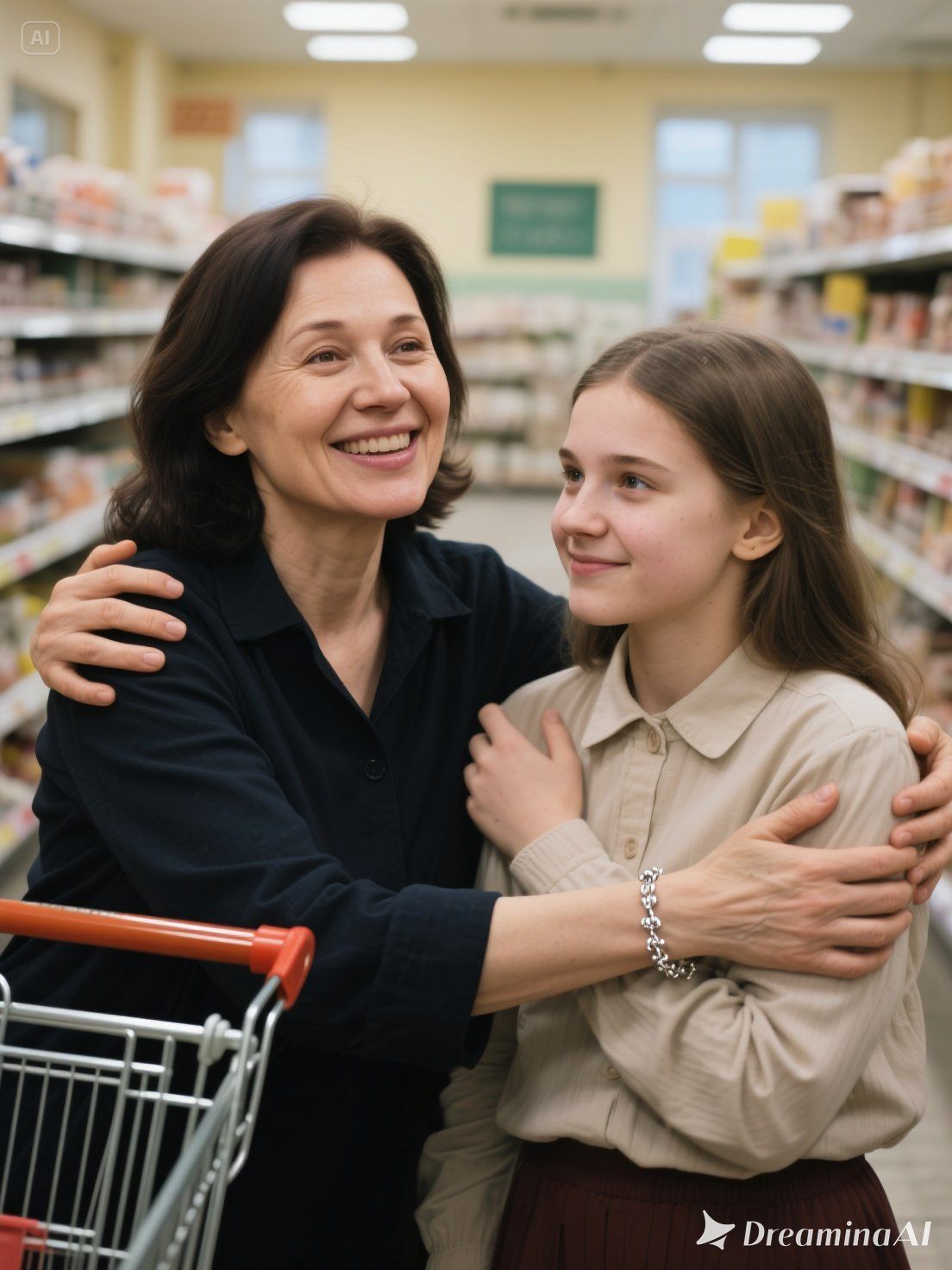
We checked out and sat in the sad little café attached to the store.
Sticky table. Lily got hot chocolate. We got coffee we barely touched.
Up close, every doubt vanished.
Her nose. Her hands. Her nervous laugh.
All Mia. Just older.
“What happened after you left?” she asked. “They told me you got a good family and… that was it.”
“I got adopted,” I said. “They moved me out of state. They didn’t want to talk about the orphanage or you. When I turned eighteen, I went back. They said you’d been adopted, your name changed, your file sealed. I tried again later. Same answer. I thought maybe you didn’t want to be found.”
Her eyes filled.
“I got adopted a few months after you,” she said. “They changed my last name. We moved a lot. Whenever I asked about my sister, they’d say, ‘That part of your life is over.’ I tried looking for you later, but I didn’t know your new name or where you went. I thought you forgot me.”
“Never,” I said. “I thought you were the one who left me.”
We laughed—the sad kind, when pain lines up too perfectly.
“What about the bracelet?” I asked.
She glanced at Lily’s wrist.
“I kept it in a box for years,” she said. “It was the only thing I had from before. I couldn’t wear it, but I couldn’t throw it away. When Lily turned eight, I gave it to her. I told her it came from someone very important. I didn’t know if I’d ever see you again, but I didn’t want it to die in a drawer.”
Lily held out her arm proudly.
“I take good care of it,” she said. “See? It’s still okay.”
“You did a great job,” I said, my voice breaking.
We talked until the café began closing.
Jobs. Kids. Partners and exes. Small memories that matched exactly.
The chipped blue mug everyone fought over.
The hiding spot under the stairs.
The volunteer who always smelled like oranges.
Before we left, Mia looked at me and said, “You kept your promise.”
“What promise?” I asked.
“You told me you’d find me,” she said. “You did.”
I hugged her.
It was strange—two strangers with shared blood and a stolen childhood—and also the most right thing I’d felt since I was eight.
We exchanged numbers and addresses.
We didn’t pretend 32 years hadn’t passed.
We started small.
Texts. Calls. Photos. Visits when time and plane tickets allowed.
We’re still figuring it out. We both built lives without each other, and now we’re carefully stitching them together without tearing anything.

But now, when I think about that day in the orphanage—the gravel under my feet, Mia screaming my name—there’s another image layered over it:
Two women in a grocery store café, laughing and crying over bad coffee while a little girl swings her legs and guards a crooked red-and-blue bracelet like treasure.
My sister and I were separated in an orphanage.
Thirty-two years later, I saw the bracelet I made for her on a little girl’s wrist.
After searching for so long, I never imagined this would be how I’d find her.