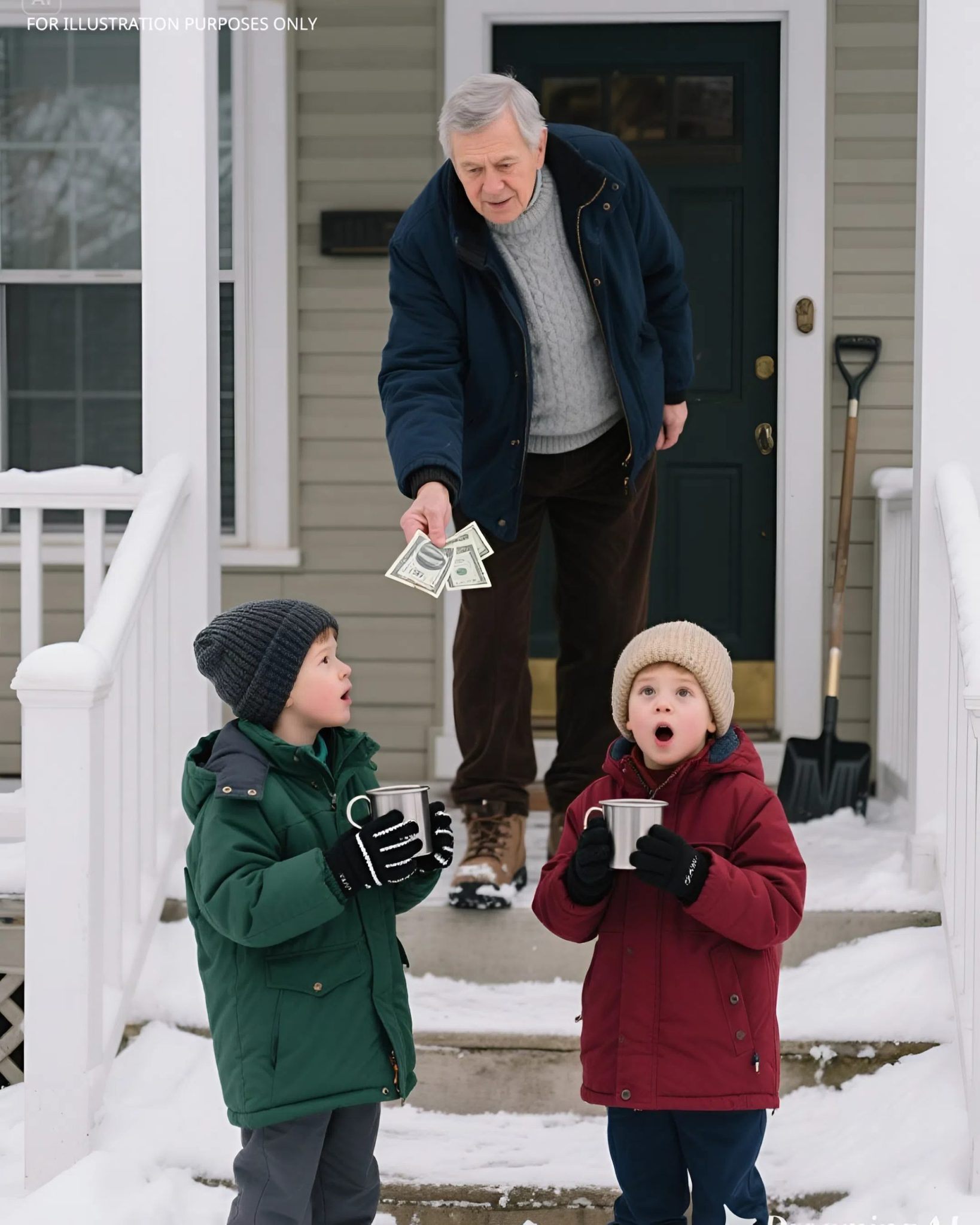
The next morning, the cold was even sharper. The kind that makes the air sting your lungs and turns every breath into a white cloud. I was sipping my coffee, staring at the clean driveway the boys had carved out of the snow, when I noticed something unusual.
A small envelope.
It was wedged between my storm door and the frame—slightly crumpled, the corner damp from frost. My name was written on it in shaky handwriting.
Inside was six dollars.
And a note:
“Sir,
We came up $6 short for the battery.
We are very sorry.
We will pay you back every dollar we owe.
—Marcus and Leo”
I stared at the note for a long time.
Six dollars.
It broke something inside me—not because of the money, but because of what it represented. Pride. Responsibility. The kind of honesty the world pretends doesn’t exist anymore.
I threw on my coat and headed outside. The snow crunched under my boots. I didn’t know where they lived, but the auto parts store was my best guess.
Inside, the shop was quiet except for the hum of fluorescent lights and the distant sound of someone stacking boxes. The clerk recognized me—small town familiarity.
“You looking for the Johnson boys?” he asked.
My eyebrows rose. “You know them?”
He nodded. “Everyone around here does. Their mom’s one of the best night nurses we’ve got. Helps anyone. Puts every spare penny into those kids.”
“Did they get the battery?”
“Barely,” the clerk said with a sigh. “Came in freezing, running like they’d been chased. They dumped everything they had on the counter. Coins, crumpled bills, even a few tokens from the laundry mat. They were short, but…” He shrugged. “We covered the rest.”
Something tightened in my chest.
“What did they say?” I asked quietly.
The clerk chuckled. “The older one—Marcus—said, ‘Sir, we’ll come work it off. We shovel. We rake. We clean. Anything.’ The kid looked like he’d fight a hurricane to defend his family.”
I nodded slowly. That sounded exactly like the boy I met yesterday.
On my way out, the clerk called after me:
“They’re good kids, Mr. Gable. World could use more like them.”
Maybe so, I thought.
But kids like that don’t just survive.
They burn themselves out if no one steps in.
For illustrative purpose only
Two days passed before I saw them again.
It was Monday afternoon when a small shadow fell across my driveway. I turned and there they were—Marcus and Leo—standing nervously at the edge of the pavement, their hands shoved into their sleeves for warmth.
They looked unsure… almost afraid.
“Mr. Gable?” Marcus asked quietly. “We’re here to pay back the six dollars we owe.”
He held out three crumpled one-dollar bills.
Leo, meanwhile, was holding something behind his back.
I walked toward them slowly, trying to keep my voice level.
“You don’t owe me anything.”
Marcus swallowed hard. “Sir… it’s the right thing to do.”
I looked at him—really looked at him.
A fourteen-year-old kid built like a grown man when it came to responsibility, but still very much a child around the eyes. A child who had carried too much for too long.
I shook my head.
“You boys paid me the moment you stepped onto my driveway in the middle of a snowstorm with a broken shovel and a purpose.”
Leo suddenly spoke, his voice trembling.
“Sir… we brought you something.”
He stepped forward and revealed what he’d been hiding.
A tiny wooden carving.
Handmade. Rough around the edges. But beautiful.
It was a small bird—maybe a sparrow—carved from a piece of scrap pine. The feathers were etched with careful, uneven lines. The eyes were just little dots made with a nail.
“I made it in school,” Leo said, looking down. “It’s not… it’s not fancy, but Mom says gifts made from your hands are worth the most.”
Marcus nudged him. “We wanted you to have it. For being kind.”
The little bird sat in Leo’s shaking hands—fragile, imperfect, full of heart. I felt my throat tighten.
“Thank you,” I said softly. “This means more than you know.”
Their shoulders relaxed slightly. But then Marcus lifted his eyes, worry returning.
“Sir?” he asked. “Did we… do anything wrong?”
“Wrong?” I repeated. “No. You did everything right.”
Marcus nodded but didn’t look convinced. He looked down at the snow, nudging it with the toe of his shoe.
“Most people think we’re trouble,” he whispered. “Mom works nights. We walk home alone. Sometimes neighbors complain. They think… they think we’re bad kids.”
Leo’s voice cracked. “We’re not bad. We just… don’t have much.”
I took a deep breath.
“Listen to me,” I said gently. “You two boys are the kind of young men this country needs more of. You worked for what you needed. You took care of your family. You showed character.”
They looked up, confusion in their eyes.
“You’re not trouble,” I continued. “You’re extraordinary.”
Leo’s eyes filled immediately. Marcus blinked hard, fighting emotion the way grown men do.