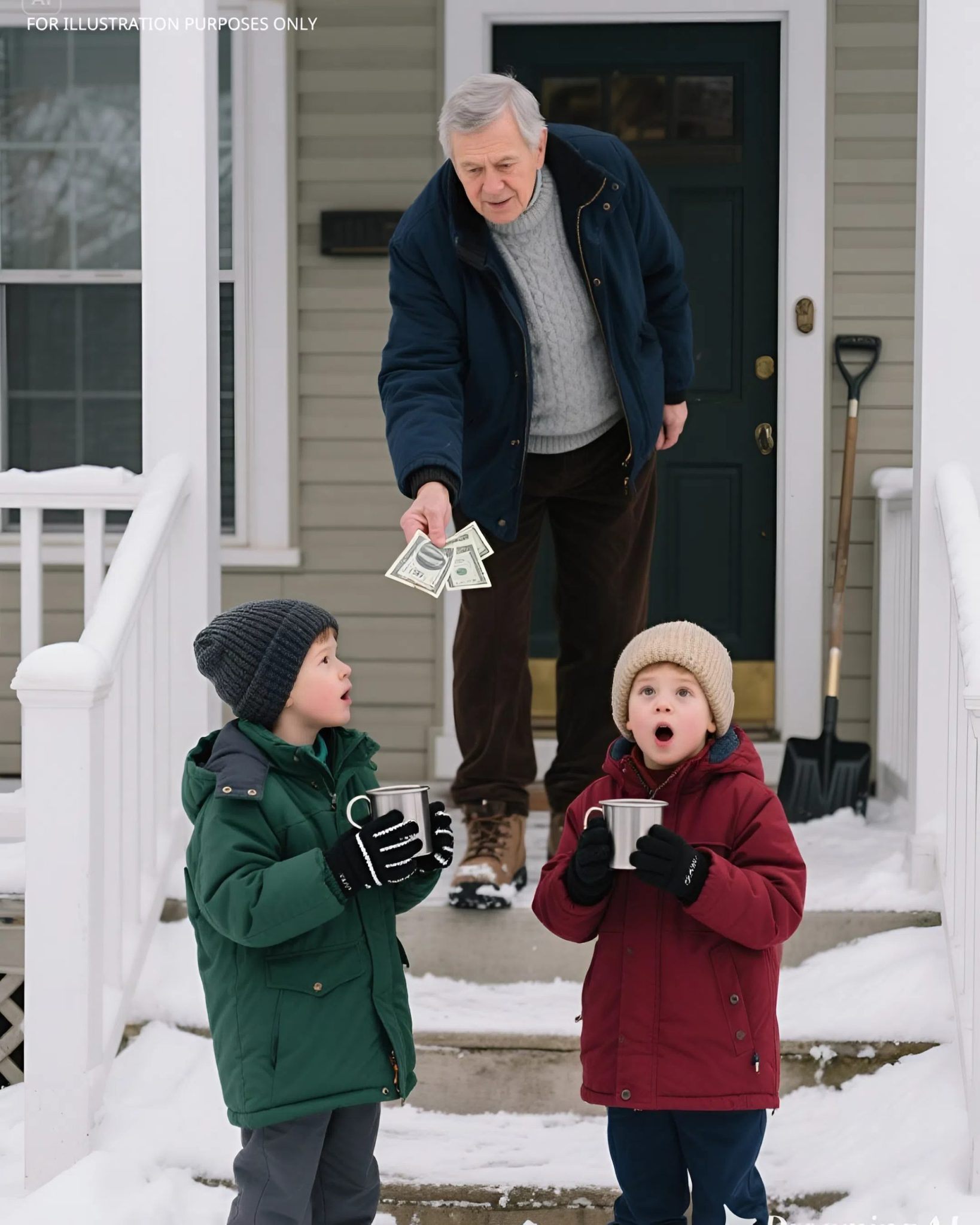
Then Marcus asked a question so soft I almost missed it.
“Can we… shovel for you again? We’re good workers.”
I smiled.
“You can shovel for me every time it snows. But you’re not working for twenty dollars.”
Marcus hesitated. “Sir… we won’t take charity.”
“It’s not charity,” I said. “It’s a job. And good work deserves good pay.”
He seemed to take that in. Slowly. Carefully. With pride.
But then Leo said something that nearly broke me.
“Mom said… the world is unfair, but sometimes there are angels who pretend to be regular people.”
He looked up at me with wide, earnest eyes.
“I think you’re one of them.”
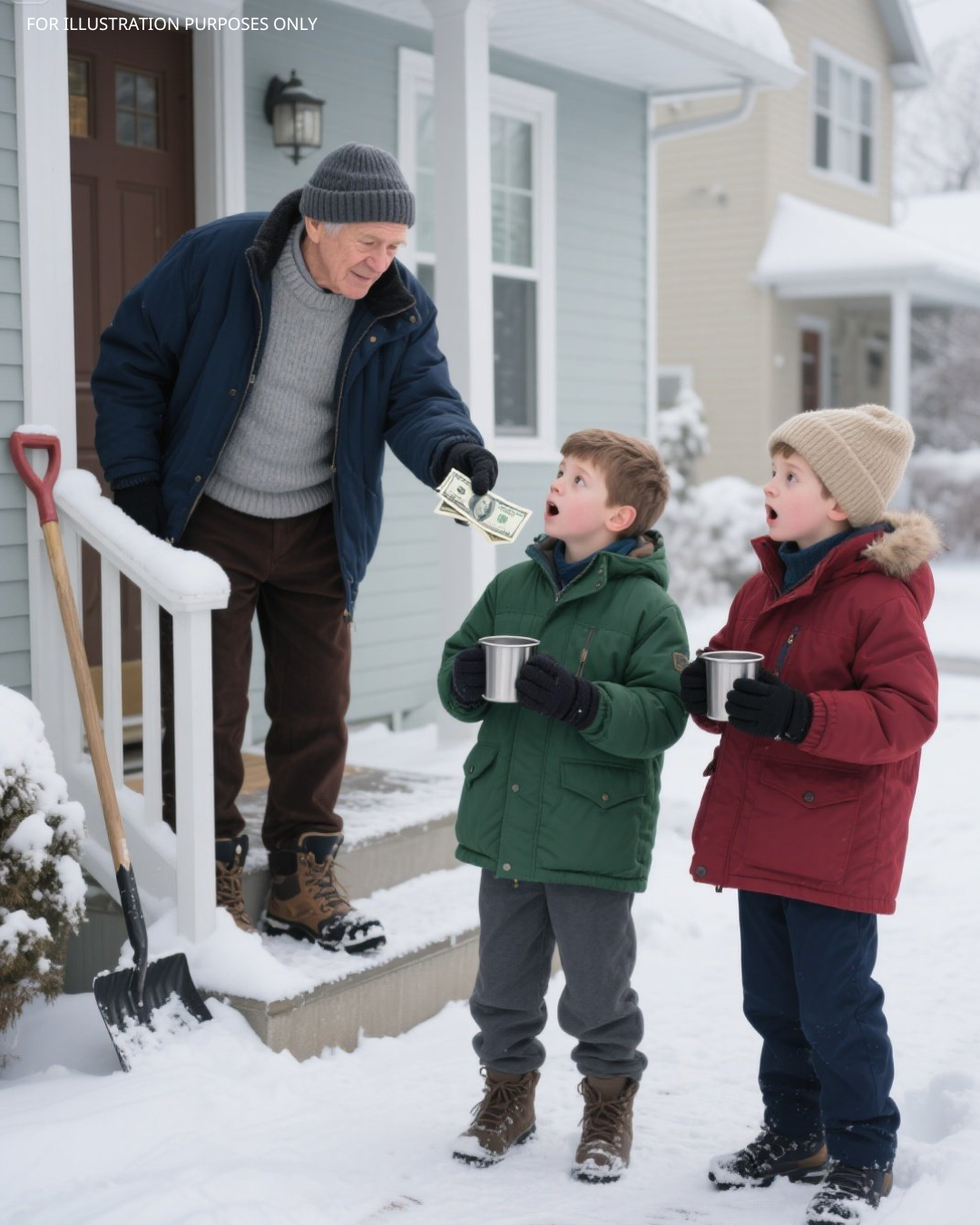
My chest tightened so hard it physically hurt.
I cleared my throat. “No, son. I’m not an angel.”
I placed a hand gently on each of their shoulders.
“But I’ll tell you something important… Sometimes the world sends us people who remind us what goodness looks like. What resilience is. What love is.”
I squeezed their shoulders.
“And those people? They’re usually kids like you.”
Later that week, I drove past St. Jude’s Hospital. I saw their mother, exhausted but smiling, stepping out of her car—the new battery humming strong beneath the hood.
She didn’t know I was watching.
She didn’t know her sons’ story had reached half the town already.
She didn’t know that an entire community was beginning to rally around her family—not out of pity, but out of respect.
All she knew was that she still had her job.
That her boys saved the day.
That they carried her through the coldest storm with courage far beyond their years.
As I watched her walk inside, I whispered something I wish every struggling parent could hear:
“You raised them right. And the world saw it.”
The bird carving still sits on my mantle.
A reminder that kindness multiplies.
That hard work matters.
That character outlives circumstance.
And that sometimes, when two boys knock on your door with a broken shovel and a desperate hope, they’re not asking for work…
They’re offering you a chance to remember what humanity looks like.
If you ever get that chance—
don’t miss it.
Three days later, on a windy Wednesday morning, I was repairing the railing on my back porch when I heard footsteps crunching through the snow. Slow… hesitant… not quite sure whether to approach.
When I turned around, I saw a woman standing by my fence.
A nurse’s uniform.
Dark circles under her eyes.
Hands twisting nervously at the hem of her coat.
It was Marcus and Leo’s mother.
She looked nothing like the force of strength the boys described. She looked tired—bone-deep tired—the way only single parents working night shifts ever look.
“Mr. Gable?” she asked softly, her voice hoarse. “Are you the man who paid my boys?”
I wiped my hands and walked toward her.
“Yes, ma’am. I hope that’s alright.”
She shook her head—not in refusal, but in disbelief. The cold wind blew her hair across her face, but she didn’t bother to fix it.
“I wanted to thank you,” she said. “But I also wanted to… apologize.”
“Apologize? For what?”
She exhaled a shaky breath.
“For them showing up on your doorstep and bothering you. They’re good boys, but sometimes they… they try too hard to fix things I should be able to fix.”
I frowned.
“Ma’am, they didn’t bother me. They impressed me.”
Her eyes filled immediately.
“They shouldn’t have been out there in that cold,” she whispered. “But when my battery died, and I realized I couldn’t afford a replacement, I thought… I thought I’d lose my job. And if I lose my job, we lose everything.”
She covered her mouth, overwhelmed.
“And before I could even think what to do, those two were already out the door with their shovels… I didn’t even know they’d left until the neighbor told me.”
I nodded slowly.
“They told me why they were working,” I said. “But I don’t think you understand something, ma’am.”
She looked up, confused.
“Those boys adore you. They’d walk through fire for you. Not because they feel obligated, but because they see how hard you fight for them. They learned their strength from somewhere.”
Her chest heaved, a single tear sliding down her cheek.
“No one ever says things like that to me,” she whispered. “All I ever hear is what I’m not doing right. What I can’t afford. What I’m failing at.”
I didn’t think—I just opened my arms slightly.
She collapsed into them like someone who hadn’t been held in years.
The wind howled. Snow swirled around us. And there, in my backyard, a woman who carried too much finally allowed herself to break for just one moment.
When she pulled back, she wiped her eyes and tried to smile.
“Can I ask you something?” she said, voice trembling.
“Of course.”
She hesitated.
“Did they… bother you too much when they asked for work?”
This was the moment my heart broke.