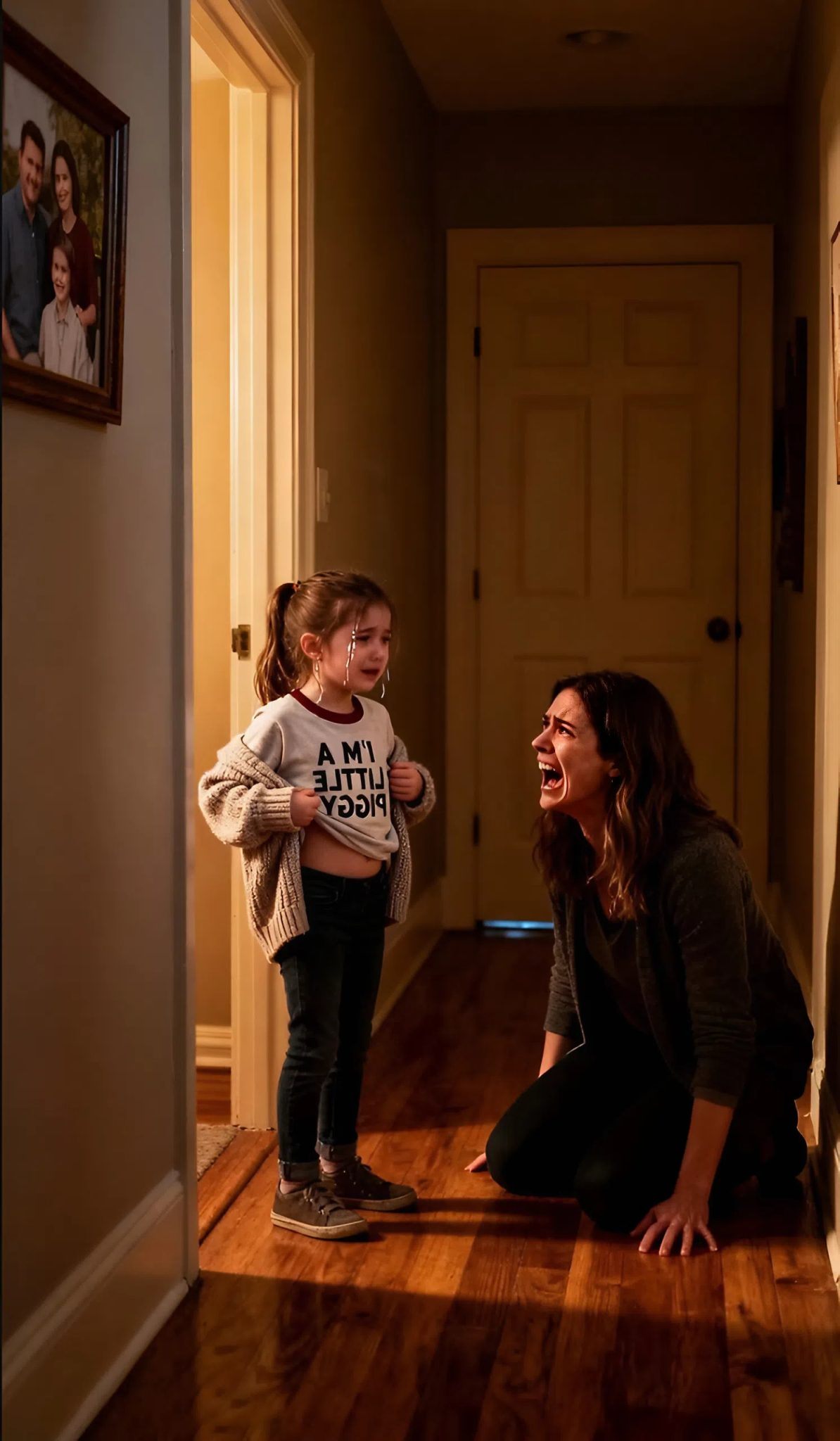
The bin bag was not tied.
It hung loosely on her small body — a grotesque parody of clothing, swaying with each shallow breath she took.

The rustling, almost weightless black plastic clung to her skin like shame and crackled in the eerie silence of our hallway.
My daughter, Lily, stood in the doorway, staring at the floorboards.
She didn’t cry.
She didn’t complain.
She didn’t make a sound.
She just whispered in a voice as dry as a leaf:
‘Grandma said… Grandma said I’m too fat to wear pretty dresses.’
Then, with a resignation no seven-year-old should possess, she raised her arms.
The air seemed to leave the room.
It wasn’t just a sight — it was a map of cruelty burned into her soft, innocent skin.

Bruises, purple fingerprints darker than the night outside the window, and red stripes like burns from a banister criss-crossed her back.
They were vicious marks.
Deliberate marks.
I didn’t scream.
I didn’t tremble.
I didn’t ask questions.
The time for confusion had passed; it was time for devastation.
I walked towards her, my movements smooth and cold.
I told her to go wash her hands, keeping my voice as flat as the line on a heart monitor.
I kissed her forehead—it was damp, cold with fear—and watched her walk to the bathroom.
Then I turned and walked to the hook by the door.
I took the car keys.
I used to believe in blood loyalty.
I married into the Halloway family thinking that their cold faces were just their manner, a generational stoicism that needed to be respected.
I believed that their harsh words were just ‘old school,’ a rougher form of love.
My mother-in-law, Victoria, smiled through clenched teeth, her eyes devoid of warmth.
She was always watching.

Always judging.
‘She’s too soft,’ she would say, sipping her tea and staring at my daughter.
‘She needs discipline.’
‘She eats too many sweets.’
‘You’re spoiling her rotten, Elena.’
Seven years of comments disguised as concern.
Seven years of control wrapped in false love.
I ignored it.
That was my first mistake.
The sin of inaction, the betrayal of instinct.
But when my car’s engine roared to life, drowning out the silence of the suburbs, I made a vow to myself.
There would be no more mistakes.
The road to Victoria Manor merged into a blur of lights and seething rage.
I didn’t turn on the music.
I needed silence to sharpen my thoughts.
I needed to turn the molten heat in my chest into cold, hard steel.
Anger is a fire that burns you from within; precision is a blade that cuts forever.

When I arrived, the house stood out against the night sky — a flawless two-storey colonial mansion, screaming perfection.
The lawn was mowed to perfection.
The windows glowed with a warm, inviting yellow light that belied what was happening inside.
I knocked.
When she opened the door, she smiled.
That smile was muscle memory — a distortion of the face, practised for decades in front of mirrors.
A smile for church elders, for neighbours, for the world.
She wasn’t expecting me.
And she certainly wasn’t expecting the silence that hung between us like a guillotine blade.
‘Elena?’ she asked, and a crack of doubt appeared in her porcelain mask.
‘Is everything all right? Where’s Lily?’
I entered without asking.
I didn’t shout.
I didn’t accuse.
I didn’t raise my voice.
I just looked around.

The house hadn’t changed.
The air smelled of lavender and condemnation.
The same sofa stood in the living room, covered with plastic — an altar of cleanliness instead of comfort.
The same family photos adorned the mantelpiece: everyone in them looked frozen, proud and religious.
She started talking, her voice turning into nervous chatter.
‘I just made some tea.’
‘Did you forget something? You know, Lily was misbehaving today.’
‘Very naughty.’
‘I had to—’
I stopped listening because I hadn’t come to explode.
I came to confirm.
And I confirmed.
I turned to her and did the unthinkable.

I hugged her.
It confused her.
I felt her body stiffen, like a mannequin.
I smelled her cheap floral perfume, a scent that tried to hide the rottenness of her soul.
I heard her shallow breath catch in her throat.
I felt the fear she was trying to bury deep beneath her tweed jacket.
She didn’t know how to respond to affection she hadn’t forced.
I stepped back, looked her straight in the eye and whispered:
‘Thank you for loving my daughter.’
Then I turned and walked out.
I heard the door close slowly behind me.
It was her moment of defeat.
She was expecting a scandal, a hysterical mother who could be presented to her friends as ‘unstable.’
She was ready to play the victim.
But I gave her nothing.
I no longer needed anger.
I needed proof.

That night, already safe in my own home, I did not sleep.