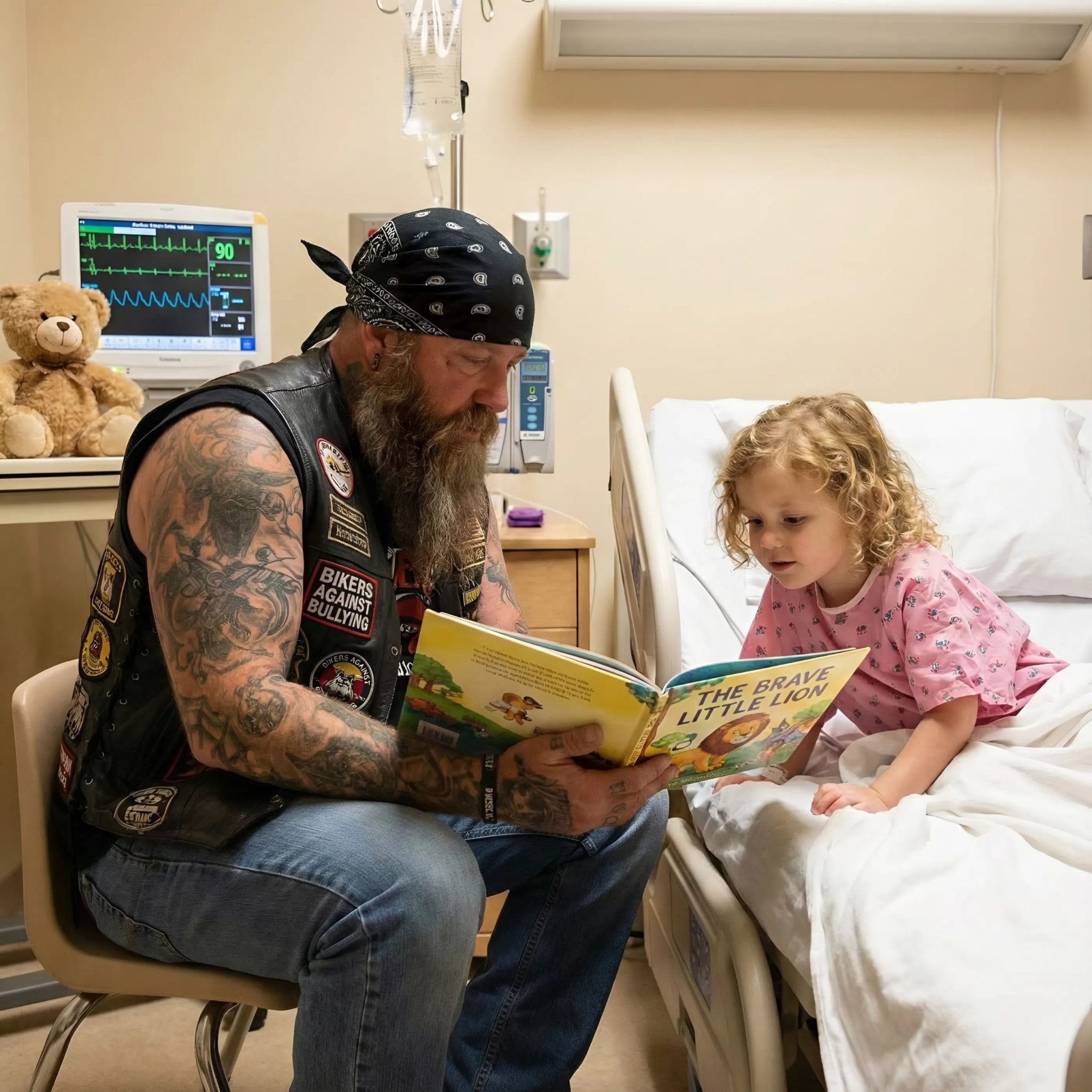
The little girl asked me if I could be her daddy until she died. Those were the exact words out of her mouth. She was seven years old, sitting up in a hospital bed with tubes in her nose, and she looked straight at me—a total stranger, a rough-looking biker—and asked if I’d pretend to be her father for however much time she had left.
My name’s Mike. I’m fifty-eight, covered in tattoos up both arms, beard down to my chest, and I ride with the Defenders Motorcycle Club.

Every Thursday, I volunteer at Children’s Hospital, reading stories to sick kids. Our club started doing it about fifteen years ago, after one of our brother’s granddaughters spent months in the pediatric oncology unit.
Most kids are afraid of me when they first see me. I don’t blame them. I look like I belong in some biker gang movie, not in a children’s ward. But once I start reading, they stop seeing the beard and the leather. They just hear the story.
That’s what I thought would happen when I met Amara.
It was a Thursday afternoon in March when I walked into room 432. The nurse had warned me beforehand: new patient, seven years old, stage four neuroblastoma. Three weeks in the hospital, and not a single family visit.
“No family at all?” I’d asked.
Her face tightened. “Her mother left her here for treatment and never came back. We’ve called and called. Nothing. CPS is involved now, but there’s no other family. Once she’s stable enough, she’ll go into foster care.”
“And if she never gets stable?” I asked.
The nurse looked away. “Then she’ll die here. Alone.”
I stood outside that door for a full minute before I could bring myself to go in. I’ve read to dying kids before. It never stops hurting. But the idea of a child dying alone was something else entirely.
I knocked softly and stepped inside. “Hey there,” I said. “I’m Mike. I come by on Thursdays to read stories. Would you like that?”
The little girl turned her head toward me. Big brown eyes. No hair left from chemo. Skin tinted that grayish color that says the body is fighting hard. But she smiled.
“You’re really big,” she rasped.
“Yeah, I hear that a lot,” I said, holding up the book I’d brought. “This one’s about a giraffe who learns how to dance. Want to hear it?”
She nodded, so I took the chair beside her bed and began to read.
Halfway through, she stopped me. “Mr. Mike?”
“Yes, sweetheart?”
“Do you have any kids?”
The question hit like a punch. “I had a daughter,” I said. “She died when she was sixteen. Car accident. That was twenty years ago.”
Amara was quiet for a moment. Then she asked, “Do you miss being a daddy?”
My throat tightened. “Every single day, honey.”
“My daddy left before I was born,” she said in a flat little voice. “And my mama brought me here and never came back. The nurses told me she’s not coming back at all.”
I had no idea what to say. What words fix that kind of truth for a seven-year-old?
She kept going. “The social worker said I’ll go live with a foster family when I get better. But I heard the doctors talking. They don’t think I’m getting better.”
“Sweetheart—”
“It’s okay,” she said calmly—too calmly. “I know I’m dying. They think I don’t get it, but I do. I heard them say the cancer is everywhere now. They said maybe six months. Maybe less.”
I set the book down. “Amara, I’m so, so sorry.”
She looked at me with those enormous eyes. “Mr. Mike, can I ask you something?”
“Anything, honey.”
“Would you be my daddy? Just until I die? I know it’s not for long. But I always wanted a daddy. And you seem nice. And you miss being a daddy. So maybe we could help each other?”
I felt my chest cave in. This little girl, dying and abandoned, was trying to comfort me. Trying to turn her own loneliness into a gift.
“Sweetheart,” I managed, my voice shaking, “I would be honored to be your daddy.”
Her whole face lit up. “Really? You mean it?”
“I mean it,” I said. “For as long as you need me, I’m your dad.”
She held out her small hand. I took it as gently as I could. Her fingers were so thin, so fragile.
“Okay, Daddy,” she whispered. Then she grinned. “Can you finish the story?”
I picked the book back up with my free hand, still holding hers with the other. My eyes were full of tears, but I kept reading. When that story ended, she asked for another. So I read another. And another.
I stayed for three hours that day, reading until she fell asleep with her hand still wrapped around mine.

Out in the hallway, the nurse stopped me. “That’s the happiest I’ve seen her since she arrived,” she said. “Thank you.”
“I’ll be back tomorrow,” I replied. “And the next day. And every day until she doesn’t need me anymore.”
Her eyes filled. “You’re a good man, Mike.”
I shook my head. “I’m just a dad who misses his little girl. And now I’ve got another little girl who needs a dad.”