Lorraine stopped calling our mutual friends after one of them asked why she had helped move her son’s mistress into property he was trying to use as business leverage.
The city house was sold.
Our joint accounts were divided.
Adrian fought for several paintings, two investment accounts and a wine collection he had once claimed was ours.
He did not receive any interest in Gull’s Rest or the coastal trust.
The following February, he came to the gate alone.
Snow remained in the shadowed sections of the road. The bay beyond the lodge was gray and restless.
Owen called from his cottage.
“Should I send him away?”
“No,” I said. “I’ll speak to him.”
Adrian waited outside the gate in a dark coat.
Without Bianca, Lorraine, investors or attorneys, he looked smaller.
Not physically.
Honestly.
“I lost my position,” he said when I approached.
“I heard.”
“Northstar may sue me.”
“I heard that too.”
He looked toward the lodge.
“I need you to reconsider the road easement.”
“No.”
“The redesigned access is impossible.”
“Then the project is impossible.”
“You could save it.”
“I could surrender to it.”
He tightened his hands around the iron bars.
“I didn’t believe you would take this so far.”
“You believed I would protect your reputation more fiercely than my own family.”
“I believed we could negotiate.”
“You believed I would become frightened.”
He looked down.
“I was wrong.”
“Yes.”
The wind moved through the bare trees.
“I hated Gull’s Rest,” he said.
“I know.”
“It always felt like a part of your life I could not enter.”
“You entered it many times.”
“I mean truly enter. Your father, your brother, your mother—everything there existed before me. I always felt temporary.”
“You could have become part of it.”
“How?”
“By respecting what was already there.”
His eyes shifted toward the lodge.
“I wanted something that belonged to both of us.”
“No, Adrian. You wanted everything belonging to me to prove that I belonged to you.”
He did not argue.
Perhaps losing his position had removed his energy for pretending.
Perhaps, for one minute, he finally understood.
“Did you ever love me?” he asked.
“Yes.”
The answer came easily.
“How can you say that after everything?”
“Love does not become imaginary because it ended badly.”
“What changed?”
“You required me to trade pieces of myself for temporary peace. My work. My friends. My judgment. My memories. Every time I surrendered something, you called the marriage stronger.”
His eyes reddened.
“One day,” I continued, “you asked for the last place where I still recognized myself.”
“I am sorry.”
I believed he felt something.
Regret.
Shame.
Fear.
Loss.
Perhaps even love, distorted by years of entitlement.
But an apology offered after the consequences arrive does not erase the choices that invited them.
“I hope you learn what being sorry requires,” I said.
I turned away.
“Evelyn.”
I stopped.
“I should never have brought Bianca here.”
“No.”
“I wanted you to see that I had moved on.”
“You wanted me to feel replaced.”
He closed his eyes.
“Yes.”
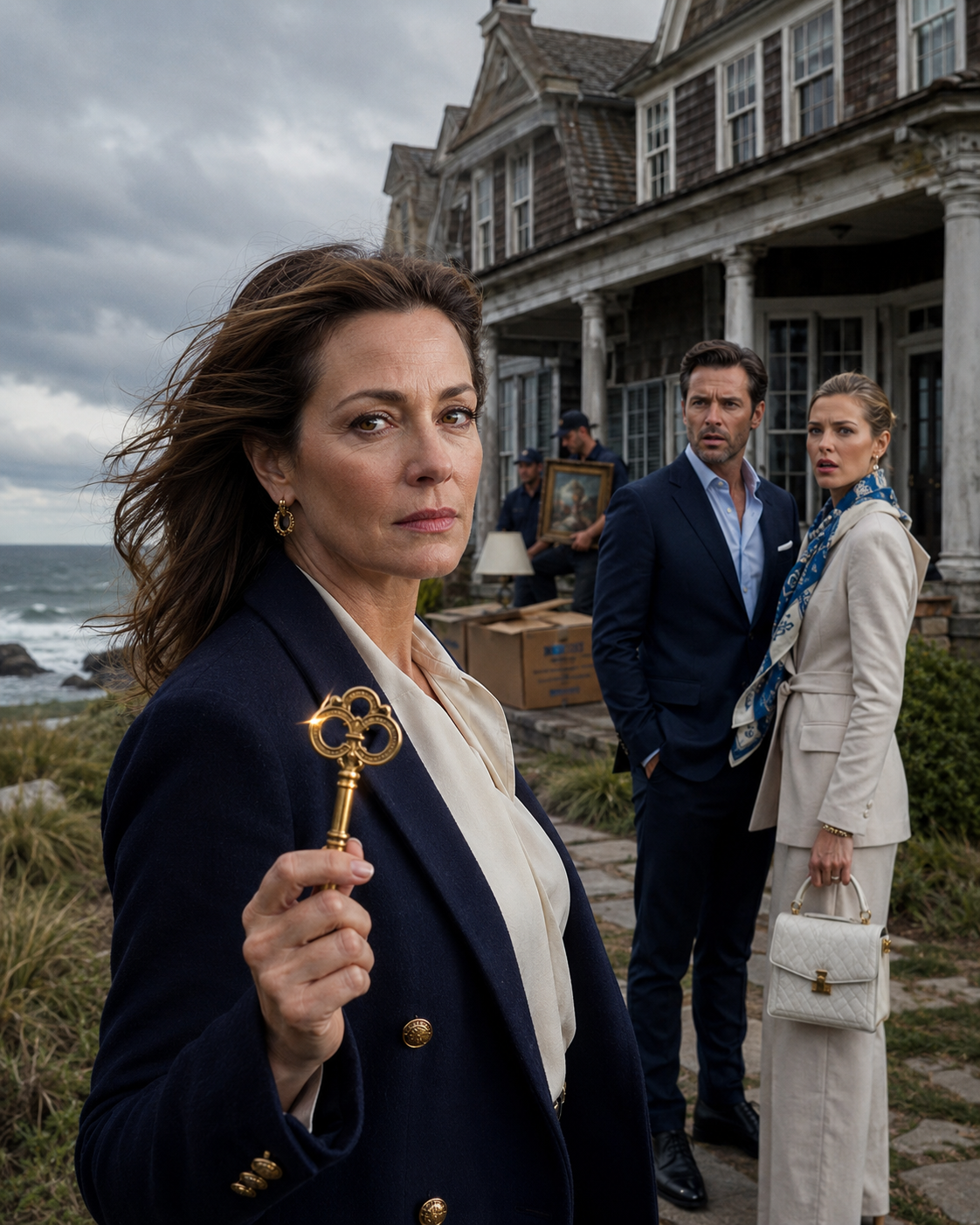
I touched the brass key inside my coat pocket.
“You didn’t replace me, Adrian. You released me.”
I walked back toward the lodge.
The gate remained locked.
Our divorce became final in March.
I returned legally to the name Evelyn Shaw.
That spring, the trust partnered with Calder Bay residents to restore the public beach path and reinforce the marsh against storm damage.
We renovated my father’s old workshop and turned it into a marine-skills center where local teenagers could learn engine repair, navigation, coastal ecology and emergency response.
We named it the Thomas and Daniel Shaw Harbor House.
On opening day, fishing boats sounded their horns from the bay.
Children ran between the workshop and the dock.
Owen wore a new jacket and spent the entire ceremony pretending the wind was responsible for his wet eyes.
I hung my grandmother’s blue scarf in a glass cabinet beside a photograph of my parents.
The brass key remained with me.
Not because I feared another invasion.
Because I finally understood my father’s lesson.
A key is not proof of ownership.
It is proof of responsibility.
Adrian had believed the lodge was the valuable part of my inheritance.
He had been wrong.
The true inheritance was the ability to decide what would remain untouched by people who measured everything in profit.
It was the road that allowed families to reach the harbor.
The marsh that protected houses during storms.
The path where children carried buckets to the beach.
The workshop where my father repaired boats for neighbors who could not pay immediately.
The memories that had survived because no one had been allowed to renovate them into something more fashionable.