I told her about the affair.
She listened.
Then she asked, “Where is the brass key?”
“In my desk.”
“Not the house key. The archive key.”
I stared at her.
“How do you know about that?”
“Your father gave me a duplicate. Evelyn, we need to discuss what you inherited.”
The next day, we drove to Gull’s Rest.
Ruth opened the archive and removed the steel case.
Inside were property maps, deeds, environmental covenants, shellfish rights, tidal-access agreements and records dating back to the nineteen-fifties.
The lodge was only the visible center of the Shaw Coastal Heritage Trust.
Over several decades, my grandfather and father had quietly purchased strips of shoreline, marshland, sections of an abandoned ferry road, freshwater access points and woodland behind Calder Bay.
Some parcels were barely wider than a driveway.
Others included protected dunes or paths local fishing families had used for generations.
My father had never talked about himself as a landowner.
He considered the trust a shield.
As wealthy developers bought coastal properties, they closed old footpaths, restricted harbor access and priced working families out of communities their grandparents had built.
My father could not stop every sale.
He could preserve strategic pieces of land that kept the bay accessible.
Ruth pointed to a section of the trust agreement.
“No spouse, creditor, partner or commercial entity can use the property as security, establish an occupancy claim or negotiate development rights without the managing trustee’s written authorization.”
“My authorization.”
“Exactly.”
“Adrian knows the lodge is protected.”
“He may know part of it.”
“Why would he care about the rest?”
Ruth folded her hands.
“Does his company have any projects near Calder Bay?”
I remembered the maps Adrian had studied at our wedding.
The renovation proposals.
The questions about neighboring parcels.
The sudden interest in replacing the old ferry road.
“I don’t know.”
“Find out before he realizes you are looking.”
Adrian filed for divorce three weeks later.
His petition described me as emotionally unavailable, financially secretive and unreasonably attached to inherited property.
He requested the city house, a large share of our investments and temporary use of Gull’s Rest until the marital assets could be evaluated.
Ruth read the request twice.
“He does not need a summer home during a divorce.”
“What does he need?”
“That is what we are going to discover.”
I moved into a small apartment near my office.
Adrian remained in the city house.
Within a month, Bianca was attending dinners beside him. Lorraine moved into the guest room and began telling mutual friends that I had driven Adrian away by choosing dead relatives over a living husband.
I said nothing publicly.
Adrian mistook silence for paralysis.
He had always assumed that if I was not arguing, I was losing.
In reality, Ruth and I were tracing corporate registrations, property options and planning applications.
Adrian’s company had formed a development partnership called Northstar Coastal Ventures.
Northstar proposed a private marina, luxury cottages, a waterfront restaurant and an exclusive wellness club near Calder Bay.
The promotional material showed sailboats, polished decks and smiling couples drinking champagne.
The maps did not show the families who repaired nets beside the harbor.
They did not show the public path children used to reach the beach.
They did not show the marsh that absorbed storm surges before they reached the lower homes.
Most importantly, they did not clearly show that Northstar’s development could not function without land controlled by the Shaw trust.
The old ferry road was the only practical route wide enough for construction vehicles.
The freshwater pumping agreement crossed one of our parcels.
The proposed marina entrance depended on tidal rights my grandfather had acquired decades earlier.
Adrian’s project was surrounded by land he could not use without me.
Suddenly, his years of pressure made sense.
He had not wanted Gull’s Rest because he loved the view.
He wanted the lodge treated as shared marital property so he could claim influence over the wider trust.
The affair was personal.
The attempted occupation was strategic.
The call from Owen Pike arrived on a Thursday morning in June.
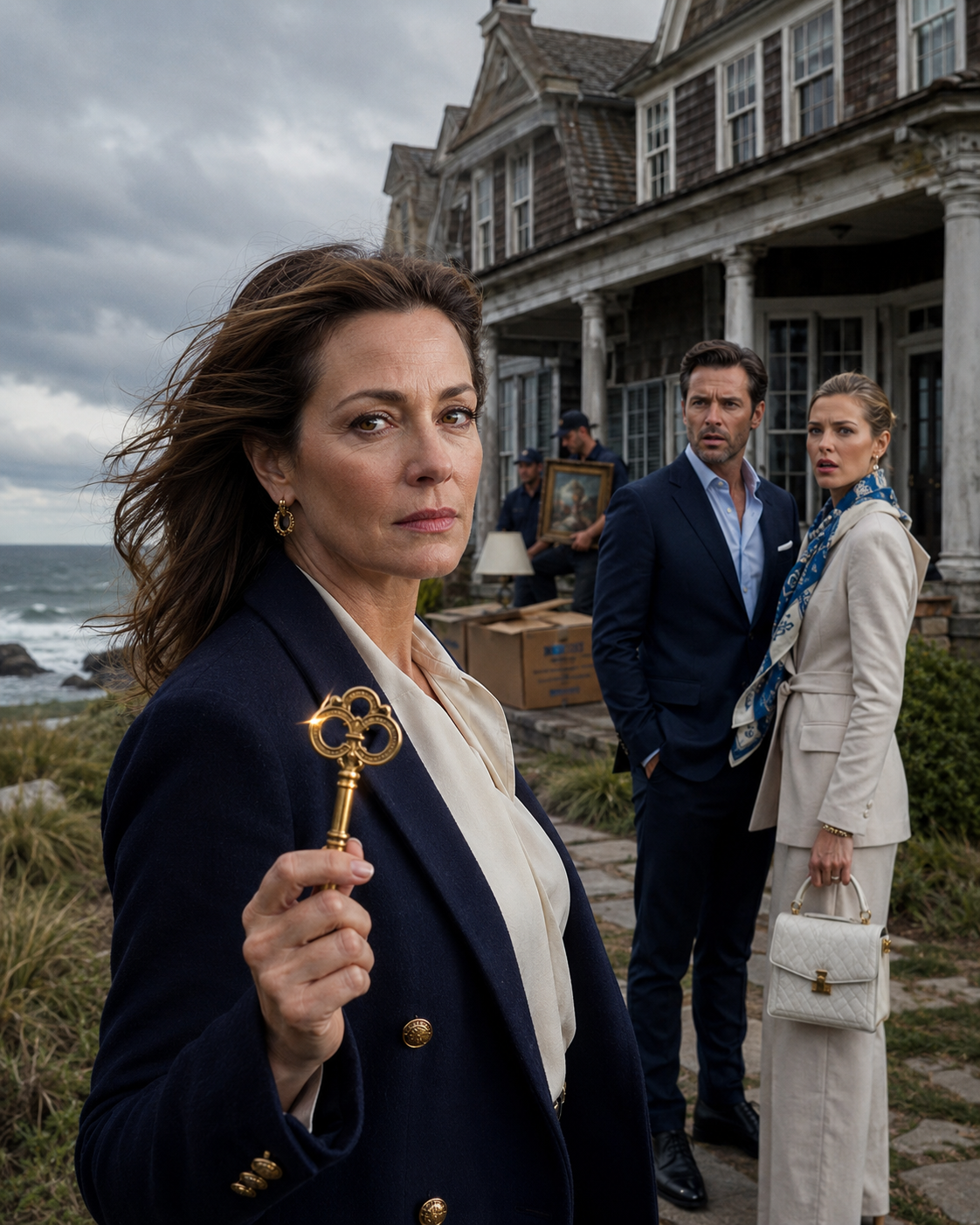
“Evelyn,” he said, “Adrian is at Gull’s Rest.”
“Inside?”
“He arrived with Bianca, Lorraine and two moving companies. He told them he has authority to occupy the lodge during the divorce.”
“How did he get through the gate?”
“He had the access code.”
“And the house?”
“He replaced two exterior locks. Claims one of your old permissions gives him the right.”
My chair rolled backward as I stood.
“Do not confront him.”
“I can call the sheriff.”
“Ruth is already doing that. I’m coming.”