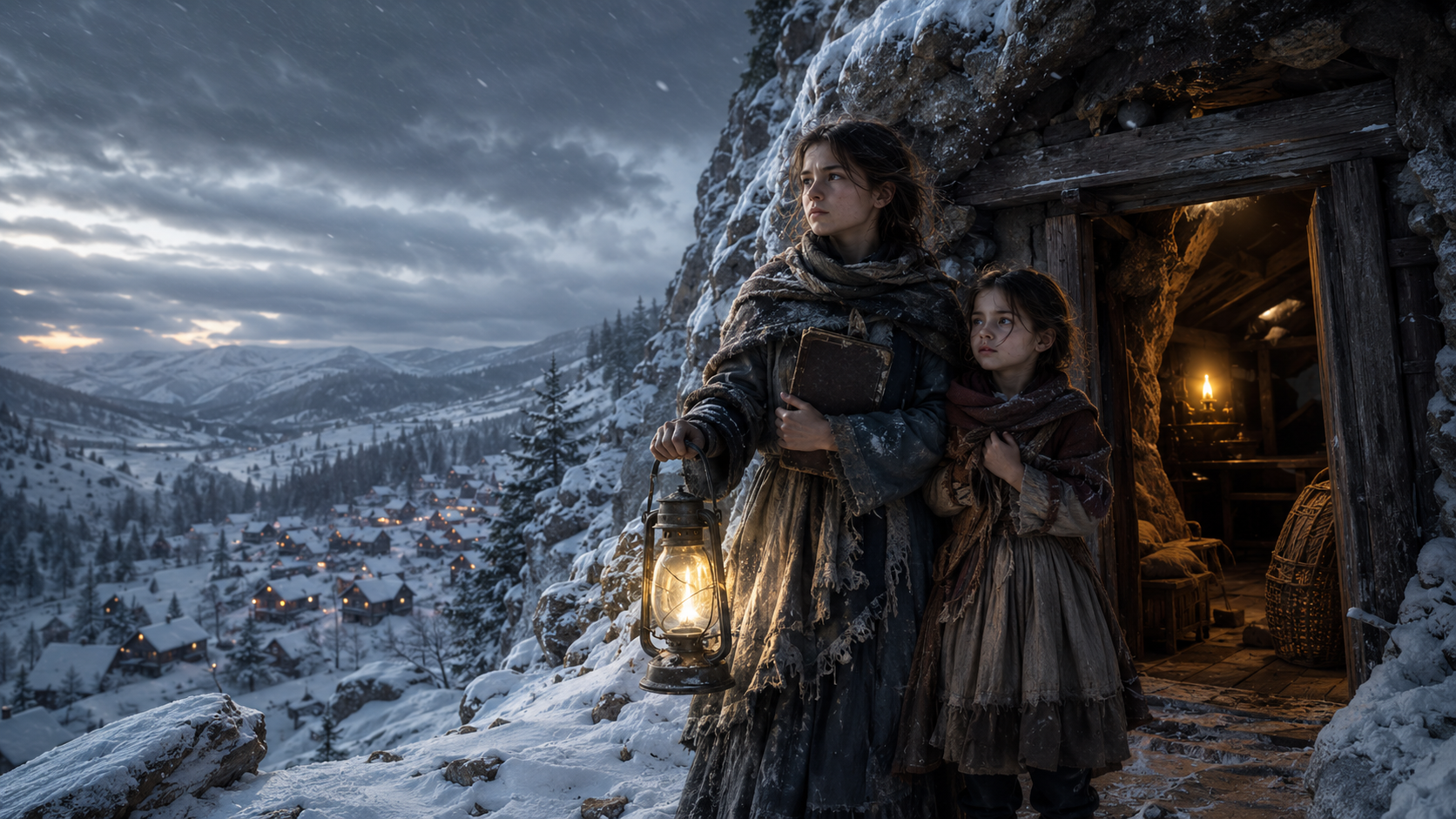
Hiram would not let them hurry it. The firebox had to be deep enough to pull cleanly but not so deep that it swallowed heat. The back had to be fitted into the cave’s own stone mass. The throat had to narrow in exactly the right place. The vent channel had to be lined where loose grit might fall. Mara’s ribs ached through every hour of it, but she worked anyway, slow and careful, refusing to give pain more authority than purpose.
The first test fire filled the room with smoke.
Elsie coughed until her eyes watered. Bea swore so fiercely that Hiram told her to save some words for the funeral if they had built it wrong. Mara stood frozen, watching smoke gather under the ceiling instead of rising.
Then Hiram raised one hand.
“Wait.”
Mara wanted to scream at him. Instead, she waited.
The smoke curled.
The flame shifted.
A thin line of gray bent toward the rear crack.
Then another.
Then the chimney caught.
The smoke lifted in one steady column and vanished into the stone throat above.
Elsie began laughing and coughing at once. Bea sat down heavily on a crate. Hiram nodded as if he had personally argued the mountain into cooperation.
Mara lowered herself to the floor in front of the new hearth.
The fire burned small and bright.
The stone behind it accepted the heat without haste.
For the first time since the fever took their mother, Mara cried.
Elsie sat beside her and touched her sleeve.
“Are you hurting?”
“Yes.”
“Your ribs?”
Mara shook her head.
Elsie understood then and leaned against her carefully.
They moved in before the second hard frost.
Everything they owned came in two wagon loads: quilts, tools, a cracked mirror, their mother’s Bible, three chairs, sacks of flour, a kettle, two trunks, and the blue china bowl Elsie insisted made any place civilized. Their old hound, Finch, chose the warmest stone near the hearth and settled there with the expression of a judge approving a verdict.
That first night, frost silvered the outside of the door.
Inside, after the fire burned down to coals, the air held steady.
Elsie stared at the thermometer Hiram had nailed beside the shelf.
“Fifty-eight,” she whispered.
Mara sat wrapped in a quilt, watching the firelight move over the stone.
“We are not finished,” she said.
Elsie smiled. “No. But we are not freezing.”
Winter began as winter always did in Briar Glen: first with gossip, then with snow.
People still laughed, though not as loudly. A few men came to the ridge pretending to inspect the sisters’ foolishness and left rubbing their hands in surprise at the warmth. Mrs. Blythe admitted it was “less dreadful than expected,” which from her was nearly a hymn. Reverend Callum said Providence sometimes worked through unconventional shelter, though he had not said so before the shelter proved comfortable.
Caleb Crowe did not come again.
But his younger cousin, Jonah Reed, did.
Jonah was twenty-three, quiet, and more curious than proud. His family lived near the north creek in a house so drafty that snow sometimes sifted through the bedroom wall. He arrived with a notebook of his own and questions he was almost embarrassed to ask.
When Mara opened the door, warm air rolled out into the white afternoon.
Jonah stopped on the threshold.
Inside, Elsie was mending a sleeve by lamplight. Bea was stirring beans over the fire. Finch slept on his back, shamelessly comfortable.
Jonah removed his hat.
“I came to see the cave,” he said.
Mara stepped aside. “Then see it.”
He walked through slowly, not laughing, not smirking, not pretending expertise. He crouched to examine the floor gap. He studied the fireplace. He touched the wall near the hearth, then the wall farther back.
“It holds heat differently,” he said.
Mara looked at him with new interest. “Yes.”
“My mother’s hands ache all winter,” he said. “Our stove burns through wood like sin, and the house still wakes up cold.”
“Where is your land?”
“Beyond Miller’s draw.”
“When the snow breaks, I’ll come look.”
Jonah turned to her. “You would?”
“My parents died in a house everyone called normal,” Mara said. “Normal is not holy. It’s just familiar.”
After that, Jonah came often.
He helped split wood, repair the snow shed, and widen the outer trench. He learned quickly and spoke carefully. Elsie teased Mara about the way he watched her when she explained things, but Mara pretended not to notice because noticing made her clumsy, and Mara disliked feeling clumsy.
The great storm announced itself three days before it arrived.
The air turned heavy.
Birds vanished from the ridge.
Finch paced at night, whining at the door and then returning to the hearth, unable to settle. Hiram came up before sunset with his barometer wrapped in wool and his expression grim.
He set it on the table.
The needle had dropped lower than Mara had ever seen.
“Bad?” Elsie asked.