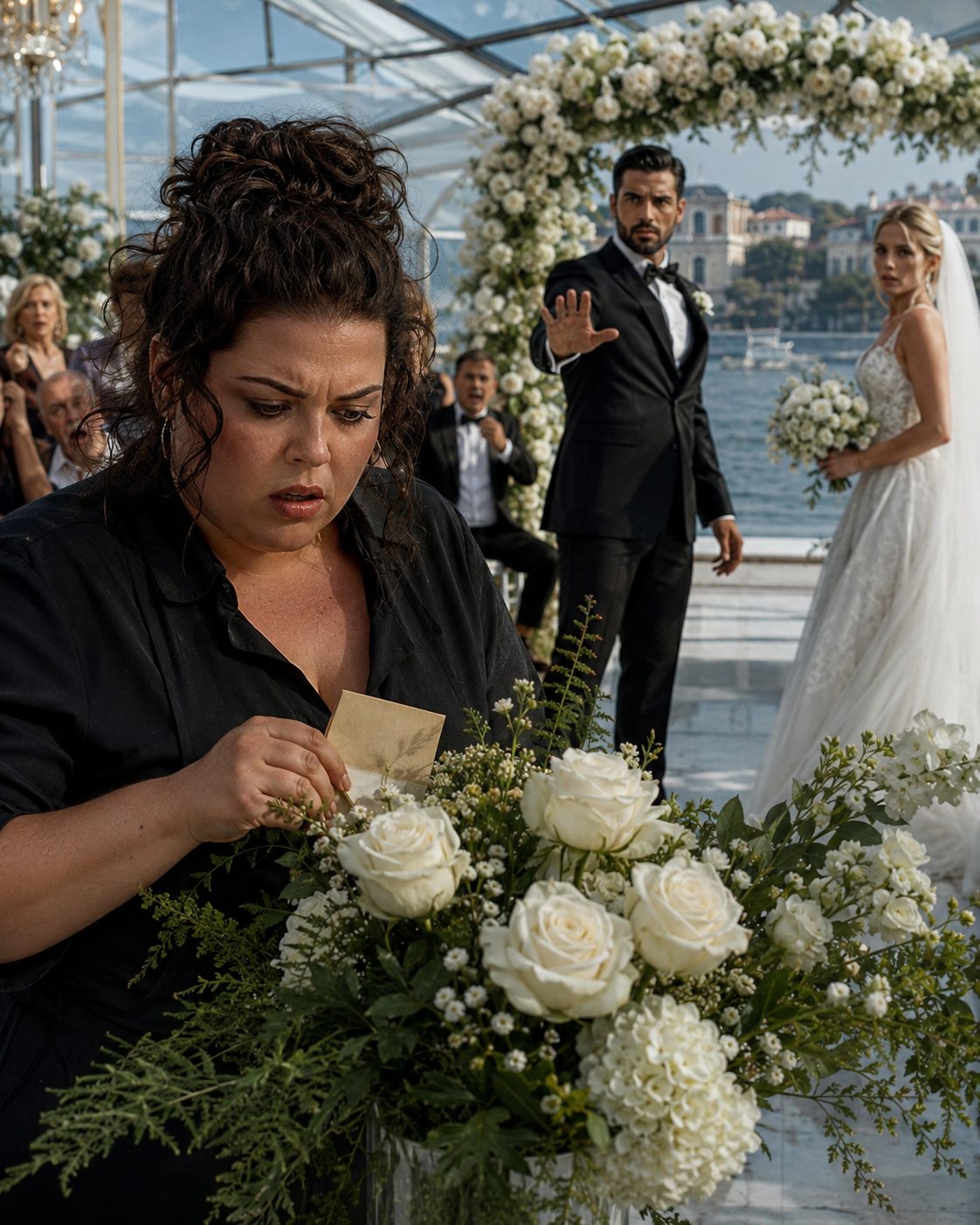
Mara Ellison had learned very early that rich people noticed flowers before they noticed the woman carrying them.
They noticed if the roses were too open, if the peonies leaned too low, if the lilies scented a room too strongly, if the ribbon on a bouquet was half a shade warmer than the table linen. They noticed fingerprints on crystal vases and water spots on marble floors. They noticed everything that could embarrass them in front of other rich people.
But Mara herself?
Most of them looked through her.
At thirty-two, she owned June & Thorn, a small flower shop wedged between a closed tailor’s studio and a bakery in Bay Ridge. The shop had once belonged to her aunt June, who believed flowers were honest because they never pretended to last forever. Mara had inherited the business, the debts, the scratched front counter, the ancient walk-in cooler, and the stubborn belief that beauty still mattered even when the world kept charging rent for it.
She was soft-bodied, broad-hipped, and round-faced, with dark curls she usually twisted into a messy knot by noon. She had hands nicked by thorns, nails ruined by floral dye, and a back that ached after every large event. Brides loved her work until they met her in person. Mothers of brides asked if she had assistants who would be “more suitable” for the front of house. Wedding planners praised her talent while calling her “sweetheart” in a tone that meant servant.
Mara had trained herself to smile through all of it.
Then Dante Bellandi walked into her shop.
He came on a rainy Tuesday afternoon, ten minutes before closing, with two men behind him and silence around him like an expensive coat. He was tall, dark-haired, dressed in a charcoal suit, and calm in a way that made the whole street outside seem louder. Mara knew his name before he introduced himself. Everyone in New York knew the Bellandi name.
Hotels. Restaurants. Import companies. Charity galas. Old money that was not old enough to be clean.
People called Dante Bellandi a businessman when microphones were present. They called him something else when they were whispering.
Mara stood behind the counter with a bucket of half-cleaned garden roses at her feet and tried not to stare.
“Miss Ellison?” he asked.
His voice was deep, controlled, almost polite.
“Mara,” she said. “And you’re early. Your appointment is tomorrow.”
“I dislike waiting.”
“That must be nice.”
One of the men behind him shifted, but Dante only looked at her more closely, as if he had expected fear and found something more inconvenient.
“My fiancée wants your flowers for the wedding,” he said.
“Your planner already told me. White roses. White orchids. White tulips. White everything. Very peaceful. Very expensive. Very easy to photograph.”
“You disapprove.”
“I didn’t say that.”
“You didn’t need to.”
Mara wiped her hands on her apron. “White can be beautiful. But too much of it makes a room look like nobody has ever lived in it.”
For the first time, Dante’s expression almost changed.
“My fiancée likes perfection.”
“Most people who ask for perfection are really asking for control.”
The shop went very still.
Mara heard herself after the words were already out. She had just insulted the bride of a man nobody sensible insulted. She opened her mouth to soften it, but Dante lifted one hand, not threatening, only stopping the room from moving.
“What would you add?” he asked.
“To the flowers?”
“To the perfection.”
Mara glanced down at the bucket beside her. Near the roses, almost hidden, was a single stem of pale blue delphinium that had come in by mistake.
“That,” she said.
Dante looked at the blue flower.
“My fiancée requested white.”
“Then she’ll get white.”
“But you would add blue.”
“I would add one small piece of sky. Something alive. Something that keeps the arrangement from looking like a beautiful apology.”
Dante studied her for a long moment.
Then he said, “Bring samples to the estate tomorrow.”
That was how Mara Ellison became the florist for the most watched wedding of the season.
The Bellandi estate sat above the Hudson behind iron gates, clipped hedges, and enough security cameras to make Mara feel as if even the trees were judging her. The ceremony was to take place on the east lawn under a glass pavilion built just for the wedding. There would be five hundred guests, three orchestras, a private chef from Milan, two magazine photographers, and a floral budget large enough to save Mara’s shop twice over.
The bride, Celeste Arden, was exactly the kind of woman magazines loved. Tall, blond, narrow as a candle flame, with cheekbones sharp enough to make kindness look unfashionable. She greeted Mara with a smile that never reached her eyes.
“So you’re the florist,” Celeste said.
“Mara Ellison. Congratulations.”
Celeste looked her over. Not quickly. Not accidentally. From shoes to face, with the smooth cruelty of a woman who knew how to make an insult invisible.
“How charming,” Celeste said. “Dante said you had opinions.”
“I also have invoices.”
The wedding planner, Vivienne Cross, made a small choking sound into her clipboard.
Celeste laughed lightly. “I like confidence. As long as it comes with obedience.”
Mara smiled because the contract was worth more than her pride.
Over the next four days, she worked until her hands cramped. Her team built rose clouds above the aisle, orchid curtains behind the altar, and massive urns overflowing with white tulips along the pavilion entrance. Celeste wanted the entire ceremony to look untouched by weather, history, or human emotion.
Dante appeared twice.
The first time, he stood at the edge of the pavilion and watched Mara argue with a ladder.
“The ladder is winning,” he said.
“The ladder is badly designed.”
“It is a ladder.”
“And yet it has an attitude.”
One of his security men coughed into his fist.
Dante’s mouth moved as if he had considered smiling but decided against giving the world evidence.
“You’re not afraid of me,” he said.
Mara clipped a wire around a rose stem. “I’m afraid of late payments, bad refrigeration, and brides who change their minds after final approval. You’re lower on the list.”
“I should be offended.”
“You probably will be eventually.”
He looked up at the half-finished arch. “Celeste said you asked to change the flowers.”
“I suggested one blue stem hidden in the altar arrangement.”
“She said no.”
“I know.”
“Why blue?”
Mara hesitated. “Because all this white feels like a secret trying to dress itself as innocence.”
Dante turned toward her.
The air changed.
For the first time, Mara wondered if the rumors had not exaggerated him at all. There was no anger in his face, no theatrical intimidation. Only attention. Complete and absolute.
“What secret?” he asked.
“I was speaking artistically.”
“Were you?”
Mara forced herself to meet his eyes. “Mr. Bellandi, I’m good with flowers. I’m not good with powerful men asking dangerous questions.”
“Dante,” he said.
“What?”
“If you are going to insult my wedding design, call me Dante.”
She should have laughed.
Instead, she looked away first.
The second time he appeared, Celeste was with him.
Mara was on her knees beside the base of the rose wall, fixing a section where the blooms sagged. Celeste watched her with a glass of champagne in one hand and a diamond bracelet glittering at her wrist.
“Careful,” Celeste said. “Those roses cost more than some people’s rent.”
Mara kept working. “Then they should behave better.”
Celeste smiled. “You’re funny.”
The way she said it made funny sound like heavy. Like loud. Like useful only in small doses.
Dante’s gaze moved from Celeste to Mara, then back again.
“The roses look good,” he said.
“They will look perfect tomorrow,” Mara answered.
Celeste stepped closer. “They need to. This wedding matters.”
“All weddings matter.”
“No,” Celeste said softly. “Some weddings change the future.”
Mara did not understand the chill that moved through her then.
She would understand soon.
The first warning came that evening, behind the west conservatory.
Mara had gone looking for a missing crate of spray roses. The estate staff had been instructed to keep deliveries moving through the service corridors, but wealthy homes were built like polite mazes, and every hallway seemed to lead to another locked door or another room nobody used.
She found the crate near the conservatory, half hidden behind a linen cart.
Then she heard Celeste’s voice.
“Dante signs before the ceremony,” Celeste said. “Not after. I’m not walking down that aisle until the trust amendment is done.”
Mara froze.
Another voice answered. Male. Smooth. Familiar from the wedding rehearsal.
“Relax,” he said. “He thinks it’s just protection for the marriage.”
Leon Bellandi.
Dante’s cousin. Best man. Smiling, charming, golden Leon, who greeted donors by name and kissed old women on both cheeks. Mara had seen him laughing with Dante that morning like a brother.
Celeste exhaled sharply. “If he notices the voting clause—”
“He won’t. The papers are buried under foundation language. He sees his mother’s charity and stops reading like a man, starts grieving like a son.”
Mara’s hand tightened around the crate handle.
Celeste was silent for a moment.
Then she laughed.
It was not nervous laughter. Not frightened. Not regretful.
It was delighted.
“And after the vows?” she asked.
“After the vows, the video plays at the reception. His reputation takes the hit. The board panics. The trust shifts. I become interim chair. You become the betrayed wife. Everyone cries for you.”
“And Dante?”
Leon’s voice lowered.
“Dante becomes exactly what the city already wants him to be. A scandal. A monster. A warning.”
Mara backed away so quickly her hip struck the linen cart. A silver tray rattled.
The voices stopped.
“Mara?” Celeste called.
Mara picked up the crate and forced herself to walk around the corner.
Celeste stood beneath a hanging fern, champagne still in hand. Leon was beside her, one hand in his pocket, his perfect smile slightly too late.
“There you are,” Celeste said. “Lost?”
“Always,” Mara replied. “This house has more corridors than a hospital.”
Leon’s eyes dropped to the crate. “You heard us?”
Mara made herself look confused. “I heard voices. I was trying not to interrupt.”
Celeste smiled.
It was the first honest expression Mara had seen on her face.
She believed Mara was harmless.
That almost saved Mara.
Almost.
The proof came the next morning, hidden behind the wedding roses.
A section of the rose wall had begun to lean forward overnight. The humidity inside the pavilion had softened one of the supports, and Mara was furious enough to forget she was exhausted. She sent her assistant for replacement wire and climbed behind the wall herself, squeezing into the narrow space between the floral panels and the white silk backdrop.
It was hot there. Dark. The air smelled of roses, wet foam, and metal.
Mara reached behind a panel to tighten a bracket.
Her fingers touched something that was not wire.
Paper.
No, not paper.
A small cream envelope sealed in clear plastic, taped to the back of the rose panel.
For a moment she only stared at it.
Then she saw the name written across the front.
L. Bellandi.
Mara’s pulse began to hammer.
She should have left it there. She should have called security. She should have done anything except peel the tape back with shaking fingers and open something that was absolutely none of her business.
But she remembered Celeste laughing.
She remembered Leon saying Dante would stop reading when he saw his mother’s charity.
She remembered every person who had ever assumed silence from her because she was paid to make things pretty.
Inside the envelope was a folded schedule, a small flash drive, and a handwritten note.
Destroy after ceremony. If anything changes, move the drive to the south fountain.
Mara unfolded the schedule.
At first it looked like wedding timing. Ceremony. Cocktail hour. Reception entrance. First dance.
Then she saw the other column.
Signature packet delivered — eleven fifteen.
Trust amendment executed — eleven forty.
Media release queued — twelve thirty.
Reception video switch — one fifty.
Board emergency contact — two fifteen.
Foundation transfer confirmation — three o’clock.
Mara’s breath left her.
The flash drive felt tiny in her palm. Too small to ruin lives. Too small to destroy a wedding. Too small to carry the kind of secret that made powerful people dangerous.
She slid it into her pocket.
Then she finished fixing the rose wall because terror, apparently, did not cancel professionalism.
Back in the service kitchen, Mara borrowed her assistant’s laptop and opened the drive.
There were folders.
Foundation Amendment.
Edited Reception Video.
Board Statement.
Insurance Leverage.
Celeste Personal Narrative.
Mara clicked the first folder.
The document inside looked official. It carried Dante’s company letterhead, legal language, signatures, and charitable references. But Mara had arranged flowers for enough law firms to recognize when a document was designed to bury one sentence under twenty pages of polished fog.
Voting authority would shift temporarily to Leon Bellandi in the event of personal scandal, criminal investigation, health emergency, reputational crisis, or marital conflict affecting executive judgment.
Temporarily.
Mara almost laughed.
That word was always where thieves hid.
The next folder was worse. The video had been cut together from private clips, public speeches, charity events, and fragments of conversation. Dante looked cold, possessive, cruel. Celeste looked fragile and trapped. Some pieces might have been real. Others were clearly twisted out of context. Together, they created a story the public would devour before anyone asked if it was true.
The last folder made Mara’s skin go cold.
It contained messages between Leon and Celeste.
But halfway down, the tone changed.
Leon was not just helping Celeste betray Dante.
He was preparing to betray Celeste too.
One message to an unnamed legal consultant read:
After she triggers the release, position Celeste as emotional accomplice. Her signature is on enough paperwork to absorb public blame. Dante falls, Celeste burns, I inherit the clean side.
Mara sat back.
The room blurred.
Celeste thought she was becoming queen.
Leon was building a funeral for everyone but himself.
Mara copied the files to her phone. Her hands shook so badly she nearly dropped it twice.
Then she looked at Dante’s number.
He had called once the day before to ask whether the pavilion would be ready. They had spoken for nine minutes about roses, rain, and why her aunt had named the shop June & Thorn.
A man like him should not have sounded lonely.
A man like him should not have remembered her aunt’s name.
Mara pressed call before fear could talk her out of it.
Dante answered on the first ring.
“Miss Ellison.”
“I found something behind the roses.”
Silence.
Then his voice changed.
“Where are you?”
“At the estate. Service kitchen.”
“Are you alone?”
“Yes.”
“Leave the kitchen. Walk to the east delivery entrance. Do not run. Do not speak to Celeste. Do not speak to Leon. I’ll meet you there.”
Mara’s mouth went dry. “You believe me?”
“I believe your voice.”
That almost broke her.
Five minutes later, Dante stepped through the delivery entrance wearing a black suit and no expression. Two attorneys came with him, not bodyguards. That frightened Mara more. Violence was one kind of danger. Paperwork was another, and rich people knew how to ruin lives with paper.
She handed him her phone.
He watched the files in silence.
Not once did he interrupt.
When the video ended, Dante gave the phone to one of the attorneys.
His face had not changed, but something in him had gone very still.
“Leon,” he said.
Mara nodded.
“And Celeste.”
“Yes.”
One attorney spoke quietly. “We need to remove you from the ceremony immediately.”
Dante looked toward the pavilion, where workers were polishing chairs under towers of white roses.
“No.”
Mara stared at him. “No?”
“The ceremony continues.”
“That is the worst idea I have ever heard, and I once watched a bride request real candles inside a dry pampas grass installation.”
The attorney blinked.
Dante looked at Mara.
This time, he smiled.
It was small, brief, and gone almost immediately.
“They built a stage,” he said. “I intend to use it.”
“Use it for what?”
“The truth.”
“Truth does not need five hundred witnesses.”
“Lies often do.”
Mara wanted to argue. She wanted to tell him not to be dramatic, not to put himself in front of people who had come to watch him marry a woman who hated him. But then she understood.
Celeste and Leon had planned everything around spectacle. They had arranged the audience, the timing, the cameras, the public wound. They had counted on Dante being humiliated before he could defend himself.
He was not refusing to cancel because he was proud.
He was refusing to hide because hiding would let them write the ending.
“What do you need from me?” Mara asked.
“Nothing.”
“I found the envelope.”
“You did more than enough.”
“No,” she said.
Dante looked at her.
Mara swallowed. “People like Celeste expect women like me to disappear after delivering the flowers. I’m tired of disappearing.”
Something moved across his face. Respect, maybe. Or sadness.
“Then stand where you can see,” he said. “But stay near my legal team.”
The wedding began at noon beneath a sky so blue it looked staged.
White roses covered everything. They climbed the altar, framed the aisle, spilled from urns, floated in glass bowls, and hung in fragrant waves from the pavilion ceiling. Guests arrived in silk, diamonds, custom suits, and careful smiles. They kissed cheeks and traded rumors. They admired the flowers. They praised Celeste’s taste.
Nobody praised Mara.
That was fine.
For once, she preferred not to be noticed.
She stood near the back beside the repaired rose wall, wearing a simple black dress and flat shoes hidden beneath the hem. Her assistant squeezed her hand before retreating to the service area. Dante’s attorneys stood a few yards away, calm as priests at a funeral.
Leon stood near the altar, one hand resting on Dante’s shoulder, whispering something that made nearby guests smile.
Dante did not smile.
Celeste arrived twenty minutes late in a vintage ivory gown with pearl sleeves and a veil long enough to look like weather. The crowd sighed when they saw her. She moved as if she knew the whole world had been built to watch her.
Mara wondered how many people had mistaken beauty for innocence simply because it was easier.
The officiant began.
He spoke about loyalty.
Mara nearly laughed.
He spoke about trust.
Dante’s jaw tightened.
He spoke about two families becoming one.
Leon looked pleased with himself.
Celeste delivered her vows first. Her voice trembled perfectly. She spoke of Dante’s strength, his protection, his misunderstood heart. She said he had given her a future when she had been afraid to believe in one. Guests wiped their eyes.
Mara felt sick.
Then Dante took Celeste’s hands.
The pavilion became very quiet.
“Celeste,” he said, his voice carrying through the microphones, “I came here prepared to make a vow.”
Celeste smiled.
Dante released her hands.
Her smile faltered.
“I came here prepared to bind my name, my family, and my mother’s foundation to a woman I believed understood loyalty.”
A murmur passed through the guests.
Leon’s face sharpened.
Celeste whispered, “Dante, what are you doing?”
Dante did not look away from her.
“I’m doing what you planned to do,” he said. “I’m changing the wedding.”
The screens around the reception pavilion came on.
At first, some guests laughed softly, assuming it was a sentimental video. Then the first document appeared. Then the amended trust clause. Then the transfer schedule. Then the messages.
The laughter died.
Celeste stepped back. “This is private.”
“No,” Dante said. “This is evidence.”
Leon moved toward him, but two plainclothes investigators stepped calmly into his path. No one shouted. No one touched anyone. That somehow made the moment more devastating.
Dante turned to the guests.
“This morning, proof was found hidden behind the wedding roses,” he said. “Proof that this ceremony was designed to transfer control of my companies, damage my mother’s foundation, and create a public scandal before I could respond.”
Celeste’s face had gone pale beneath her makeup.
“That florist did this,” she said suddenly.
Mara felt every eye turn toward her.
There it was.
The moment Celeste had been saving.
Not a defense. A direction.
Look at her.
Not listen to her.
Not ask what she found.
Look.
Celeste pointed at Mara as if Mara’s body were a confession. As if a plus-size florist in a plain black dress could not possibly be honest in a room full of diamonds.
“She was jealous,” Celeste said. “She wanted attention. She stole from me. She has been watching us since she arrived.”
Mara’s heart slammed against her ribs.
For one second, she was sixteen again, standing in a school hallway while girls laughed at the way her dress fit. She was twenty-two, being told she had such a pretty face. She was thirty, carrying flowers through a hotel lobby while a mother of the bride asked if the real designer would be arriving soon.
Then Dante stepped down from the altar.
He walked the length of the aisle, past frozen guests and abandoned vows, until he reached Mara.
He did not touch her. He did not stand in front of her like she needed hiding.
He stood beside her.
“She found the truth,” he said.
Celeste’s eyes flashed. “You believe her over me?”
“Yes.”
The word was calm. Complete.
Dante looked at the crowd. “Mara Ellison had nothing to gain. She risked her business and her name because she refused to let my family be destroyed in silence.”
Mara’s throat tightened.
Celeste laughed, but it cracked in the middle. “You think she cares about you? Look at her. Women like that always want someone powerful to notice them.”
The pavilion went silent.
Mara stepped forward before Dante could answer.
“No,” she said.
Her voice was not loud.
But it did not shake.
“I wanted to finish the flowers, collect my payment, and go home. I wanted your roses to stay upright long enough for the photographs. I wanted not to know anything about your lies.”
Celeste stared at her.
Mara continued.
“But you hid your secret behind my work because you thought no one would look there. You thought flowers were decoration. You thought I was decoration too.”
A sound moved through the guests. Not applause. Not yet.
Attention.
Mara lifted her chin.
“I heard you laugh about destroying a man who trusted you. I found the proof you tried to bury. And I was scared. I am still scared. But fear does not make silence noble.”
Dante looked at her then, not like a man looking at a witness.
Like a man looking at the only honest thing left in the room.
Leon began to laugh.
It was too bright, too forced.
“You’re all being ridiculous,” he said. “Dante, this is a misunderstanding. Celeste panicked. The florist got confused. Let’s go somewhere private and fix this like family.”
Dante turned slowly.
“Family,” he repeated.
Leon spread his hands. “You raised me better than this.”
“I raised you,” Dante said. “That was my mistake.”
Leon’s smile vanished.
The screens changed again.
This time, the messages were not between Celeste and Leon.
They were between Leon and an outside attorney.
Mara watched Celeste read them.
Watched the bride’s face change.
Watched her understand that she had not been Leon’s partner.
She had been his next sacrifice.
Once Celeste triggers the scandal, let her absorb emotional motive. Dante falls first. Celeste follows. I remain the stable successor.
Celeste whispered, “No.”
Leon said nothing.
Dante’s voice was quiet. “You used her vanity. She used my trust. And you both mistook my grief for weakness.”
Celeste looked at Leon as if seeing him for the first time.
“You promised me control,” she said.
Leon’s mask cracked.
“I promised you what you needed to hear.”
That was the real betrayal.
Not just a bride against a groom.
Not just a cousin against blood.
Everyone had used everyone. Celeste had planned to ruin Dante. Leon had planned to ruin Celeste. The wedding had never been a wedding. It had been a machine built from greed, envy, beauty, and lies.
And the only person who had noticed the hidden piece was the florist they had treated as invisible.
The investigators moved in quietly. Leon did not fight. Celeste did not scream. The crowd parted as if shame were contagious. The officiant closed his book. Somewhere near the front, an elderly woman began to cry.
Dante turned back to Celeste.
“The wedding is canceled,” he said.
Celeste’s veil trembled around her shoulders.
“You’ll regret humiliating me,” she whispered.
“No,” Dante said. “I regret trusting you. That is different.”
By sunset, the estate looked like the remains of someone else’s dream.
The guests were gone. The musicians had packed their instruments. The chairs stood empty beneath the white flowers. Reporters waited beyond the gates, but security kept them far from the pavilion. The roses still looked perfect, which seemed almost cruel.
Mara stood behind the floral wall where she had found the envelope.
Her body felt hollow now that fear had left it.
The biggest contract of her career had collapsed into scandal. Her name would be everywhere by morning. Some people would call her brave. Others would call her a thief. Some would say Dante had paid her. Some would say she had wanted him from the beginning.
People loved a woman’s courage only until it made them uncomfortable.
“You should be proud.”
Mara turned.
Dante stood a few feet away, his tie loosened, his jacket open, his face tired in a way power could not hide.
“I ruined your wedding,” she said.
“You saved me from a funeral disguised as one.”
She looked back at the roses. “That sounds dramatic.”
“It was a dramatic day.”
Despite herself, Mara smiled.
Dante stepped closer, stopping at a respectful distance. “My attorneys will protect your name. Your payment will be made in full.”
“The flowers did not technically complete the event.”
“The flowers performed better than most of the guests.”
That startled a laugh out of her.
Dante’s face softened.
“There,” he said.
“What?”
“The first honest sound I’ve heard today.”
Mara looked away before the warmth in her chest became dangerous.
He held out an envelope.
She shook her head immediately. “No.”
“You don’t know what it is.”
“I know what rich guilt looks like.”
“It’s not guilt. It’s the balance of your contract, hazard compensation, staff overtime, and a personal apology to your cooler, which I’m told is older than several federal laws.”
Mara stared at him.
Then she took the envelope because pride did not pay rent, and her aunt June had not raised an idiot.
Inside was a check large enough to clear the shop’s debts, replace the cooler, repair the sign, and keep her staff employed through winter.
Her eyes burned.
“I don’t know what to say.”
“Say you’ll keep the blue flower next time.”
She looked up.
Dante’s gaze moved to the altar arrangement. There, hidden among all the white roses, was the one pale blue stem Mara had added that morning before everything fell apart.
Celeste had never noticed.
Dante had.
“I thought you disliked disobedience,” Mara said.
“I dislike betrayal. Disobedience can be useful.”
“Careful. That almost sounded like a compliment.”
“It was one.”
The river behind the estate turned gold in the last light.
For a while, neither of them spoke.
Then Dante said, “The stories about me are not all false.”
Mara looked at him.
“My family built things in ugly ways,” he continued. “I inherited power before I learned what it cost other people. I have spent years trying to clean what carries my name, but some stains do not disappear because a man writes checks to charities.”
Mara listened.
He did not sound like he was asking for absolution.
That mattered.
“What will you do now?” she asked.
“Remove Leon from every company. Restructure the foundation. Cooperate where I must. Fight where I should.” He paused. “And learn to read every document, even when it mentions my mother.”
Mara’s voice softened. “That would be a good start.”
Dante looked at her, and for the first time since she had met him, he seemed less like a man surrounded by power and more like a man standing after a storm, unsure which walls were still real.
“When the headlines calm down,” he said, “I would like to take you to dinner.”
Mara’s first instinct was to laugh.
Not because it was funny.
Because women like her learned to laugh before anyone else could. They learned to make jokes about their own bodies so no one could use them as weapons. They learned to distrust desire when it came dressed in expensive suits.
“You know I’m not like the women people expect beside you,” she said.
“No,” Dante replied.
Too fast.
Too honestly.
Then he added, “That is not a problem for me.”
Mara studied him.
“One dinner,” she said.
“One dinner.”
“And not somewhere with twelve forks and silent waiters.”
“Where, then?”
“My neighborhood. There’s a place near my shop with plastic chairs, loud families, and the best baked ziti in Brooklyn.”
Dante nodded solemnly. “I will prepare myself.”
“You won’t survive.”
“I survived today.”
“That was easier.”
Six months later, June & Thorn had a new sign.
Mara kept the same name, the same narrow shop, and the same chipped bell above the door. But the cooler no longer groaned like a dying animal. The front window gleamed. Two new assistants worked beside her. Orders came from hotels, galleries, restaurants, and brides who had once been unable to pronounce her last name.
People came for the scandal at first.
Then they came for the flowers.
Mara learned that attention could be survived. She learned that being seen did not have to mean being consumed. She learned to say no to clients who spoke to her like furniture. She learned to charge more.
As for Dante Bellandi, the papers still called him dangerous.
Maybe he was.
But people were not made of one truth. They were made of choices, repeated until they became a life.
He cleaned his companies. He rebuilt the foundation with independent oversight. He removed men who had confused loyalty with silence. He visited June & Thorn every Friday evening with coffee, pastries, and the careful patience of a man trying to deserve ordinary things.
One winter night, snow began falling over Brooklyn while Mara arranged a small display in the shop window.
White roses.
Pale blue delphinium.
A single thorned stem left visible in the glass.
Dante stood beside her, hands in the pockets of his dark coat.
“What does this one mean?” he asked.
Mara tilted her head as if considering.
“White roses for the wedding that ended before it became a lie. Blue for the truth nobody expected to find. Thorn for the woman who finally stopped apologizing for having edges.”
Dante was quiet for a moment.
Then he said, “It’s my favorite.”
“You say that about all my work.”
“Because I value my life.”
Mara laughed.
Outside, the snow softened the street. Inside, the shop smelled of roses, pine, coffee, and sugar. Dante reached for her hand slowly, giving her every chance to refuse.
She did not.
For most of her life, Mara had believed love would arrive as proof that she was finally enough.
But standing in her own shop, under her own sign, holding the hand of a man who had lost a false future and chosen a truer one, she understood something better.
She had been enough before anyone saw her.
The right people only helped her stop hiding.
And sometimes, the truth did not arrive loudly.
Sometimes it waited behind roses.
Sometimes it wore work shoes, carried pruning shears, and had the courage to bloom with thorns.

