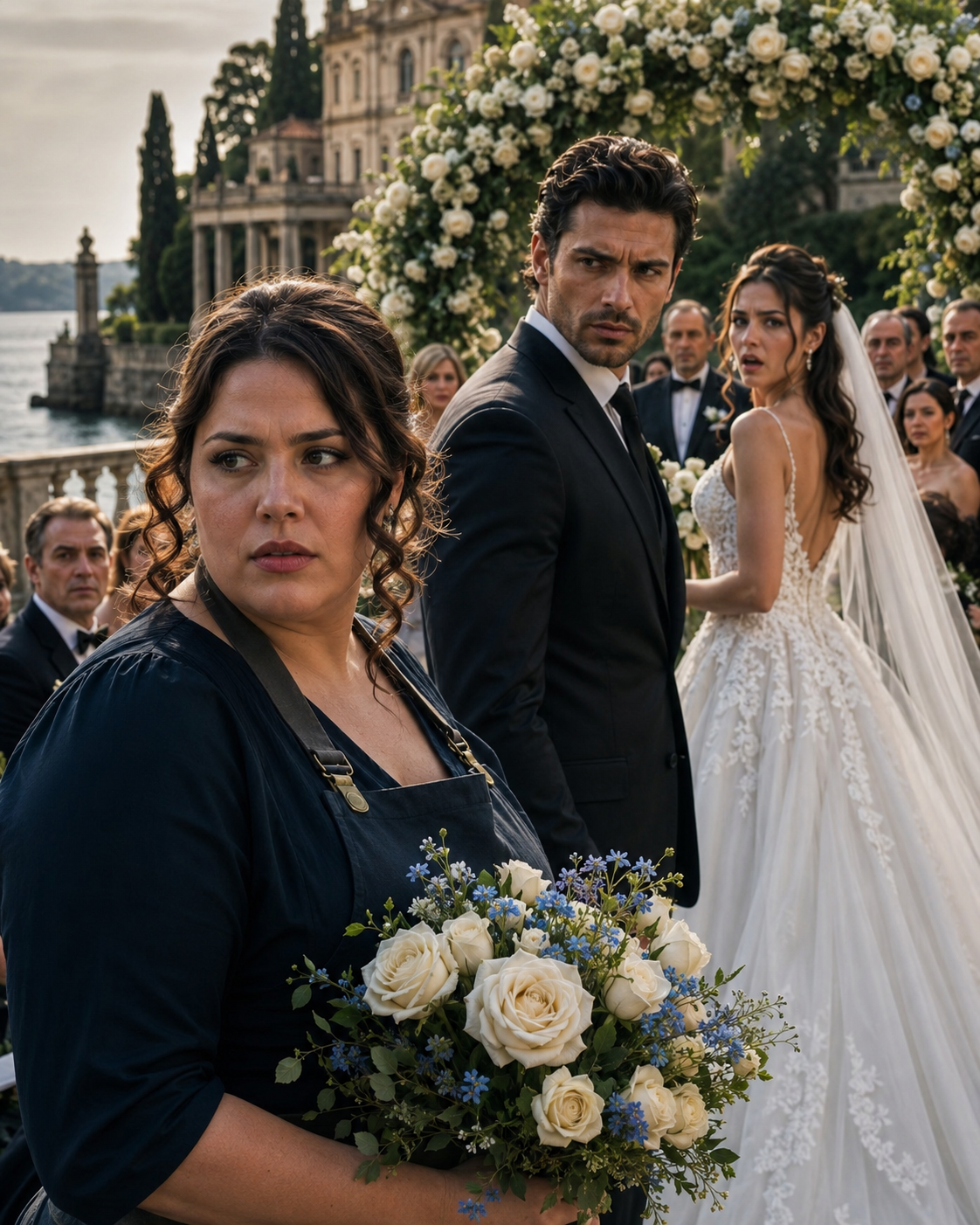
By the time Lila Marlowe arrived at the Vescari estate, the wedding roses had already begun to wilt.
Not visibly. Not in the way a wealthy bride would notice. The petals were still full, the stems still straight, the imported white blooms still arranged in obedient waves along the garden aisle. To the guests, planners, photographers, and security men moving across the estate like pieces on a chessboard, everything looked flawless.
But Lila noticed the edges.
She always noticed edges.
A faint browning beneath one petal. A bruised leaf hidden under ribbon. A stem cut too short and forced into place by someone who cared more about appearance than life. Flowers told the truth before people did. They showed stress. They showed neglect. They showed when someone had handled them with impatience and called it elegance.
Lila stood beneath the half-built floral arch with pruning shears in one hand and a coil of ivory ribbon over her arm, staring at the roses as if they had whispered her name.
“Miss Marlowe?”
She turned.
A young assistant planner in a beige headset hurried toward her, clutching a tablet against her chest. “Mrs. Hale wants the blue flowers removed.”
Lila blinked. “The forget-me-nots?”
“Yes. She says they look cheap.”
“They’re not cheap,” Lila said before she could stop herself. “They’re delicate. There’s a difference.”
The assistant’s eyes widened, as if disagreeing with the bride was more dangerous than disagreeing with God.
Lila exhaled and looked back at the arch. The white roses were beautiful, yes. Expensive, yes. But without the tiny blue flowers tucked between them, the entire arrangement would look like a room where no one had ever laughed. Perfect, empty, cold.
“The groom requested them,” Lila said.
The assistant lowered her voice. “The groom requested a lot of things before Mrs. Hale took over.”
Lila did not answer.
Everyone in Chicago knew the name Vescari. Some people said Dante Vescari was a businessman. Others whispered older words behind locked doors. Crime boss. Kingmaker. Wolf in a tailored suit. The sort of man who owned hotels, restaurants, shipping contracts, private security firms, and enough silence to make entire scandals disappear before breakfast.
Lila had only met him once.
Three weeks earlier, in a glass conference room above the river, she had stood across from Dante Vescari while his bride-to-be, Vivienne Hale, inspected Lila like a stain on silk.
Vivienne had been breathtaking in the way expensive things often were: polished until warmth had no room left to breathe. Blond hair smooth as champagne. Diamond bracelet flashing every time she lifted her hand. Smile soft enough for magazines and sharp enough for servants.
“You own the little flower shop in Bridgeport?” Vivienne had asked.
“My grandmother opened it,” Lila replied. “I run it now.”
Vivienne’s gaze had moved over Lila’s black dress, her round face, her full arms, the curls pinned messily at the back of her head after a long morning of deliveries. “How charming.”
That word had landed like a coin tossed at a street musician.
Dante had noticed.
He had not smiled. Men like him did not waste expression. But he had looked from Vivienne to Lila with dark, watchful eyes and said, “Miss Marlowe’s work was recommended by the director of the Marconi Foundation gala.”
Vivienne’s mouth tightened. “Of course.”
Dante had turned the portfolio pages slowly. He paused at a photograph of a winter memorial arrangement Lila had made two years ago for a family who had lost a daughter. White roses, blue forget-me-nots, and bare branches wrapped in silver thread.
“This one,” he said.
Vivienne leaned closer. “For a wedding?”
“For my mother,” Dante said.
The room went quiet.
Lila remembered the silence more than the words. Vivienne had stopped objecting at once. The wedding would have white roses and forget-me-nots because Dante’s mother had loved them, and because no one in that room was foolish enough to argue with grief when it wore Dante Vescari’s face.
Now, standing beneath the arch one day before the ceremony, Lila touched one of the blue flowers gently.
“No,” she said. “They stay.”
The assistant looked frightened. “Mrs. Hale won’t like that.”
“She can discuss it with Mr. Vescari.”
The girl vanished quickly, as if the sentence itself might explode.
Lila returned to work. Around her, the estate prepared for the wedding of the decade. White chairs faced the river. Crystal chandeliers were being hung inside the transparent reception tent. Men in dark suits checked gates, doors, and camera angles. Caterers carried silver trays past gardeners trimming hedges already trimmed to perfection.
Everywhere she looked, money had disguised control as beauty.
By noon, Dante appeared at the garden entrance.
He wore a charcoal suit without a tie, his black hair brushed back, his expression unreadable. Two security men followed several steps behind him. They did not crowd him. They did not need to. Power made space for him before his body arrived.
Lila straightened too quickly and nearly dropped the ribbon.
Dante stopped beneath the arch and looked up.
For several seconds, he said nothing.
Lila’s stomach tightened. “The right side isn’t finished yet. It needs more depth.”
“It looks finished.”
“It isn’t.”
One of his brows lifted.
Lila realized what she had said and to whom she had said it. Heat rushed into her cheeks. “I mean… from a distance it’s acceptable, but up close it needs balance.”
“Do you always correct dangerous men about roses?”
“Only when they’re wrong about roses.”
The faintest change touched his mouth.
Not a smile.
Almost.
“Then I’ll try to be wrong less often,” he said.
Lila looked away first. She had learned young not to enjoy the attention of men who lived in rooms she could not afford to enter. Attention could be flattering until it became a bill.
Dante stepped closer to the arch, careful not to touch anything. “You kept the blue.”
“You asked for them.”
“Vivienne asked you to remove them.”
Lila froze. “She sent a planner.”
“I know.”
“Then you know I said no.”
“I do.”
She waited for punishment.
Instead, Dante looked at the flowers. “My mother used to say white roses were too proud alone. She said every beautiful thing needed a little memory tucked inside it.”
Lila’s throat softened despite herself. “She sounds like someone who understood flowers.”
“She understood people. Flowers were easier.”
Lila almost smiled.
Then laughter rose from the other side of the hedge.
Vivienne’s laughter.
Dante turned his head slightly. So did Lila.
The voices were low, hidden behind the tall wall of boxwood that separated the ceremony lawn from the east garden path. Lila could not see them, but she recognized Vivienne’s polished tone at once.
“Tomorrow he signs,” Vivienne said. “After that, he can glare at the whole city if he wants. It won’t matter.”
A second woman answered. “And if he refuses?”
“He won’t. He thinks it’s about protecting me.”
The women laughed.
Lila’s hand tightened around the ribbon.
Dante’s face did not change, but something in the air around him sharpened.
“Who is with her?” he asked quietly.
“I don’t know,” Lila whispered.
A man’s voice joined them, smooth and amused. “Careful. The staff moves everywhere.”
Vivienne scoffed. “The staff hears everything and understands nothing.”
The second woman laughed again. “Especially the florist.”
Lila went still.
“They all think she’s sweet because she’s soft,” Vivienne said. “Women like that are always grateful just to be allowed near rich people.”
The words hit old bruises Lila thought she had buried.
Dante looked at her.
Lila wished he hadn’t.
She wanted to be composed. Professional. Invisible in the useful way. Instead, she could feel every inch of herself: the body Vivienne had dismissed, the hands red from flower thorns, the shoes bought on sale, the black dress that looked modest beside this estate’s wealth.
The man behind the hedge spoke again. “Enough. The media package is ready. The forged approvals are in place. The transfer order goes live once the marriage papers are signed.”
Dante’s eyes darkened.
Vivienne said, “And the video?”
“Prepared. By the time he realizes what happened, the room will already believe he did it all to himself.”
Lila’s pulse roared so loudly she almost missed Dante’s next words.
“Go back to work,” he said softly.
She stared at him. “What?”
His voice remained calm. “Not here. Not now. Go back to work.”
“But you heard—”
“I heard.”
“Then stop it.”
His gaze flicked toward the hedge. “If I stop it now, I catch only the bride. I want the hand behind her.”
Lila swallowed.
Before she could answer, Vivienne emerged from the garden path with her maid of honor, Celeste Wynn, and Dante’s cousin, Nico Vescari.
Nico was younger than Dante by nearly ten years, handsome in a bright, careless way. He had the easy confidence of someone raised close enough to power to mistake borrowed light for his own sun. He smiled when he saw Dante.
“Cousin,” Nico said. “Inspecting the flowers?”
Dante turned toward him with the calm of a closed door. “Admiring them.”
Vivienne’s eyes moved to Lila. “Still working on the arch?”
“Yes,” Lila said.
“Do try to make it look less sentimental.”
Dante said, “It will stay exactly as Miss Marlowe designed it.”
Vivienne’s smile held. Only her eyes changed. “Of course, darling.”
She slipped her hand through Dante’s arm. He allowed it. Lila looked down before she could see anything more.
But as Vivienne passed, Lila noticed something caught beneath the rose bundles waiting near the stone urn.
A thin black case, half hidden behind folded silk ribbon.
It had not been there before.
Lila waited until they were gone. Then she crouched beside the urn as if checking the stems.
The case was small. Not decorative. Not part of any floral supply. It had been pushed behind the roses in haste.
Inside was a silver flash drive.
Lila’s breath stopped.
For a moment she did nothing. Every instinct in her body argued at once. Leave it. Take it. Tell Dante. Pretend she never saw it. Walk away from the estate, from the wedding, from the kind of people who destroyed lives before dinner and still slept on imported sheets.
Then she remembered Vivienne’s laugh.
Women like that are always grateful.
Lila closed the case and slipped it into the pocket of her apron.
All afternoon, she worked with the weight of it against her hip.
She saw Nico twice. Once near the reception tent, speaking to a man Lila recognized from the wedding schedule as Vivienne’s uncle, Sterling Hale. Once near the east hedge, searching the ground with a smile that looked casual only from far away.
He was looking for the case.
By evening, the estate had turned gold in the low sun. Lila’s assistants finished the centerpieces and left in a van loaded with empty buckets. The planners moved to the ballroom for final checks. Guests had not yet arrived, but the estate already felt crowded with secrets.
Lila should have gone home.
Instead, she found a quiet corner in the service kitchen and plugged the flash drive into her battered laptop.
The first folder was labeled Ceremony Video.
Inside were edited clips of Dante: him speaking at business dinners, him turning away from cameras, him standing beside Vivienne with a cold expression. Each clip was cut to make him look cruel, controlling, suspicious. There were voice recordings too, sliced into fragments, arranged to sound like threats when they were not. Lila listened for less than a minute before closing the file, sickened.
The second folder was worse.
Bank transfers. Corporate documents. Signature pages bearing Dante’s name. Draft statements accusing him of fraud, abuse of charitable funds, and intimidation. Some documents were clearly staged. Others had been twisted from real events. Together, they formed a trap built not merely to embarrass him, but to destroy him publicly.
The third folder carried Nico’s initials.
Lila opened it.
Messages.
Not between Vivienne and Dante.
Between Nico and Sterling Hale.
Nico had planned everything. Vivienne was not innocent. She had agreed to humiliate Dante, to sign false statements, to marry him long enough for the trust documents to shift control. But Nico had gone further. Once Dante fell, Vivienne would be blamed for the forgery. Sterling would be tied to the transfers. Nico would step forward as the grieving cousin, the clean successor, the only Vescari left untouched.
Lila sat back slowly.
This was not a wedding.
It was a funeral with flowers.
A sound came from the corridor.
Footsteps.
Lila shut the laptop. She slid the flash drive into her pocket and lifted a tray of boutonnieres just as Nico entered the service kitchen.
His smile appeared instantly.
“Miss Marlowe,” he said. “Still here?”
“Flowers don’t arrange themselves.”
“No. I suppose not.”
His gaze moved over the counters, the boxes, the laptop bag by her feet.
Lila kept her face still.
Nico took one step closer. “You didn’t happen to find anything near the garden, did you?”
She looked at him blankly. “Like what?”
“A small case. Probably dropped by one of the planners.”
“Ask the planners.”
“I’m asking you.”
“And I’m telling you I’ve been working.”
His smile thinned. “You know, people underestimate service workers. I don’t.”
“That must make you very wise.”
For one second, his eyes turned empty.
Then Dante’s voice came from the doorway.
“My cousin bothering you?”
Nico’s expression recovered quickly. “Just looking for something.”
Dante looked at Lila. “Did he find it?”
Lila’s heart slammed once.
She understood the question beneath the question.
“No,” she said. “He didn’t.”
Dante held her gaze.
Nico laughed lightly. “Well. Let me know if it turns up.”
He left.
Lila did not move until his footsteps faded.
Dante entered the kitchen and closed the door behind him. His security men remained outside.
“You have it,” he said.
It was not a question.
Lila set down the tray. “If I say yes, do I become a problem?”
His jaw tightened. “No.”
“Men like you say that before people become problems.”
“I’m not asking you to trust men like me.”
“Then what are you asking?”
Dante stepped no closer. That restraint mattered more than it should have.
“I’m asking you to trust what you saw.”
Lila pulled the black case from her pocket and placed it on the table between them.
Dante did not touch it immediately. His eyes remained on her face.
“Did you open it?”
“Yes.”
“And?”
She laughed once, without humor. “Your wedding has excellent flowers and terrible people.”
Something like pain moved through his expression.
“Nico?” he asked.
Lila nodded.
Dante closed his eyes briefly.
That frightened her more than anger would have. Rage would have been easy to understand. This was grief. Quiet, contained, old grief cracking open around a new blade.
“I raised him after his father died,” Dante said. “He was sixteen. Angry at the world. I thought giving him my name would save him.”
“Maybe he thought it buried him.”
Dante looked at her sharply.
Lila regretted the words at once. “I’m sorry.”
“No,” he said. “You may be right.”
She pushed the case closer. “Cancel the wedding.”
“I will.”
Relief loosened her shoulders.
Then he said, “At the altar.”
Lila stared. “That is the worst idea I have ever heard.”
His mouth curved faintly. “You’ve heard all my ideas?”
“I’ve heard enough if that’s your best one.”
“Their plan needs an audience. So does the truth.”
“You want a public confrontation.”
“I want witnesses.”
“She’ll blame me.”
“Yes.”
“You’re very calm about that.”
“I won’t let her ruin you.”
Lila wanted to believe him. The foolish part of her did. The wiser part stood back with crossed arms and waited for proof.
“I don’t need saving,” she said.
“No,” Dante replied. “You need protection while you save me.”
The words silenced her.
No one had ever put it that way before.
For years, Lila had survived by making herself useful enough not to be dismissed and quiet enough not to be punished. She had inherited her grandmother’s flower shop, along with its debts, its cracked tile floor, its leaking cooler, and its reputation for beauty no rich decorator could fake. She had swallowed insults from brides half her age and mothers twice as cruel. She had smiled when people called her “sweet” because they meant harmless.
Now a man feared by half the city stood in a service kitchen and looked at her as if she were the only honest person left in the building.
“What do you need me to do?” she asked.
“Nothing.”
“No.”
Dante’s brow lifted.
“I’m already in this,” Lila said. “I found it. I opened it. I know what it means. You don’t get to put me back in the corner like another floral arrangement.”
For the first time, Dante truly smiled.
Small. Brief. Dangerous in a different way.
“Then stand where everyone can see you,” he said. “And when they lie, don’t let them make you small.”
The wedding morning came bright, cloudless, and cruel.
The estate looked impossibly beautiful. White roses climbed the arch like frozen waves. Forget-me-nots gleamed pale blue between them, tiny and stubborn. The aisle shimmered with petals. The river beyond the garden glittered in the June light. Guests arrived in silk, linen, diamonds, and guarded expressions.
Lila stood near the back, beside the stone urn where she had found the case.
Her black dress was plain. Her curls had already started escaping their pins. A thorn scratch marked the back of her hand. Compared to the women drifting past her in designer gowns, she looked exactly like what Vivienne would call her: the florist.
Good, Lila thought.
Let them underestimate the florist.
Dante stood at the altar in a black suit, motionless beneath the roses. Nico stood beside him as best man, smiling with the confidence of a man who believed the floor belonged to him. Vivienne waited at the far end of the aisle, glowing beneath a cathedral veil.
Everyone rose.
Vivienne walked slowly, beautifully, perfectly.
Lila watched Dante.
Not once did he look away from the woman coming toward him. Not once did his face show disgust, rage, or triumph. He looked like a man attending the burial of something he had once wanted to believe in.
The officiant spoke of trust.
Lila almost laughed.
Vivienne gave her vows first. Her voice trembled at the right moments. She spoke of Dante’s strength, his loneliness, the man beneath the legend. She promised to stand beside him when the world misunderstood him. Several guests dabbed their eyes.
Dante took her hands.
For the first time, Vivienne looked truly relaxed.
She thought she had won.
Dante began quietly.
“Vivienne, when I asked you to marry me, I believed loyalty could still be chosen.”
Her smile softened for the cameras.
“I believed,” he continued, “that love meant placing your future in another person’s hands and trusting they would not sharpen it into a weapon.”
Nico’s smile faded.
Vivienne’s fingers stiffened.
Dante released her hands.
The officiant stopped speaking.
A murmur moved through the garden.
“Dante?” Vivienne whispered.
He turned toward the guests.
“I invited you here today to witness a marriage,” he said. “Instead, you will witness the reason it cannot happen.”
The garden went silent.
Behind the ceremony space, large screens intended for the reception flickered to life. No readable text remained visible for long; the evidence appeared in brief, blurred flashes while a prepared legal narration played through the sound system. Bank records. Transfer routes. Edited video files. Signature comparisons. Message threads. Names spoken aloud by an attorney’s recorded voice.
Vivienne stepped backward. “Stop this.”
Dante did not look at her. “You planned to marry me long enough to access my trust, forge my approvals, and release edited footage to make the city believe I had destroyed myself.”
Gasps rippled through the chairs.
Nico moved.
Two security men stepped into his path without touching him.
He smiled too late. “This is absurd.”
Dante turned to him. “You always smile when you’re cornered.”
Nico’s eyes hardened.
Vivienne pointed suddenly toward the back of the aisle.
Toward Lila.
“She did this,” Vivienne cried. “That woman stole private files. She has been lurking around this estate for days, desperate to feel important. Look at her.”
Hundreds of eyes turned.
Lila felt them like heat.
Look at her.
Not listen to her.
Not ask what she found.
Look at her.
As if her body were an argument. As if her plain dress, her working hands, her soft waist, her place near the flowers made her truth less valuable than a bride’s lie.
The old shame rose fast. School hallways. Bridal appointments. Customers who spoke over her. Men who flirted as a joke. Women who called her brave for wearing a sleeveless dress.
Then Dante stepped down from the altar.
He walked the length of the aisle, past politicians, investors, judges, and whispering guests, until he stood beside Lila.
He did not touch her.
He did not make a show of rescuing her.
He simply stood there, close enough that everyone understood his choice.
“She told the truth,” Dante said.
Vivienne’s face twisted. “You believe her?”
“I believe evidence. I believe timing. I believe courage when I see it.” He looked at Lila, then back at the crowd. “Miss Marlowe had nothing to gain. She risked her business, her name, and her safety because she refused to let a lie become permanent.”
Lila’s throat tightened.
Vivienne laughed sharply. “Please. She wants money. Women like her always want to be chosen.”
Lila’s fear broke.
Not vanished.
Broke open into something louder.
“No,” she said.
Her voice was small at first, but it carried through the garden because the garden had gone quiet enough to hear a petal fall.
“I wanted to finish the roses, get paid, and go home. I wanted not to know your secrets. I wanted not to hear you laugh about humiliating a man who trusted you.”
Vivienne stared at her.
Lila stepped forward.
“I found the case because someone hid it behind my flowers. I opened it because your people were looking for it. And I brought it to Dante because being afraid of powerful people does not make powerful people right.”
A sound moved through the guests.
Not applause.
Not yet.
Something better.
Belief.
Nico laughed suddenly. “Very moving. A florist gives a speech and now we pretend this is a courtroom?”
Dante looked at him. “No, Nico. This is a stage. You built it. I’m only changing the ending.”
The screen shifted again. This time, the attorney’s voice explained the part Vivienne had not known.
The final transfer plan. The backup statements. The clause that framed Vivienne as the emotional instigator and Sterling Hale as the financial handler. The documents Nico had prepared to walk away clean while everyone else burned.
Vivienne went white.
“What is that?” she whispered.
Dante’s voice was cold. “Your future, if I had signed.”
Vivienne turned slowly toward Nico. “You said we were partners.”
Nico’s charm cracked. For the first time all day, he looked less like a prince and more like a boy furious that the crown had never fit.
“You were useful,” he said.
The words destroyed what remained of her.
Sterling Hale tried to leave. Security blocked the path. Celeste began crying. Guests rose from their seats, whispering into phones, stepping away from the family names they had spent years trying to stand beside.
In the distance, sirens approached.
Dante did not move.
“My attorneys contacted federal investigators this morning,” he said. “Everything has already been delivered.”
Nico lunged forward.
Security stopped him before he reached the aisle.
No violence. No spectacle. Just the quiet end of a man who had mistaken betrayal for intelligence.
Vivienne sank onto one of the white chairs, her veil spilling around her like a ruined cloud.
The wedding was over.
The truth had arrived in its place.
Hours later, the estate looked like a dream after waking.
The guests had gone. Reporters waited beyond the gates. Investigators had taken Nico, Sterling, and two financial officers for questioning. Vivienne left with an attorney, her bouquet abandoned on the grass, the white roses bruised where her fingers had crushed them.
Lila stood beneath the arch as sunset turned the river copper.
Her body ached from fear leaving it too late.
She should have felt victorious.
Instead, she felt hollow.
The biggest job of her career had collapsed into scandal. By morning, her name would be everywhere. Some people would praise her. Some would call her a thief. Some would say she had been brave. Others would say she had been lucky, jealous, desperate, or used.
Flowers did not care what people said beneath them.
They bloomed for vows and betrayals alike.
A voice behind her said, “Your grandmother would be proud.”
Lila turned.
Dante stood several steps away. His jacket was unbuttoned, his tie loosened, his face worn by a grief too private for the headlines already forming.
“I didn’t say that out loud,” Lila said.
“You looked like you were asking.”
She looked back at the arch. “What happens now?”
“Lawyers. Investigations. My family name dragged through the street. Some of that it deserves.”
“I’m sorry.”
“I’m not.”
She glanced at him.
“If I had married her,” Dante said, “I would have signed away control of businesses tied to thousands of employees. My mother’s foundation would have been gutted. The clean work I spent years building would have been buried under Nico’s crimes.”
His voice lowered.
“You didn’t just save me from embarrassment, Lila. You saved people who will never know your name.”
The words landed slowly.
Lila had spent most of her life measuring success in small survivals. Rent paid. Cooler repaired. Staff paid on time. Another month with the shop lights on. She had never imagined herself standing between a powerful man and ruin.
Dante held out an envelope.
She immediately shook her head. “No.”
“You haven’t opened it.”
“I recognize rich guilt.”
That surprised a real laugh out of him.
It was brief, but it changed his whole face. Made him look younger. Human.
“It isn’t guilt,” he said. “It’s payment.”
“You already paid the deposit.”
“And the balance is inside. Doubled. Along with compensation for staff overtime, reputational risk, replacement flowers, and emotional damages suffered by innocent roses.”
Despite everything, Lila laughed.
The sound came out shaky and uneven, but it was hers.
Dante smiled faintly. “There it is.”
“What?”
“The first honest sound I’ve heard all day.”
Lila accepted the envelope because refusing would have been pride, not dignity. Inside was a check large enough to repair the shop sign, replace the cooler, pay overdue bills, hire another assistant, and let her breathe for the first time in years.
Her eyes burned.
“I don’t know what to say.”
“Say you’ll keep making beautiful things for people who may or may not deserve them.”
“That is terrible business advice.”
“I’m not in the flower business.”
“No,” Lila said. “You’re in the terrifying-silence business.”
Another smile touched his mouth. Then it faded.
“I owe you truth,” he said.
“You don’t owe me anything else.”
“Yes,” Dante said. “I do.”
Lila waited.
“The rumors about me are not all false,” he said. “I inherited a family with blood in its history and arrogance in its bones. I spent years believing control was the same as safety. I told myself dangerous men only respected power, and sometimes I became exactly what I claimed to be fighting.”
Lila did not interrupt.
“But the hotels, the foundation, the scholarships, the housing projects — those were real. They were my attempt to build something clean from something dirty. Nico knew destroying those would hurt me more than attacking my pride.”
“What will you do now?” she asked.
“Clean house.”
“And after that?”
Dante looked at the flowers. “Learn how to live without turning every room into a battlefield.”
It was the most honest thing he had said.
Lila nodded. “That’s a good beginning.”
He looked at her then, not like a man giving orders, not like a boss, not like someone used to being obeyed.
Like a man asking.
“When the headlines calm down,” he said, “I would like to take you to dinner.”
Lila’s first instinct was to laugh it away.
Women like her learned early to distrust desire. They learned to make jokes before anyone else could. They learned to call themselves practical when what they really meant was afraid.
Instead, she breathed.
“You know I’m not like the women usually photographed beside men like you.”
“No,” Dante said.
The answer came too quickly.
Too honestly.
Lila’s chest tightened.
He stepped one careful inch closer, still leaving space between them. “That is not a warning to me.”
For a moment, every version of Lila stood together: the girl mocked in school, the young woman ignored in elegant rooms, the florist who learned to smile through insult, the granddaughter trying to keep a blue sign lit above a failing shop.
Then she smiled.
Not because life had become simple.
Not because a powerful man had noticed her.
But because, for once, being seen did not feel like danger.
“One dinner,” she said.
Dante nodded. “One dinner.”
“And not somewhere with black walls and waiters who look like they’re guarding state secrets.”
“Where, then?”
“My neighborhood. Tiny Italian place near the shop. Plastic tablecloths. Best garlic bread in Chicago.”
“Done.”
Six months later, Marlowe Flowers no longer had a cracked front window.
The old blue sign still hung above the door, freshly painted because Lila refused to erase her grandmother’s touch. The cooler worked. Two full-time employees handled weekday orders. A teenager from a neighborhood arts program came after school to learn arrangements. Business had grown after the Vescari scandal, but not only because of the headlines.
At first, people came for the story.
Then they stayed for the flowers.
They discovered what had always been true. Lila did not simply arrange stems. She understood emotion. She could make grief gentle, joy sincere, romance honest, and apology less cowardly.
As for Dante Vescari, the investigations cracked open rooms that had been locked for years. Nico’s network collapsed. Sterling Hale cooperated too late to save his reputation. Vivienne testified against both men and disappeared from the social pages that had once worshipped her.
Dante did what he said he would do.
He cleaned house.
Executives resigned. Old associates lost access. The Vescari Foundation was rebuilt with independent oversight. His hotels expanded training programs for kids from neighborhoods wealthy donors loved to mention at charity dinners and forget by dessert.
The papers still called him dangerous.
Maybe he was.
But Lila learned that people were not made of one story.
They were made of choices.
And Dante, for the first time in a long time, was choosing differently.
On a snowy December evening, he arrived at Marlowe Flowers carrying coffee in one hand and a paper bag in the other.
Lila looked up from a holiday centerpiece. “If that isn’t from Bellini’s bakery, turn around.”
Dante placed the bag on the counter. “I value my life.”
She opened it and smiled at the smell of warm almond cookies.
“You’re learning.”
“I have a strict teacher.”
“The best ones are.”
The shop was quiet except for the hum of the cooler and soft music from the old radio near the register. Outside, snow dusted the sidewalk and gathered along the blue sign above the door.
Dante walked to the window display.
In a narrow glass vase stood one white rose with a tiny blue forget-me-not tucked beside it.
He recognized it immediately.
“You kept the blue,” he said.
Lila joined him. “Perfection still looks lifeless without memory.”
“And the thorn?” he asked, noticing the small stem she had left deliberately visible.
Lila smiled. “That means beauty is allowed to defend itself.”
Dante was silent for a moment.
Then he reached for her hand.
Not dramatically.
Not possessively.
Gently, giving her every chance to pull away.
She did not.
For most of her life, Lila had believed love would arrive as proof that she was finally enough. But standing in her grandmother’s flower shop beside a man who had lost a false future and chosen a truer one, she understood something better.
She had been enough before anyone saw her.
The truth had not made her worthy.
It had only revealed what had been there all along.
Sometimes life changes at the altar.
Sometimes it changes behind wedding roses, when one trembling woman decides that silence costs too much.
And sometimes the person everyone overlooks is the only one who sees clearly enough to save the day.

