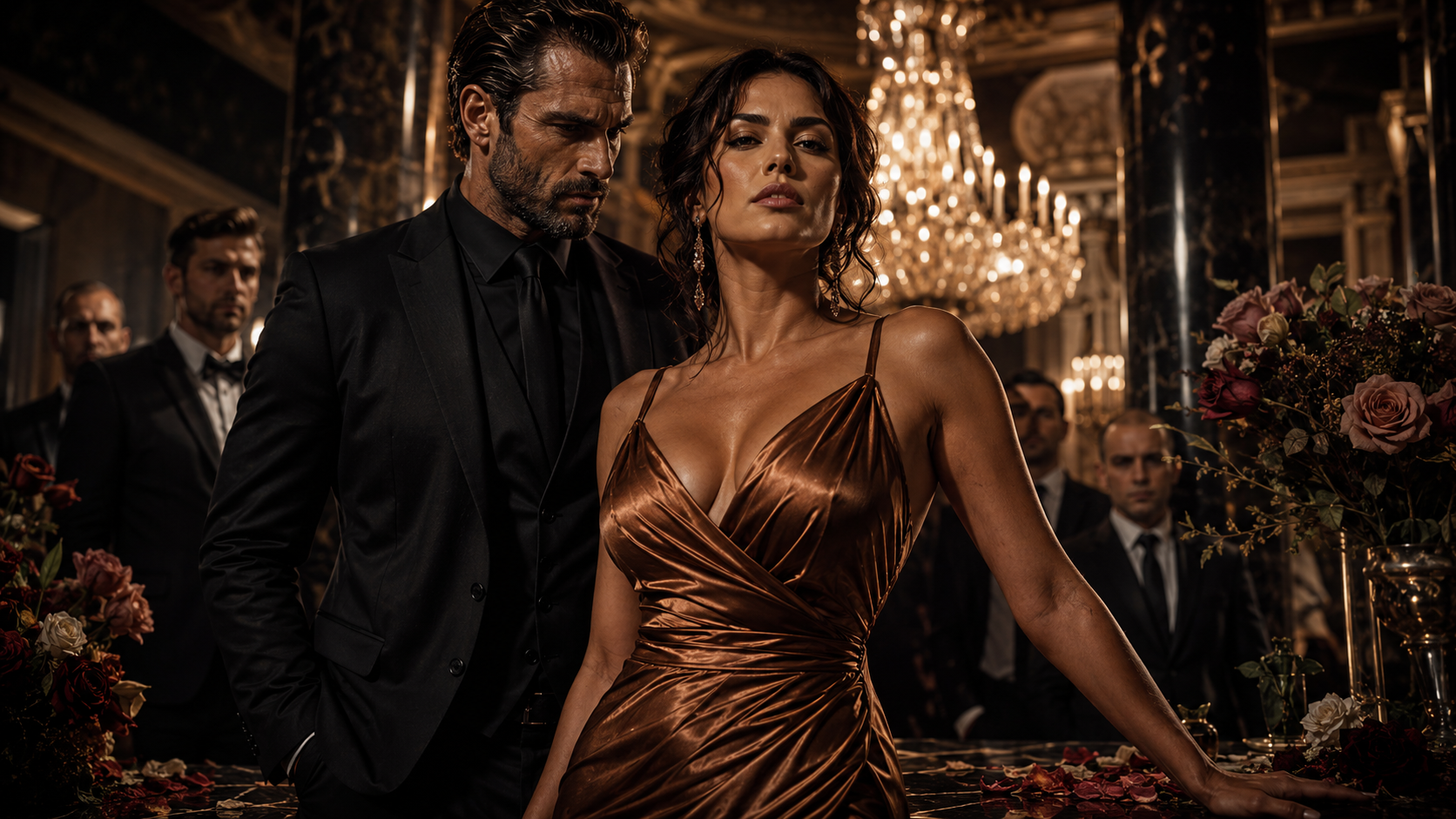
Nobody in the ballroom expected the woman in the copper dress to fight back.
That was the first mistake.
The second mistake was thinking Dorian Kade had brought her there because she was decoration.
And the third—the mistake that would break a criminal dynasty open from the inside—was believing that a woman everyone laughed at could not hear, count, remember, and destroy.
Her name was Lena Hart.
To the guests at the Kade Foundation Gala, she was easy to dismiss. She was not thin enough for their gowns, not rich enough for their circles, not polished enough to pretend she had been born beneath chandeliers. She owned a small wedding flower studio in East Harbor, the kind of place where brides cried over peonies and mothers argued over ribbon colors. She drove a scratched blue van. She paid her bills late, tipped delivery boys too much, and kept a jar of emergency chocolate under her counter.
In that room, among diamond throats and silk shoulders, she was an accident.
At least, that was what they thought.
Lena stood beside a column near the west terrace, one hand wrapped around a glass of champagne she had not touched. The bubbles had gone flat. Her patience was close behind.
Across the ballroom, her younger brother, Theo, sat pale and sweating between two men in dark suits. He looked as if he had aged ten years in one week. His tie was crooked. His eyes kept searching the room for Lena, then dropping away.
He had always been beautiful in a way that made people forgive him too quickly.
Lena did not forgive him quickly.
She loved him. That was worse.
Three nights earlier, Theo had appeared at her apartment door with blood on his lip and terror in his hands. He had confessed to gambling, lying, borrowing from the wrong people, and signing documents he had not read. Then he told her the amount.
Four hundred and eighty thousand dollars.
Lena had laughed at first because the number was too large to fit inside her life.
Then Theo had said the name Dorian Kade, and the laugh died in her throat.
Everyone in East Harbor knew the Kade name. Half the city said Dorian Kade was a businessman. The other half said he owned the men who owned the businesses. He had inherited a criminal empire built on docks, unions, private security, construction contracts, and quiet bodies at the bottom of quiet water.
He was thirty-eight, ruthless, controlled, and handsome in the cold, expensive way of men who never had to ask twice.
Lena had expected a meeting in a basement. Maybe a threat. Maybe a demand.
Instead, a black car came for her at seven o’clock and delivered her to a charity gala where people paid five thousand dollars a plate to pretend they cared about children’s hospitals.
Dorian Kade stood near the center of the ballroom, surrounded by politicians, lawyers, and men whose smiles never reached their eyes.
He wore black.
Not a tuxedo that begged to be admired, but one that simply assumed obedience from the room. His dark hair was swept back. His jaw was clean-shaven. His face held no softness, only angles and restraint. When he looked at someone, that person seemed to remember a secret they had hoped to keep.
Lena had felt his gaze on her twice.
Both times, she refused to look away first.
That may have been when he started paying attention.
The man who approached her was not Dorian.
He was younger, broader, and drunk enough to mistake cruelty for charm. His name, she had heard whispered, was Milo Venn. One of Kade’s captains. A man who laughed too loudly and touched too freely.
“Well,” Milo said, stopping in front of her. “You must be the sister.”
Lena looked at him over the rim of her glass. “That depends on who is asking.”
He grinned. “Someone who thinks Theo Hart has terrible taste in mistakes.”
“You would know.”
A woman nearby hid a laugh behind her hand.
Milo’s smile thinned.
Lena knew that expression. She had seen it in men who hated being mocked by women they considered beneath them.
His eyes moved over her body with lazy insult.
“You clean up better than I expected,” he said. “Still, that dress is brave.”
“It has survived worse than your opinion.”
The woman nearby stopped laughing.
Milo stepped closer.
Lena smelled whiskey and expensive tobacco.
“Careful,” he murmured. “In this room, women who speak like that usually belong to someone powerful.”
Lena set her untouched champagne on a passing tray.
“Then you are in luck,” she said. “I belong to myself.”
The words changed something in him.
His hand shot out, fingers closing around her upper arm.
The ballroom did not go silent all at once. It softened first. A ripple of attention moved through the nearest guests. Conversations became thinner. Faces turned. Then, as always happened in rooms full of cowards, people pretended not to see.
Lena looked at his hand.
Then she looked at his face.
“Remove it.”