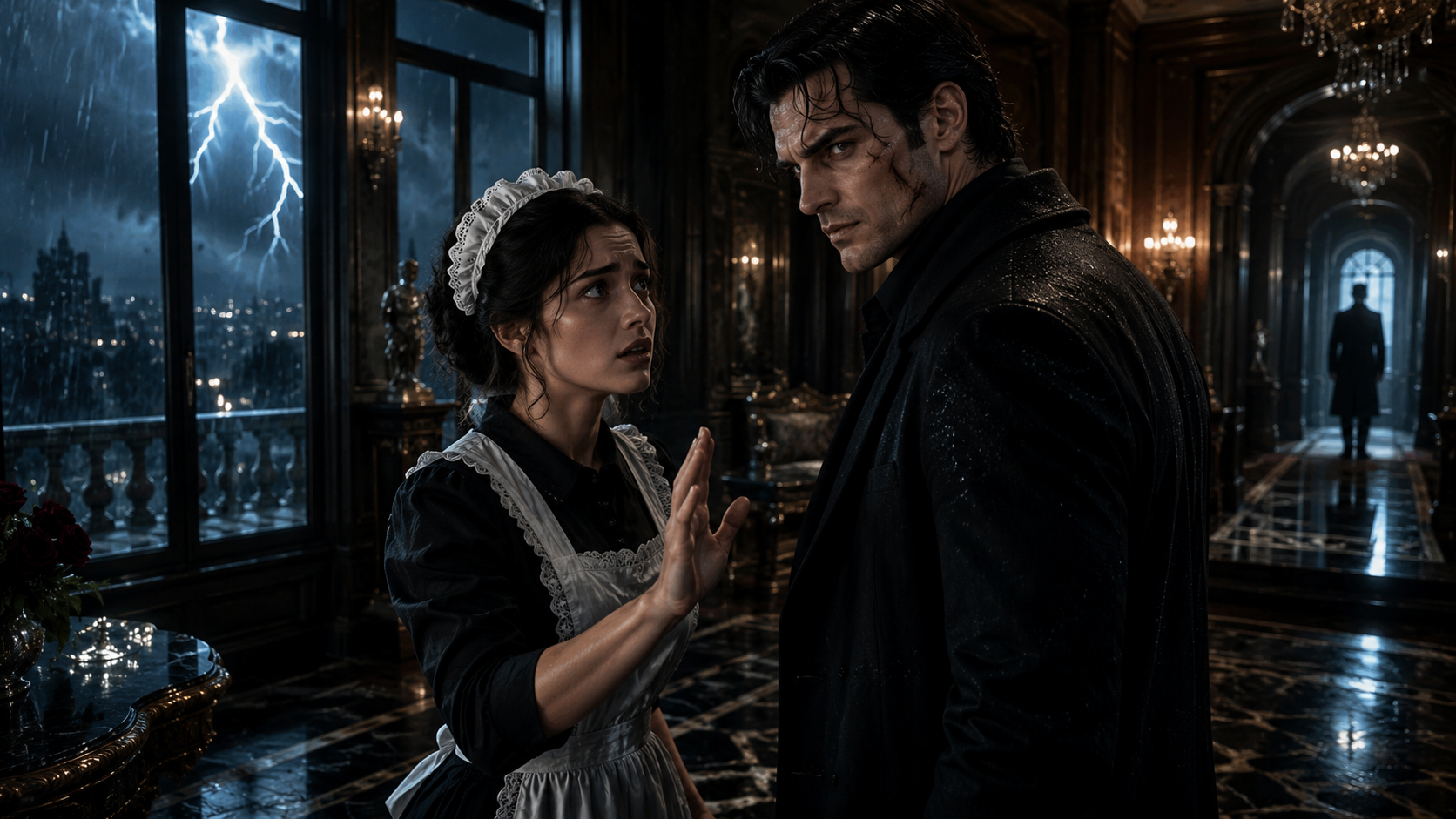
Not because she was losing Adrian.
Because she was losing control of the story.
“You think confession makes you clean?” she hissed. “You think your children will forgive you because you handed papers to prosecutors?”
“No,” Adrian said. “I think forgiveness is theirs to give or keep. I am only removing the knife from their hands before they mistake it for an inheritance.”
Celeste stared at him.
Then her eyes shifted to Clara.
“You,” she said softly. “The little maid.”
Clara lifted her chin.
Celeste smiled with venom. “He will disappoint you too.”
“I know,” Clara said.
Adrian looked at her.
Clara did not look away from Celeste. “But tonight he listened. That was more than you expected. Maybe more than he expected too.”
Celeste’s mask cracked.
Only for a second.
Then the officers took her.
The call ended.
No one spoke for a while.
Outside, morning finally broke through the storm clouds. Pale light spread over the sea, over the pines, over the wet road leading away from Blackthorne House.
Ruth poured coffee.
Clara accepted this cup.
Adrian stood by the window, watching the dawn as if it belonged to someone else.
“What happens now?” Clara asked.
He did not turn. “Prison, probably. Trials. Enemies. Headlines. Men pretending they never knew me.”
“And your children?”
“Safe for today.”
“That’s not nothing.”
“No,” he said quietly. “It is not.”
He turned then and looked at her, not like a boss looking at a servant, not like a king looking at a subject, but like a man looking at the person who had seen him at his worst and refused to let that be the end of the story.
“Your brother,” he said. “Jonah. I will give the prosecutor everything I have on the docks. If Matteo killed him, the truth will come out.”
Clara’s throat tightened.
“And if it leads back to you?”
“Then it leads back to me.”
She searched his face for performance.
There was none.
That did not make him good. Clara knew better than to confuse one night of courage with redemption. Adrian Voss had ruined lives. He had built fear into walls. He had taught loyalty as obedience and called control protection. Men like him did not become innocent because they bled.
But perhaps, she thought, some men could become honest after the lies finally collapsed around them.
“You should rest,” she said.
“So should you.”
“I was shot saving a crime lord. I think I deserve two days off.”
Ruth laughed from the stove.
Adrian almost smiled. “With pay.”
“Generous.”
“And medical care.”
“Basic decency.”
“I am learning.”
Clara looked toward the gray morning.
For the first time in nearly a year, she did not count the day as survived.
She counted it as lived.
Weeks later, Blackthorne House stood empty.
Police tape crossed its doors. Reporters camped beyond the gates until the next scandal called them elsewhere. The servants found other work. The guards vanished. The portraits were removed from the walls and placed in storage, where dead men could stare at dust instead of descendants.
Adrian Voss testified for eleven days.
He did not ask for sympathy.
He named names until powerful men stopped sleeping. He gave locations until rivers and warehouses and buried rooms surrendered their secrets. He spoke of Matteo Greer, Celeste Voss, the dock fires, the false companies, the bought judges, the dead who had never received justice because fear had been cheaper than truth.
Sometimes he looked at the gallery.
Mira came twice.
Elian came once.
Clara came every day.
Not for him, she told herself at first. For Jonah. For her father. For every answer she had entered that house to find.
But on the final day, when Adrian stepped down from the witness stand and saw her waiting near the doors, she understood that truth was rarely so clean.
He stopped before her.
“You are free of me now,” he said.
Clara considered that.
Then she shook her head.
“No. I am free of the version of you I feared.”
He looked as if he did not know what to do with that.
Outside the courthouse, sunlight struck the steps with almost cruel brightness. Cameras flashed. Reporters shouted. Somewhere in the crowd, people cursed Adrian’s name. Others shouted questions about Celeste, Matteo, the children, the empire that had fallen because one maid knew the hidden routes of a house better than its king.
Clara walked down the steps alone.
At the bottom, she turned once.
Adrian stood at the top between two federal officers, no crown, no guards, no mansion behind him. Only a man left to face what he had made.
He met her eyes.
Clara did not smile.
But she nodded.
It was not forgiveness.
It was not absolution.
It was simply proof that the night had happened, that fear had not won, that a woman everyone ignored had changed the ending of a powerful man’s story.
The rain had washed Blackthorne clean.
But it was Clara Bell who had opened the door.