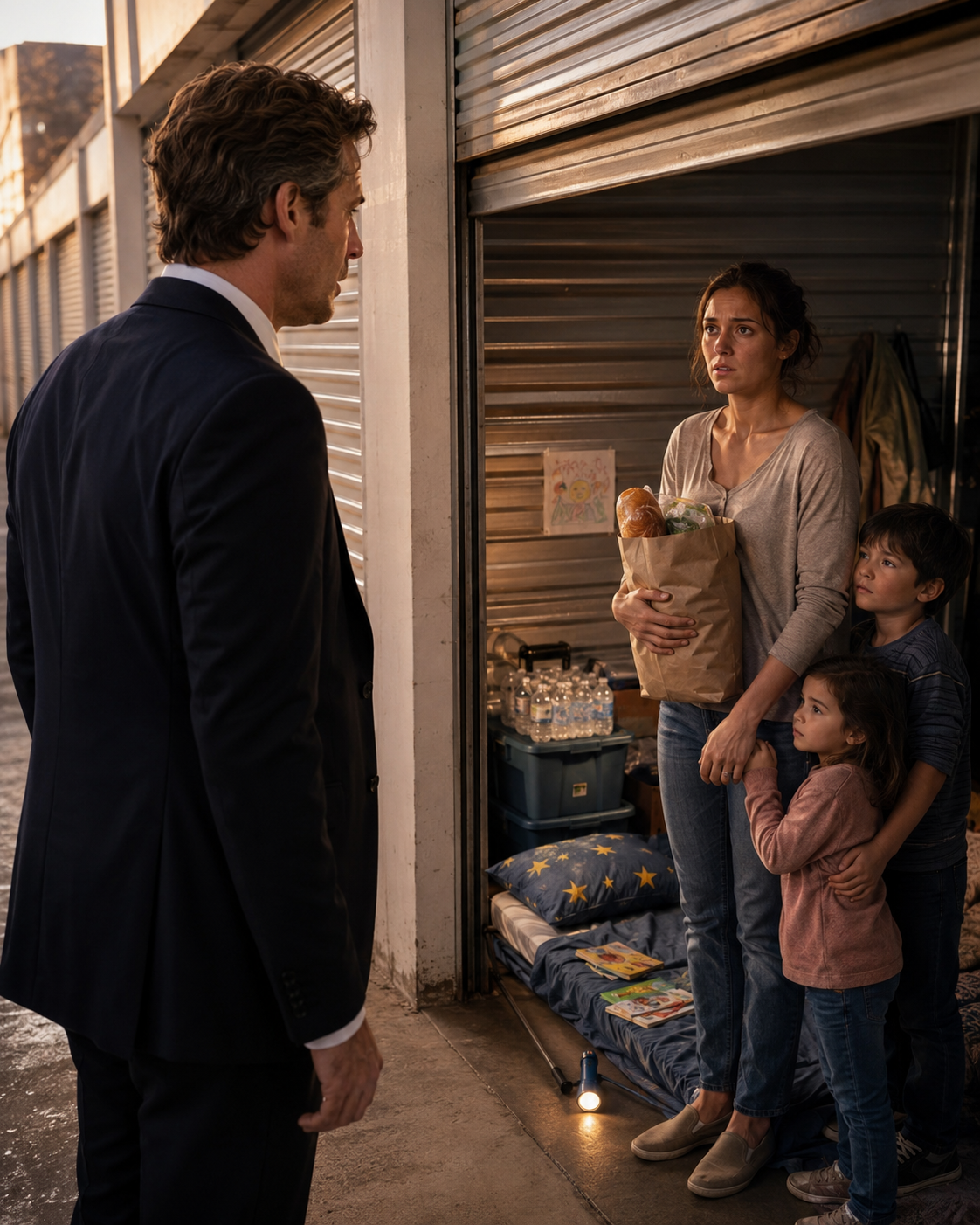
Walter nodded. “Useful beats all right on certain days.”
Six months later, Harborline Storage had not been sold.
Adrian’s board called it emotional decision-making.
His chief operating officer called it a dangerous precedent.
The developer called it a mistake.
Adrian called it an audit.
Not of finances.
Of blindness.
Harborline became the first Vale Community Access Site. The office was renovated into a small resource room where housing navigators came twice a week. Storage managers across the company received new training. If a tenant appeared to be living in a unit, the first response would no longer be disposal, removal, or silence.
There would still be safety checks.
There would still be rules.
But the first question changed.
Not: How quickly can this person be removed?
But: What happened, and who can help before this gets worse?
Walter stayed on with a raise and a title he disliked.
Community Site Lead.
“It sounds like something printed on a badge at a conference,” he complained.
“Choose your own title,” Adrian said.
Walter chose Keeper of Doors.
Human Resources objected.
Adrian approved it anyway.
Other stories surfaced after that.
A retired cafeteria worker in Unit 9C whose medical debt had swallowed her savings. A veteran living out of his truck who rented a unit so his daughter would not know he owned only two bags. A college student sleeping in a climate-controlled unit three nights a week because tuition had eaten rent.
Adrian did not ask Walter how many rules he had broken quietly.
He suspected the number would humble him.
Marissa began a daytime job at a medical supply office and enrolled in evening classes for nursing. She did not transform overnight into someone untouched by fear. She still checked locks twice. She still kept folded cash in an old cookie tin. She still woke at small sounds.
Survival does not disappear just because a lease is signed.
But some things changed.
Ava stopped asking where they would sleep next.
Ben’s reading improved. Slowly at first. Then all at once. One Friday afternoon, he read a whole page aloud in class, and when his teacher praised him, he stared at her as if kindness were a magic trick he had not yet learned to trust.
That evening, Marissa found him at the kitchen table drawing a new map.
This one did not begin at Unit 14B.
It began at Home.
The map still included safe places — the library, the bus stop, the church steps, the grocery store with the kind cashier. Marissa did not correct him. Old routes were not failures. They were proof that a child had kept going.
Adrian visited once a month, always with practical things. School supplies. Grocery cards. A repaired bicycle Ben had found broken near a dumpster. He never brought anything too grand. He had learned that help should not enter a room louder than the people who live there.
One afternoon, Ben handed him an envelope.
“What’s this?” Adrian asked.
“A copy.”
Adrian opened it later in his car.
Inside was a clean version of the old map, redrawn carefully. At the top, Ben had written a sentence in pencil.
For Mr. Vale, so he remembers people are inside places.
Adrian sat in the parking lot for a long time.
A year after he opened Unit 14B, Adrian stood in a hotel ballroom at a housing policy conference he would once have avoided. He had been invited to speak because institutions found it easier to applaud billionaires who changed policies than mothers who survived them.
He understood that now.
So he did not begin with numbers.
He began with a map.
He held up Ben’s copy, with permission.
“A child drew this,” Adrian said. “Not because he loved geography. He drew it because the adults around him had failed so completely that he needed to chart safe lights, bathrooms, bus stops, and corners between a storage unit and a school.”
The room went quiet.
He looked out at investors, city officials, nonprofit directors, planners, executives, and people who spoke fluently about zoning, risk, liability, funding gaps, and square footage.
He had once spoken only that language too.
“I used to believe unused space was wasted money,” Adrian said. “Then I opened a storage unit and realized that a paid bill can still hide a crisis. My company knew the account was current. It did not know two children were sleeping behind a metal door. It did not know a mother had chosen proximity to school over comfort, dignity, and rest. The spreadsheet did not know. But someone could have looked.”
He paused.
“When I was a boy, my mother and I slept in a car for eleven nights because the parking lot was close to my school. I spent my life becoming rich enough to forget that boy. Unit 14B reminded me that forgetting is not the same as escaping.”
At the back of the room, Marissa stood beside Ruth and Walter. She had refused to be introduced. She did not want applause. She did not want to become a symbol to make strangers feel generous. Adrian had promised she would not have to speak.