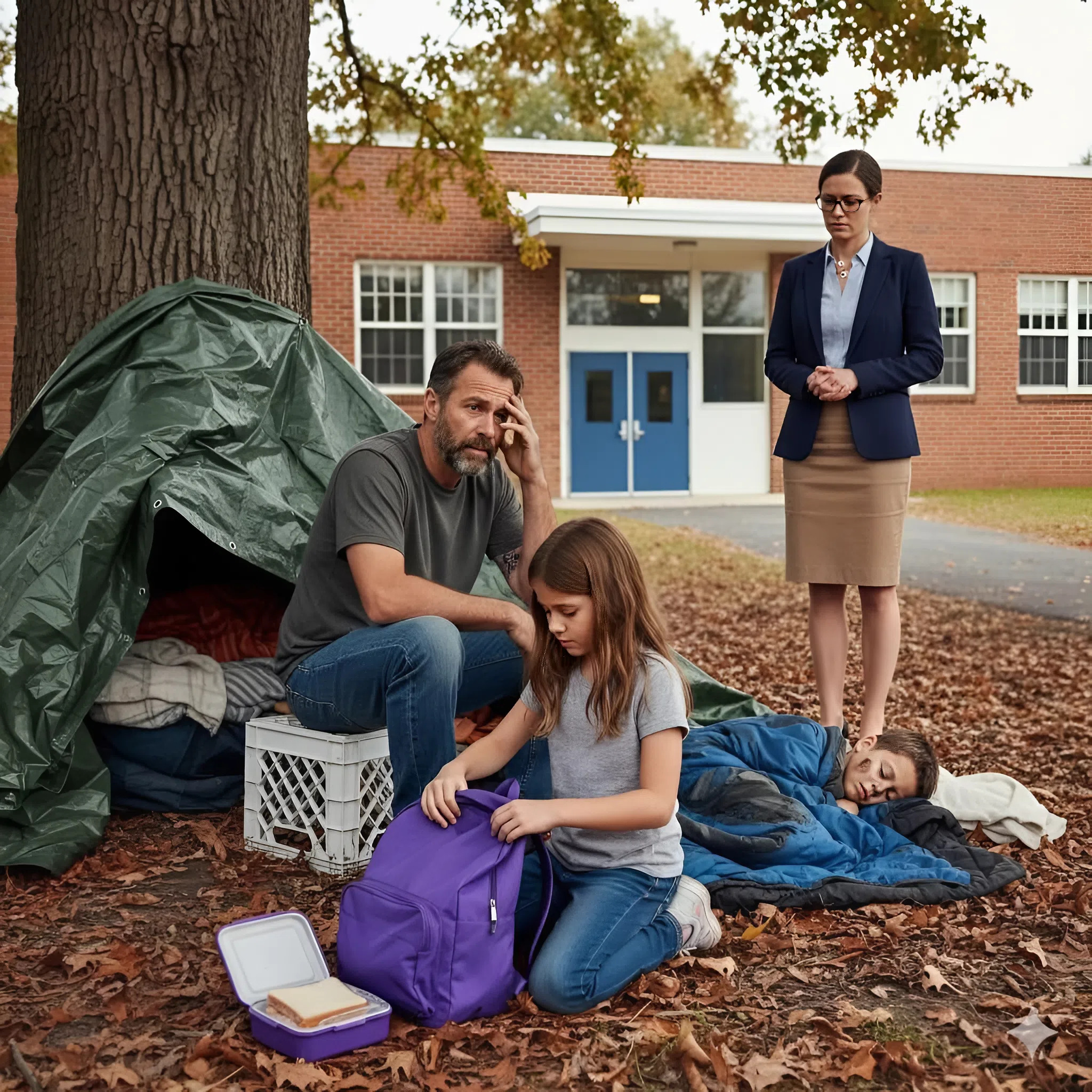
The bell rang, signaling the end of recess at Oakwood Elementary School, its familiar tone marking the end of lunch. I, Rebecca Collins, stood at my classroom door, watching my second graders slowly return, bringing with them the faint scent of chocolate milk and peanut butter sandwiches.
Nineteen, twenty, twenty-one…
One missing.
Lily Parker.
Again.
I glanced at my watch. For the third time this week. The last two times, I found her in the library, where she claimed to have lost track of time while reading. But the librarian told me she hadn’t been there yesterday.
“Katie, could you lead the class in silent reading while I step out?” I asked my assistant, a serious little girl with tortoiseshell glasses.
“Yes, Miss Collins!” she replied, beaming with joy at the responsibility.
I stepped out into the hallway, my dark blue ballet flats clicking softly on the waxed linoleum. The October chill seeped through the old school windows, and I pulled my sweater tighter around me. Three years of widowhood had made me hypersensitive to absence—to the feeling that someone or something should be there but isn’t.
Something was wrong with Lily.
I checked the girls’ restrooms, the water fountains, and then headed for the cafeteria. The cooks were already mopping the floor.
“Marjorie, have you seen Lily Parker? She has dark hair and a purple backpack,” I asked.
“The quiet one with the big eyes?” she replied. “I haven’t seen her since lunch started. Come to think of it, she doesn’t eat much. She takes a tray, but she just tosses it around.”
I felt guilty. I noticed that she was just pushing her food around instead of eating it. I thought it was typical for children—upheaval at home, a new baby, maybe arguments between her parents.
The playground outside was almost empty. I looked at the swings, the climbing frames, the asphalt. No sign of Lily. I was about to give up when a purple flash caught my eye—the corner of a backpack sliding down the side of the building toward the small forest behind the school.
My heart started racing. Students weren’t allowed to go there alone.
I ran across the asphalt, torn between fear of overreacting and a heavy feeling in my stomach. Lily had always been one of my brightest students: focused, kind, willing to please – until recently.
I slowed down when I reached the trees, not wanting to scare her. About fifty meters ahead of me, I saw her—Lily, with her purple backpack bouncing as she walked along the narrow forest path between the maple trees. I hesitated. Following a student off school grounds without telling anyone wasn’t in the handbook. Neither was letting a seven-year-old wander through the woods alone.
I quickly texted the school secretary:
Checking on Lily Parker after school. Will be back in 10 minutes.
Then I followed her—keeping far enough away that she wouldn’t notice me, but close enough that I wouldn’t lose sight of her purple backpack. The woods weren’t dense, just a buffer between the school and the neighboring neighborhood, but dense enough that the building soon disappeared behind the trees.
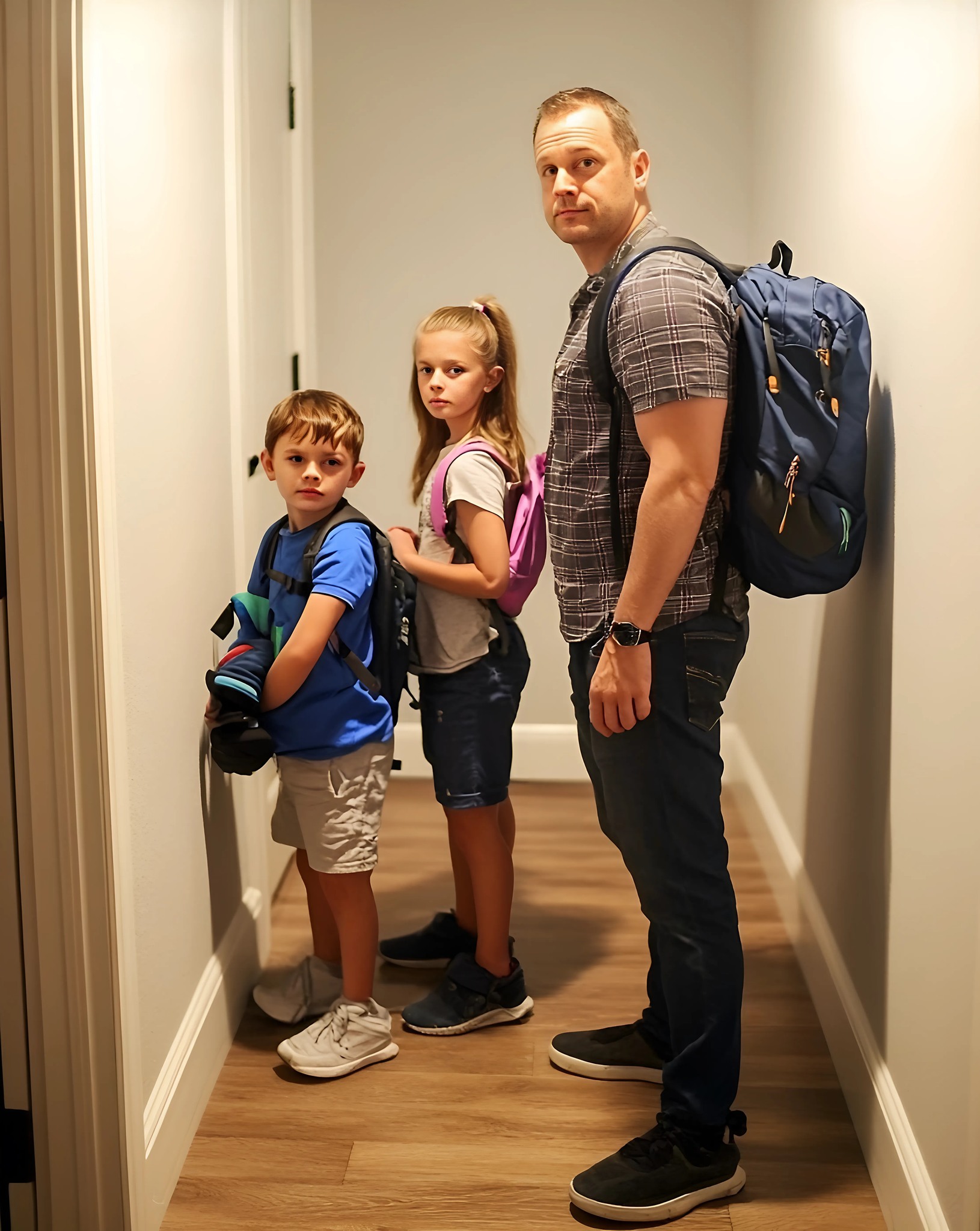
Lily stopped by a large oak tree, looked around, then knelt down and unzipped her backpack. I hid behind the tree trunk and felt strangely like a spy.
She took out her lunch box and carefully opened it. Inside was the same lunch I had seen her pack and which she hadn’t eaten: a sandwich, an apple, carrots, pudding. My heart sank. Hadn’t she eaten at school?
She closed the box, put it in her front pocket, and continued on her way.
I followed her. The trees parted to reveal a small clearing by a narrow stream. The sight stopped me in my tracks.
There was a makeshift shelter by the bank—tarps, an old tent, pieces of wood. A man sat hunched over on an overturned milk crate, his head in his hands. Next to him, a little boy—about four years old—was sleeping on a worn sleeping bag, his face red as a lobster.
“Daddy?” Lily called. “I brought lunch. Is Noah feeling better?”
The man looked up, and I noticed the dark circles under his eyes, the stubble on his cheeks, and an exhaustion that ran deeper than just a lack of sleep. His posture and features suggested that he hadn’t always lived like this.
“Hi, sweetheart,” he said in a hoarse voice. “He still has a fever. I’m running out of Tylenol.”
Lily knelt beside him and unzipped her backpack. “I brought lunch. And they had chocolate pudding today!” she said, proudly handing it to him.
His face twisted for a moment, but then relaxed. “That’s great, sweetie. But you should eat it. You need to eat to have energy for school.”
“I’m not hungry,” she insisted. “Noah likes pudding. Maybe it will help.”
“Lily,” he said gently. “You haven’t been hungry for two weeks.”
I stepped forward, leaves crunching under my shoes.
“Lily?”
She turned and paled. The man quickly got up and stood between me and the sleeping boy.
“Miss Collins,” Lily whispered. “I… I just…”
“It’s okay,” I said quietly, trying to keep my voice calm. I turned to the man. “I’m Rebecca Collins. I’m Lily’s teacher.”
He watched me cautiously. Up close, I could see that his clothes were dirty but had once been expensive. His watch had stopped, but it was a good watch.
“Daniel Parker,” he said finally. “Lily’s father.”
He pointed to the boy. “This is Noah. My younger son.”
I looked at the child—his cheeks were red, and he was breathing quickly and shallowly.
“Lily brought you lunches from school,” I said quietly.
Daniel closed his eyes for a moment. “I told her she had to eat. But she doesn’t listen to me.”
“Dad needs it more,” Lily protested. “And Noah too.”
“When you get home?” I repeated, looking around the clearing. “Is this your home now?”
He hesitated.

“For now, yes,” he admitted. “It’s… temporary.”
I wanted to ask a lot of questions, but Noah’s irregular breathing caught my attention.
“How long has he had a fever?” I asked.
“Three days,” Daniel replied. “It started as a cold. It keeps getting worse. I give him medicine whenever I can.”
I stepped closer and gently placed my hand on Noah’s forehead. His skin was burning hot.
“This isn’t just a cold,” I said. “He needs a doctor.”
“We don’t have insurance anymore,” Daniel said hoarsely. “I can’t…”
“Will Noah be okay?” Lily’s eyes filled with tears.
“He will,” Daniel said, kneeling down and placing his hands on her shoulders. “He just needs some rest.”
As I watched their interaction, I saw a caring father trying his best, not a man who didn’t care. It wasn’t indifference. It was exhaustion.
“Mr. Parker,” I said. “I’ll call for help.”

Panic flashed in his eyes. “Please don’t. They’ll take my children. I already lost my wife. I can’t lose them too.”
“Who will take them?” I asked quietly.
“Social services. We lost our house. Emma died six months ago. Heart defect. Medical bills, funeral… I couldn’t handle it.” He ran his hand over his face. “I looked for work, but with Noah sick, shelters refuse us or are full…”
He paused and swallowed. “Please. We just need time.”
I looked at Noah’s red face and Lily’s thin shoulders. Lily’s words, “I eat at home,” echoed in my head.
“Noah needs treatment,” I said firmly. “We don’t have time.”
He bowed his head. “They’ll separate us.”
“I’ll do everything in my power to prevent that,” I promised, surprising myself with how convincing it sounded. “But we can’t leave him like this.”
I took a few steps aside and called 911. While I was talking to the dispatcher, I watched Daniel stroke Noah’s hair, his hands shaking.
“The ambulance is on its way,” I said, putting the phone in my pocket.

“Thank you,” he mumbled. “For seeing us.”
A few minutes later, the paramedics arrived, brought by the school guard. They took Noah’s temperature—40°C—and loaded him into the ambulance.
“You can go with him, Dad,” said the lead paramedic.
“What about Lily?” Daniel asked, his eyes wild.
“I’ll bring her,” I said quickly. “I’ll follow you to the hospital.”
Relief washed over his face. “Thank you,” he repeated.
I led Lily back into the trees as the ambulance drove away.
“Are they taking Noah and Daddy away?” she asked in a quiet voice.
I stopped and knelt down so we were at the same level.
“I’ll do everything in my power to keep your family together,” I told her. “Everything.”
At the time, I didn’t fully realize how big a promise that was—or how much it would cost me.
As we entered the emergency room at Memorial Hospital, we smelled the scent of disinfectant.
“I don’t like hospitals,” Lily whispered, looking at the chairs and IV stands.
“Me neither,” I admitted quietly, remembering the nights spent in the oncology ward, holding John’s hand while chemotherapy dripped into his veins.
We found them in pediatrics, in room 412. Noah was lying in bed, pale and small, with an IV in his hand. Daniel stood next to him, listening to the doctor.
“This is Miss Collins,” Daniel said as we entered. “Lily’s teacher.”
“Dr. Patel,” he introduced himself. “Noah has pneumonia. We’ve started him on antibiotics and IV fluids. Children usually recover quickly from this, but he’ll need to stay in the hospital for a few days.”
“Thank you,” I said.
After the doctor left, Daniel whispered, “If you hadn’t found us…”
“Anyone would have done the same,” I replied.
“No,” he said quietly. “Most would have called the authorities and stayed away. You came with us.”
Before I could answer, an elegantly dressed woman entered the room.
“Mr. Parker? I’m Vanessa Morales from hospital social services,” she introduced herself. “I understand you are homeless.”
“It’s temporary,” Daniel said immediately. “I’m looking for a job. After my wife died, we found ourselves in a difficult situation.”
Vanessa nodded and checked her notepad. “We still have to notify social services. Living on the streets with small children is considered dangerous, especially with winter approaching.”

“Are you going to take us away from Daddy?” Lily asked, squeezing my hand.
“No one is taking you anywhere right now,” I said, looking meaningfully at Vanessa. “Your dad is here. Your brother is in care. That’s what matters.”
Outside the room, Vanessa spoke quietly.
“You care about this family. I can see that. But you can’t make promises you can’t keep,” she said. “CPS may decide that foster care is the safest option.”
“He’s not abusing them,” I argued. “He’s a widower who lost everything. That’s different.”
“I know,” she said quietly. “But the system treats risk the same, regardless of intent.”
“Is there any chance CPS will let them stay together?” I asked. “If Daniel had a stable place to live?”
“That would definitely help,” she said. “Housing, food, some kind of plan—all of that strengthens his case.”
As she spoke, an idea came to me.
“I have a two-bedroom apartment,” I said. “The second bedroom is empty. They could stay with me temporarily until he finds a job. It’s close to school, safe, and clean.”

She blinked. “Are you offering to take in the whole family?”
“Yes.”
“That’s… very unusual,” she said.
“So is a seven-year-old girl skipping lunch to feed her father and brother,” I replied. “The foster care system is overwhelmed. You know that siblings are sometimes separated. If they stay with me, they’ll stay together.”
Vanessa looked at me for a long time. “I can’t approve this on my own. But I can recommend a temporary solution—sixty days, regular home visits, and clear conditions.”
“That’s something,” I said.
The next morning, I went to Principal Washburn’s office. She didn’t waste any time.
“Rebecca,” she said, folding her arms. “You left school grounds without proper permission, interfered in a student’s private life, and went to the hospital. Do you understand the legal implications of that?”
“With all due respect, Noah could have died,” I said. “Waiting for paperwork was not an option.”
She sighed. “CPS called this morning. They have concerns about your… level of involvement.”
“I promised Lily I would help her,” I said.
“You’re her teacher,” she snapped, “not her social worker. Not her guardian. I’m giving you a written warning. And Lily will be transferred to Miss Peterson’s class.”
“What?” I couldn’t believe it. “You’re removing her from my class now?”
“It’s a conflict of interest,” she replied. “You’ve crossed the line. I recommend you stay on the right side from now on.”
Jade Wilson, a CPS worker, met us later in the hospital hallway.
“I recommend temporary emergency foster care,” she said bluntly.
“No,” I protested. “Please. They’ve lost enough already.”
“If Mr. Parker had stable housing—today—it would be different,” she said. “But at this moment, he doesn’t.”
“He does,” I replied. “My place. They can stay with me.”
Jade looked surprised, then skeptical. “Ms. Collins, taking in an entire family is a big responsibility. Are you sure?”
“Yes,” I said. “I’ve thought it through. I can handle it for sixty days. Then we’ll reevaluate.”
She hesitated, then nodded. “I’ll write it up as a supervised placement within the family. It’s unorthodox, but better than splitting them up.”
“I’m taking a short leave of absence from school,” I told Daniel as we sat in the family room at the hospital.
“For us,” he said quietly.
“It’s logistics. It will work better if I’m there,” I replied. “Besides, after everything that’s happened, I need time just as much as you do.”
He thought about it. “In the twelve years you’ve been teaching, there must have been other children in difficult situations. Why us?”
“When my husband died,” I said slowly, “people helped me. They brought me food, sat with me, filled out endless forms. Even so, I barely managed. You’re trying to do all that and raise two children without anyone to help you.”
He swallowed.
“Maybe I see too much of myself in your situation,” I admitted. “Someone helped me once. I can’t pretend I don’t see what you’re going through right now.”
He nodded, his eyes filling with tears. “We won’t stay a day longer than we have to.”
“Take as much time as you need,” I said. “You don’t have to prove anything to me.”
But he did—to himself.
Six months later, on a bright June afternoon, I stood in the driveway of a modest colonial house on Oak Lane. Daniel and my brother were carrying boxes inside. Lily was directing traffic. Noah was chasing a golden retriever puppy across the lawn.
Just before Christmas, the wrongful foreclosure dispute we had encouraged Daniel to pursue was settled. That, combined with his steady job at the hospital, was enough for the Parkers to buy their own house.
They spent the intervening months in a small apartment, rebuilding their routine, going to therapy, saving money, and recovering. In January, I returned to teaching. Lily remained in Miss Peterson’s class; our relationship changed from teacher-student to something… deeper.
Daniel and I found time between our responsibilities to meet for coffee, quiet conversations, and shared grief. Something gentle and patient grew between us.
“We’ve moved everything,” Daniel called out, wiping his forehead as he descended the path. “Next step: survive unpacking.”
“It’s really yours,” I said, looking at the finished flower beds, bikes, and porch. “Your home.”
“Our home,” he corrected me gently and put his arm around my waist.
“Miss Rebecca!” Noah called, running toward me, Rex jumping at his side. “Can we put the stars and dinosaurs on my wall now?”
“After lunch,” I laughed. “Decorating takes energy.”
“It’s already cozy,” Lily said firmly, joining us. “Because we’re all here.”
Her simple wisdom made my throat tighten. Home isn’t walls. It’s the people you choose to be with.
“Are you coming in?” Daniel asked, reaching his hand out from the doorway.
I intertwined my fingers with his and crossed the threshold.
“Yes,” I said. “I’m going home.”
On the day I followed a lost little girl into the woods and called an ambulance for her brother, I thought I was just doing my job. I had no idea I was being given a second chance.
By trying to save Noah, I helped save his family from falling apart—and without realizing it, I changed my life from mere survival to something like joy.
Sometimes the most important decisions in life don’t come from following the rules.
They come from following your heart.