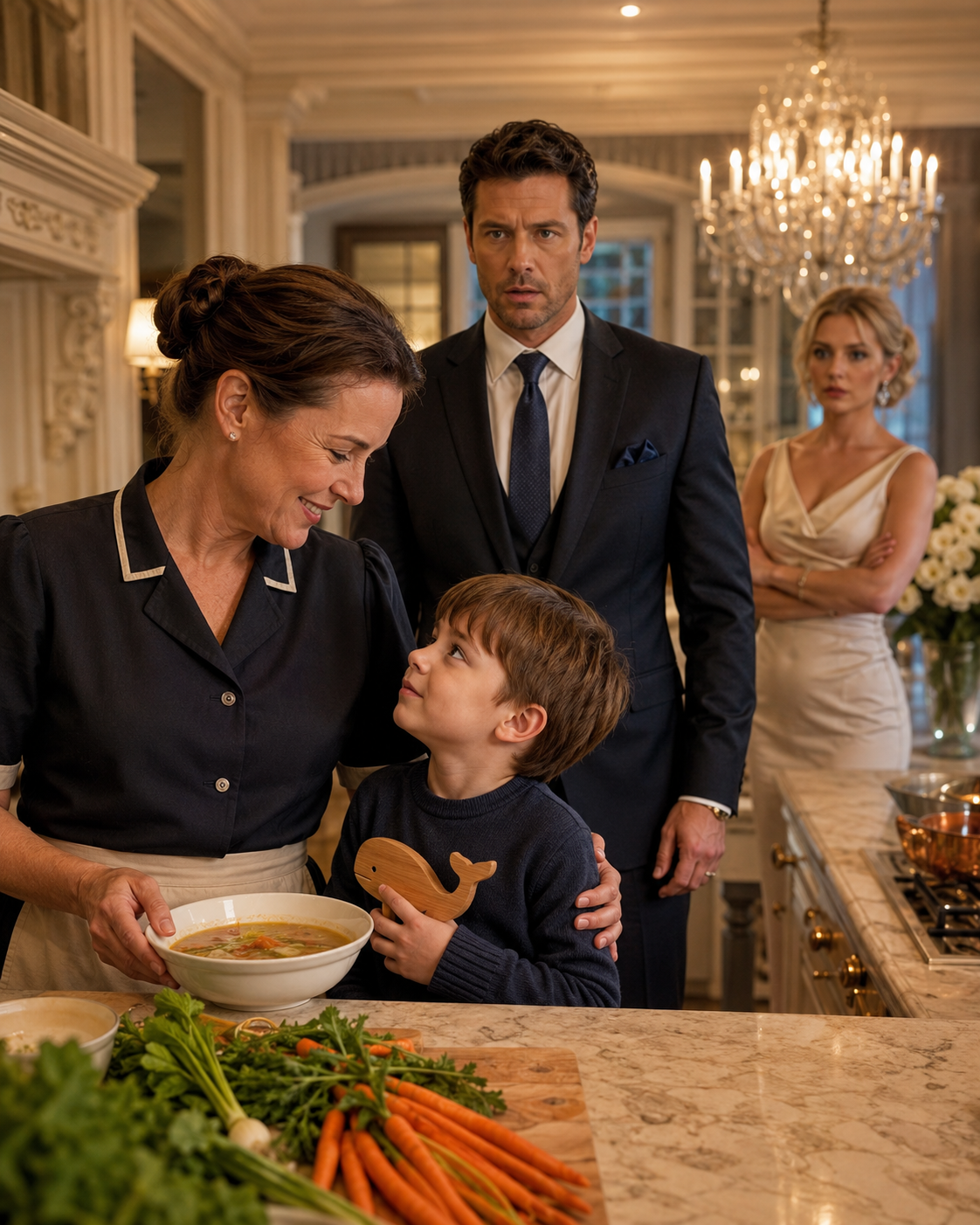
She learned which windows stuck after rain. Which pantry door creaked. Which plants Natalie had chosen herself. Which staff members were nervous around Sabrina. Which rooms Oliver avoided.
And most importantly, she learned Oliver.
She never forced him to speak.
She never asked, “Why are you so quiet?”
She never said, “Your father is worried.”
She never treated his silence like a problem to be solved quickly so the adults could feel comfortable.
Instead, Marian simply appeared every day in the kitchen.
At breakfast, she hummed softly while slicing fruit.
At lunch, she told small stories about ordinary things: a neighbor’s stubborn cat, a soup that once boiled over, her grandmother’s habit of hiding peppermints in apron pockets.
At dinner, she described recipes as if they were adventures.
“Carrots are shy,” she once said while chopping vegetables. “They need time before they become sweet.”
Oliver, seated at the far end of the kitchen counter, looked up.
Marian continued as if she had not noticed.
“Onions are dramatic. They make everyone cry, then become delicious. Very unfair of them.”
For the first time in weeks, Oliver’s mouth twitched.
Not a smile.
Almost.
Marian accepted it like a gift.
Days became weeks.
Oliver began visiting the kitchen more often. He watched Marian roll dough, rinse rice, stir soup, peel apples, and fold napkins. Sometimes he sat with his wooden whale, a small toy Marian had found in a drawer and polished for him.
She called it Captain Blue.
Oliver never said the name aloud, but he kept the whale with him.
One rainy afternoon, Marian was making apple tart. The whole kitchen smelled of butter, cinnamon, and warm fruit. Oliver sat at the counter, his small hands wrapped around a cup of milk he had not touched.
Marian peeled an apple slowly.
“My mother made this when the weather was ugly,” she said.
Oliver watched the curl of apple skin fall onto the cutting board.
“She used to say a house needed something sweet on sad days.”
Oliver’s fingers tightened around the cup.
Marian kept her voice gentle.
“She believed people leave little pieces of themselves behind. In recipes. In songs. In habits. In the way we fold towels or make tea.”
Oliver’s eyes lifted.
The rain tapped against the window.
For a long while, there was only the sound of the knife moving through fruit.
Then Oliver whispered, so quietly Marian nearly thought she imagined it.
“What pieces?”
Marian’s hand stopped.
Her heart rose into her throat.
But she did not gasp. She did not cry out. She did not rush from the room to call Ethan. She understood fragile things. A frightened child might retreat if everyone stared at the miracle too hard.
So she simply placed the apple slice into the bowl and answered.
“Memories.”
Oliver looked at the tart.
“Stories,” she added. “Favorite breakfasts. Funny mistakes. Love that stays, even when a person cannot.”
Oliver lowered his gaze.
“My mommy made pancakes with faces.”
Marian swallowed carefully.
“I think those must have been very important pancakes.”
Oliver nodded.
And just like that, after more than a year of silence, a conversation began.
That evening Ethan came home late, exhausted from negotiations he barely remembered attending. He entered the dining room expecting the usual scene: untouched food, worried servants, Sabrina pretending concern, Oliver staring at his plate.
Instead, his son was eating.
Not pushing food around.
Not hiding bites in a napkin.
Eating.
Slowly, but truly.
Ethan stopped so suddenly that the butler nearly walked into him.
Oliver sat beside Marian, who stood respectfully near the sideboard. A bowl of vegetable stew steamed in front of him.
Sabrina was at the other end of the table, her smile stiff.
“What is this?” Ethan whispered.
Marian looked at him with quiet warmth.
“Oliver helped make dinner.”
Ethan stared at his son.
Oliver lifted his spoon, then glanced at his father.
“I washed the carrots.”
The briefcase slipped from Ethan’s hand and landed against his leg.
For a second, he could not breathe.
Three words.
Only three.
But to Ethan they were sunrise after the longest winter of his life.
“Oliver,” he said, his voice cracking.
The boy looked uncertain, as if he feared he had done something wrong.
Ethan crossed the room and knelt beside him.
“You washed the carrots?”
Oliver nodded.
Ethan pressed one hand over his mouth. His eyes filled before he could stop them.
“I’m proud of you,” he whispered.
Oliver looked down at his bowl.
Then, after a pause, he took another spoonful.
From that evening, something began to change.
Not quickly.
Not magically.
But steadily.
Oliver spoke in small pieces. A word at breakfast. Two at lunch. A question in the kitchen. A memory before bed.