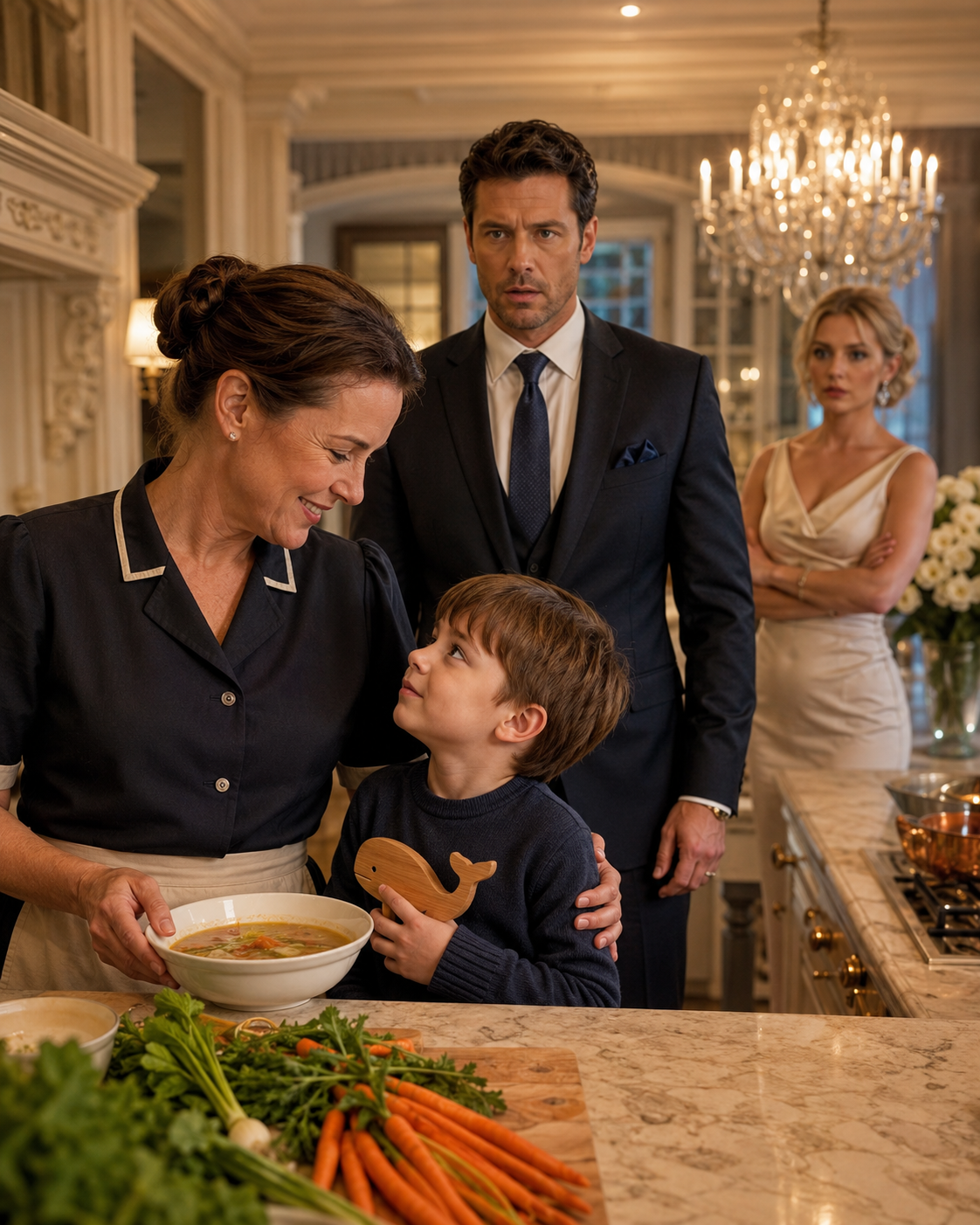
The house was enormous.
Polished marble floors. Crystal chandeliers. Tall windows. A dining room large enough to seat thirty guests. A garden designed by one of the most expensive landscape architects in the country.
From the outside, everything about Whitmore House looked perfect.
But Ethan knew the truth.
The house had stopped feeling like a home the day his wife, Natalie, died.
Nearly fourteen months had passed since the accident, yet the silence she left behind still lived in every hallway. It waited for him in the nursery she had decorated by hand. It followed him into the dining room where she used to laugh across the table. It sat beside him at night when he signed contracts he no longer cared about.
But the worst silence did not come from the empty rooms.
It came from his son.
Oliver was five years old. Before Natalie died, he had been the kind of child who filled every corner of the house with noise. He asked questions about clouds, dinosaurs, elevators, moonlight, cars, birds, soup, shoes, and why grown-ups used such boring words. He used to run into Ethan’s office with a toy truck in one hand and a drawing in the other, demanding that his father stop working and admire both.
Then Natalie was gone.
And something inside Oliver closed.
At first, everyone said it was grief.
Then they called it trauma.
Then one specialist quietly used the words selective mutism.
Oliver still understood everything. He still followed instructions. He still looked at people when they spoke to him, though sometimes only for a second.
But he rarely spoke.
And he barely ate.
Every meal became a quiet defeat. The cook prepared his favorites. Doctors recommended routines. Therapists suggested patience. Ethan tried everything. Pancakes. Broth. little star-shaped sandwiches. Warm milk with honey. Gentle encouragement. Silence. Bribes. Stories. Familiar songs.
Nothing worked.
Oliver would stare at the food, move it once with his fork, then whisper, if he spoke at all, “Finished.”
That one word broke Ethan more than any business failure ever could.
Because every time Oliver refused to eat, Ethan remembered Natalie standing in the kitchen in her blue robe, making breakfast while Oliver sat on the counter, giggling because she let him stir batter with both hands.
Food had become memory.
And memory had become pain.
A few months after Natalie’s death, Ethan met Sabrina Vale at a charity auction.
She was elegant, intelligent, and impossibly polished. She knew exactly when to smile, when to lower her voice, and how to make grief feel less awkward in a crowded room. At first, Ethan was grateful for her presence. She seemed patient. Calm. Capable of handling the strange, quiet life he had been living.
The world loved her immediately.
Newspapers called her graceful. Friends called her a blessing. Staff members said she brought warmth back into the mansion.
Ethan wanted to believe them.
Soon Sabrina was spending more time at Whitmore House. Then she moved in. Then people began to speak of her as his future wife.
In front of Ethan, she was careful with Oliver.
“My sweet boy,” she would say, kneeling beside him with a smile that belonged in a magazine. “You don’t have to talk until you’re ready.”
But when Ethan was not in the room, her kindness thinned.
“You are not a baby,” she once said while Oliver sat frozen at the breakfast table. “Your father has suffered enough. Stop making everything harder.”
Oliver lowered his eyes.
Sabrina sighed as if his sadness were an inconvenience.
The staff heard things. They saw things. But Sabrina was soon to be mistress of the house, and nobody wanted trouble.
Then Marian Cole arrived.
She was not glamorous. She was not young enough to make society women nervous or polished enough to impress guests. She was forty-six, soft-spoken, practical, and plain in the way people become when life has taught them not to waste energy pretending.
She came highly recommended by a retired judge and his wife, whose grandchildren she had helped raise.
“I don’t specialize in luxury homes,” Marian told Ethan during the interview. “I specialize in houses that need peace.”
Ethan almost smiled for the first time that week.
“You may find this house difficult,” he said.
Marian looked around the grand sitting room, not with awe, but with understanding.
“Most difficult houses are only grieving houses,” she replied.
Ethan hired her the next morning.
Sabrina disliked her almost immediately.
Not openly, of course. Sabrina never showed dislike when witnesses mattered. She simply inspected Marian’s references twice, corrected the way she arranged linen, questioned her schedule, and made small remarks that sounded polite until you listened closely.
Marian did not react.
She learned the house.
She learned which windows stuck after rain. Which pantry door creaked. Which plants Natalie had chosen herself. Which staff members were nervous around Sabrina. Which rooms Oliver avoided.
And most importantly, she learned Oliver.
She never forced him to speak.
She never asked, “Why are you so quiet?”
She never said, “Your father is worried.”
She never treated his silence like a problem to be solved quickly so the adults could feel comfortable.
Instead, Marian simply appeared every day in the kitchen.
At breakfast, she hummed softly while slicing fruit.
At lunch, she told small stories about ordinary things: a neighbor’s stubborn cat, a soup that once boiled over, her grandmother’s habit of hiding peppermints in apron pockets.
At dinner, she described recipes as if they were adventures.
“Carrots are shy,” she once said while chopping vegetables. “They need time before they become sweet.”
Oliver, seated at the far end of the kitchen counter, looked up.
Marian continued as if she had not noticed.
“Onions are dramatic. They make everyone cry, then become delicious. Very unfair of them.”
For the first time in weeks, Oliver’s mouth twitched.
Not a smile.
Almost.
Marian accepted it like a gift.
Days became weeks.
Oliver began visiting the kitchen more often. He watched Marian roll dough, rinse rice, stir soup, peel apples, and fold napkins. Sometimes he sat with his wooden whale, a small toy Marian had found in a drawer and polished for him.
She called it Captain Blue.
Oliver never said the name aloud, but he kept the whale with him.
One rainy afternoon, Marian was making apple tart. The whole kitchen smelled of butter, cinnamon, and warm fruit. Oliver sat at the counter, his small hands wrapped around a cup of milk he had not touched.
Marian peeled an apple slowly.
“My mother made this when the weather was ugly,” she said.
Oliver watched the curl of apple skin fall onto the cutting board.
“She used to say a house needed something sweet on sad days.”
Oliver’s fingers tightened around the cup.
Marian kept her voice gentle.
“She believed people leave little pieces of themselves behind. In recipes. In songs. In habits. In the way we fold towels or make tea.”
Oliver’s eyes lifted.
The rain tapped against the window.
For a long while, there was only the sound of the knife moving through fruit.
Then Oliver whispered, so quietly Marian nearly thought she imagined it.
“What pieces?”
Marian’s hand stopped.
Her heart rose into her throat.
But she did not gasp. She did not cry out. She did not rush from the room to call Ethan. She understood fragile things. A frightened child might retreat if everyone stared at the miracle too hard.
So she simply placed the apple slice into the bowl and answered.
“Memories.”
Oliver looked at the tart.
“Stories,” she added. “Favorite breakfasts. Funny mistakes. Love that stays, even when a person cannot.”
Oliver lowered his gaze.
“My mommy made pancakes with faces.”
Marian swallowed carefully.
“I think those must have been very important pancakes.”
Oliver nodded.
And just like that, after more than a year of silence, a conversation began.
That evening Ethan came home late, exhausted from negotiations he barely remembered attending. He entered the dining room expecting the usual scene: untouched food, worried servants, Sabrina pretending concern, Oliver staring at his plate.
Instead, his son was eating.
Not pushing food around.
Not hiding bites in a napkin.
Eating.
Slowly, but truly.
Ethan stopped so suddenly that the butler nearly walked into him.
Oliver sat beside Marian, who stood respectfully near the sideboard. A bowl of vegetable stew steamed in front of him.
Sabrina was at the other end of the table, her smile stiff.
“What is this?” Ethan whispered.
Marian looked at him with quiet warmth.
“Oliver helped make dinner.”
Ethan stared at his son.
Oliver lifted his spoon, then glanced at his father.
“I washed the carrots.”
The briefcase slipped from Ethan’s hand and landed against his leg.
For a second, he could not breathe.
Three words.
Only three.
But to Ethan they were sunrise after the longest winter of his life.
“Oliver,” he said, his voice cracking.
The boy looked uncertain, as if he feared he had done something wrong.
Ethan crossed the room and knelt beside him.
“You washed the carrots?”
Oliver nodded.
Ethan pressed one hand over his mouth. His eyes filled before he could stop them.
“I’m proud of you,” he whispered.
Oliver looked down at his bowl.
Then, after a pause, he took another spoonful.
From that evening, something began to change.
Not quickly.
Not magically.
But steadily.
Oliver spoke in small pieces. A word at breakfast. Two at lunch. A question in the kitchen. A memory before bed.
He began eating more. He asked Marian if peas were shy too. He told Ethan that Captain Blue preferred soup over sandwiches. Once, while standing in the garden, he laughed because a squirrel dropped an acorn into a fountain.
Ethan heard that laugh from his office and nearly broke down at his desk.
The doctors were astonished.
The therapists were careful not to call it a cure, but even they admitted that Oliver’s progress was remarkable.
Ethan began coming home earlier.
He spent more evenings in the kitchen than the dining room. He listened while Marian helped Oliver stir batter or count potatoes. Sometimes he found himself standing in the doorway simply watching his son live again.
And with every bit of life that returned to Oliver, something colder appeared in Sabrina.
At first, it was subtle.
A tightened jaw when Ethan praised Marian.
A sharp glance when Oliver chose to sit near the housekeeper.
A small complaint about “boundaries.”
Then the comments became harder to ignore.
“She is only staff,” Sabrina said one night after Oliver went to bed.
Ethan looked up from his tea.
“Marian?”
“Who else?” Sabrina’s smile was thin. “I admire what she has done, of course. But Oliver is becoming attached in a way that may not be healthy.”
“He is speaking again.”
“He should be speaking to us.”
“He does.”
Sabrina placed her cup down.
“He speaks to her first.”
Ethan studied her face.
For the first time, he noticed what he had been too relieved to see before.
Sabrina was not grateful.
She was resentful.
The next afternoon, Marian stepped into the garden to gather herbs and heard Sabrina’s voice near the fountain. She was speaking on the phone, low and sharp.
“No, he doesn’t see it yet.”
Marian froze behind the rosemary hedge.
Sabrina paced slowly.
“She is becoming a problem. Oliver trusts her. Ethan trusts her. If this continues, everything becomes complicated.”
A pause.
Then Sabrina said, “I will handle it.”
Marian’s skin went cold.
She backed away quietly and returned to the kitchen.
That evening Sabrina confronted her.
It happened in the hallway outside the laundry room. No servants nearby. No Ethan. No Oliver.
“You have made yourself very comfortable here,” Sabrina said.
Marian folded a towel and placed it into the basket.
“I do my work, Miss Vale.”
“No,” Sabrina replied. “You do more than your work.”
Marian met her eyes.
“Oliver needed patience.”
“Oliver is not your child.”
“I never claimed he was.”
“But you behave as if you belong in this family.”
The words were soft, but the meaning was clear.
Marian’s voice remained calm.
“I belong wherever I am useful.”
Sabrina stepped closer.
“You were hired to keep a house, not to become the heart of it.”
For a moment, neither woman moved.
Then Marian picked up the basket.
“Good night, Miss Vale.”
As she walked away, she knew the truth.
Sabrina did not see her as an employee anymore.
She saw her as an obstacle.
A week later, Ethan left for a three-day business trip.
He almost canceled. Oliver had been doing well, but Ethan still hated leaving him. Sabrina insisted everything would be fine.
“You cannot build your life around one child’s moods forever,” she said, then softened her tone when Ethan looked at her. “I mean, he needs consistency. I will make sure he has it.”
Marian watched Ethan’s car disappear down the driveway and felt dread settle in her stomach.
By lunch, Sabrina stopped pretending.
She criticized the soup.
She complained about the kitchen schedule.
She told Oliver he was too old to sit near the counter while Marian cooked.
At dinner, when Oliver asked softly whether Marian could make pancakes the next morning, Sabrina set down her fork.
“You are not to make demands of staff,” she said.
Oliver went silent.
Marian saw his shoulders tighten.
The next morning, Sabrina summoned Marian to the small office near the west wing.
The curtains were open. Sunlight fell across the desk. An envelope sat in the center of it.
Sabrina did not ask her to sit.
“Pack your things.”
Marian stared at her.
“I’m sorry?”
“You are dismissed.”
For several seconds, the words made no sense.
“Mr. Whitmore did not approve this.”
Sabrina’s smile was cold.
“Mr. Whitmore left household decisions to me.”
“Not decisions involving Oliver.”
“Especially decisions involving Oliver.”
Marian’s chest tightened.
“Please think carefully.”
“I have.” Sabrina pushed the envelope forward. “Two weeks’ pay. I expect you gone within the hour.”
Marian looked at the envelope, then back at Sabrina.
“You know this will hurt him.”
Sabrina’s expression barely changed.
“Children recover.”
“That is not always true.”
“Do not lecture me about children.”
Marian understood then that argument would not help. Sabrina had not acted in anger alone. This had been planned.
So she left the office with her dignity intact and her heart breaking.
When Marian entered the kitchen to gather the few personal items she kept there, Oliver was waiting.
He knew.
Children always know when the air changes.
His wooden whale was clutched in both hands.
“Are you going away?”
Marian knelt in front of him.
“Only for now.”
His face went pale.
“No.”
The word shook.
“Please don’t.”
Marian closed her eyes for one second, because seeing his fear was almost more than she could bear.
“I need you to remember something,” she said softly. “You did nothing wrong.”
Oliver’s eyes filled.
“Was I bad?”
“No, sweetheart. Never.”
He stepped into her arms.
She held him tightly. She wanted to promise she would stay, but she refused to lie to him. So instead she slipped a small recipe card beneath Captain Blue’s ribbon. On one side was the vegetable stew he liked. On the other, a message simple enough for him to understand whenever he felt alone.
Then she kissed the top of his head and left.
By evening, the mansion was silent again.
Oliver refused dinner.
The next morning, he refused breakfast.
By the second day, he stopped answering even Ethan’s calls.
When Ethan returned, he expected to find his son in the kitchen, perhaps waiting to tell him about carrots or pancakes or Captain Blue’s newest adventure.
Instead, he found Oliver sitting on the bottom stair.
Silent.
Pale.
Empty-eyed.
The wooden whale rested in his lap.
Every bit of progress had vanished.
Ethan’s blood turned cold.
“Oliver?”
No answer.
He knelt.
“Buddy?”
Oliver stared at the floor.
Ethan looked toward Sabrina, who stood near the dining room entrance in a cream dress, elegant as always.
“What happened?”
Sabrina sighed.
“He had a setback.”
“This is not a setback.”
“He is emotional. Children are unpredictable.”
Ethan rose slowly.
“When did this start?”
Sabrina hesitated.
Just half a second.
But Ethan noticed.
“A few days ago,” she said.
A strange instinct sharpened inside him. He had built an empire by hearing the difference between truth and performance. Somehow, he had ignored that difference in his own home.
Now he heard it clearly.
His gaze dropped to Oliver’s wooden whale.
A small card was tucked beneath its ribbon.
Ethan pulled it free.
On one side was a recipe.
On the other side, in Marian’s neat handwriting, were words that made his throat close.
When the house feels too quiet, remember this: your mother’s love did not leave you, your father’s love is still here, and you are braver than you think.
Ethan looked up.
“Where is Marian?”
Sabrina’s face hardened almost invisibly.
“I let her go.”
The words struck the room like shattered glass.
“You did what?”
“She crossed boundaries.”
“What boundaries?”
“She encouraged dependency. It was unhealthy.”
Ethan stared at her.
The answer sounded rehearsed.
Prepared.
Convenient.
“You fired the one person helping my son?”
Sabrina lifted her chin.
“I was protecting him.”
“No,” Ethan said.
The word echoed through the foyer.
For the first time since Natalie’s death, his voice held real anger.
“No, Sabrina. You were protecting yourself.”
Tears appeared in her eyes almost instantly.
“I have tried so hard to be part of this family.”
Ethan said nothing.
“I love you,” she whispered. “I love Oliver. I only wanted what was best.”
But Ethan had spent years watching people use emotion to cover lies. He recognized the performance too late, but he recognized it.
That night, he canceled everything.
No meetings. No calls. No dinner guests. No charity board conference.
He stayed home.
And he watched.
He watched how Sabrina spoke to Oliver when she thought he was distracted. He watched how quickly her patience vanished. He watched how she corrected small movements, dismissed small fears, and treated silence as rebellion.
Everything Marian had answered with gentleness, Sabrina answered with control.
By morning, Ethan needed facts.
He went first to the staff.
The gardener said Sabrina had argued with Marian several times.
The cook admitted Sabrina hated how often Oliver asked for Marian.
The driver, after a long silence, finally told Ethan the truth.
“Miss Vale was jealous, sir.”
Ethan frowned.
“Jealous?”
“She thought Master Oliver trusted Mrs. Cole more than he trusted her.”
The words should have sounded absurd.
Instead, they sounded painfully believable.
That afternoon, Ethan reviewed the mansion’s security footage.
At first, he found only ordinary images. Hallways. Servants. Deliveries. Sabrina entering the west office. Marian arriving. Marian leaving with a small box.
Then he saw Oliver.
The child ran down the corridor, crying silently on the screen. He reached Marian near the side entrance and wrapped his arms around her waist. Marian knelt, holding him, her own face twisted with grief.
In the background stood Sabrina.
Still.
Expressionless.
Watching a broken child beg the only person who had reached him not to leave.
And doing nothing.
Ethan closed his eyes.
His guilt was enormous.
He had failed to see the danger inside his own house.
But the worst truth came later that night.
Ethan was in his study, unable to sleep, when he heard a small voice from the doorway.
“Daddy?”
He froze.
Oliver stood there in pajamas, Captain Blue held against his chest.
Ethan pushed back his chair slowly.
“Come here, buddy.”
Oliver walked to him. Ethan lifted him into his lap as if he were something precious and easily shattered.
For a while, neither of them spoke.
Then Oliver whispered, “Did Marian do something wrong?”
Ethan’s heart broke all over again.
“No.”
Oliver’s eyes filled with confusion.
“Then why did Sabrina make her leave?”
Ethan smoothed his son’s hair.
“I don’t know yet.”
Oliver looked down at the wooden whale.
Then he said the sentence that changed everything.
“I heard her.”
Ethan went still.
“Heard who?”
“Sabrina.”
“When?”
“The day Marian left.”
Ethan kept his voice calm with effort.
“Where were you?”
“In the hallway closet. I was playing with Captain Blue.”
Ethan nodded.
“You’re not in trouble.”
Oliver swallowed.
“She was on the phone.”
Ethan’s pulse quickened.
“What did she say?”
Oliver’s fingers tightened around the toy.
“She said Marian was ruining everything.”
The study seemed to grow colder.
“What else?”
“She said if you kept looking at Marian like that…”
Oliver stopped.
Ethan waited, forcing himself not to interrupt.
Oliver whispered, “You might not want to marry her anymore.”
Ethan stared at him.
Oliver continued, his voice trembling.
“She was angry. Really angry. She said everything was almost hers.”
Ethan’s chest tightened.
Children sometimes misunderstood adult conversations.
But Oliver had always remembered words exactly.
“What happened then?”
Oliver’s eyes filled with tears.
“She said it would be easier if Marian was gone.”
A silence fell so heavily that even the clock seemed to stop.
Ethan held his son closer.
“It’s all right,” he murmured. “You told me the truth. You did the right thing.”
But inside, fear began to grow.
Fast.
Because this was no longer about jealousy.
It was no longer about a fiancée dismissing a housekeeper.
It was no longer even about a grieving child.
Something colder had entered his home wearing a beautiful face and speaking in a soft voice.
After Oliver finally fell asleep, Ethan went to Sabrina’s office.
He was not looking for revenge.
He was looking for proof.
At first, he found nothing.
Neat files. Receipts. Charity invitations. Wedding notes. Household schedules.
Then he noticed the bottom drawer of her desk.
Locked.
Sabrina kept the key hidden in a porcelain vase beside the window. Ethan had seen her use it once and forgotten until that moment.
The drawer opened.
Inside was a thick envelope.
Photographs slid across the desk.
Ethan picked one up.
His breath stopped.
Sabrina stood beside a man Ethan had never met. They were smiling in front of a hotel entrance. In another photo, the same man sat with her at a private table. In another, Sabrina held a folder while the man leaned close, whispering something.
Ethan turned the photograph over.
Five words were written on the back.
The Whitmore plan is working.
Ethan stared at the message.
A terrible realization began forming piece by piece.
Sabrina had not entered his life by accident.
She had not moved into his home because of love.
And Marian Cole had not been fired simply because a jealous woman disliked sharing a child’s trust.
Ethan looked toward the dark hallway leading to his son’s room.
For the first time, he understood that Oliver had not only found his voice again.
He may have saved them both.

