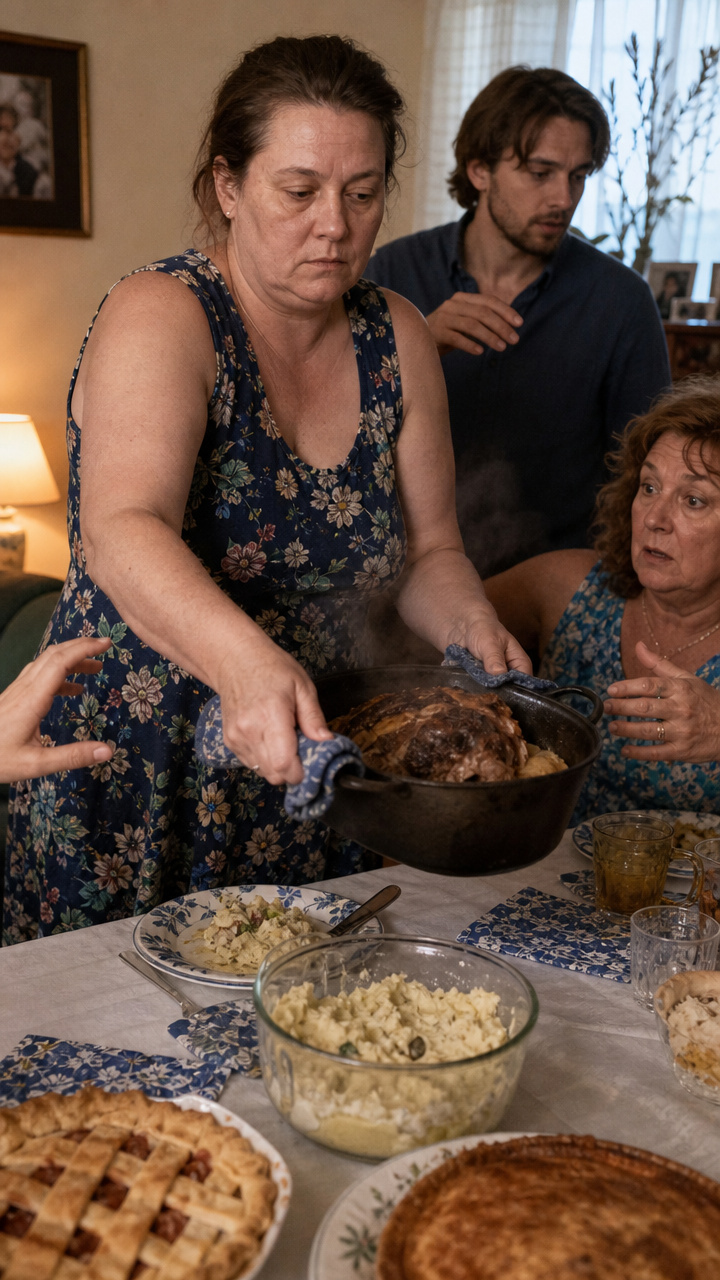
Margaret replied evenly, “When you leave, pull the door shut.”
After her son crossed the threshold, she closed the door and turned the key.
In the quiet hallway, the dry click of the lock sounded unusually loud.
Margaret leaned her back against the door and closed her eyes for a moment.
She had expected her hands to begin trembling, tears to come, or the familiar guilt that followed every family conflict to return and torment her.
But none of that happened.
Instead, she felt lighter and lighter.
It seemed as though she had finally taken from her shoulders a heavy sack filled with wet sand, one she had dragged uphill along an endless road for years.
She went back into the kitchen.
The roasting pan still stood beneath its lid on the stove. The warm, rich scent of meat, garlic, and spices lingered in the air.
Margaret opened the china cabinet and took out her favorite porcelain plate with its thin gold rim.
She had saved that plate for truly important occasions. Even guests rarely ate from it—she was always afraid someone might break it by accident.
Apparently, this was an important day after all.
Margaret cut herself a generous, juicy slice of pork.
Beside it she placed two soft potatoes soaked in the meat juices and scattered fresh dill over everything. The dill grew in a pot on her own windowsill.
From the refrigerator, she took a crisp, salty pickle.
Then she poured homemade cranberry liqueur into a small clear glass. She had set it to steep the previous autumn. Finally, she sat down near the window.
The gentle evening sun flooded the clean kitchen with golden light.
Outside, young birch leaves rustled softly, while sparrows called to one another from the thick branches.
The meal was wonderful.
The pork was tender enough to fall apart in her mouth.
The potatoes crumbled beneath her fork, and the tart berry liqueur sent a pleasant warmth down her throat.
Margaret was in no hurry.
She ate slowly, savoring every bite and the unexpected quiet that had settled over her apartment.
Afterward, she brewed herself a strong cup of tea and happily ate a large piece of still-warm pastry filled with egg and green onions.
She packed the remaining meat, potatoes, and savory pies into containers.
The next day she would take everything to the laboratory and share it with her colleagues.
They always praised her baking sincerely. They would certainly ask for the recipe again and want to know how she managed to make the dough so soft.
Three days passed.
On Tuesday, during her lunch break, Margaret’s phone began to ring.
Her son’s name appeared on the screen.
Daniel.
She did not snatch up the phone.
She calmly finished her sip of tea, set the cup down, and answered only after the fifth ring.
“Hi, Mom,” Daniel said.
His voice sounded tense.
There was awkwardness in it, along with the familiar note of mild irritation—as if Margaret already owed him something.
“Emily and I were talking. Anyway, we need to go out to the country this weekend. It’s time to plant the potatoes, and we’re running out of time. You’re driving there with us, right? And, listen… did you already eat all that meat, or is there some left? We could stop by this evening and take it.”
Margaret looked out through the laboratory window.
Small bluebirds hopped across the sun-warmed pavement outside the clinic.
A faint smile appeared on her face.
“You’ll plant the potatoes yourselves now, darling. You can use the entire garden plot. I’ll transfer my share to you so there won’t be any misunderstandings later. As for the meat, I gave it to my colleagues yesterday. They’re simple people and not hard to please. They don’t turn up their noses at cat food or a modest table. You can order yourselves some expensive restaurant delivery. You’re used to modern, luxurious menus now.”
Margaret ended the call, placed the phone face down on the table, and opened her laboratory journal again.
For the first time in many years, her head did not ache at all.
And the weekend ahead was completely free.
For the first time in a very long while, no one had made plans for it except Margaret herself.