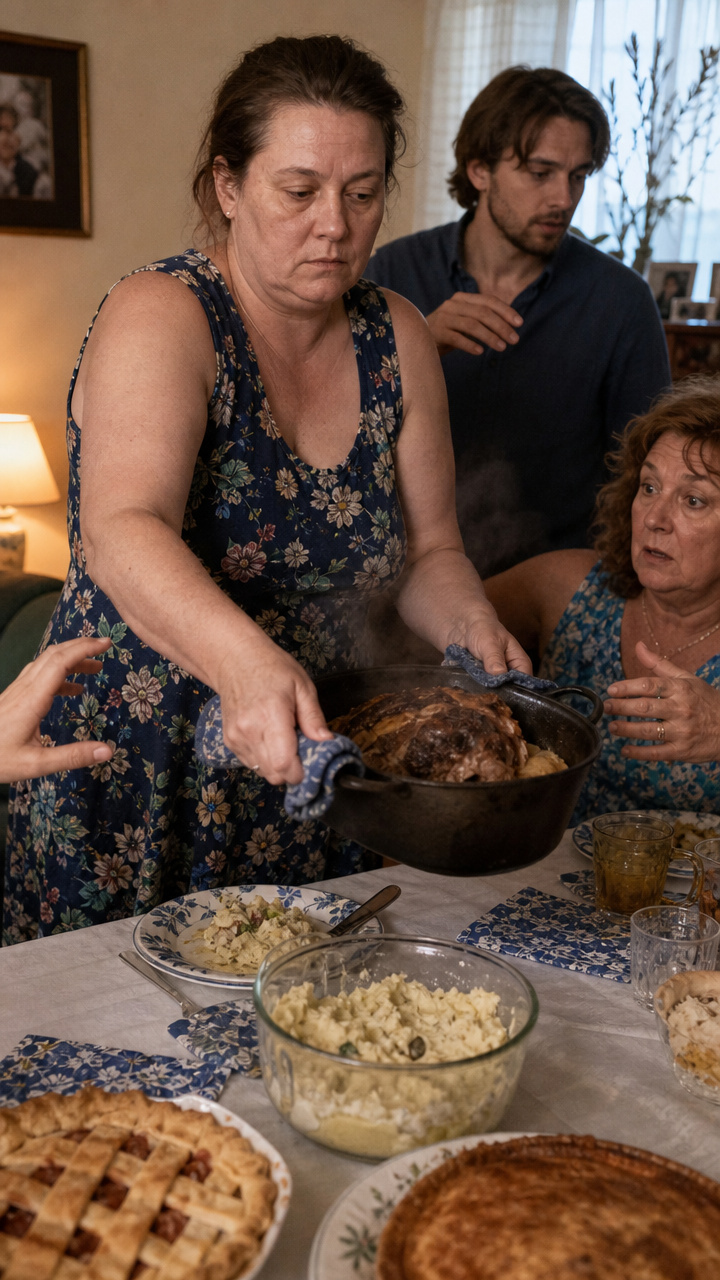
So Margaret had done her best.
She had risen at six that morning. She had mixed yeast dough for little pies filled with eggs and green onions, prepared eggplant rolls with walnuts, seasoned the fish, and baked it beneath a golden layer of melted cheese.
But in this family, her help had long ago stopped being seen as kindness. It was treated as her responsibility.
When Daniel and Emily needed money for the down payment on their car, Patricia had been the loudest person insisting that parents were supposed to help their children get established. She herself had contributed not a penny. Margaret, however, had withdrawn almost all her savings and handed them over to her son.
When the couple needed someone to take their little boy to the country for three weeks while the other grandparents went to the seaside, Margaret had stepped in again. She watched the child, tended the vegetable beds, cooked fresh meals every day, and made homemade fruit drinks.
Gratitude, however, was something she almost never heard.
After the country visit, Patricia had remarked that the boy looked far too pale. In her opinion, Margaret’s strawberry jam had turned out too runny. And, as she had announced on another occasion, Margaret’s apartment always smelled of old books.
Even so, Margaret tried once more to steer the conversation toward something peaceful.
“Let me serve you some fish, Patricia,” she offered, reaching for the broad serving spatula. “It’s fresh pollock. I cooked it slowly with carrots and onions. It came out very tender.”
“Pollock?”
Patricia threw up both hands. She laughed loudly, as though Margaret had just delivered a brilliant joke, and turned toward her daughter.
“Emily, did you hear that? They served us pollock for an anniversary! Good heavens, that is cat food. You could feed it to the strays behind the building. We ate so much of that fish years ago that I can hardly stand the thought of it. Imagine inviting people over for a celebration and putting frozen pollock on the table!”
Robert, who had been silent until then, reached cautiously for one of the small pies.
“It’s perfectly good fish, Patricia. Don’t be so harsh.”
She spun toward him.
“Oh, do be quiet. Now we have an expert. You only care about filling your stomach. What it is doesn’t matter to you.”
Then she turned back to Margaret.
“Don’t take it personally, Margaret. I’m a straightforward woman. I don’t lie or flatter anyone. But this is not a festive meal. It’s practically an insult to your guests.”
An oppressive silence settled over the room.
A car passed outside with a soft rush of tires. The cuckoo clock on the wall measured out the seconds.
At last Daniel lifted his head from the phone and shifted uneasily on the sofa. Yet he made no effort to defend his mother.
Instead, he said irritably, “Mom, honestly, you could have ordered prepared food. Every place offers celebration packages now. Why spend two days wearing yourself out at the stove if people are only going to criticize you afterward? We were hoping for something a little more modern.”
Margaret slowly turned and looked directly at him.
“Delivery costs money, Daniel,” she said, her voice calm and almost emotionless. “On Tuesday, you sat right here and told me that after the car payment you could barely afford gasoline. Everything on this table was paid for with my laboratory wages and my pension. Every last cent.”
Patricia sighed loudly, rolled her eyes, and pushed her fork away with theatrical disgust.
“There it is. Now we’ll spend the entire evening hearing how much every pickle cost and how many pennies went into the salad. We came to visit family, and instead we’re being given an accounting report over food. If I had known what a poverty-stricken table this would be, Robert and I would have gone to a restaurant. At least we could have eaten properly. Now we’re expected to choke this down out of politeness!”
Margaret placed both hands in her lap.
And suddenly, something inside her became completely still.
The pressure in her head vanished. The familiar pain of resentment, which only moments earlier had tightened her throat and stung her eyes, simply disappeared.
In its place came a cool, level calm—and an unexpected sense of freedom.
Margaret rose from her chair.
Without hurrying or making a single sharp movement, she went into the kitchen, pulled on thick oven mitts covered with bright sunflowers, and opened the oven.
A wave of hot, fragrant steam rolled over her.
The apartment filled with the deep scent of garlic, baked apples, bay leaves, spices, and roasted meat.
At the back of the oven sat a large, heavy cast-iron roasting pan.
Inside it, Margaret had roasted an entire pork shoulder weighing nearly seven pounds. Its surface was covered with a glossy honey-mustard crust. Around the meat lay browned new potatoes and wild mushrooms she had gathered the previous autumn.
Carefully lifting the blazing-hot pan, Margaret carried it into the living room and set it on a thick wooden trivet in the middle of the table.