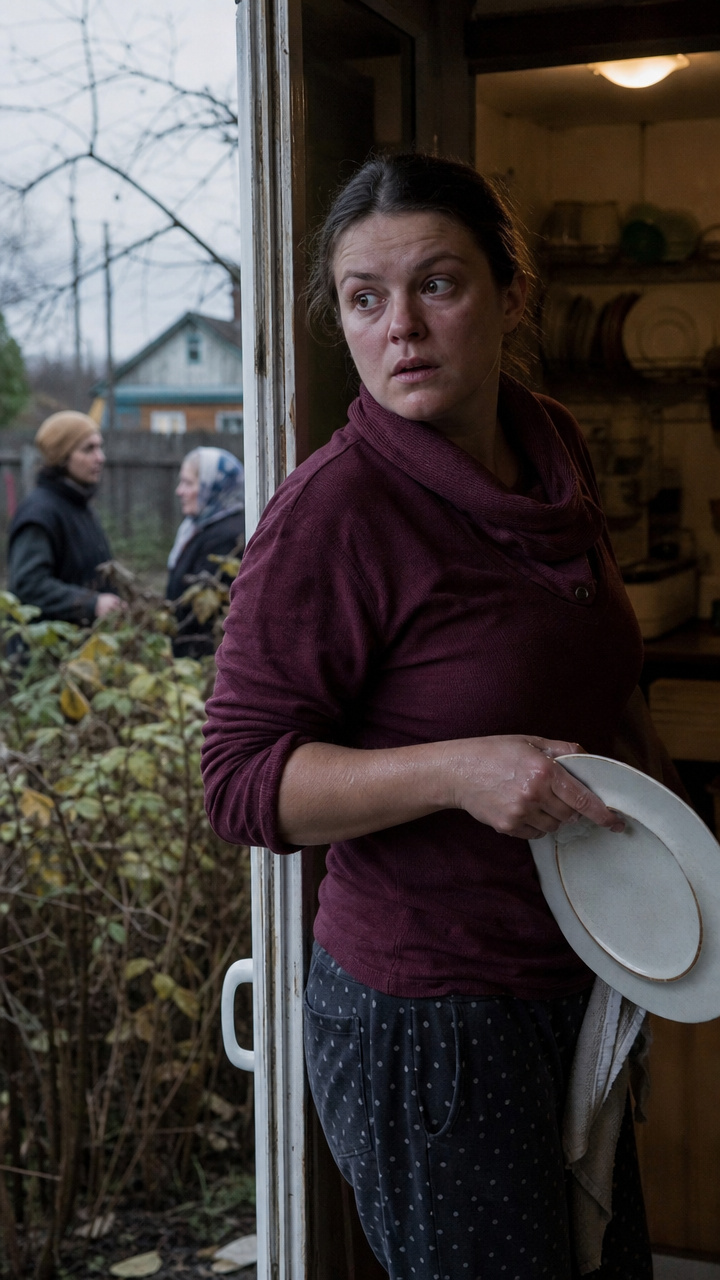
Daniel hugged his father tightly enough to make him cough.
“Dad, we aren’t angry. Come visit whenever you want. You don’t even have to call.”
“I will. As soon as the honey runs out, I’ll be there.”
The car had already reached the gravel road when Sophie suddenly threw up her hands.
“Oh! Annie! I left her on Grandma’s bench!”
Daniel slowed.
“Should we go back?”
Claire looked in the rearview mirror.
Margaret stood by the gate.
She was not waving.
She was not watching them leave.
She simply stood among her carefully arranged asters, her arms hanging at her sides.
Claire was about to say, “Let’s go back.”
But Sophie spoke first.
“No, Daddy. Let Annie stay with Grandma. She’ll be alone now. She might get bored.”
Silence filled the car, so complete that they could hear a wasp striking against the window.
Daniel remained still for several seconds.
Then he wiped his eyes with his sleeve and drove on.
Three weeks later, they received the keys to their new apartment.
It had one bedroom, a tiny kitchen where two adults could barely pass each other, and a wide enclosed balcony overlooking a line of poplar trees.
There was almost no furniture.
For the first few nights, even ordinary words echoed through the empty rooms.
Sophie loved it.
She would stand in the center of the living room and shout, “Helloooo!”
Then she would burst into laughter because no one answered, “Quiet!”
Claire’s parents were the first to visit.
They came by bus from their small town with three enormous bags.
Ruth’s husband brought a cordless drill. In one day, he assembled a table from pine boards, mounted several bookshelves, and showed Daniel how to attach the curtain rod properly.
Ruth brought white lace curtains, cabbage pastries, and a new doll.
Sophie named her Annie the Second.
Ruth hung the curtains, stepped back, and admired them.
“There,” she said. “Now it’s a home. A small one, but no one gets to tell you where you’re allowed to stand.”
One evening, Sophie accidentally knocked over a glass of fruit punch at the new wooden table.
The red liquid spread quickly toward the edge.
The little girl froze.
Her shoulders rose toward her ears.
She looked at her mother in terror.
“Mommy… am I allowed to spill things here?”
Claire took a cloth, wiped the table, and kissed the top of her daughter’s head.
“Yes, sweetheart. Tables are for living around. If something spills, we clean it up.”
Sophie let out the breath she had been holding.
A week later, she sang in the bathroom for the first time at the top of her voice.
Claire stood in the hallway with her back against the wall and listened.
Adjusting to the new life was harder for Daniel.
Guilt did not disappear overnight.
He often sat on the balcony with his phone in his hand.
The screen would light up with one word:
Mom.
Then it would go dark.
“She didn’t answer?” Claire asked one evening as she sat beside him.
“She declined the call. That’s the sixth time.”
“Call again.”
“Why?”
Claire looked at him.
“Because one side of the door should remain open. If she ever decides to take a step toward us, she needs to know where to go.”
Daniel dialed again.
The phone rang for a long time.
No one answered.
He placed it face down on the table.
“It’s all right,” he said, taking Claire’s hand. “The important thing is that we made our decision.”
Meanwhile, the three-bedroom apartment was finally as spotless as Margaret had always wanted.
The towels were folded three times.
The mugs faced right.
There was not a single toy on the rug.
Not one unnecessary sound.
Peter watched the evening news with the volume nearly muted, relying mostly on the captions.
“Daniel called again,” he said one night without turning around. “You should answer him.”
“Let him learn what it feels like to be hurt by his own mother,” Margaret replied coldly. “They’ll come running when they run out of money.”
“They won’t come running, Margaret.”
She turned toward him.
“Why not?”
“I visited them yesterday. I brought the honey.”
He paused.
“It’s cramped over there, but it’s warm. The little one sings in the bathroom. Daniel laughs. I don’t think I’ve heard him laugh like that since he was in school.”
Margaret opened her mouth.
No words came.
She rose and walked into the room where Sophie had once slept.
Annie sat on the windowsill, still wearing her yellow knitted hat.
Peter had brought the doll back from the cottage.
He had offered no explanation.
He had simply placed her there.
Margaret picked Annie up.
Only then did she notice a folded piece of paper sticking out of the doll’s dress pocket.
She unfolded it.
It was a child’s drawing made with colored markers.
A little house.
Three people standing beside it.
And another figure a short distance away.
The figure had gray hair gathered into a bun.
Above it, in crooked childish letters, Sophie had written:
“GRANDMA MARGARET. COME VISIT.”
Margaret sat on the edge of the bed.
The floorboard near the doorway gave a soft creak.
No one had walked across it.
The old apartment was simply settling.
In the hallway, the phone screen lit up on the side table.
Daniel.
Margaret stepped out of the room, still holding the doll against her chest.
She stared at the ringing phone for a long time.
Then she slowly extended one finger toward the green answer button.
She stopped less than an inch away.
The screen went dark.
For a while, she remained standing in the silence she had worked so hard to create.
And for the first time, she understood how empty that silence really was.
Then she placed Sophie’s drawing beside the phone, where she would see it every time the screen lit up again.
Across town, in the little apartment with the poplar trees outside, three people sat around a pine table drinking mint tea that Ruth had brought from home.
Sophie was telling her father that Annie the Second could sing too.
And in that home, no one ever walked on tiptoe again.