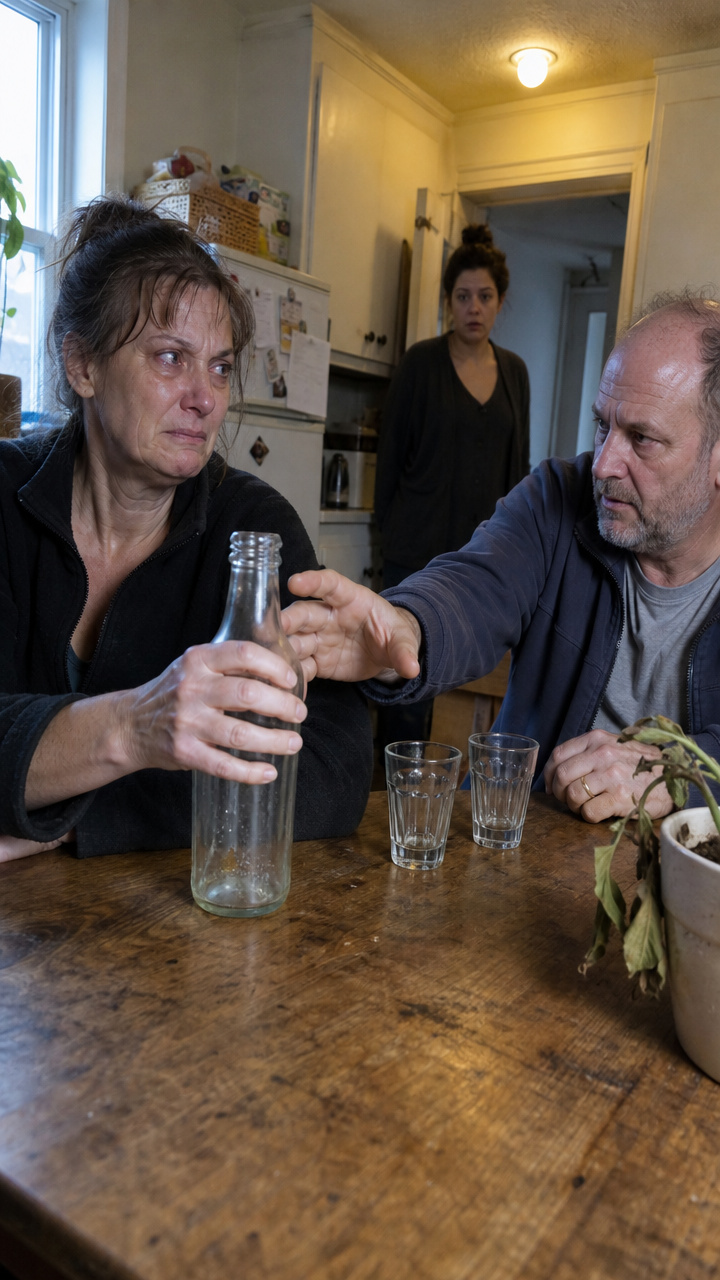
At first, the ritual seemed almost romantic. Every evening, after another day spent together, Daniel would pour them both a drink. It was his private way of marking the fact that they had made it through one more day side by side.
“One drink for every day of our life together,” he would say, as predictably as the setting sun.
But as the years passed, the little tradition changed.
It stopped feeling like an invitation.
It became an obligation.
She could be exhausted, ill, or doubled over with pain, and Daniel would still place the glass in front of her and wait.
Silently.
Patiently.
With a calm persistence that gradually began to unsettle her.
The drink had a sharp, unpleasant smell. At times, it left a strange metallic taste on her tongue. After only a few sips, a burning sensation lingered in her mouth and throat for far too long.
And there was something else.
Daniel never offered the drink to anyone else.
Whenever friends or relatives visited, the bottle vanished from sight. It would return only after the guests had left and the front door had been locked behind them.
The Evening Her Suspicions Became Something More
One night, their daughter Sophie, still a teenager at the time, reached toward the bottle and asked if she could smell it.
Her fingers had barely touched it when Daniel snatched it away.
The movement was so sudden and harsh that everyone in the room fell silent.
No one had ever seen him react that way before.
That was the moment a real fear first took root inside her.
A few days later, she decided to test the liquid herself.
Instead of drinking what Daniel had poured for her, she waited until he was distracted and emptied the contents into a potted houseplant.
By morning, nearly every leaf had turned black.
She stood in front of the ruined plant for a long time, unable to look away.
Then her hands began to tremble.
That day, she spent hours searching for substances capable of harming the body gradually rather than all at once.
She thought about the dizzy spells.
The unexplained weakness.
The endless fatigue she had always blamed on age, stress, and work.
One terrifying question kept circling through her mind:
What if Daniel had been trying to hurt her for years?
The Last Words of a Dying Man
She learned the truth too late.
Or almost too late.
During the thirty-fifth winter of their marriage, Daniel suffered a severe heart attack.
He was taken to the hospital.
Even from his hospital bed, he called her every evening at exactly nine o’clock.
And every time, he asked the same question:
“Did you drink it?”
She always answered:
“Yes.”
By then, she had not touched the mixture for several days.
Perhaps Daniel knew she was lying.
He never said so.
A few hours before he died, he motioned for her to come closer.
Speaking had become difficult for him.
“Promise me you’ll keep taking it,” he whispered.
She tightened her fingers around his hand.
“Daniel, please. Tell me what’s really in that bottle.”
Tears gathered in his eyes.
For a long while, he said nothing.
Then he murmured, “It’s the one truth I never found the courage to tell you.”
She wanted to ask another question.
But Daniel only held her hand more firmly.
It was the last time their fingers were ever joined.
A few hours later, he was gone.
After the funeral, she took the bottle and brought it to an independent medical laboratory.
They told her the results would be ready within several days.
On the third day, the laboratory called and asked her to come in person.
They also strongly recommended that she not come alone.
She brought Sophie with her.
Inside the consultation room, the physician closed the door, placed the papers in front of them, and remained silent for several moments.
She braced herself for the worst.
Instead, his first words left her completely stunned.
“This isn’t poison.”
She stared at him.
“What?”
“The bottle contains a specially prepared medication. It is prescribed for an extremely rare inherited disorder.”
Sophie turned toward her mother first.
The woman could not understand what she was hearing.
The doctor continued.
During the first year of her marriage, she had suddenly collapsed one day.
The examinations that followed had revealed a rare hereditary illness—the same disease that had once taken her mother’s life.
At the time, the diagnosis had devastated her so completely that she had refused treatment.
She would not take the prescribed tablets.
She would not return to the doctors.
She would not even speak about the illness.
As the years passed, she had somehow pushed the entire episode out of her mind.
Daniel had not.
He remembered every detail.
He found a specialist.
He spoke with physicians.
For years, he arranged for the medication she needed.
Then he secretly mixed it into their evening drink because he believed that, if he told her the truth, she would refuse treatment all over again.
“But why did he drink it with me?” she asked, her voice barely audible.
The doctor looked at her with quiet sympathy.
“There was no medication in his glass.”
“Then what was he drinking?”
“Plain bitter fruit juice.”
She covered her face with both hands.
Thirty-five years.
Every evening.
Two identical glasses.
Daniel had drunk beside her only because he did not want her to feel sick, different, or alone.
Along with the test results, Daniel had left a letter.
It was given to the family after his death.
There was only one sentence in it, but she read it again and again:
“I was willing to let you hate me one day, as long as you were still alive when that day came.”
For a long time afterward, she could not bring herself to look at the empty chair across from her.
But the evening ritual did not end.
Every night at nine, she takes out two glasses.
She places one in front of herself.
The other goes across the table, beside the vacant chair.
She pours her drink.
Raises the glass.
And whispers:
“To one more day.”
Now she understands that what had seemed for so many years like control and coercion was, to Daniel, a desperate and misguided attempt to keep her alive.