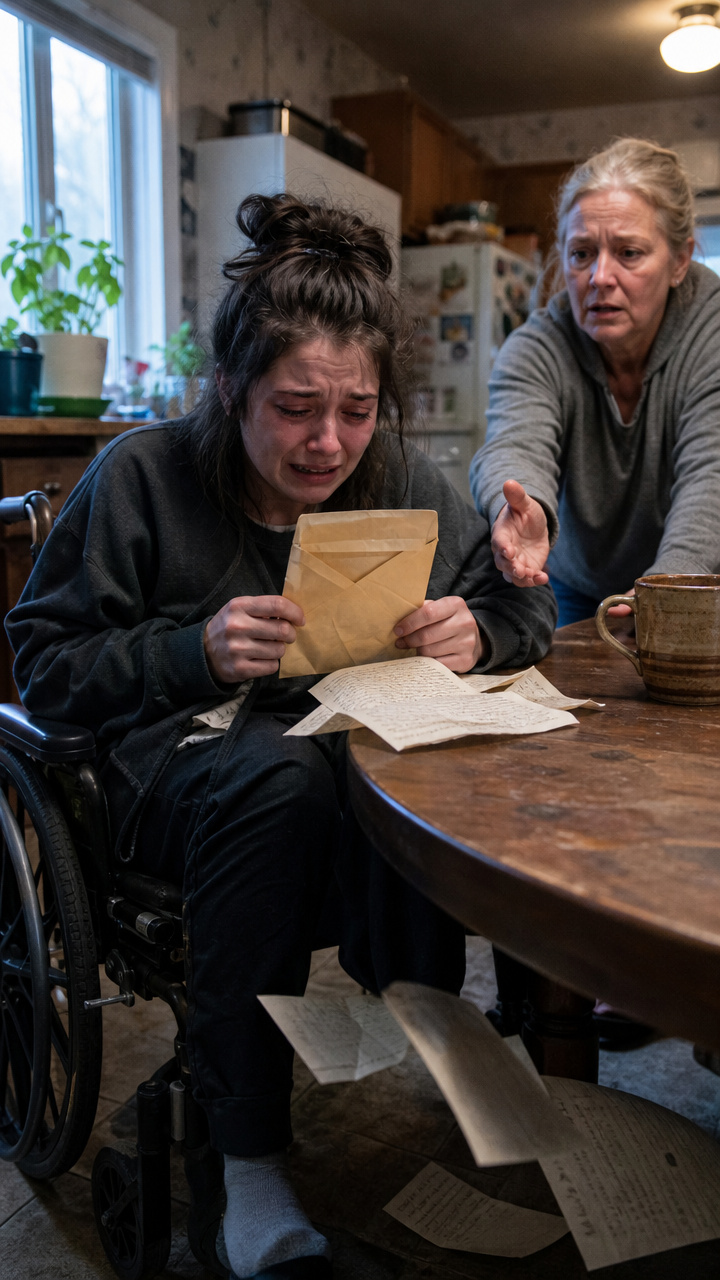
I was twenty-six years old, and I had not taken a single step since I was four.
Whenever people heard that, they usually imagined my life beginning in a hospital bed.
But I had a life before that.
I do not remember the accident itself.
I remember my mother, Emily, singing so loudly in the kitchen that the neighbors could hear her. I remember my father, Daniel, smelling of motor oil and peppermint gum.
I remember wearing sneakers with bright white soles, drinking from my favorite purple cup, and having far too many opinions for a four-year-old.
The accident itself is gone from my memory.
All my life, I knew only one version of what happened: my parents were in a car crash, they died, I survived, and my spine suffered permanent damage.
Afterward, the authorities began deciding where I should go.
There were conversations about foster homes and families equipped to care for a disabled child.
Then my mother’s older brother appeared.
“We’ll find her a loving home,” the social worker, Rebecca, said gently.
She stood beside my hospital bed with a stack of paperwork balanced against her chest.
Thomas looked as though he had been made from concrete, rain, and years of hard labor. His hands were enormous, and his face seemed permanently caught beneath a heavy frown.
“We have families with experience in situations like—”
“No,” Thomas interrupted.
The word came out sharp enough to stop her.
“Sir, I’m only trying to—”
“I’m taking her home. I’m not leaving her with strangers. She’s family.”
And that was how I ended up in his small house, where everything smelled faintly of coffee.
He had no children.
No partner.
And, if I am honest, absolutely no idea what he was doing.
But he learned.
He watched the nurses carefully and wrote everything down in a battered notebook: how to turn me without hurting me, how to protect my skin, how to lift me so I felt secure instead of frightened.
On my first night at home, he set an alarm to ring every two hours.
Each time, he shuffled into my room with his hair sticking up in every direction.
“Time to turn you over, pancake,” he mumbled, carefully rolling me onto my side.
Whenever pain made me whimper, he bent over me immediately.
“I know,” he whispered. “I’ve got you. I’m right here.”
He built a wooden ramp so my wheelchair could cross the threshold and reach the porch.
It was crooked and ugly.
But it worked.
He spent endless hours on the phone with insurance companies.
“No, she really cannot bathe without a shower chair,” he snapped once. “Would you like to come here and explain that to her yourself?”
No one came.
He took me to the park.
Our neighbor, Mrs. Garcia, began bringing over food and hovering around us constantly.
“She needs friends,” she insisted.
“She especially doesn’t need to fall down the stairs,” Thomas grumbled.
Even so, he later wheeled me around the neighborhood and introduced me to every child as though I were the most important person in the world.
At the park, children stared at me.
Their parents looked away.
Then a girl about my age came up to my chair.
“Why can’t you walk?” she asked bluntly.
I froze.
Thomas crouched beside me.
“Her legs don’t listen to her brain,” he explained. “But she can still beat you at cards.”
The girl laughed.
“I don’t believe that.”
Her name was Chloe.
She became my first real friend.
Thomas had a strange kind of gift.
He could place himself between me and an uncomfortable moment, then soften it until I could bear it.
When I was ten, I found an old chair covered in tangled balls of yarn in the garage.
“What is this?” I asked.
“Nothing. Leave it alone.”
That evening, he sat on the edge of my bed.
His hands were trembling.
“Don’t move,” he muttered.
He tried to braid my hair.
The result looked disastrous.
Still, happiness swelled inside me until it almost hurt.
When puberty arrived, he walked into my room carrying a plastic shopping bag and looking as if he wanted to disappear.
“I bought a few things,” he announced.
“What kind of things?”
“You know… things. For when your body starts doing things.”
Inside were pads, deodorant, and the cheapest mascara he could find.
“You watched videos online, didn’t you?”
He grinned sheepishly.
“Those girls talk awfully fast.”
We never had much money.
But I never felt like a burden.
He washed my hair over the kitchen sink, supporting my neck with one hand while pouring warm water over my head with the other.
“That’s good,” he would repeat. “I’m here.”
When I cried because I would never dance or stand in the middle of a crowd like everyone else, he sat beside me.
“Listen to me,” he said firmly. “You are not less than anyone. You never have been, and you never will be.”
By the time I reached my teens, it was clear no miracle cure was coming.
Most of my life happened inside my room.
Thomas, however, kept bringing the outside world to me.
He installed shelves low enough for me to reach.
In the garage, he welded a makeshift holder for my tablet.