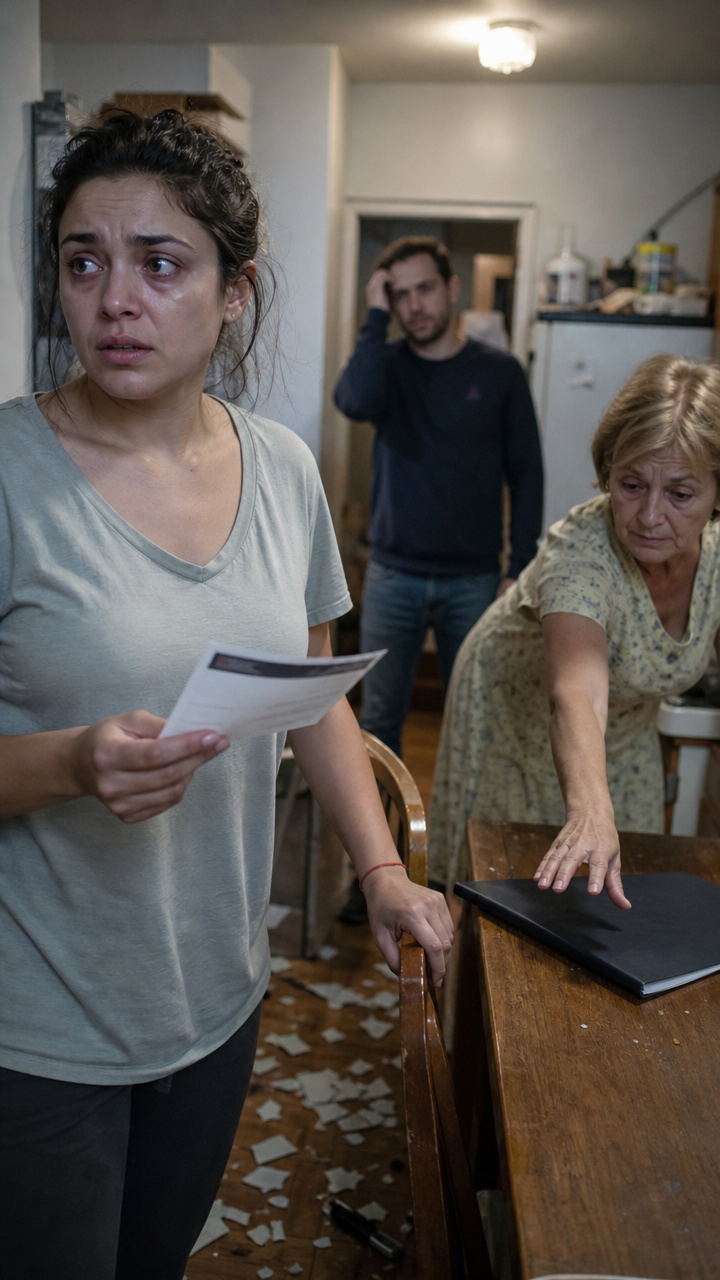
“You have to understand… Mom has debts. She underestimated the expenses for her birthday. I was going to take out a loan so we wouldn’t touch your savings anymore. I planned to clear the debts and pay everything back gradually.”
“A loan secured against our home,” Claire repeated slowly. “The home where I’m listed as a co-borrower. Do you understand that if you stopped making payments, both of us could have been forced onto the street?”
“I would have paid it!”
“You?”
Claire gave a short, joyless laugh.
“For five years, you haven’t been able to tell your mother the simplest word in the English language: no. And now you expect me to believe you could manage a massive loan?”
She turned and headed for the entryway.
Daniel followed helplessly.
“Claire, I’m sorry. I got confused. You know Mom is used to a certain lifestyle. I can’t just refuse her. She’s my mother. Looking after her is my responsibility.”
Without answering, Claire put on her sneakers and reached for her keys.
“Do you understand that your mother has effectively stolen everything from me?” she asked without looking back. “I saved for eight years. Eight. I worked two jobs. And you’re standing there lecturing me about your responsibility toward her.”
“Claire, don’t exaggerate.”
She spun around.
“I’m exaggerating?”
She reached into the pocket of his jacket and pulled out a receipt she had noticed that morning while looking for a charger.
Then she unfolded the paper in front of his face.
“Explain this. Diamond earrings. Two thousand eight hundred dollars. Purchased last week. Who were they for? Me? You know I’m allergic to gold. So they were for your mother?”
Daniel looked away.
“They’re a birthday gift. From both of us.”
“From both of us?”
Claire laughed.
The sound was dry and unpleasant, like a branch snapping in winter.
“You bought your mother diamonds with my money while I was sitting beside my dying mother in the hospital. Do you understand how sick that is?”
Daniel said nothing.
Claire stared at him and suddenly saw not a grown man, but a broken doll.
An empty shell packed with fear, guilt, and years of someone else’s commands.
The sight made her feel physically ill.
“I’m leaving,” she said.
Daniel’s head snapped up.
“Where are you going?”
“To Helen’s. She lives downstairs. I’ll sleep there tonight.”
“Claire, don’t do this. We can talk calmly.”
“Talk?”
She opened the front door.
“What exactly should we discuss? The way you secretly applied for a loan against our home? The way your mother drained my savings for a year while you protected her? Or perhaps we should talk about the possibility that you never loved me at all?”
Daniel’s face turned pale.
“That’s ridiculous. Of course I loved you.”
“Did you?”
Claire stopped on the threshold.
“Then why didn’t you defend me once in five years? Why did you lower your eyes every time your mother humiliated me? Why did you let her call me a freeloader and a nobody?”
He had no answer.
Claire stepped outside and closed the door behind her.
Helen lived one floor below.
She opened almost immediately, as if she had been expecting Claire.
“Come in,” the neighbor said, taking in her expression. “The kettle is still hot.”
Claire sat at the old wooden kitchen table, wrapped both hands around a mug of herbal tea, and told her everything.
She did not cry.
She did not lose control.
She did not embellish a single detail.
She simply listed the facts, as though giving evidence in court.
The card.
The birthday.
The call from the bank.
The earrings and the receipt.
Helen listened without interrupting, occasionally stirring her tea with a small spoon.
Then, without warning, she stood, walked to the cabinet, and pulled out an old photo album with a worn cloth cover.
“Claire, sit down properly,” she said, opening it near the final pages. “There’s something you need to see.”
Claire came closer.
A young Margaret appeared in the yellowed photograph.
She was standing in a hospital corridor, holding a newborn baby in her arms.
But the hospital looked strange.
It clearly was not in Britain.
A sign in a foreign language hung in the background. Claire stared at it for several seconds before she could make out the words.
“Where was this taken?” she asked.
“Dublin,” Helen replied quietly. “In 1994, I worked there as a nurse on a temporary contract. Margaret arrived with diplomatic papers. She couldn’t have children, or so she said. Then, suddenly, she had a baby. She claimed he had been abandoned. She took him out of the country. From what I heard, the documents were forged. Later, she registered the boy as her own.”
Claire felt as though the floor had shifted beneath her.
“You’re saying Daniel…”
“He is not her biological son,” Helen finished. “She either stole him or paid someone for him. I never learned exactly which. But Margaret did not give birth to him. And as far as I know, Daniel has never heard the full truth.”
Claire sank into the chair.
The buzzing had returned to her ears.
“Why did you stay silent all these years?”