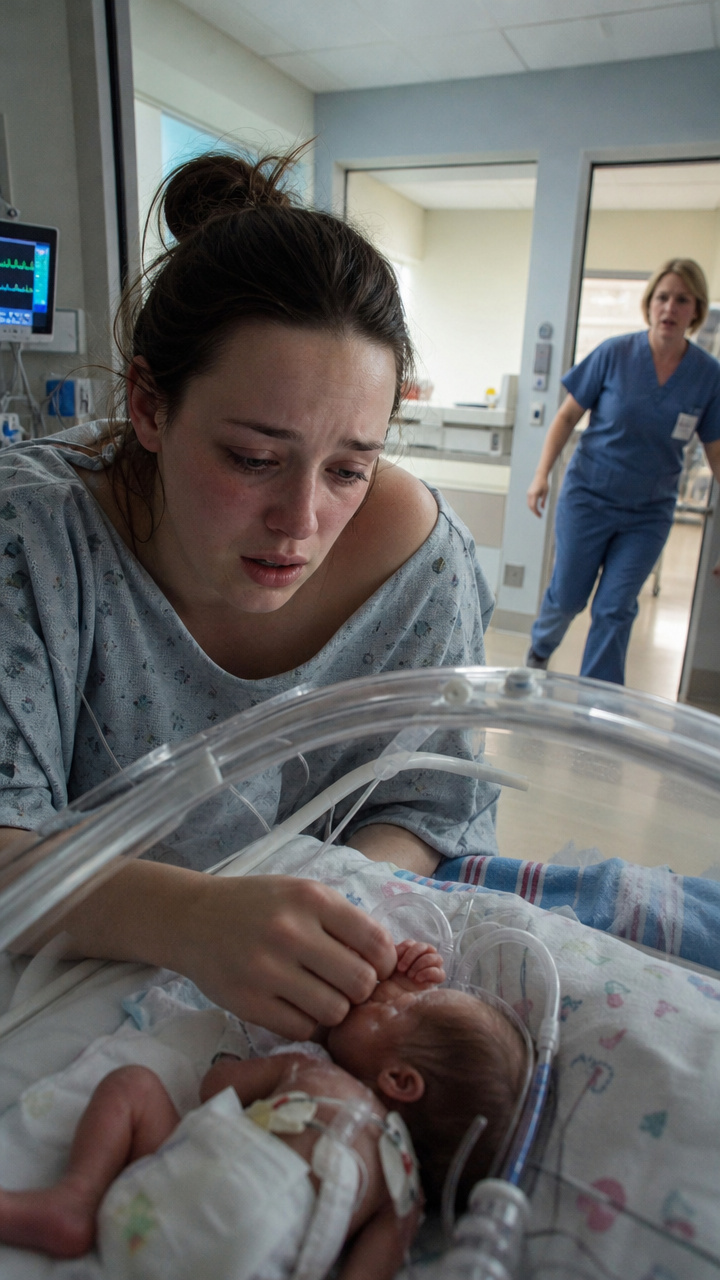
Emily’s pregnancy ended without warning. She was only twenty-six weeks along when violent contractions began tearing through her body. An ambulance rushed her to the hospital, but the doctors could not stop the labor. Before anyone was ready, her daughter Lily entered the world nearly three months too soon, weighing barely three and a half pounds.
The baby did not breathe. There was no cry, no movement, no sign that life remained inside her fragile body. The medical team began resuscitation immediately. A neonatologist was called, monitors were checked, and the baby’s heartbeat was searched for again and again.
Nothing.
The machines stayed silent.
After every attempt failed, the doctors officially recorded the infant’s death. Lily was wrapped in a soft cloth, placed inside a tiny wooden coffin, and taken to the hospital morgue.
Emily was still under anesthesia when it happened. She learned the truth only after waking. Just hours earlier, she had believed the doctors would save her little girl. Now, instead of her baby, she was facing paperwork that confirmed Lily was dead.
It was a blow so devastating that Emily could barely breathe.
Still, she refused to accept the death until she had seen her daughter herself. She begged the staff to let her go to the morgue and say goodbye. She wanted to hold Lily’s hand one final time—and take a last photograph for the funeral.
More than twelve hours had passed since the birth.
Emily could hardly stand, yet she slowly made her way downstairs with her husband, Daniel, and her brother. The morgue was cold and painfully quiet. Their footsteps faded against the walls, and not one of them spoke.
In the middle of the room stood a small wooden coffin.
Emily drew in a trembling breath. She gathered what little strength she had left and walked toward it. A piece of cloth covered part of the baby’s face. With shaking fingers, the mother reached down and touched Lily’s tiny palm.
For several seconds, she did nothing but stand there.
Then she carefully moved the cloth away from her daughter’s face and leaned closer.
Suddenly, Emily froze.
She jerked backward and gasped, breathing in the icy air as though she had just surfaced from deep water.
Had Lily’s eyelids moved?
It had been almost imperceptible—so slight that Emily wondered whether grief had begun to distort her vision. She stared at the pale little face, afraid to blink in case the movement disappeared.
“Daniel…” she whispered. “Come here. Please.”
Her husband was standing beside her. Assuming that Emily was about to collapse, he placed a hand on her shoulder. But she seized his fingers and pulled him toward the coffin.
“Look,” she breathed. “I think she’s breathing.”
Daniel stared at the baby’s motionless chest for a long moment. He was about to tell his wife that it was impossible, that exhaustion and heartbreak were making her imagine things.
Then the tiny hand Emily was holding twitched.
Only once.
Barely enough to see.
All three of them went rigid.
“That can’t be…” Emily’s brother whispered.
But Emily no longer doubted what she had seen.
She ran to the door, pounded on the metal panel, and screamed with every ounce of strength left in her body:
“Get a doctor! Hurry! My baby is alive!”
Within minutes, nurses and an elderly pathologist rushed into the room.
At first, the doctor looked at Emily with suspicion. Even so, he approached the little coffin and pressed his stethoscope against the baby’s chest.
Several seconds passed.
Then his expression changed.
He listened again.
He checked the infant’s pulse.
He glanced at his watch, then looked down at the baby once more.
“Her heart is beating,” he finally said. “It’s extremely weak…but it’s beating.”
The room fell silent.
“She has been here for more than twelve hours,” the doctor continued. “Her body temperature is dangerously low. And yet she’s alive.”
Everything that followed happened in a rush.
Lily was carried straight to the intensive care unit. The medical team began warming her body little by little, connected her to life-support equipment, and administered the necessary medication.
Even the doctors struggled to understand how the child had survived so long in such a condition.
Their best explanation was that the severe cold had slowed the baby’s metabolism to an extraordinary degree. Her tiny body may have entered a state resembling deep suspended animation, using almost no energy while preserving the last traces of life.
Emily stood behind the glass wall of the intensive care unit, unable to take her eyes off her daughter.
Lily’s impossibly small body was surrounded by tubes and wires. Her skin looked almost translucent beneath the hospital lights.
But Emily watched only one thing.
The green line on the monitor continued to move.
Lily’s heart was beating.
On its own.
Weakly, but stubbornly.
“Can you hear me, sweetheart?” Emily whispered, pressing both palms against the glass. “You didn’t leave me. You were only waiting for Mommy to find you.”