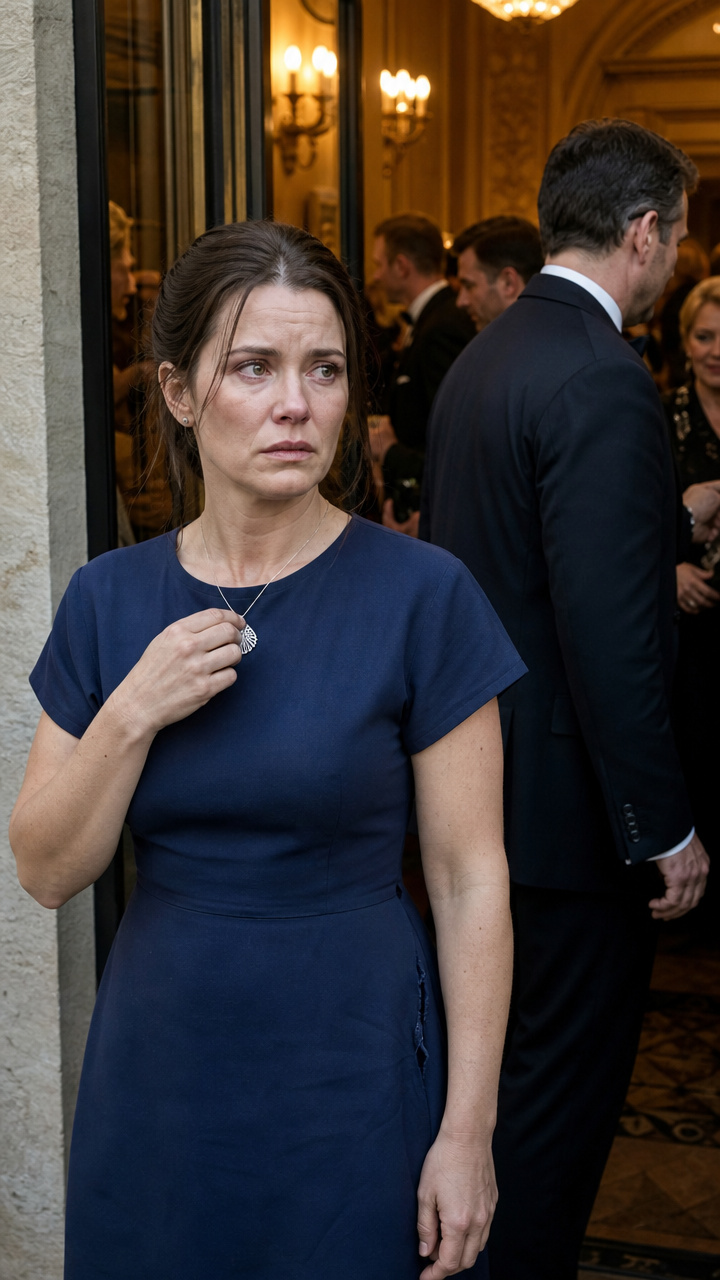
Henry’s voice thundered across the room.
“Take your hands off her.”
Immediately.
Silence fell so completely that the music seemed to vanish.
It was the particular kind of silence that arrives when everyone realizes the ground beneath them has shifted, though no one yet understands why.
All evening, guests had tried to approach Henry Whitmore, impress him, and win his favor. Every person in the ballroom had just watched Ethan Mercer send his wife away as though she were a member of the staff.
Now Henry’s anger was directed not at a competitor or an employee, but at Ethan—the man who had humiliated the woman standing beside him.
Ethan released Clara at once.
“Sir, I—”
Henry did not look at him.
The old man moved slowly toward Clara. His eyes had filled with tears.
“That pendant,” he whispered. “Where did you get it?”
Part Nine — The Fire Thirty Years Earlier
Clara swallowed.
“It belonged to the woman who raised me,” she said carefully. “She found me after a car fire outside Savannah thirty years ago.”
“I had a high fever. There was a burn near my collarbone. I was holding the pendant.”
A broken sob escaped Margaret.
With trembling fingers, she drew a gold chain from beneath her blouse.
Attached to it was the other half of the silver sun.
The two pieces had been made for one another. Even from several feet away, Clara could see how perfectly they would join.
A wave of astonishment moved through the room.
Ethan forced a laugh.
“Mr. Whitmore, I’m sorry, but similar jewelry can be bought anywhere—”
“Be quiet,” Margaret cut in.
Part Ten — The Inscription
She turned the pendant over.
“There’s an inscription on the back,” she said. “It has always been there.”
Henry’s hands shook as Clara lifted the pendant and allowed him to take it.
Two letters and three words had been carved into the darkened silver.
H.W.—My light always returns.
Henry closed his eyes.
Then the most powerful man in the room dropped to his knees before a woman in a cheap navy dress.
“Evelyn,” he breathed, his voice breaking. “My daughter.”
“My little Evelyn.”
The entire meaning of the room changed in an instant.
Only moments earlier, the hierarchy had seemed obvious. At the top stood a billionaire whose approval everyone wanted. Near the bottom stood a woman in an inexpensive dress who had been told to wait beside the restrooms.
Now the man at the top knelt on polished marble in a suit worth thousands of dollars and wept before the woman at the very bottom, as if she were the only precious thing in the ballroom.
Because to him, she was.
Henry did not see the missing designer label. He did not see the absence of an expensive handbag. He did not see a woman who had been mistaken for catering staff.
He saw the daughter everyone had believed dead for thirty years.
That alone was enough to bring Georgia’s most powerful businessman to his knees.
Clara would remember forever that her father’s first act after finding her was not to demand anything from her. It was to kneel.
Part Eleven — When the Ground Disappeared
The ballroom filled with stunned whispers.
Clara felt as though the floor had vanished beneath her.
For thirty years, she had carried an empty space no answer could fill—the missing beginning of her own life, a question she had learned to live with because she was certain it would never be answered.
Now the impossible was kneeling before her and crying.
There is a peculiar dizziness in being recognized after an entire lifetime of believing you belong nowhere.
Clara had lived as a girl without a past, raised by a woman unrelated to her by blood, and later as the wife of a man who was ashamed of the few facts she knew about herself.
She had built her identity like a house on borrowed land: carefully, lovingly, always aware that the ground beneath the foundation did not truly belong to her.
She had convinced herself that ignorance did not matter. Most of the time, she had even believed it.
Longing for a family presumed dead would have slowly suffocated her. Rosa had taught her something else instead.
She had taught Clara how to keep swimming.
But now an old man knelt before her, gave her a name she had never heard, and claimed her without hesitation.
Suddenly, the ground beneath her feet seemed real.
She had a beginning.
It had been near her all along, hidden in the back of the pendant she touched during frightened moments, waiting thirty years for someone who could read it.
The emptiness did not fill gently.
It rushed in like a flash flood, sudden and uncontrolled, spilling over every bank. Clara stood in the middle of it, unable at first to tell whether it was carrying her to safety or pulling her under.
Margaret could barely speak.
“That accident,” she sobbed. “We were told no one survived. We buried an empty coffin. We mourned you for thirty years.”
Years later, Clara would know her aunt well. But she would never forget Margaret as she appeared that night: elegant, controlled, and completely undone, pressing both hands to her mouth while she cried in the middle of a crowded ballroom without caring who saw her.