At a certain age, people begin to assume that the heart has made peace with everything it once wanted. Conversations turn to prescriptions, blood pressure, retirement checks, utility bills, grandchildren, aching knees, and whether the stove was left on.
No one asks about love anymore.
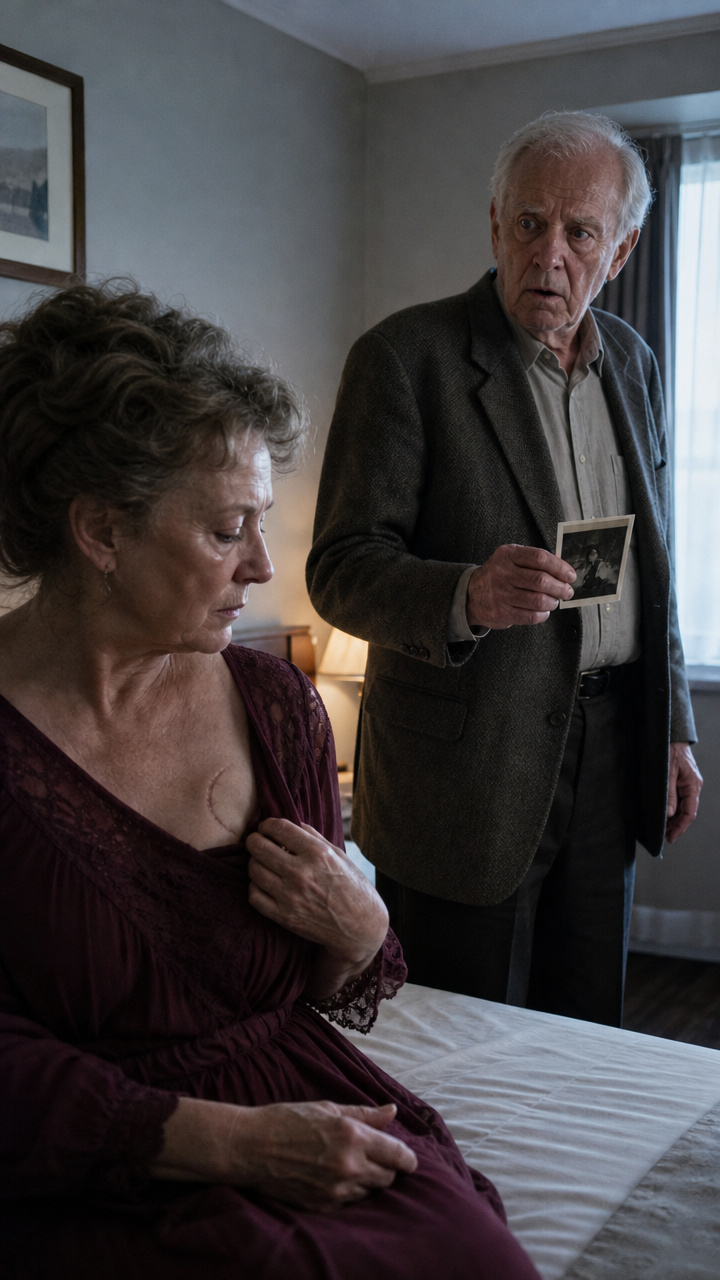
No one noticed the burgundy dress that fell just below my knees, the one I chose with the nervous excitement of a schoolgirl. No one knew how badly my hands trembled at the thought of being alone, for the first time in decades, with the man I had loved for most of my life—in a room with white sheets, a faint scent of lavender, and a happiness so unlikely it almost frightened me.
But my heart still knew how to race.
His name was Daniel Carter.
When we were teenagers in a small town outside Dayton, Ohio, I used to watch him secretly from the far end of our school hallway. The corridor smelled of chalk dust, damp coats, and weak coffee drifting from the teachers’ lounge. We had never dreamed of grand things. A modest apartment would have been enough. We imagined pale curtains at the windows, tea together after work, and, if life was kind, one child.
We did not ask for more.
Life made its own decision.
My father became seriously ill. Unpaid bills began appearing on the kitchen table with frightening regularity. The mail carrier lowered her eyes whenever she delivered another envelope.
Daniel left town to find work in another state. In those days, poverty did not care what the heart wanted. First, you survived. Love could wait.
At the beginning, he wrote often.
Every Thursday, I opened the mailbox, took out his letter, and tucked it inside an old cookie tin tied with a blue ribbon. I loved his careful handwriting, the postmarks from distant train stations, and, once, a tiny dried violet pressed between the pages.
Then the letters came less frequently.
After that, there was only silence.
Eventually, even the silence disappeared.
Exactly forty years ago, on March fourteenth, my father placed a notebook filled with debts and a marriage application in front of me at the kitchen table. My love and my need to survive lay side by side.
He told me that feelings could not pay a bill.
So I became someone else’s wife.
My husband was a good man. Quiet, honest, dependable. He never raised his hand to me or deliberately caused me pain.
But my heart had never belonged to him.
Sometimes a cage can look perfectly respectable. It may have clean curtains, peaceful evenings, and no shouting behind its walls. A woman can live inside such a cage for years without realizing that she has slowly stopped being herself. She keeps serving dinner. She keeps smiling. She keeps telling everyone that she is fine.
That was how thirty years passed.
I was a dutiful wife.
A loving mother.
The person everyone relied on because no one ever saw how often I wanted to sit down and cry.
When my husband died, the apartment seemed to grow larger.
Not because there was suddenly more room.
Because silence had moved in.
His coat remained on the hook by the door for nearly six weeks. I could not make myself take it down. Removing it felt like admitting that he truly would not be coming back.
I was certain my story had ended.
Then an invitation to my high-school reunion arrived.
It came in a thick cream-colored envelope with the school emblem stamped across the front. Even my last name had been misspelled. I nearly threw it away with the advertisements, but that evening I put on my pearl earrings and decided to give myself one night with the past.
Daniel was standing beside the window.
We had both become different people.
Gray had touched his temples. His shoulders were no longer as broad, and deep lines had settled around his mouth, as if too many words had spent a lifetime waiting there.
Only his eyes were unchanged.
He said my name.
Not my married name.
Mine.
We began cautiously, as though an old wound might open if either of us moved too quickly. At first, we spoke about our children, illnesses, jobs, neighbors, the friends who had moved away, and the ones who had died.
Then, without either of us noticing exactly when it happened, the conversation became easy.
It felt as if forty years had not passed between us.
Three months later, we were sitting in a little café beside the bus terminal.
Daniel held a white coffee cup marked by a hairline crack. He folded his napkin, smoothed it flat, and folded it again. At last, he lifted his eyes and said quietly:
“Maybe we don’t have to be alone anymore.”
Those words meant more than any grand declaration could have.
Our children did not know how to celebrate for us at first.
They said it was too late. They said people our age should not make such dramatic changes. They worried that we were turning our lives upside down for no reason.
But after sixty, love no longer needs elaborate promises.
It needs only someone who will still be there in the evening and wake beside you in the morning.
We married quietly.