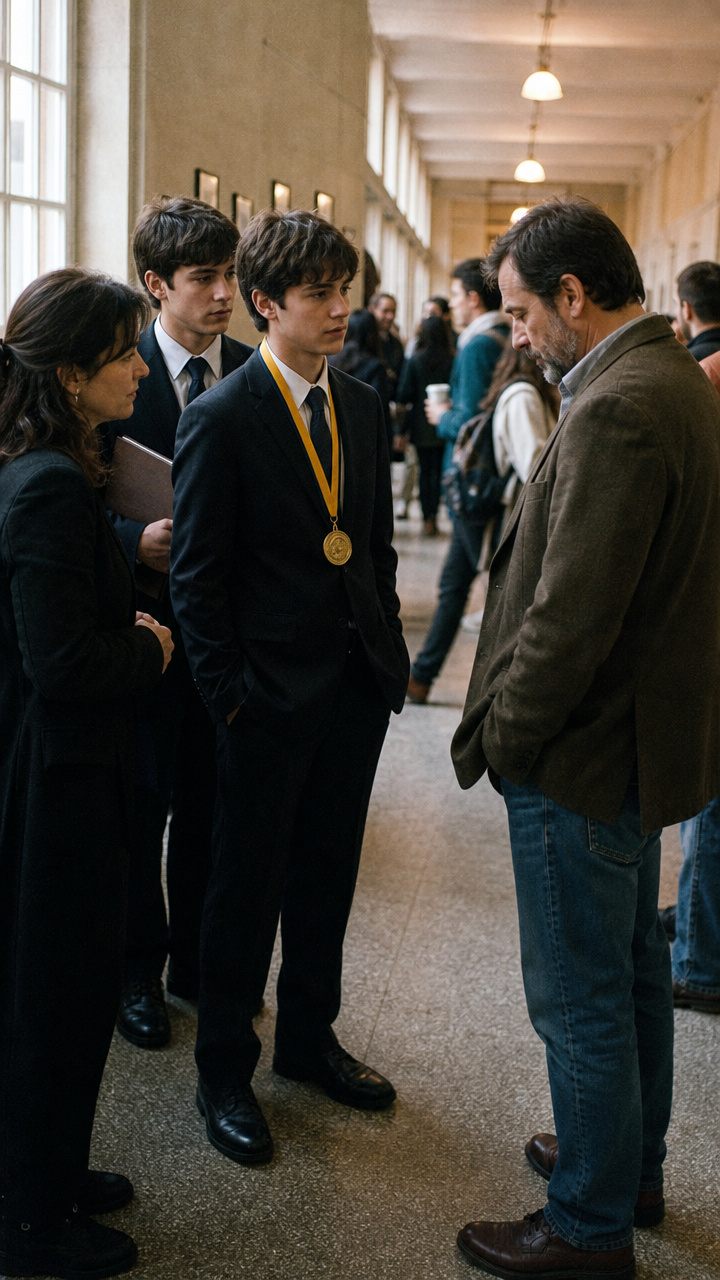
“You’ve had thirteen years to make me the villain in their eyes.”
That was the moment he lost whatever small chance remained to speak about repairing anything.
I didn’t answer.
I didn’t need to.
Lucas did.
“Mom never prepared anything for you.”
Mark looked at him.
Lucas’s hands rested at his sides, and his new medal caught the light above us.
“She never told us to hate you,” he continued. “Actually, she said we would understand more when we were older.”
Hope softened Mark’s face for one brief second.
It lasted no longer.
“We got older,” Lucas said. “We understood that you weren’t there.”
Mark looked as if the floor had shifted beneath him.
Noah spoke next.
“We knew your name. We knew where you lived. Mom never hid you from us. There just wasn’t much else to know.”
No one spoke after that.
A few minutes later, an announcement called the finalists back into the auditorium for the closing team challenge.
The boys turned toward the doors.
Mark took one step forward.
“Can I watch?”
Noah looked at Lucas.
Lucas looked at me.
Then Noah said, “It’s a public auditorium.”
It wasn’t forgiveness.
But it wasn’t punishment either.
Mark returned to his seat.
Eventually Ethan came back with Rachel and sat on her other side, away from his father.
The final challenge wasn’t based on individual scores. Each team received a complex problem combining logic, engineering, and data analysis. They were given twenty minutes to prepare and present a solution.
Noah and Lucas were usually assigned to different subteams during competitions, but that afternoon their coach gave them separate roles in the same final presentation.
I watched Lucas manage the mathematical model while Noah defended the practical design. Their teammates filled in the spaces around them. No one tried to dominate. No one needed to.
Their public-school team placed first overall.
Ethan’s school came in third.
When the rankings appeared, Ethan applauded before either of his parents did.
Mark joined him a second later.
Rachel followed.
For a while, I thought that might be the end of it.
The ceremony continued. Coaches thanked the volunteers. Students traded pins and posed for pictures. Parents filled the aisles. The tension that had built throughout the day dissolved into the ordinary noise of a crowded event.
Mark stayed near the back.
He didn’t approach us again.
I was relieved.
Then the announcer asked the individual gold-medal winners and their coaches to return to the front for official photographs.
Noah and Lucas stood beside their team coach, Dr. Bennett, a patient man who had spent two years pushing them harder than they believed they could go.
The photographer arranged the students first.
Then he asked the parents or guardians who had supported the medal winners to join them for one final picture.
I remained where I was for a second.
I had never liked standing in front of cameras.
Lucas noticed me immediately.
“Mom!”
He waved me forward.
Noah pointed to the open space between them.
“Come up here.”
I started down the aisle.
At the same moment, Mark stood.
He took one step forward.
Then stopped.
No one had told him he couldn’t come.
No one needed to.
He looked at the boys.
They were looking at me.
That was the consequence he finally seemed to understand.
Fatherhood was not a title he could claim simply because a microphone had announced his sons’ names.
It was thirteen years of ordinary days, and he had been absent from them.
I reached the front.
Noah placed me between himself and Lucas. Dr. Bennett stood on Lucas’s other side. Their medals rested against their shirts, while the state team trophy sat on a nearby table.
The photographer asked us to move closer.
Lucas slipped an arm around my shoulders.
Noah did the same.
From the back of the auditorium, Mark watched.
Then Ethan came down the aisle.
For one second, I thought Mark had sent him.
He hadn’t.
Ethan stopped at a respectful distance and looked at the twins.
“Could I get your contact information later?” he asked. “For the summer invitation. Our coach is putting together a mixed team.”
Lucas smiled. “Sure.”
Noah nodded.
It was awkward, but it was real.
Three boys connected by a truth none of them had created.
Mark had spent years avoiding one family while controlling what another family knew. In less than a day, the boys had begun facing the truth more honestly than he ever had.
After the photographs, Mark approached me one last time outside the auditorium.
His anger was gone.
So was the certainty he had carried that morning when he demanded to know how I dared show up.
“Hannah,” he said, “I don’t know how to fix this.”
I believed him.
That didn’t mean it was my job to teach him.
“Start by not making them responsible for helping you feel better,” I said.
He looked through the glass doors toward Noah and Lucas.
“Do you think they’ll ever give me a chance?”
“Maybe. Maybe not.”
He stared at me helplessly.
I continued, “But if you only show up because they’re winning, they’ll know. If you want a relationship with them, you’ll have to show up when nobody is handing them medals.”