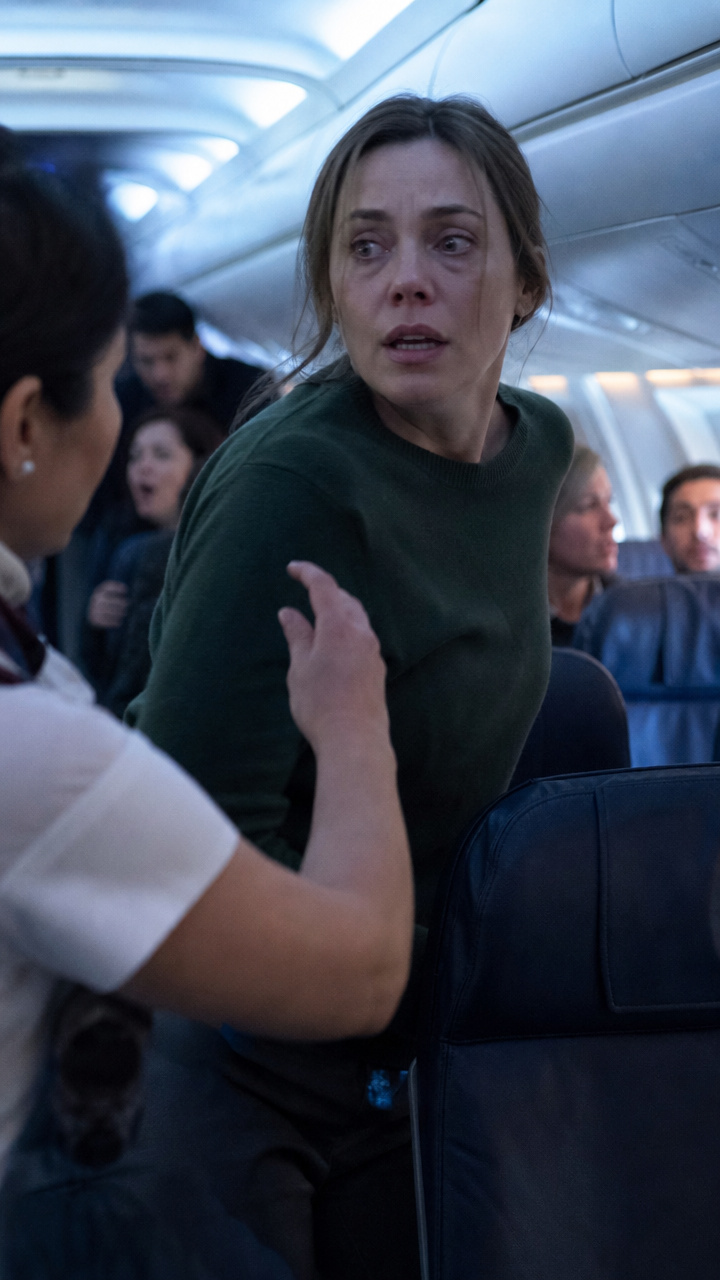
The passenger jet had been crossing the Pacific for nearly two hours when the captain’s voice suddenly broke through the quiet cabin.
“Ladies and gentlemen, if anyone on board has experience flying military fighter aircraft, please contact a member of the crew immediately.”
Nearly three hundred passengers fell silent at once.
Why would an ordinary commercial flight suddenly need someone who knew how to fly a fighter jet?
No one had an answer.
And no one suspected that the quiet woman dozing in seat 8A might be the only person capable of saving them.
Her name was Claire Bennett.
She was thirty-eight, dressed in a plain green sweater, with tired eyes and an unremarkable appearance. At first glance, she looked like any other passenger.
But Claire had once been one of the most experienced and decorated F-16 pilots in the United States Air Force.
Only eighteen months earlier, her closest friend and wingman, Captain Daniel Morales, had gone down during a training flight.
Claire had survived. Daniel had not. From that day forward, she had been unable to escape the guilt.
The official investigation concluded that a mechanical failure had caused the crash. Still, Claire kept telling herself that there had been something else she could have done.
She left the military, refused to sit behind the controls again, and tried to erase aviation from her life.
Until that night.
The captain’s voice came over the intercom once more.
“This is the captain speaking. We’re dealing with a serious technical malfunction. If anyone on board has experience piloting military fighters, please notify a flight attendant immediately.”
A few minutes later, a flight attendant stopped beside Claire’s seat.
“Ma’am, were you really a military pilot?”
Claire froze for a moment.
Then she looked at the faces around her—confused, frightened, and tense.
“I was. I flew F-16s.”
“Please come with me.”
When Claire entered the cockpit, she saw the first officer unconscious in his seat. Captain Michael Reed was fighting to keep the aircraft under control, his hands tight around the controls.
“The autopilot failed,” Michael said quickly. “And the flight-control system is sending contradictory commands.”
At that instant, the aircraft lurched sharply to one side.
Michael pulled hard against the controls, struggling with the plane.
“Don’t fight it,” Claire said. “The computer is feeding you false information.”
She instructed him to disconnect the backup control channel.
The jet began to shudder so violently that the instrument panel seemed to come alive.
Then, without warning, the trembling stopped.
Michael stared at her in disbelief.
“How did you know?”
“I’ve seen this kind of failure before.”
Soon, a doctor traveling among the passengers reported that the first officer’s condition looked most consistent with poisoning.
Then the crew discovered that his travel mug of coffee had disappeared.
Claire’s instincts immediately told her this was no coincidence.
Someone had deliberately incapacitated the copilot.
And that same person might have been connected to the aircraft’s malfunction.
Before the crew could investigate further, hydraulic pressure in the right landing-gear assembly began dropping rapidly.
The jet had to make an emergency landing in northern Oregon.
Michael lowered the landing gear.
Two green indicators appeared on the panel.
The third never came on.
“The right gear isn’t locked,” he said.
Claire strapped herself into the first officer’s seat.
“Then we keep the aircraft perfectly aligned with the runway.”
They descended through a thick curtain of rain.
The wheels struck the soaked runway.
Almost immediately, the jet veered violently to the right.
Claire and Michael fought to keep the aircraft centered, refusing to let it slide off the strip.
Then a loud metallic snap rang through the cockpit.
The landing gear finally locked into place.
Several seconds later, the aircraft came to a complete stop.
Nearly three hundred passengers erupted into applause.
But the real danger had not ended.
Police arrested Richard Hawthorne, the airline’s director of flight operations. During the emergency, he had tried repeatedly to force his way into the cockpit.
The investigation that followed uncovered a massive fraud scheme involving forged maintenance records and illegally installed counterfeit components.
According to investigators, Hawthorne had planned for the aircraft to crash so that the evidence of his crimes would disappear along with it.
Then an even more personal and painful truth came to light.
The same defense contractor connected to Hawthorne had once supplied defective equipment to the military unit where Claire served.
Those very components had played a role in the accident that killed Daniel.
For eighteen months, Claire had carried a burden of guilt that had never belonged to her.
Later, investigators recovered the final data from Daniel’s flight recorder.
The recording confirmed that his aircraft had suffered a critical mechanical failure.