I have no idea how many people will condemn me after reading this story.
Probably most of them.
And honestly, they would have every right to do so.
I am not writing this to defend myself. Sometimes a person has to confess the thing that shames him most before he can finally understand who he used to be.
My name is Daniel.
I was twenty-five when I met Margaret. I had no home of my own, no steady job, and not even enough pride left to stop me from doing things I would later struggle to forgive.
Debt collectors called almost every day. At night, I slept in an old sedan parked behind a grocery store, telling myself it was only a temporary setback and that my life would turn around soon.
But the truth was much uglier.
I was completely broken.
Margaret was seventy-two. She had been widowed for years and lived alone in a small, well-kept house on a quiet suburban street. Everyone who knew her said she had an unusually gentle heart.
I discovered that for myself almost immediately.
Then I decided to take advantage of it.
Yes, I married Margaret without loving her.
I married her because she owned a house and I owned nothing.
She had a warm kitchen where the lights were always on.
I had the hard, freezing seat of my car.
She possessed a peaceful, settled life.
I had empty pockets and thoughts I am ashamed to remember now.
Back then, I repeated the same lie to myself:
“It’s only a way out. I’ll live with her for a few years, pretend to be a good husband, and eventually the house will be mine. The money will be mine too. Then I can start over.”
Even now, writing those words makes my hands tremble, because I understand how far I had fallen.
Margaret never demanded that I pretend to love her.
She never asked me to hold her hand when we went out.
Not once did she look at me and say, “Do you really love me?”
Sometimes I even wondered whether she had known the answer from the beginning.
Still, every evening she cooked dinner for me.
I would come home exhausted, wearing the same cold expression I carried everywhere, and she would greet me with a smile as if my return had been the happiest part of her day.
“Daniel, wash your hands first. Dinner is ready,” she would say gently.
I sat down, ate, and often did not even offer the simple “thank you” she deserved.
One evening, Margaret noticed that my boots were falling apart.
The next night, a new pair was waiting beside the front door.
“You’ve needed these for a long time,” she told me.
“Yeah. These are better,” I replied.
And that was all.
I did not hug her.
I did not thank her properly.
I did not pause, even for a moment, to consider that the woman I intended to use was still taking care of me with quiet, unquestioning kindness.
That winter, she bought me a new coat.
“Don’t go outside in that thin jacket,” Margaret said. “You’ll get sick.”
But the only thought in my mind was:
“I don’t need your coat, Margaret. I need your house.”
That was the man I had become.
Whenever I saw her medication lined up on the kitchen counter, I barely wondered how much pain she was in.
I thought about my future.
Whenever Margaret came home from the doctor, I asked, “Everything all right?”
Yet beneath the concern in my voice was another question entirely.
How much longer would I have to wait?
I know how disgusting that sounds.
But years later, the worst part was not realizing that some stranger had been the monster in this story.
The worst part was understanding that the monster had been me.
Then, one morning, Margaret suddenly collapsed in the kitchen.
The coffee cup slipped from her hand, struck the floor, and shattered across the tiles.
For the first time, I was truly frightened.
Not because of the house.
Not because of her money.
Not because of the will.
For one brief moment, Margaret stopped being an opportunity to repair my life.
I saw her as a human being.
A woman who had spent years caring for me without demanding anything in return.
She remained in the hospital for three days.
On the third day, the doctor stepped out of her room, walked toward me, and said the words I had imagined so many times before.
But when I actually heard them, an enormous emptiness opened inside me.
Margaret was dead.
At the funeral, her relatives and friends looked at me as if they could see every filthy thought that had ever passed through my mind.
“He was only with her for the money,” someone whispered.
“Margaret knew that perfectly well,” another person replied. “And she still treated him kindly until the very end.”
I pretended not to hear them.
In reality, I heard every word.
And I knew I deserved all of them.
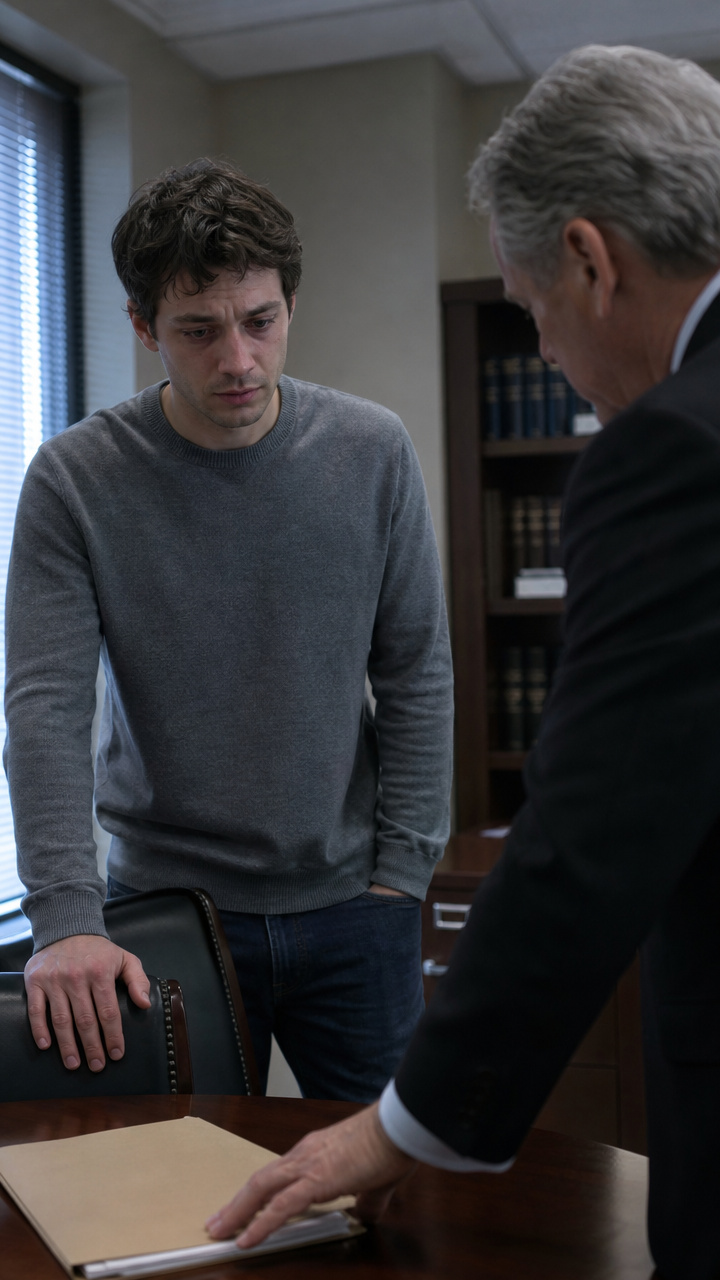
After the funeral, Margaret’s attorney asked me to come to his office.
I sat across from his desk and tried to appear calm.
Inside, however, I was already calculating what might come to me.
The house.
The money.
A quiet life without debt.
At last, I thought, I would escape the pit I had dug for myself.
The attorney unfolded the will.