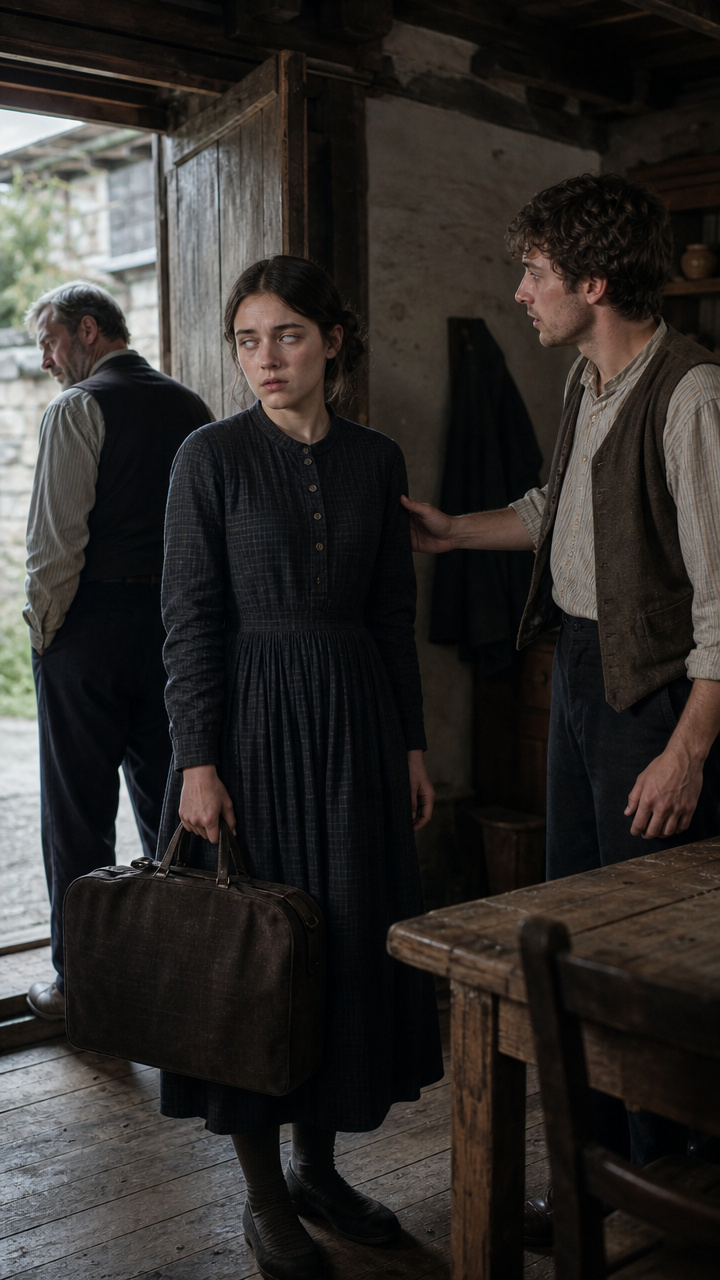
They appeared to be waiting for an order.
Ethan hurried back inside.
“We have to leave.”
Mia woke instantly.
“They came for the journal?”
“Or they came for us.”
He helped her out through the back door. Mia held tightly to his hand as they moved into the darkness.
She followed him without fear.
This man had never betrayed her.
Together they made their way toward an abandoned orchard. Long ago, a house had stood there, but only broken walls remained.
According to Ethan’s mother, Mia’s mother had visited that place several times during her secret meetings.
When they reached the ruins, Ethan began searching the ground.
Mia stood beside him, listening.
Then she suddenly stopped.
“Wait.”
“What is it?”
“There’s a familiar scent here.”
Ethan sounded surprised.
“What kind of scent?”
“My mother always used those herbs in the house.”
Mia dropped to her knees and ran her hands over the earth near the ruined wall. A few seconds later, her fingers touched the edge of wood.
“There’s something here.”
Ethan quickly cleared away the dirt.
Beneath the soil was a small wooden cover.
He lifted it.
Inside lay an object wrapped in cloth.
A thick notebook.
The journal.
They had barely concealed the discovery when unfamiliar voices rose nearby.
There was no time to waste. They fled through the trees.
Only by evening did they reach the home of an elderly reverend whom Ethan trusted more than anyone else.
The old man listened to their story.
Then he opened the journal.
Page after page revealed a history that had been hidden for decades.
Mia’s mother had written in detail about the influential men who had plotted to take Ethan’s family land.
Her husband had truly been among them.
She had tried to make him withdraw.
She had begged him not to take part in the fraud.
She had warned him about the consequences.
But Mia’s father had chosen money.
The final entry left everyone speechless.
“If anything happens to me, I beg whoever finds this journal to protect my daughter. She is innocent. One day, the truth will set her free.”
Mia could not hold back her tears.
For the first time since her mother’s death, she felt that she had not been abandoned.
Her mother had tried to protect her until the very end.
The reverend decided to call a meeting of the village elders.
Several days later, the villagers gathered in the town square.
Witnesses arrived—men and women who had kept silent for years.
Now they were no longer willing to remain afraid.
One after another, they confirmed what had been written in the journal.
At last, Mia’s father appeared.
At first, he denied every accusation. He claimed the documents had been forged. He said the witnesses were lying. He insisted that the journal could not be treated as proof.
Then the reverend placed Ethan’s family letters and the writings of Mia’s late mother before him.
The older man went pale.
His hands began to shake.
He understood that there was nowhere left to hide.
After a long silence, he confessed.
He had taken part in the conspiracy.
He had helped seize the family’s property.
He had given false testimony.
And for the rest of his life, he had lived in fear that the truth would emerge.
That was why he had tried to remove two people who reminded him of the past: Ethan, who was living under another name, and his own blind daughter.
He had believed Mia was weak and helpless.
The square fell silent.
No one had expected a confession so terrible.
The elders ordered that Ethan’s family receive the land and property that had been stolen from them. Everything obtained through deception was to be returned to its rightful owners.
Mia’s father lost his status, his wealth, and the respect he had once enjoyed—the very things he had betrayed others to obtain.
Before leaving, he approached his daughter.
“Forgive me.”
Mia did not answer for a long time.
Then she said:
“I don’t want to spend my life carrying hatred. So I forgive you for my mother’s sake. But what you did cannot be undone.”
The man lowered his head.
Perhaps that was more painful than any punishment the elders could have given him.
Slowly, he walked away.
Over the following months, life began to change.
Ethan rebuilt his family home.
Yet the wealth returned to him did not change the kind of man he was.
Together, he and Mia opened a small refuge for people who had been left without family or support.
They both knew too well what it meant to feel unwanted.
The elderly reverend often told them:
“A person’s wealth is not measured by the amount of land he owns, but by the kindness he leaves behind.”
Mia still could not see the world with her eyes.
But she experienced it differently now.
A loving husband stood beside her.
Her mother’s name was no longer connected only to silence and fear.
The truth had finally come into the light.
Each evening, Mia wore her mother’s ring and traced the familiar pattern with her fingertips.
She thanked the Lord that even the longest darkness could one day come to an end.
That was how the story of the girl her father had always considered a burden reached its conclusion.
Mia found love.
She discovered what a true family felt like.
She restored her mother’s good name.
And she showed everyone around her that a person’s worth is measured neither by wealth nor appearance nor physical ability.
It is measured by whether, after the hardest trials, they can still preserve their kindness, dignity, and mercy.