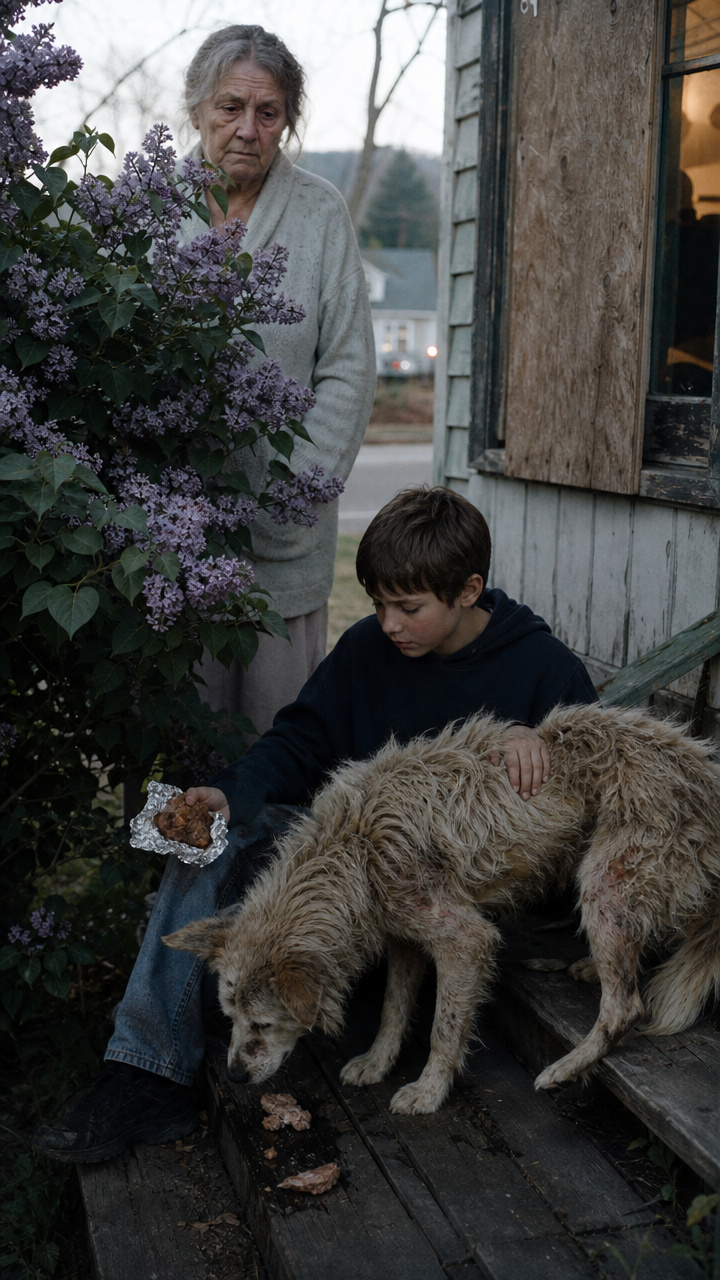
For the third week in a row, Margaret Caldwell packed two sausage sandwiches in her grandson’s school lunch. And for the third week in a row, ten-year-old Ethan came home saying he was hungry.
At first, Margaret thought nothing of it. Children grew quickly, after all, and perhaps Ethan had simply developed the appetite of two boys. But one evening, while they were eating dinner, she noticed him quietly slip a piece of meatloaf beneath the table and wrap it in a paper napkin.
She didn’t ask what he was doing. Ethan already answered most questions with a simple “yes,” “no,” or “I don’t know.” If she asked one thing too many, he would retreat to his bedroom and remain there until morning.
Only that room had once been the house’s formal parlor, with a glass-front cabinet full of dishes and an old braided rug on the wall. Now it belonged to a ten-year-old boy whom Margaret had seen no more than five times in his entire life before that autumn.
Her daughter Claire had brought him home during the last days of August. They had stepped off the bus near the town hall. Ethan carried a backpack over one shoulder, Claire dragged two heavy suitcases behind her, and her eyes were red from a sleepless night.
“Mom, it won’t be forever,” Claire had said in the kitchen while Ethan sat alone on the front steps. “Maybe a year. A year and a half at most. The warehouse job in Ohio pays well, and everything is already arranged. I can’t support him by myself here anymore. You know what things cost now—clothes, winter boots, a math tutor. I can barely keep up with the rent.”
“I’m not against him staying, Claire. Of course he can stay. But he barely knows me.”
“He’ll get to know you. He’s a good boy, Mom. He’s just quiet.”
Ethan barely remembered his father. The man had left when the boy was four and had never called, not even on his son’s birthday. Claire never spoke about her former husband, and Ethan never asked. The two of them had managed somehow until the money began disappearing faster than each paycheck arrived.
The next morning, Claire left. Ethan walked with her to the bus stop and stood there until the bus vanished around the bend by the pond. Then he returned to the yard wearing such a stricken expression that Margaret immediately wanted to gather him into her arms.
She even opened them.
But the boy silently walked around her and shut himself inside his room.
That was how all of September passed. Margaret baked apple turnovers, made the meatball soup Claire had once told her Ethan loved, and drove to the county seat to buy him a new winter coat. Ethan thanked her, ate what she put before him, and wore the coat.
He simply hardly spoke.
“How was school today?” Margaret would ask.
“Fine.”
“Did you make any friends?”
“No.”
“Do you like your teacher? Mrs. Carter is a lovely woman. I remember her when she was just a girl.”
“She’s okay.”
That was usually the end of their conversation.
The day everything changed began with rain. It was a thin, bitter October rain that seemed to seep through every layer of clothing. Ethan was walking home from school by the shorter route, through a narrow lane where almost nobody had lived for years.
At the end of it stood the abandoned Harper house. Boards covered the windows, the leaning fence had disappeared beneath nettles, and the roof over the porch sagged dangerously toward the ground.
Suddenly, a dog barked from beneath the porch.
It wasn’t an angry bark or a warning. It was hoarse, weak, and strangely bewildered.
Ethan stopped.
Two eyes gleamed between the wet boards. A few seconds later, a dog’s head appeared—gray with rusty markings, its coat tangled and hanging in dirty clumps. A large burr clung to its side. The animal was big, but so thin that every rib showed beneath its soaked fur.
“Who do you belong to?” Ethan asked softly.
The dog, naturally, gave no answer.
It only sniffed him carefully, then wagged its tail once, as if deciding whether this unfamiliar boy could be trusted.
Ethan slipped off his backpack, unzipped it in the rain, and pulled out one of his sandwiches.
The dog swallowed it in barely two bites, somehow eating the napkin stuck to it as well.
The second sandwich disappeared just as quickly.
“You’re certainly a shaggy one,” Ethan said, studying him. “The shaggiest dog I’ve ever seen.”
That was how the dog got his name: Shaggy.
From that day forward, Ethan always took the abandoned lane home.
At first, he gave Shaggy only the sandwiches from his lunchbox. Then he began bringing meatloaf, bread, and bones left over from dinner. On Saturday, he traded his favorite light-up gel pen to a classmate named Caleb for a small bag of dry dog food.
Caleb couldn’t understand why a boy from town needed dog food, but he had no intention of turning down such a profitable trade.
Beneath the porch, Ethan made the dog something like a bed. He took a piece of burlap from Margaret’s shed—the kind she kept for covering potatoes—and spread it in a dry corner behind an old barrel. Then he found a cracked plastic basin in the weeds and placed it where rainwater could collect inside.