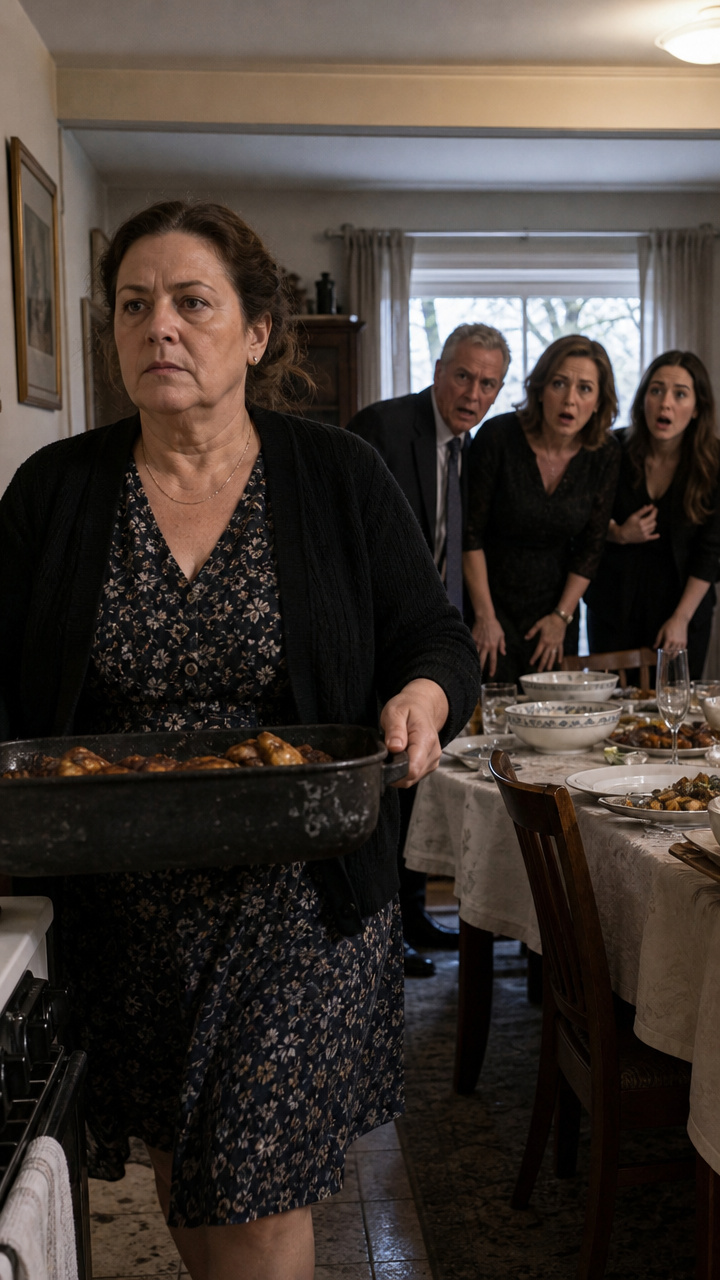
She expected her hands to begin trembling. She expected tears, or the familiar guilt that had followed every family argument for years.
But none of it came.
Instead, she felt lighter.
It was as if she had finally dropped a heavy sack filled with wet sand—a burden she had carried uphill along an endless road.
Margaret returned to the kitchen.
The roasting pan still stood beneath its lid on the stove. The warm scent of pork, garlic, and spices lingered in the air.
She opened the china cabinet and took out her favorite porcelain plate with its thin gold rim.
She had saved that plate for truly important occasions. Even guests rarely used it because she was always afraid someone might break it.
Apparently, this was an important day after all.
Margaret cut herself a generous slice of tender pork.
She added two soft potatoes soaked with meat juices and scattered fresh dill over everything. The dill grew in a pot on her windowsill.
From the refrigerator she took a crisp pickled cucumber.
Then she poured a small glass of homemade cranberry liqueur, which she had set aside the previous autumn, and sat down by the window.
Soft evening sunlight spread across the clean kitchen, turning everything gold.
Outside, young birch leaves whispered in the breeze. Somewhere in the thick branches, sparrows called back and forth.
The meal was wonderful.
The meat was tender enough to fall apart in her mouth. The potatoes yielded beneath her fork, and the sharp sweetness of the berry liqueur warmed her throat.
Margaret did not hurry.
She ate slowly, enjoying every bite and the unexpected silence that had settled over the apartment.
Afterward, she brewed a strong cup of tea and happily ate a large piece of warm pastry filled with egg and green onion.
She packed the remaining pork, potatoes, and hand pies into containers.
The next day she would take them to the laboratory and share them with her coworkers.
They always praised her baking sincerely. They would probably ask for the recipe again and wonder how she made the dough so soft.
Three days passed.
On Tuesday, during her lunch break, Margaret’s phone rang.
Her son’s name appeared on the screen.
Ethan.
She did not snatch up the phone. She finished her sip of tea, set the cup down, and answered only after the fifth ring.
“Hi, Mom,” Ethan said.
His voice was tense. There was embarrassment in it, along with the faint irritation Margaret knew so well—as though she had already failed to fulfill some duty owed to him.
“Lauren and I talked. Anyway, we need to go to the country house this weekend. It’s time to plant the potatoes, and we’re already late. You’re taking your car, right? And, uh… did you finish all that meat, or is there some left? We could stop by tonight and take it.”
Margaret looked out the laboratory window.
Small bluebirds hopped across the sun-warmed pavement outside the clinic.
A barely visible smile touched her face.
“You can plant the potatoes yourselves, sweetheart. You may use the entire property. I’ll transfer my share to you so there won’t be any confusion later. As for the meat, I gave it to my coworkers yesterday. They’re simple people, not difficult to please. They don’t turn up their noses at cat food or a humble dinner. You can order something expensive from a restaurant. You’re used to modern, luxurious menus now.”
Margaret ended the call, placed the phone face down on the table, and opened her laboratory journal.
For the first time in many years, her head did not hurt at all.
And the weekend ahead belonged entirely to her.
For once, no one but Margaret had made plans for it.