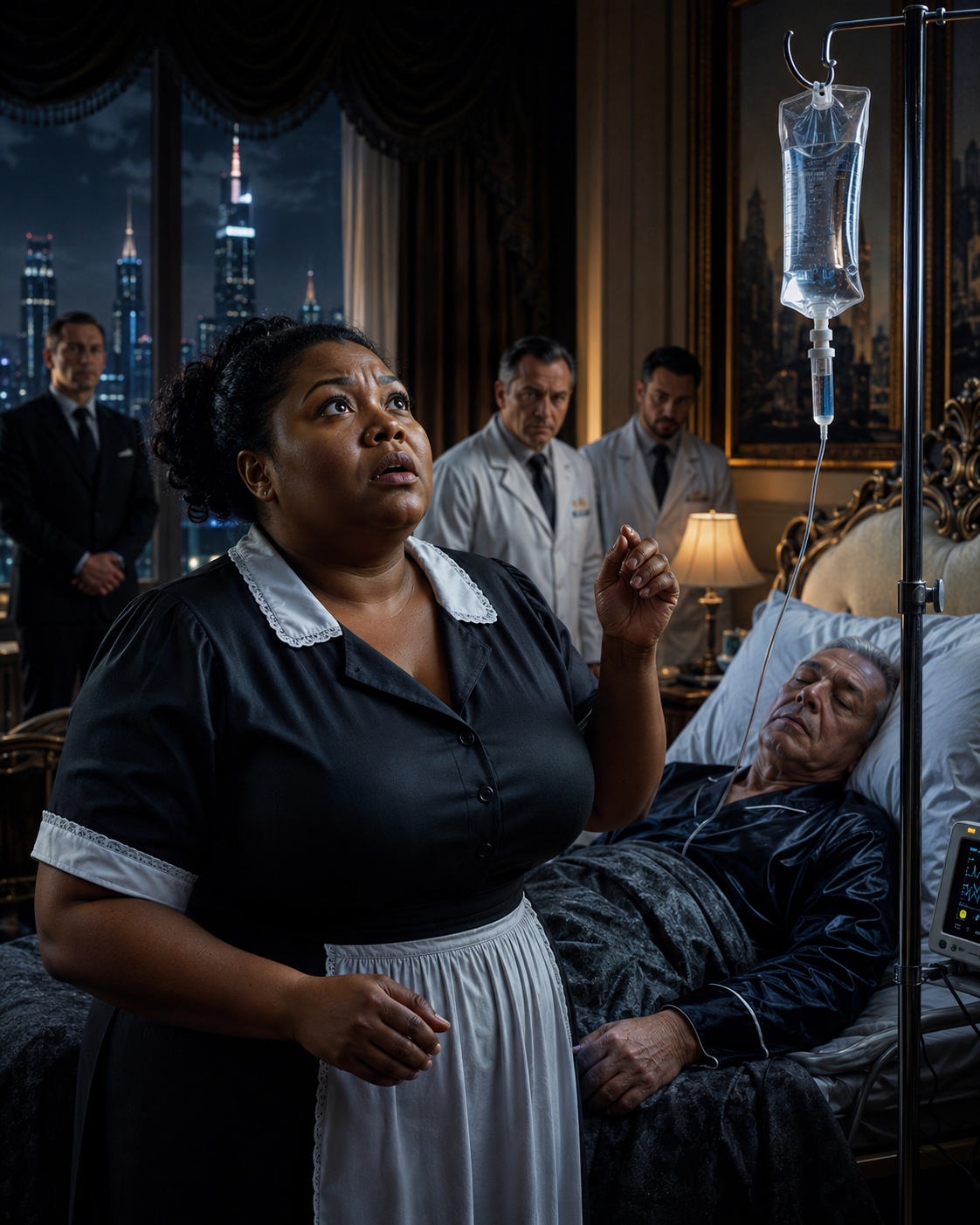
Men like Cassian did not call police. They did not give statements. They did not trust courts. In his world, justice usually happened in rooms with no windows and no paperwork.
But Cassian Vale had been close enough to death to see the shape of his own life.
He looked at Dr. Marsh.
“Call the sheriff.”
The room froze.
Nolan stopped struggling.
Cassian continued, breath by breath.
“Call the federal contact in the locked folder in my study. Tell them Nolan Pierce tampered with my medical treatment and attempted to kill me. Tell them my doctors preserved evidence. Tell them I will give a statement when I am able.”
Caruso stared. “Boss?”
Cassian turned his head toward the men in the doorway.
“You came here to learn who would lead if I died,” he said. “Here is what you learn instead. No throne is worth poisoning a sick man in his bed. No empire survives when cowards inherit it. Nolan wanted daylight? Give him daylight. Give him judges. Give him cameras. Give him a courtroom where he can explain how a maid destroyed his perfect plan.”
Nolan’s face went gray.
“You’ll expose yourself.”
Cassian leaned back, exhausted.
“Not all of me,” he said. “Just enough of you.”
Before dawn, Nolan Pierce left the Vale estate in handcuffs under a sky the color of wet stone.
Reporters gathered at the gate by sunrise. They were told there had been criminal tampering by a trusted associate during a private medical crisis. They did not learn the full truth. They did not learn about the tiny puncture in the hidden bag, or the smell Mara remembered from childhood, or the way twelve experts had stared at monitors while the answer hung above the bed.
But the house knew.
The doctors knew.
The men knew.
And Cassian knew.
Recovery was not elegant.
Cassian hated weakness more than he had hated most enemies. He hated the walker. He hated broth. He hated being told when to sleep. He hated the physical therapist who congratulated him for crossing a room as though he had conquered Europe.
But he did not hate being alive.
Mara visited him every afternoon at the private medical facility after her shift, though Cassian repeatedly told her she no longer had a shift.
“You fired me?” she asked the first time.
“I promoted you.”
“To what?”
“I don’t know yet.”
“That is not a job title.”
“It is if I say it with enough confidence.”
She brought him the dark wool cardigan he liked, the sandalwood soap from his bathroom, and books he pretended not to read. He complained about every one of them, then asked for the next.
On the fourth week, Cassian’s daughter arrived.
Her name was Claire Vale, and she had not stepped inside her father’s house in eleven years.
She came to the hospital in a camel coat, her hair pulled back, her face composed in the way people compose themselves when they are afraid grief will embarrass them. She looked like Cassian around the eyes and like someone else entirely around the mouth.
Mara was in the hallway when Claire stepped out of the elevator.
“You’re Mara Wells,” Claire said.
“Yes, ma’am.”
“My father says you saved his life.”
Mara looked down at the coffee cup in her hands.
“I noticed something.”
Claire’s expression softened in a way that made her suddenly look younger.
“Sometimes that’s the difference.”
They stood together outside Cassian’s room, both listening to him argue with a nurse about soup.
Claire folded her arms.
“My father has hurt people.”
“I know.”
“He has done things I still cannot forgive.”
“I know that too.”
“Then why save him?”
Mara looked through the glass panel in the door. Cassian was scowling at a spoon as if it had personally betrayed him.
“Because dying should not be the only way a man stops doing harm,” she said. “If he is breathing, he still has choices left.”
Claire studied her.
“And you believe he’ll make better ones?”
“No,” Mara said honestly. “I believe he has no excuse not to try.”
Inside the room, Cassian had gone quiet.
He had heard.
He did not open his eyes.
He did not speak.
But from that day forward, something in him shifted.
Not all at once. Men like Cassian Vale do not become saints because they survive betrayal. A brush with death does not wash blood from the past. But it can make a man look at the furniture of his life and finally see the dust.
Three months later, Chicago newspapers reported that Vale Consolidated was restructuring.
Two clubs were sold.
Three silent partnerships vanished.
Several dangerous men found themselves cut off from money they had assumed would always flow.
Legal teams appeared. Accountants appeared. Auditors appeared. Claire took formal control of the legitimate side of the business after two brutal arguments and one shattered glass.
Cassian called it housekeeping.
Claire called it overdue.
Mara called it “better than nothing,” which made Cassian laugh for the first time in weeks.